|
FAQs on Marine Algae Identification
21
Related Articles: Avoiding Algae Problems in Marine System,
Algae
Control, Marine Maintenance,
Nutrient Control and Export,
Marine Scavengers, Snails, Hermit
Crabs, Mithrax/Emerald
Green Crabs, Sea Urchins, Blennies, Algae
Filters, Ctenochaetus/Bristle Mouth
Tangs, Zebrasoma/Sailfin Tangs,
Skimmers, Skimmer Selection, Marine Algae, Coralline Algae, Green Algae, Brown
Algae, Blue-Green
"Algae"/(Cyanobacteria), Diatoms, Brown
Algae,
Related FAQs: FAQ ID Visual
Guide, Marine
Algae ID 1, Marine Algae ID 2,
Marine Algae ID 3, Marine Algae ID 4, Marine Algae ID 5, Marine Algae ID 6, Marine Algae ID 7, Marine Algae ID 8, Marine Algae ID 9, Marine Algae ID 10, Marine Algae ID 11, Marine Algae ID 12, Marine Algae ID 13, Marine Algae ID 14, Marine Algae ID 15, Marine Algae ID 16, Marine Algae ID 17, Marine Algae ID 18, Marine Algae ID 19, Marine Algae ID 20, Marine Algae ID 22, Marine Algae ID 23, Marine Algae ID 24, Marine Algae ID, 25, SW Algae ID 26, SW Algae ID 27, SW Algae ID 29, SW Algae ID 30, SW Algae ID 31, SW Algae ID 32, SW Algae ID 33, SW Algae ID 34, SW Algae ID 35, SW
Algae ID 36, SW Algae ID 37, SW
Algae ID 38, SW Algae ID 39, & Marine Algae Control FAQs 2, Marine Algaecide Use, Nutrient Limitation, Marine Algae Eaters, Culturing Macro-Algae; Controlling: BGA/Cyano, Red/Encrusting Algae, Green Algae, Brown/Diatom Algae
|
|
 |
New Print and
eBook on Amazon
Marine Aquarium Algae Control
by Robert (Bob) Fenner
|
|
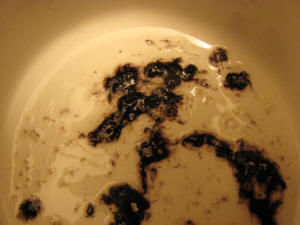
Unknown algae growth and unknown coral
03/28/2008 Hello Guys and Gals. Thank you once again for all
of your help! <<G'Morning, Andrew today>> I have
an algae growth that none of my LFS can seem to tell me what it
is. It shows up on my sand bed after the lights come on and seems
to grow patches within the first couple hours and grows
throughout the day. After the lights go out, it seems to diminish
a great deal over night. I'm not sure if it's being eaten
by my snails and hermits but it is a lot less in the a.m. before
the lights come back on. It looks black in the tank on the sand,
although I have removed some before and put in a bag to take to
my LFS and it sat in the bag for a couple days and turned the
water in the bag pink! Then the water turned clear eventually. It
has a very fine hair like look when stirred up. <<Yes, its
a red hair algae, from what i can see in the picture. There is a
good possibility that your snails are keeping this under control.
The tufts on the substrate can easily be syphoned out>> I
have a 65 gallon tank. 3 1/2 month old, 75 lbs. live rock, 3
circulating powerheads w/ a total 1000 gph circulation. (3) 96
watt lights equaling 50% blue and 50% daylight. Night light is a
submergible LED blue strip lights. <<For a reef tank, you
may want to up your flow a little, get yourself into the region
of 1600gph>> Water parameters are 0 ammonia, 0 nitrites,
calcium, 480-500, nitrates are questionable, I get about 20-30,
LFS test 0, PH 8.2, salinity 1022-1023. I use Oceans Blend for
Calcium, PH, Alkalinity. Had phosphate tested today and they said
very minimal. <<Usually with plague algae, they have
already absorbed the phosphates from the water, so, a test
showing up minimal is common. Have you tested the water before it
goes in the tank? If not, give it a test, see what it
shows>> I have several small frag corals, mostly soft
coral, but some candy cane coral, one Bubble tip anemone and a
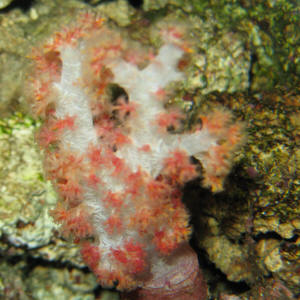
fair size frog spawn. I also bought a coral today that the LFS
told me was a Cotton Candy Coral. <<I would concur on the
carnation coral. They are not the easiest to keep, however, with
research and understand, you should be fine>> It has
extended out at least two inches since I put it in. Now that I am
looking online, it looks like a carnation coral! They say that
they are difficult to keep. Mine seems very happy in the few
hours I have had him but now I am afraid that I won't be able
to keep him alive! Included is a pic of it as well. Can you
identify this coral? <<As above>> Fish include: 1
Dwarf Coral Beauty 1 Six Line Wrasse 1 Lawnmower Blenny 3 Blue
Green Chromis 1 Midas Benny 2 Mated Percula Clowns Inverts: 1
skunk cleaner shrimp 20 Nassarius snails 2 large Mexican Turbo
Snails 4 very large stocky Cerith Snails? The ones that burrow
under the sand I pulled some of the algae out and put in a bowl
for you to take a look at. Please tell me what this is. I have
been told may be hair algae, another told me red slime. Another
place said they don't know what it is, they have never seen
it. Will you please take a look at the pics attached and tell me
what YOU think. Also, what kind of coral in the other pic. Thank
you for all you do for us! Rachel <<Thank you for the
questions, hope this helps. A Nixon>>
|
|
|
|
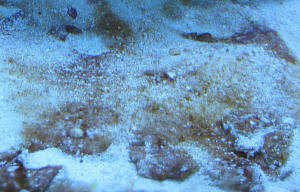
Diatom Bloom... BGA 3/20/08 Hi
Crew, <Hello there.> I seek your advice once again.
Recently I've experienced what appears to be a diatom/Cyano
bloom. <It is what it appears to be.> I have a 90 FOWLR.
The recent change I've made was switching from 110W PC's
to the Nova Extreme Pro T5 HO (324W). I'd like to start
introducing polyps, xenia, etc to start into the reefkeeping
life. <Great!> I started seeing this bloom around the time
of this lighting switch, but I'm not sure this is the root
cause based on the readings, which indicate I should be looking
for issues with water parameters and nutrient export.
<Exactly, while the lighting has spurred the growth, there are
underlying causes that need to be addressed.> I've tested
Phosphate (0), Silicate (0), Nitrate (.25), and pH (8.2-8.3 with
lights on). I'm using Salifert test kits, so I believe these
are reliable numbers. <Yes, these test kits are good. Do be
aware these numbers can be deceiving, nitrate and phosphate can
be used up as they are produced, allowing BGA growth and yet
still yielding low numbers when you test. The proof is in how the
tank looks.> I employ an AquaC Urchin skimmer, a 3gal refugium
w/ a DSB and Chaetomorpha (which is growing and being trimmed),
and 30% water changes every other week. I've attached a few
pics of the sand as well as the growth on the rocks. With a
diatom/Cyano, I was expecting to see this develop in more
stagnant areas, but the pics are where my powerheads are hitting
the rocks pretty much head on and is where the growth is
thriving. <They idea behind not allowing stagnate areas is to
keep detritus in suspension to be exported via your filtration
(mechanical/skimmer) or processed by live rock and its
inhabitants. The nutrients that cause the outbreak will be spread
throughout the tank, causing growth all over. It merely
originates from the stagnant areas more than others.> I'm
a bit confused on this and I'm wondering if this is really a
Cyano/diatom issue or something else. <Nothing else, BGA it
is.> You're help would be greatly appreciated, especially
if I need to be testing or looking for something else. Thanks
again <Welcome, a link with related FAQ's to help you
learn how to control this outbreak. Good luck, Scott V.>
http://www.wetwebmedia.com/bluegralgae.htm
|
|
|
|
help indentify a red/brown type algae... no
pic, poor English... no reading 03/15/2008 I have
this reddish/brown type growth(im sure a algae) here is the
description. <Umm, really need a good photo...> It is very
fine. It grow approx. 2 inch in height. It looks like i a clump
of daisy's(Flowers) You could say it looks similar to a
daisy, and moves like a waving hand's coral. It spreads
quickly. Every 3 days it will die down where there is no flower
on top, looks like dead hair grass algae, but blooms again into a
full daisy. I have removed by hand but it breaks apart easily,
and of course attaches somewhere else. I have scrubbed it off.
and again back in full force. My tank is a reef friendly one.
Tangs/crabs/snails/urchins/Seahares none of them won't touch
it. It will spread to any of my hard corals that are damaged. But
the coral will not die from it. (Not yet anyway) I have looked at
many on line pictures or red hair type algae. But nothing looks
exactly like it just some similarities. I would like to know if
you have any idea what it might be, and if so, any cures? Your
help would be greatly appreciated. Thank you. mc <... a pic
please. That and/or a long read on WWM re Algal (et al.)
Identification: http://wetwebmedia.com/marinvind1.htm Bob
Fenner>
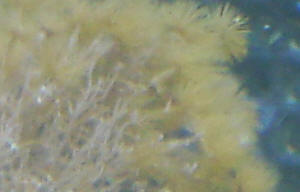
Red/brown type algae identification... Hydroids likely
3/19/08 Bob Fenner, thank you for your quick response.
Attached are photo's of my mysterious algae as per your
request. Again description: It is very fine, reddish/brown in
color. Grows like a bad weed. Moves like a wavy hands coral. Has
a flower type (Daisy) top on it. <I see this... am glad you
sent along such large file sizes... Cropped... maybe Myrionema or
such...> Every 3 - 4 days the flower dies down, and what's
left looks like red hair type algae, but will rebloom again. If
moved by hand it breaks apart easily. Will attach to any coral
that is damaged (hard coral) but doesn't seem to kill it yet.
Your help of what it is, and what might help get rid of it? Again
your help would be greatly appreciated. Thank you. MC <I do
believe this is likely a Hydrozoan, not an algae... Need even
"closer-up" pix to determine. Read here:
http://wetwebmedia.com/hyzoanidfaq.htm and the linked files Bob
Fenner>
|
|
|
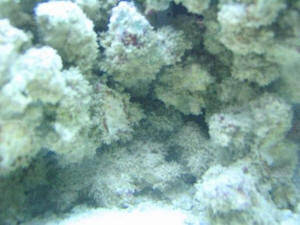
| Brown/green spots on live rock 03/03/2008 Hi,
<<Hello Joseph, Andrew this evening>> I want to let you
know that I love WWM. You have never steered me wrong.
<<Thanks for the kind comments>> The tank in question
is a 45 g. tall tank with an 18 g. refugium. Has a deep sand bed
(about 4²) a good amount of live rock, 1-250 w. metal
halide, with 2 65 w. actinic pc.¹s. <<Sounds
good>> I have noticed over the past couple of months, that
there are some brownish green spots, usually about 1/8 in in size
growing on some of my live rock, and occasionally on the glass.
They remove easily, but they keep returning. I haven¹t
seen any harm caused by them, but they are kind of unsightly. I
would like to know what they are, and how to get rid of them.
I¹m including 2 pictures. <<I would need some
better pictures really which are in focus. From your description,
they just sound like normal algae spots, and you'll just
continue to clean as you are. To get a better idea, please
re-submit some more photos please>> Thank You, <<Thanks
for the questions. A Nixon>> |
|
 It's the algae man! RMF It's the algae man! RMF
|
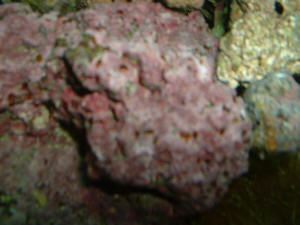
Brown Gray Stuff On Rock -02/27/08 Hey Crew,
You're site is such a valuable resource and I appreciate all
your seemingly endless assistance. My question is that I am seeing
this brownish grayish substance on some of my rock. It is only on a
small percentage of the rock I have and seems to be only affecting
a certain type of rock. I am not exactly sure what this type of
rock is (e.g. Tonga, Fiji, etc), but it is a rather knobby rock.
None of my other rock is affected at this time. Most of this
substance easily comes off with very little effort using a brush or
blowing it off and either settles on the bottom or gets filtered or
ends up back on other rock. I do have a certain amount of debris
constantly floating throughout the tank due to my Diamond Goby
stirring up the live sand, and my water flow keeping it afloat, so
it is hard for me to tell if it is growing back, or new stuff is
settling on the rock. I initially thought this may be just
particles from the sand sticking to this one type of rock, but that
seems a bit odd that it only sticks to this one type. <It's
not odd at all, some algae prefer some types of surfaces over
others to cling to. The rock it's on might be more rough or
porous... more conducive to brush or hair algae growth.> Then I
thought it might be some sort of hair algae, but after extensive
research, I couldn't find any algae that looked like what I am
seeing and seems like most hair algae is red or green. I do have
what I believe is purple and green Coralline algae growing under
this stuff on the rock as it is exposed once I clean off sections.
The substance does look very fuzzy, almost like it is statically
charged to the rock. My tank is 150 gallons and only up and running
for a few months now. <Ah, algae blooms are quite common in new
tanks.> My water parameter are pretty good: Salinity is 1.0245,
Calcium is around 400, Phosphates are around .03, Magnesium is at
1250, Alkalinity is at 4.1, PH is 8.3, and Nitrates are at around
10. I have attached a picture (probably not the best depiction of
how it really looks) and hopefully you can help me identify this
issue. Sorry if this is a bit long winded. Please let me know if
you need more info. Thanks so much for your time. <Well,
it's some type of nuisance brush or hair algae that is
collecting debris on its surface. As with any nuisance algae,
you'll want to remove as much of it as you can manually
whenever you do a water change (even if it means using a tooth
brush to scrape it off)... and do more/bigger water changes until
it's under control. Check your nutrient levels, try to lower
them, etc. Please see here:
http://www.wetwebmedia.com/nutrientcontrol.htm> <Best,
Sara M.> |
|
|
|
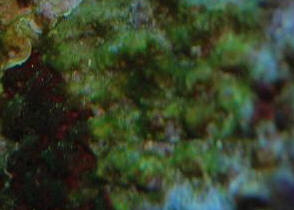
Green Algae ID/Help -02/24/08 Dear Crew, Today, I find
myself confronting a nuisance algae uprising, and I've spent
about 2 hours skimming WWM and other sites in an effort to
determine what I'm up against. This outbreak started this
week and seems to be spreading rather quickly to portions of my
substrate and the portions of my LR that aren't covered in
coralline algae. I do not believe it to be green hair algae, but
maybe a green diatom? It has the appearance of grass, or
Astroturf. <It's some type of green hair and/or brush
algae... possibly growing along with Cyano, diatoms or other
bacteria/algae. It might not be just one
thing.><<Bingo!>> I have not been able to
positively ID it, so I am really hoping someone at WWM can help
me figure this out. Two pictures are attached. I feel like
I've described my setup to the Crew 100 times, but I think a
repeat is essential for this issue: a 110g tank, a wet-dry
trickle filter with bio-balls, a Coral Life Super Skimmer, and a
30g refugium. Inside the tank are 4 Maxi-Jet 1200s positioned so
that there is turbulent flow. My return pump is a 1,325 gph
Little Giant. My lighting is a 760W fixture (two 250W 20,000K
HQI's and four 65W true actinics). The actinics are on from
10:30 a.m. until 10:30 p.m., and the HQI's are on from 11:30
a.m. until 9:30 p.m. For all water top-offs and water changes, I
use water from my six-stage RO/DI (two of the stages consist of
redundant DI canisters)-all filters were recently replaced and my
TDS meter reads 0 ppm coming out. I have about 95 lbs of LR in my
display, and about 10 lbs of LR in my fuge (5" DSB and large
tuft of Chaeto). The Chaeto tuft in my fuge had gotten quite
large, so I pruned it 2 days ago by about 1/3 by pulling clumps
off the main body rather than cutting (for which my LFS gave me
$5 store credit today!!) and I also stretched it out a bit so it
wasn't as compacted. The lights on my fuge are on a reverse
daylight cycle opposite my display lights. Now for the important
stuff: my water parameters (as of last night) are 0 for ammonia,
nitrite, nitrate and silicate; alkalinity is 3.5 mEq/L; specific
gravity is 1.025; pH is 8.3 during the day and 8.1 at night; temp
is 80.1*F; calcium is 400; and (and maybe a big "and"?)
phosphate is 0.03 ppm (confirmed on both a Salifert kit and a
SeaChem kit). I checked the phosphate in my pre-mixed salt water,
and it is likewise 0.03. I then tested the fresh water coming out
of my RO/DI unit, and phosphate was 0. So, contrary to the
manufacturer's claim, it would appear that my Instant Ocean
salt mix has some phosphate (I know this is a very reputable, old
brand. I have read all the literature on WWM and the web about
salt mixes, and it is clear that there is no consensus on the
"best" mix. It also seems that most people recommend
Instant Ocean). <Very true, there is no consensus on this.
Instant Ocean is an old stand by and certainly many accomplished
marine aquarists have used it for years. However, it has been
known to be inconsistent and at times imperfect. Have you seen
this?
http://www.aquariumwatertesting.com/AWT_Salt_Analysis_0208.pdf>
The tank has been up and running for 11 months. I feed my fish
once or twice a day--I rotate Formula One flake, live black
worms, Spirulina flake, dried seaweed, Hikari frozen Mysis shrimp
(thawed and rinsed), Hikari frozen blood worms (thawed and
rinsed), and live littleneck clams. I target feed my tree corals
twice per week with Cyclop-Eeze, and I feed my Open Brain coral
small silverside pieces once per week. I change 10% of my water
every Sunday. The only supplement I use is ESV B-Ionic 2-part
calcium buffer, as needed with testing. As stated above, this
outbreak came on quite quickly. It first appeared on the
substrate in a corner of my tank (where there is good flow!) and
now it's spreading to my LR and the other end of the tank.
For the most part, it is not spreading to any surface that
receives a lot of light--rather, it appears mostly in shaded
areas. I can't figure out why this would happen after 11
months. <It happens. Most aquarists have this false idea that
the tank is "done" cycling after a month or two. The
truth is that marine tanks often don't become
"stable" until after a year or so (and that's
assuming there are no interfering major changes in that year).
And even in older tanks there can be periodic algal blooms that
seem "unexplained." It could also be the
inconsistencies in your salt mix. It's hard to say for
sure.> I noticed that it's hit a rock on which I have
several Rhodactis and it is growing between some of the polyps,
so immediate action is required. When I do my water change
tonight, I intend to use a toothbrush attached to my syphon hose
to try to get as much out as possible. <Good idea.> I'm
wondering if the former size of my Chaeto has something to do
with this, i.e., that it had outgrown the fuge and wasn't
growing/absorbing phosphates? <That's possible.> Any
thoughts you have will make me happy. <Sorry I can't give
you a more definitive answer, but such is the nature of these
things sometimes. Sometimes it just doesn't take much to
throw things out of balance (out of your favor). The problem with
nutrient tests is that the nutrients could be registering zero
because the algae is using them up. Given what you've told me
about your Chaeto and salt mix test, I think you might have a
phosphate problem. Do you have a media reactor? If so, you might
consider using a phosphate sponge media in it for awhile. And of
course, doing bigger water changes for awhile might help (unless
of course your salt mix is the source of the problem-- then you
might want to consider switching brands).> Thank you for your
time/help. Andy <Good luck, Sara M.>
Re: Green Algae ID/Help Thanks for your help Sara. Do
you have a suggestion for a good salt mix alternative (i.e.,
which brand would you buy if you were in my shoes)? <Oh, tough
question... I use Reef Crystals because it seems like one of the
better overall salts for reef tanks and it's available just
about everywhere and usually isn't too terribly expensive.
But do take a look at the chemical analysis data I linked you to.
If nothing else, it is pretty interesting. > Andy <Best,
Sara M.>
Green Algae ID/Help -02/24/08 Sara, First, thanks
again. You always offer great information and are a lot of help.
<Thanks, we try :) > I have read that salt summary
before--very interesting/informative. I was thinking that maybe
the ESV activated carbon that I am running in my sump could be
leaching PO4? <It's possible.> I read an article by
Steven Pro that tested a bunch of carbon brands, and ESV was one
of the worst. Interestingly, I did swap out my carbon this week,
but I don't think this is it as I've been using this
brand for a while. Plus, since my PO4 is only 0.03 ppm (which
really isn't all that bad) and since my display water matches
exactly my pre-mixed salt water, my guess is that the problem is
a bad batch of salt (I've always used Instant Ocean).
<Looking at the data in that report, this certainly seems
possible too.> I'm kind of surprised that a PO4 level of
0.03 ppm could spark this sort of problem--I guess I'm
assuming correct testing instructions, which say what is and
isn't a good PO4 level. Of course, who knows what isn't
being detected because it's being immediately absorbed by my
Chaeto! <Ah yes, as I mentioned earlier, testing for nutrients
can be misleading when you have an algae breakout (or are using
macro for nutrient export). The nutrients get used up by the
algae before they're detected.> I just ordered some Reef
Crystals (was almost out of salt anyway), PhosBan and some
Marineland Black Diamond carbon (I've read that it's a
pretty good brand). I don't have a Phos reactor but was
thinking of running a bag in my sump and floating a bag in my
pre-mix vat (wouldn't you know that I mixed my saltwater
yesterday??!! Hate to throw out 30g of saltwater). <This
sounds like a good plan. Sorry you have to waste the water, but
better safe than sorry.> Andy <Good luck, Sara M,>
Green Algae ID/Help -02/25/08 Dear Sara/Bob, I see from
RMF's commentary to my post on WWM that he thinks this is a
Cyano bloom. Do I interpret his comment correctly? Andy <Is at
least partly this highly likely. B>
Re: Green Algae ID/Help 2/27/08
Dear Sara/Bob, I see from RMF's commentary to my post on WWM
that he thinks this is a Cyano bloom. Do I interpret his comment
correctly? <<Indeed, the green stuff on the white gravel
looked like Cyano. But it looks like you have other nuisance
algae also (the turf-like one on the rocks for instance). But
honestly, it doesn't really matter. Nuisance algae is
nuisance algae and they're all more or less caused/cured by
the same problems/solutions. -Sara M.>> Andy
<Is at least partly this highly likely. B>
|
|
May just look green. RMF.
|
| Red unidentified plant type thing
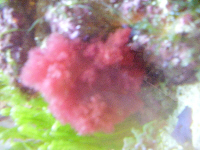
2/8/08 Hey there Wet Web! This is about my mother's tank.
Recently, I believe within the last three months, this red fern
type thing grew. <Neat!> We didn't worry about it at
first because since live rock can grow things, it didn't seem
like a big deal; as there have been many strange things growing in
there. However, I was looking at it tonight and I see little worm
type things wiggling around inside it( I couldn't get a picture
of them but they are the same color red as the thing). <Are a
separate item> She is concerned that it may be bad. Some of her
fish and snails have died rather unexpectedly recently. She does
regular water changes, and tests ( everything has been normal as
far as levels). The worm type things are similar to something we
found months and months ago under a rock. But this fern-ish thing,
we can't find anywhere to identify. We would be eternally
grateful if you guys could help us out, and let us know if it might
be detrimental to the tank. Thank you guys( and ladies), N. Alps
<This is most likely a Rhodophyte (Red Algae), but could be a
Cyanophyte... the worms are just using it as habitat. If concerned,
I would vigorously vacuum all out... scrub the rock with the siphon
end... Bob Fenner> |
|
|
|
|
New Print and
eBook on Amazon
Marine Aquarium Algae Control
by Robert (Bob) Fenner
|
|
|

