|
|
| Home | Marine Aquariums |
Freshwater Aquariums |
Planted Aquariums |
Brackish Systems |
Ponds,
lakes & fountains |
Turtles & Amphibians |
Aquatic Business |
Aquatic Science |
Ask the WWM Crew a Question |
| Please visit our Sponsors | ||||
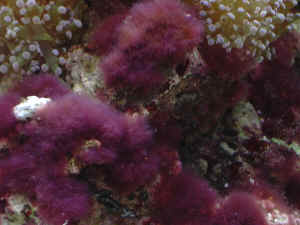
Unidentified Algae 7/11/04 Hi gang: <hi Chuck, MacL here> I've cruised the archives re: red turf algae. . . and the stuff I'm having a problem with seems to have a lot less 'structure' than the pictures and descriptions I've read. Mine is whitish -- texture sort of a cross between a 'hairy mold' on something forgotten in a refrigerator and cotton candy -- with a reddish cast to the outer layers. It grows VERY rapidly, is mostly epiphytic. . . ignoring some macro algae species (brown Dictyota, red kelp) while completely overwhelming others (turf grass, Halimeda, lace, mermaid's wine cups, etc.) <Have you been to www.algae-base.org? Its a great website for algae identification complete with pictures.> Water parameters are good (ammonia a bit high, nitrites 0, nitrates 0. <Definitely need to get that ammonia down to zero. In an active system with a DSB you should have 0 ammonia.> I know the combination seems a bit unusual, but my system contains a large/active DSB, downdraft skimmer and enough live rock to run the Pacific Ocean). The affected tank is a macro algae display with no herbivores and home to a rose BTA. Flow in the tank is good. . . not as good as the system's main reef (which has ZERO detectable nuisance algae) but considerably BETTER than a 26 gal. refugium which also has zero detectable nuisance algae. . .<I'm guessing you have grasses and Caulerpa in the refugium eating up the nuisance algae nutrients.> yet the tanks share a common sump and similar (relatively high wattage) PC lighting. I'm hoping the description will 'cue' recognition of this species (if indeed it is a form of red turf). . . and recommendation of something that would like to eat this nasty stuff while sparing my display macro algae. Since there are no corals in this tank, it doesn't need to fit the standard definition of 'reef safe'. . . Finally, in my fishless refugium, I'm currently marveling at the reproductive powers of the rust red planarian. I've read the usual suggestions about predators (mandarin gobies, dragon wrasses, leopard wrasses). . . and upping the flow isn't an option because I'd either chop the fauna to bits with a powerhead. . . or run the 'current' through the tank too quickly for the little critters to reproduce with a bigger return pump. <I had a case of these early in my tank and ended up limiting my lighting in order to help contain them. I also continually scraped them off the acrylic walls and kept them constantly stirred up. It ended up working for me.> What I'm hoping to find is something -- a shrimp, crab, whatever -- which would go for the planarians while being either uninterested-in or incapable-of catching the amphipods and copepods that are the refugium's reason-for-being. Some kind of 'magic bullet' in terms of an arrow crab or some other non-reef safe creature that might possibly work in this segregated area. Any thoughts?. . . <I'm not sure of a magic bullet for these guys. Unfortunately everything that's going to eat them will also eat the pods etc there. <Good luck.> Chuck Algae id... RMF doesn't have pix I'm attaching a pic of something that is growing and thriving in my tank. It apparently came in on my live rock. It looks like Codium, but it is not now, nor has it ever been, green. << Yes, a question about algae. >> Closest Codium I've found is c. geppii schmitt, but it seems a lot more compact than this is. Note on the left one how it gets almost red near the base. << Depending on how red it is, I would consider Scanaia complanata. >> The larger one is even more red, though it doesn't show in the pic. Any help with an ID would be appreciated. << After looking at the pic, it is very much Codium looking isn't it? It may be a type of Rosenvingea. Like R. sanctae-crucis. That is my best guess. Do you know if it was on Pacific or Atlantic rock? >> Thanks, Tom << Adam Blundell >> RE: Need an ID I'm 90% sure it was on Atlantic rock. << Great, I love the Atlantic algae! >> This is based on other species that showed up on it. I found some pics online of the Scanaia, and two of them are very close to what I have, so I'm thinking that's the one. Can't find any pics at all of Rosenvingea. Thanks for your help. ) << Hope I helped. Feel free to send more pics as it grows and changes. I would suggest the Caribbean Algae books by Littler and Littler if you want to learn more. >> << Adam Blundell >> Red Algae ID - Cyanobacteria? 6/2/04 Friend or Foe? I can probably get you a picture of my tank here shortly... 90 gallon saltwater 95lbs live rock 24oc 1.24? 1.0024? salinity ~ you know what I mean... pH 8.2-8.4 2" livesand 2 Percula Clowns 3 gobies Pistol Shrimp Coral Banded Shrimp Cleaner Shrimp Black starfish 10 blue legged hermits 10 snails <all good> I have a dark burgundy hard algae growing all over my liverock... a nice encrusting algae. <many types of corallines... all good/desirable more or less> I just recently changed about 1/3 of my filter rock and within the last 3 weeks have had a very quick growing burgundy algae cover about 1/3 of my live sand. The stuff is also growing over my liverock and the already established encrusting algae. Can encrusting algae grow on sand?? <not likely at all... not to any appreciable extent. Do you know what maroon slime algae (BGA, Cyanobacteria) is? Do look it up in our archives at wetwebmedia.com if not. Its rather common, and a sign of accumulated nutrients, poorly functioning skimming, weak water flow and/or overfeeding> Is this simply another coat of algae blanketing my rock?? The algae looks almost the same as the original algae except it is brighter. I'm not sure if it's just because it is 'new' or not... but this stuff seems soft and flakey. Any ideas? <no possible way to say from your very general descriptions. Hundreds of possibilities. Please do take the time to review our photos and data in the archives to ID or at least put things in better perspective> Is it good? Bad? I can't think of anything else that has changed in my tank recently. <just the accumulation of nutrients over time. A weak water change schedule can aggravate this too> I'm moving my tank in a couple of months... is it better to stock up on critters (crabs n snails) now... or is it better to wait till the move is complete? <do wait and control nutrients as best you can in the meantime> Is it a bad thing to have only a few crabs and snails in my tank? <not at all... crabs are generally tricky in the long run anyway, and add only enough snails as needed. They can be reduced/avoided with other nutrient export habits/mechanisms mentioned above> Thanks for all your help! Dave <best of luck. Anthony>
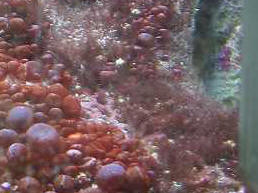
Red Hair/Branching algae - Ceramium 5/31/04 Hello Bob, <Anthony Calfo in his stead> I hope you're well and in a good shape. <the more years that go by with me working in front of a computer, the rounder I get. I'm thinking of strapping my laptop to a treadmill <G>> I'm ok too, it could be better but it could be worse.... <keep on keeping on my friend> I have received a question about : "red algae Ceramium (???, do you know this algae?) <the correct spelling is Ceramium with an "m". It is a nuisance species... one of the many things called "red hair algae". This one really is a doozy though. It naturally occurs in high nutrient nearshore environments and often lives as an unwelcome epiphyte on other critters and substrates> The aquarist has a wild growth of these algae and can't get rid of it. <no worries... it can be controlled. Easily starved into submission with tighter nutrient control. Really... it can disappear in 2-3 weeks with wicked protein skimming. It probably got there because of poor protein skimming, weak water changes and/or weak water flow which allowed sediments to accumulate> He asks for my help. Al seems to be good in his measurements but he has a Ca test of 600, to heavy I think. <I doubt that the reading is even accurate. Indeed too high. And if his Alk is not very low, then I am sure it is a misreading. Else, the poor chap is having a precipitous snowstorm as we speak <G>> I ask for my help and I ask for the help of the supreme chancellor.... <Hmmm... yikes! And we've just been calling him "Bob" all along.> He said he had a problem with his Ca reactor a while ago, what he did to help the problem, he didn't say, perhaps is the solution knowing what he did.... Read You. Regards, the best. Claude <Claude, do suggest in concert with starving the algae out, some Diadema urchins (Pacific or Atlantic species). They will only be treating the symptom and not the problem, but will give results fast. They are marvelous algae grazers. One small urchin per 100 gallons if you want to be conservative. Prost! Anthony> Rust-looking algae? Hi, I'm hoping you can help me. <Leslie here tonight That's what I am here for. I sure will try> I've had a small 10 gallon tank for the last 9 years or so. In February, my husband and I bought a 26 gallon bow front tank. We chose white gravel and fake plants. After several months, the gravel started forming rust colored spots that quickly spread on the surface of the gravel and on to some of the glass, as well as on the plants. I've never experienced anything like this in all the years I've had a tank. <You've been lucky> It doesn't look like any algae I've ever had. I spoke with the guy at Petco whom we bought the tank from. He's got several tanks of his own and has had the problem himself. He told me to clean the tank thoroughly, along with the glass and the rocks and plants. I did all of these things, and all was fine until a few days ago when it started happening again. I don't leave the light on during the day, and I don't leave the light on too much during the evening either, and I've changed the fishes food too. Any suggestions as to what this rust colored stuff is and what I can do about it??? <Sounds like Cyanobacteria. It is a multifaceted problem and there is a wealth of information here on the site. Check out the following links ..... http://www.wetwebmedia.com/cyanocontrolfaqs.htm http://www.wetwebmedia.com/bluegralgae.htm It's driving me nuts!!! <I am sure it is. I can relate!> Thanks, Marilyn Frank <Sure anytime glad to help, Leslie Cyano de Bergerac and Cody's usual response hey guys!<Howdy!> I got a question for ya and I hope u can help I have this really weird algae in my tank it looks just like red velvet coating my LR it is also in a maroon and green velvet any help is good thanks.<This is likely a cyanoBACTERIA and you can find tons of info on it at our site: www.wetwebmedia.com. Cody> Is That Red Coralline? Or Is it Cyano? (4/28/04) Greetings WWM crew. <Steve Allen tonight> I've got something of a concern. I searched WWM for Red Coralline and found out about it and seems as though people desire it. I have a 20 Gal, Extra high w/ a "hang on the back" Bio/Mechanical filter deal and a Power head, suited for 30Gal tanks. I'd say there's about 25# of Live rock (which seems to be sprouting more and more polyps and stuffs that I haven't seen before). There's the appropriate bottom of 3" of sand. I've also got (2) A. Ocellaris (False Percula right?) <yes> and one Yellow tail damsel. It is a apparently a well-established aquarium, used to house a Black Edged Moray eel and some other fish. It's a second-hand tank. Contrary to recommendation, my tank is placed right against a window w/ a Western exposure; it gets A LOT of direct Sunlight. <Very bad from a pest algae perspective. You should block this.> Over the course of about a month, the ENTIRE back wall of my aquarium was covered with a thick (Read; "Opaque") layer of Red Coralline algae. It was so thick that it began to create oxygen bubbles beneath the layer <coralline should not do this> and allowed very little light to pass through. Just the other day, I built a rack of PVC pipe and connectors in order to keep my Live rock off the bed of sand, so I could grow... well, Life, on all sides of the rock. it's suspended on a 1/2" PVC grid, which has about 20 3/8" holes drilled all around the perimeter of the PVC frame, and tied into the suction for my "hang on the back". This allows a constant top-to-bottom circulation and the power head creates circular current around the tank from its position in the top-rear corner . well, I used a rubber spatula to remove my coating of Algae off the back wall, in thick sheets, about 2"x14"... <This is not coralline algae. You can't scrape it off with rubber, only hard plastic or medal will work. Coralline does not come off in sheets, it powderizes into a cloud of tiny particles because it is calcified. The stuff you are talking about is almost certainly Cyano, cont coralline.> Should I have left it on? <No> Is this desirable? <No> It just was somewhat unsightly from an aesthetic point of view... probably beautiful from a biological stability view though. <No. It is ugly and it is an indicator of too much light and too much nutrition in your tank.> *shrugs* Would Others desire this algae? I seem to have "hairs" and "whisps" of it growing from some of my rock <This is hair algae, also bad.> and I also have thin layers of Red coralline and small spots of Green algae growing on the sides, front and floor of the tank, even BELOW the sand line. I know I should be checking my levels regularly, but I don't even own a testing kit <Well, go buy one!>; thus I have not checked the levels in the tank since I took ownership... approximately 4 months now. <Time to start. I'll bet you've got tons of nitrate and phosphate in there driving this and it will soon reach plague proportions.> Only one fish has died, black and white striped Damsel, but I think it was killed by the Domino, blue and Yellow tail damsels. =o/ any insight you can give me on coping w/ my copious amounts of red coralline <Cyano> will help. thanks Chris <well Chris, not to be harsh, but you don't know enough about your aquarium and how to maintain it. You need to get a good aquarium book such as Bob's "The Conscientious Marine Aquarist" and read. I'd suggest you read all the FAQs on the site about Cyano and hair algae. You've got some learning and some work to do.> PS; Love the website, I'm absorbing everything I can and being inspired to get a 55gal. <A better size to work with. Hope this info helps. Glad to be of service.>
New to slime algae 4/25/04 Hello I currently have about 4"-5" of sugar fine sand for my DSB. As of late the upper layer of sand has been turning pink/red in color. I thought that my phosphate levels may be rising again and another bout with red/slime algae was coming my way. But my levels are within the norm and this red/pink isn't occurring anywhere else in the tank with the exception of the sand. Is this coralline algae growing within the sand bed? Is this good or bad? If it is bad what is the cause and the cure? Thank you Kevin Conner <it sounds like the nuisance slime algae Cyanobacteria (red form of blue-green algae). Use these terms in a keyword search with the google.com toolbar on our home page at www.wetwebmedia.com for so much more information in our (free content) archives. The short solution is increased water flow, better protein skimming (make your skimmer yield dark skimmate closer to daily) and be careful about feeding. Best of luck! Anthony>
|
|
||||||||||||||||||||

|
Features: |
|
| Featured Sponsors: |