|
FAQs on Marine Algae Identification
14
Related Articles: Avoiding Algae Problems in Marine System,
Algae
Control, Marine Maintenance,
Nutrient Control and Export,
Marine Scavengers, Snails, Hermit
Crabs, Mithrax/Emerald
Green Crabs, Sea Urchins, Blennies, Algae
Filters, Ctenochaetus/Bristle Mouth
Tangs, Zebrasoma/Sailfin Tangs,
Skimmers, Skimmer Selection, Marine Algae, Coralline Algae, Green Algae, Brown
Algae, Blue-Green
"Algae"/(Cyanobacteria), Diatoms, Brown
Algae,
Related FAQs: FAQ ID Visual
Guide, Marine
Algae ID 1, Marine Algae ID 2,
Marine Algae ID 3, Marine Algae ID 4, Marine Algae ID 5, Marine Algae ID 6, Marine Algae ID 7, Marine Algae ID 8, Marine Algae ID 9, Marine Algae ID 10, Marine Algae ID 11, Marine Algae ID 12, Marine Algae ID 13, Marine Algae ID 15, Marine Algae ID 16, Marine Algae ID 17, Marine Algae ID 18, Marine Algae ID 19, Marine Algae ID 20, Marine Algae ID 21, Marine Algae ID 22, Marine Algae ID 23, Marine Algae ID 24, Marine Algae ID, 25, SW Algae ID 26, SW Algae ID 27, SW Algae ID 29, SW Algae ID 30, SW Algae ID 31, SW Algae ID 32, SW Algae ID 33, SW Algae ID 34, SW Algae ID 35, SW
Algae ID 36, SW Algae ID 37, SW
Algae ID 38, SW Algae ID 39, & Marine Algae Control FAQs 2, Marine Algaecide Use, Nutrient Limitation, Marine Algae Eaters, Culturing Macro-Algae; Controlling: BGA/Cyano, Red/Encrusting Algae, Green Algae, Brown/Diatom
Algae,
|
|
 |
New Print and
eBook on Amazon
Marine Aquarium Algae Control
by Robert (Bob) Fenner
|
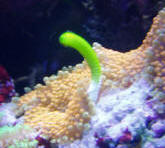
| Please identify 3/16/2007 Good day all:
<Paul> Can you identify this for me. I noticed it
as a tiny protrusion from the rockwork around four months
ago. It has grown at a good pace. It appears
to be some kind of hard tube worm but I have yet to see anything
like it in my reef before. <Is a green algae... genus
Neomeris...> Thanks in advance. Paul Boynton Bch,
FL <Mmm, have been diving off your coast... a
very nice town as well. Bob Fenner> |
|
|
| Algae ID 3/16/2007 Hello again,
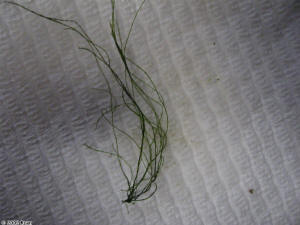
I've had this on your forum for a while now and cannot seem to
get a positive ID. This algae recently started to
"bloom", not completely covering rocks but enough to get
me worried. It seems to prefer the walls of the tank
(acrylic) and sticks to anything that is not smooth (coralline
algae, diatom). It is dark green, thinner than
Chaetomorpha, and branches off close to the point of growth (what I
mean is, it branches off slightly higher than the point of
origin). I've had a lot of things going on lately
that may be contributing to this, first of all I have been trying
to raise Berghia nudibranchs in a 10 gallon in my basement.
<Raise these in small cups... if doing so commercially...>
I have been pulling rocks from my 90 gallon to feed the
Berghia, and in turn am losing 2 filters (my rock and
Aiptasia). My water parameters have not changed since
all of this started, ammonia 0, nitrite 0, nitrate 2, phosphate 0,
calcium 400, alk 10 DKH, Ph 8.3, temp (has varied)
80-82.5. I should mention this is accompanied by
Cyanobacteria, not a terrible outbreak, just there. I
really hope you can help me out with an ID so that I know what
I'm dealing with and know how to fix it. I
researched everywhere I can think of and can't find an answer,
please help. Thank you, Ryan. I've tried
to copy and paste the image, hopefully it's not to large.
<Need to get/use a microscope... to determine if this is indeed
a thallophyte or an embryophyte... Might be an algae or a
true/vascular plant... Does it have obvious organelles?
BobF> |
|
Re: Algae ID -- 03/18/07 Thanks for the reply, we just
keep running into each other. After finding out what
organelles are I did the best with what I had to answer the
question. I used a magnifying glass and a flashlight,
which let me see into the algae/plant and it does appear to have
organelles. Unfortunately I do not have or have access
to a microscope, but maybe the fact that it has organelles can
help with an ID. Thanks again, Ryan. <Is likely a
vascular/true plant then... Do read here: http://www.wetwebmedia.com/marinvind1.htm The second to
last tray... We really need a consummate piece on algal and
embryophyte Id... The Id FAQs files, and bits on True marine
plants. Bob Fenner>
|
|
|
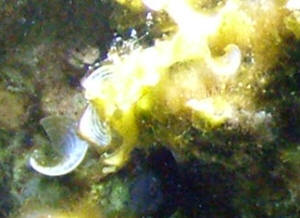
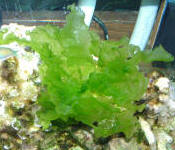
| Padina SP and the Brown Fuzz - 03/06/07
Well, the hair algae died !!!! Can I Get A
WOOHOO. It had me worried. You were likely right on the
phosphates Bob... they were zero because the hair was consuming
them. I purchased a poly filter and a few days later it was all but
gone. <Congrats> I know I had at least 4 small fish die that
I couldn't find to pull out so I assume that was the source.
<Ah, likely so> Anyhow to the point. Early on in my 1st email
to you guys, you identified Padina SP for me since I couldn't
locate it in the coral section (duh). I have a follow up
question, as it appears to be spreading pretty good. Is the furry
brown algae that grows up tight and around it, part of it, or is
this some other monster I am going to have to deal with. Dan <Is
another algae type... likely a BGA... it too should go with time
(try adding a bit more iodine supplement...). Nice patch of Ulva!
BobF> |
|
|
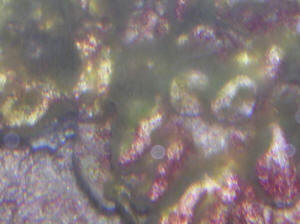
| Green algae problem... looks green... BGA... but
too palatable to be so 2/28/07 Greetings,
<Howdy> I currently have a problem with green
algae. I'm not really sure what it is. It
is approximately 4cm in height, single stranded, bright green,
flows in the current and is not easily removed by
hand. I'm pretty sure from looking at the photos on
your site that it isn't BGA. <I wouldn't be so sure...
do you have a microscope?> The algae is covering my
glass, substrate and rock. My tank is a 100 gallon tank
with (2) 54 watt T5's (10000 and a 460 blue), 150lbs live rock,
100lbs CaribSea aragonite, 2 maxi-jet (230 gph), Magnum Deluxe Pro
(for my carbon 350gph), Remora Pro Skimmer (mag 3,
300gph). The tank has been up for only 3
months. I currently have a lawnmower blenny, 25 scarlet
reef crabs, 5 blue-legged hermit crabs and a chocolate chip
starfish. The lawnmower blenny and crabs love the algae
but can't keep up. <Oh! This is a good clue... They would
not likely eat it period if it were Cyanobacterial> My water
tests show salinity 1.023, ammonia 0, nitrite 0, nitrate 0, phos 0,
calcium 380, temp 77.8, alk 8 dKH, and ph 8.3. I'm
running a RO with add on DI unit with a house water
softener. I cut the light hours down to 6 per
day. Is my lighting to much for a 100 gallon FOWLR tank?
<Mmm, nope> I can't see any other reason for the growth
besides the lighting since all of my water tests are good.
<"Because it can"... a lack of competitors, paucity of
predators... and your nutrient readings are likely low... because
the algae is rapidly taking up what is available> The only thing
I'm currently feeding the tank is a little meat for the CC
starfish, which he eats all of everyone else is eating
algae. Any help or algae identification is appreciated.
Thanks, Jayson <Mmm, not able to ID over the Net... w/o
"very" close up (microscopic) pix, showing a lack of
nuclei, organelles... But, do know what avenues to consider in
control here... Please read: http://www.wetwebmedia.com/algaeconMar.htm and the linked
files above... A refugium, DSB, RDP lighted macroalgae...
BobF> |
|
|
Livestock question ID Suspect Caulerpa taxifolia
no Photo 2/20/07 Hello crew <Hello again
Wayne! Mich here.> Had a quick question on the
Caulerpa that's exploded in my refugium. Pic
attached. <I don't know why, but I can't see
the picture. The webmail is showing there is an
attachment and the size is 80 kb, which seems
appropriate. However, I'm not seeing an attachment
or a photo, I'm not sure what the source of the problem, but
other crew members are also unable to view any
photo/attachment.> <<I couldn't either... RMF...
troubles with our webmail server... which are hopefully being
corrected>> I've tried to only keep Chaetomorpha because
I didn't like to risk of spreading Caulerpa into my display.
<Wise in my opinion.> Is this Caulerpa
taxifolia? If yes, is there risk of this spreading into
my display? In your opinion should I keep or
trash? <If there is a possibility that it is
Caulerpa taxifolia, I would remove it. The Caulerpa
species as a whole can be quite noxious and
aggressive. Once established, it can be quite difficult
to remove. I would not take the risk especially as you
already have the more desirable Chaetomorpha.> If
not Taxifolia, please help me ID. Is it a keeper?
<Sorry. I can't help you here without a
photo.> <Anytime, -Mich>
Wayne |
| Re: Livestock question ID Suspect Caulerpa
taxifolia no Photo 2/20/07 Thanks Mich
<You're quite welcome.> Don't worry about the pic...I
removed the suspected C taxifolia. After doing more
research I figured better safe than sorry. <I think you are wise
here my friend.> Thanks again. <Always a
pleasure. -Mich> Wayne |
| Mysterious Green Algae... BGAs -
02/17/2007 Hello <Hello there... next time... images/files
no larger than a few hundred Kbytes... you've crashed our
server... sigh... Does anyone read instructions?> I have had
this green hair like algae before and it rapidly overtook the
entire tank on all the surfaces except the glass. Only after
extreme measures of basically starting over from scratch was I able
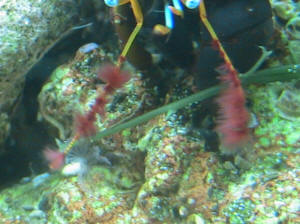
to remove it. There is also a pick of a reddish algae growing on
the feelers of the crabs that has started to grow recently.
<These are all blue-greens, Cyanobacteria... see WWM re nutrient
limitation, competition, other stated means for control. Bob
Fenner> |
|
|
| Re: Mysterious Green Algae - 02/17/2007
Hello And my apologies for the image size I forgot to check that
before firing off that email. Thank you for your help on
identifying the issue! :) Jeremy <Ahh, thank you for coming
forward, explaining. BobF> |
| Gold algae plague driving me mad --
03/17/07 Dear WWM-crew, <<Goede dag, Arno>> Some 2+
years ago I started a coral propagation system under light
circumstances I've never tried before.
<<Really?...ok>> The system consists of 3 tank layers
and a sump. Total volume: app. 1000 liters, Water
circulation: app. 5000 l/h in the system. <<Hmm'¦a
bit more water flow would likely be of benefit>> Each layer
has some 4000-7000 l/h extra. <<Ahh, okay'¦very
good>> Skimmer: Bubble King 300 (oversized in view of
enlarging the system). <<Very nice>> Life rock: app 100
kg.s. Fish: 10 small fish, normally fed. <<And a
beneficial nutrient source for your corals'¦>>
Proper cooling (never higher than 27 C) <<Excellent>>
Illumination: -2 years: sunlight through roof and doors -upper
tank: 2x MH 150W- no gold algae -2nd/3rd tank: each 8x T5 39W- many
gold algae <<Mmm'¦since these are 'stacked'
tanks, it would seem to suggest your problem may be attributable in
part to 'inadequate' lighting intensity>> -sump: no
illumination Since 4 months no more sunlight through the
roof. Nevertheless the algae keep coming back and damage
the corals severely. <<A problem indeed>> For a good
understanding: To the eye gold algae look similar to certain
dinoflagellates, but under a microscope the latter move and gold
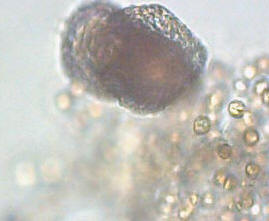
algae don't. <<Hmm'¦looking at the photos you
supplied, I think what you have here is a blue-green
alga'¦aka -- Cyanobacteria>> Countermeasures:
-removing the algae regularly... <<Do siphon carefully as it
can easily be spread through the system when disturbed>>
-less daylight. <<But not to the detriment of the
corals>> -previously regular 10% water changes; later hardly
any as it seemed to stimulate growth. <<Indeed, I have noted
this phenomenon before myself>> -no longer additives of
trace-elements. <<Ok>> -higher Ca, KH and pH <<A
good move>> -careful daily dosing of hydrogen peroxide
<<Is a powerful sanitizer/oxidizer'¦with
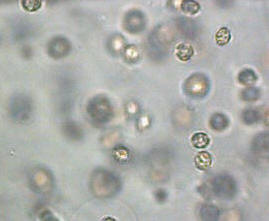
'careful' being the operative word>> Attached
you'll find some (microscope) photographs to get a good
visional idea. It's driving me mad! Does anyone have other
smart ideas? I'd be very grateful! <<Well
Arno, as stated I believe you have a form of
Cyanobacteria. These can be VERY difficult to eradicate
as they seem to have the nasty ability to produce their own
nutrients. Very strong water flow seems to help, as does
boosting alkalinity and pH as you have begun to do. I
think you do need to continue water changes as well, but consider
doing a 20%-25% change every 4-5 weeks with 'well aged'
saltwater. I would even add a cup or two of system water
to this change water a week before use to get some microbial
activity going. And definitely have a read here (and
among the many links at the top of the page) for more ideas re
controlling this troublesome organism: http://www.wetwebmedia.com/bluegralgae.htm >> <I
agree with your ID Eric. RMF> Thanks, gr's Arno The
Netherlands <<A pleasure to assist. Eric Russell,
South Carolina, USA'¦and who also lived for three years in
a small village just outside Amersfoort in the
Netherlands'¦about three decades ago
now'¦>> |
|
Re: Gold Algae Plague Driving Me Mad --
03/19/07 Hi Eric, <<Greetings Arno>> Thanks for
your quick re. <<Quite welcome>> As for the
algae/Cyanobacteria: So far all the Cyanobacteria I viewed
microscopically looked long-stretched, like clusters of short
threads... (just like the pics on: http://www.wetwebmedia.com/bluegralgae.htm). The
ones I sent you pictures of, do not cluster and are rather
round/oval. I compared them to other microscope pic's of
dinoflagellates and gold algae and they look astonishingly
similar. So I'm still somewhat doubtful if you are
right about it being Cyanobacteria. <<Well Arno I am
certainly no expert on Cyanobacteria, but I do believe there are
many strains of such 'blue-green' alga. What
tips me in this direction is mainly the appearance of the algae
as it covers and smothers your corals (as in one of the pics you
sent). The 'slimy' appearance/texture and
embedded/escaping gas bubbles are classic signs of
Cyanobacteria>> What do mean by "inadequate"
lighting intensity? The problem tanks have a water column of only
25 cm and are illuminated by 8 T5-tubes of 39 W. Thus
establishing some 1.65 watts/litre. <<Understood...but even
so, this is no where near as intense as a pair of 150w metal
halide fixtures like you have over the un-infected
tank. Thus, I am suggesting this strain of alga may be
inhibited by very high light intensity>> What do you mean
by "well aged saltwater"? Older water from
another aq.system (I have plenty of that) or freshly made water
well aerated for several days? <<The latter...though I
prefer to 'age' freshly made saltwater for a couple weeks
to ensure all chemical processes are completed and to render the
water less 'harsh'>> All that's mentioned in
http://www.wetwebmedia.com/bluegralgae.htm was already
known to me and it does not give me any handle... <<I
see... Perhaps reading among the associated links will
render a clue>> The only thing I can think of and which I
haven't tried yet, is increasing the amount of live rock,
thus 'disturbing' the balance. What do you
think? <<This may prove helpful, especially if you can
introduce/maintain enough biota to 'out compete' the
algae for its nutrients. You might also consider
changing brands of salt mix. Perhaps something in your
mix is 'feeding' the problem. And I do think
increasing light intensity on the affected tanks is worth a try,
if possible>> Groetjes,
Arno
<<Be chatting, Eric Russell>>
|
  |
|
|
New Print and
eBook on Amazon
Marine Aquarium Algae Control
by Robert (Bob) Fenner
|
|
|

