|
|
| Home | Marine Aquariums |
Freshwater Aquariums |
Planted Aquariums |
Brackish Systems |
Ponds,
lakes & fountains |
Turtles & Amphibians |
Aquatic Business |
Aquatic Science |
Ask the WWM Crew a Question |
| Please visit our Sponsors | ||||
Algae ID this is not an algae I think it is a plant of sorts! I looked for a picture and could not find one.. nor do I have a digital camera bummer but it does root in the sand it is starting to even grow on my power head .. it is about three inches long at this point and is moving like crazy!! <do visit your local University library or even try Borders or Barnes & Nobles booksellers. Seek an algae reference by the Littlers (likely to find easily). Therein you will find many pics for comparison. There is also algaebase.org to browse with names once you get into the ballpark. Best regards, Anthony>
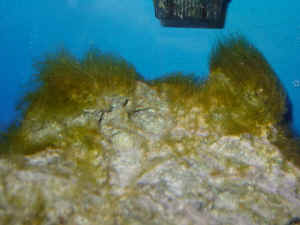
Algae ID Can you help me to identify "brown leather algae"? It has a stem then is like a fan - similar to that of the Stylopodium zonale picture. However the stem is narrow and each of the flattened, edges looks hairy. These are large macroalgae at around 12 inches tall at this time. They are greenish-brown and rather robust except near the edges. I'm sorry that I can't tell you more. <Alas... I wish I could be of more help, but there are so many algae species. We cannot even narrow this one down to an ocean(!) by the description. When possible, do send a picture... hoping Santa is good to you this year ;P Kindly, Anthony> Brown Wafer Algae: Lobophora and like species I have on a couple of my LR some algae that look's exactly like the algae on this page: http://www.globaldialog.com/~jrice/algae_page/lobophora.htm It began to grow at the same time coralline started (aprox. 2 months back)... I was wondering if you 'aqua-maestros' have any idea (and I'm sure you do)on what this is and what steps should I take do get rid of it. My tank is 6 months old, all water params are ok, I use Kalkwasser for all evaporation and a RO unit... Thank you. <The "brown wafer algae" Lobophora is fast growing but not at all palatable to most herbivores. Some Diadema urchins will eat it, and if your tank is over 100 gallons, then a Naso tang may control it for you. Else, manual extraction is called for (Ughhh!... no fun). Best regards, Anthony> Macroalgae and Water Pre-Treatment Good evening! <Hello! Scott F. here tonight> Have just 2 quick (I think!) questions for you this time around. I recently emailed you regarding changing my "nitrate factory" (sump with bioballs) over to a macroalgae filter, you recommended Chaetomorpha or Ulva vs. Caulerpa. Problem is, I have only found mention of the names of these macroalgae; never any pictures (for identification) or locations where I might purchase them. <Chaetomorpha is also called "Spaghetti Macroalgae". It really does look like spaghetti or a kitchen scrub pad! A good commercial source of this algae is Inland Aquatics. Ulva can be purchased from Indo Pacific Sea Farms. There are other commercial sources for these and other macroalgae; it will take a bit of searching. Alternatively, you may want to post an inquiry on WetWebMedia.com's chat forum; in all likelihood, there are other hobbyists out there who have these macroalgae available for sale/trade.> I searched the site for several hours this week.........(It's a guy thing ya know, never ask for directions!! Well, I'm convinced........I'm lost!) Any help would be greatly appreciated. <You are right- there is not a tremendous amount of hobbyist-related stuff on the internet regarding this particular species. Much of the husbandry information that you'll find on this macroalgae is from fellow hobbyists, so do use the chat forum on our site or more information.> Also, in scanning through all the FAQ's, I caught something about watching your PH, and alkalinity if you use "raw" R/O water for tank top offs. Can you point me to more information as to what I should be adding to my R/O water before adding to my tanks? <First, you should always aerate the water before using it; to help drive off the carbonic acid that's usually present in highly purified water. Second, you may want to use an aquarium alkalinity buffer product to help "reconstitute" the water. More on this topic is available on the wetwebmedia.com site, and a further discussion of source water and its treatment is available in Anthony Calfo's "Book of Coral Propagation".> I didn't realize this was a problem, yet probably explains my low PH. <R/O water tends to be very unstable, acidic, and have no hardness, so aerating and buffering the water before using it is a necessary step when using RO water, IMO> Thanks and Happy Holidays!! Doug Edwardsville, IL <And thanks to you, Doug- Good luck in your efforts! Regards, Scott F>
Do you know what these are and how to get rid of them an early thanks for the help. I have a 200g FOWLR set-up. About 5 months old with only 5 fish and about 100 lbs. of live rock. A few months ago I noticed tiny little rectangular shaped (yellow-gold in colour with a speck of red) objects showing up on my glass and gravel. I am assuming they are some type of algae growth ?? When I clean my glass to get rid of these they fall to the gravel and magically 24 hrs later have managed to get back on the glass. I am running a Aqua-C EV-240 skimmer and not having any other algae issues, assuming that this in fact is algae. Is there anything I can do to reduce these pesky little things. I just bought a purple tang, will he make dinner of these?? <Mmm, hard to say what this is, or if the Zebrasoma will consume them (I would have suggested a bristlemouth species instead, genus Ctenochaetus. More likely these organisms are crustaceans or worms... and very likely that they are innocuous/harmless. I would keep wiping them off. They will likely "cycle out" on their own in due time. Bob Fenner> thanks. Joe Brown film algae evening crew, i have brown almost hard
looking film algae spreading across the surface of some of my live
rock. i have picked off a lot of it by hand but the majority of it is
encrusting the surface, and now starting to grow over some of my button
polyps and star polyps. could you identify this type of
algae, which I'm sure is probably common. also are there
any natural herbivores that may eat this slow growing but now poss.
deadly algae?? <Mmm, hard to make out from the description. Please
take a read through our "brown algae" pages, perhaps starting
here: http://www.wetwebmedia.com/brnalgae.htm
and the associated (linked, in blue, at top) files> thanks for the
(always) great advice, Brent UK
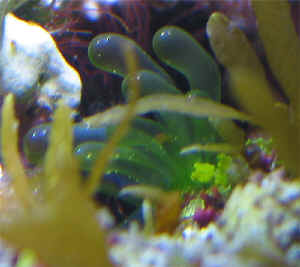
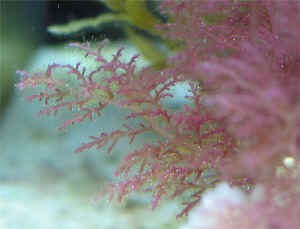
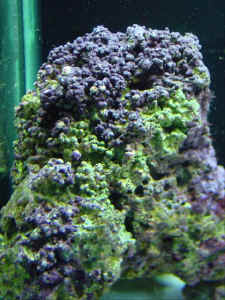
Re: Algae or coral ?? Bob, thanks for the quick response. Your reply was you thought it looked like a zoanthid. I looked at <A HREF=" http://www.wetwebmedia.com/zoanthid.htm">http://www.wetwebmedia.com/zoanthid.htm >. Can they lack tentacles? <Can be small... not evident when colony is not open... but I think maybe we/I was looking at something else in your pic from your description below> These things look like a painted bubble. One of the oldest and largest, about a half inch in size, has one of the dark spots on the top growing a stem that has two tiny bubbles. <Please take a look here: http://www.wetwebmedia.com/greenalg.htm> I have a large 3/4" Chiton that lives in that same LR. I've noticed many small ones all over my tank along with many cone shaped snails. I also have some kind of flat tan 1/8" "slugs" all over LR. Friends or foe? Thanks, Jim <Please read through the "Worm" and "Gastropod" sections posted on WetWebMedia.com re these animals. Bob Fenner> Grey Algae ID 3/30/03 I couldn't find anything like this on your site or the 'net - do you think you can ID this alga? <alas... cannot discern clearly from the image at all> It looks very much like the lint-type dust you find in a vacuum cleaner bag - not really "hairy" more clumpish - like dust. I know the pic isn't the best (hard for it to focus) I want to make sure it isn't something dangerous. The algae in question is the clump dead center in the pic. David <there is a great algae web-site you can browse (www.algaebase.org) once you have an idea of its genera/ballpark. The Littlers have produced several incredible algae ID books if you are interested too and can be purchased at SeaChallengers.com As far as this algae is concerned, it is likely limited by nutrients and well within your control. No worries <G> Anthony> Kelp help- Algae ID Hello crew, once again I call on you for help. I recently bought a live sand starter kit from Indo-pacific, excellent product. <agreed> In the kit was a small piece of kelp or algae that I can't identify. Basically it is red/brown in color, branched with pointed ends. No fronds and no apparent roots. Well that small piece has grown to fill most of my sump. Looks like it is helping with nutrient export so I don't mind keeping and harvesting. Any ideas where I might find some general information to help ID this, I looked over the site and didn't see anything quite like it. As always thanks for your help. <Hmmm... start with a google WWW search of Phaeophytes (brown algae... you mentioned kelp-like)... for genus names to ponder like Turbinaria, Dictyota, Sargassum, etc... unless its not a kelp and you want to explore possibilities with Rhodophytes (red algae). Perhaps carry some of those names over to a search on www.algaebase.org DO send us a picture for an even faster ID <G> Kind regards, Anthony> Brown creeping algae ID Bob I have a 75 gallon reef set up with four fish largest fish being a yellow tang various stony corals and leather corals. All parameters are fine but now I have noticed brown algae starting to creep over my live rock. The turbo snails don't eat this the blue, red and brown leg hermits don't do the job as well. Could you please help? As I would like to keep the beauty of the live rock from being taken over thanks. >> Hmm could be a few things... together or by themselves... favoring the brown (probably a big mix of Diatoms, Blue Greens, Greens....) over the encrusting Reds... Is your alkalinity low? How about biominerals like calcium? Have any idea what your redox is? What about lighting? What sort do you have? How old are the lamps? Do you have Hermits that might be eating the corallines and leaving the undesirable forms? You might want to peruse the various Marine Algae sections stored at my site: www.wetwebmedia.com (make a large pot of coffee...) to gain better insights as to the cause(s) and options you have in prompting coralline algae "re-growth". Bob Fenner Algae on the LR and crushed coral looks like a small fern plant, ID I have a 75 gallon tank with 75 lbs of live rock (from FFexpress). The problem is that I have green algae growing on the LR, crushed coral substrate, glass, pumps, etc. My biggest concern is the daily build-up of film on the glass and how to prevent this ongoing nuisance. The algae on the LR and crushed coral looks like a small fern plant and others look like a spiral tube about 1/32 in diameter. Phosphates, Ammonia, Nitrites are 0, Nitrates are 2.5, pH is 8.3, SG is 1.022, temp is 77. I have a Berlin HO protein skimmer that is running full blast and clean (the cup) daily. I also have a 75 gallon clean up crew from FFexpress on the way. Will this solve my problem or do I need additional help? >> I definitely would seek "extra help" in the way of biological algae eaters in your case. Look into the Tangs/Surgeonfishes of the genera Zebrasoma (the 'Sailfins') and Ctenochaetus (the 'Bristle Mouths') for sure if they'll fit, and possibly one or two Mithrax (Emerald Green) Crabs, and my favorite genus of Lawnmower Blennies... just one of these. And let's see what these can do to help in the first wave of offense. Additionally, do look into using some form(s) of macro-algae in your system or a lighted sump tied into your system to use up the nutrients and light that the nuisance filamentous is utilizing. And, even though you state a zero concentration of phosphate, I would use some (two units maybe) of activated carbon once a month in your filter flow path to remove some of the dissolved organic compounds that are fueling the pest algae... they are soaking up the phosphates ahead of your being able to measure them. Lastly, a philosophical note re the matter of "algae control"... it's best to approach these situations with a view on long term, slow success... and not expect, or desire the fast fix. Beware of any chemical controls... as they are toxic in their own right, simply recycle the nutrients in a system... and can take out all your livestock (happens every day) by killing the algae too much too soon. Be patient, and employ the controls and techniques I have listed... You will win. Bob Fenner What algae is this?? Hi Bob, <Hello> I have asked this question in a couple different forums and haven't gotten any answer, so I know "you be the man" as they say around here. I mean "you be the FISH man". :-) <One of many> The predominant algae I have right now, I have been looking in your algae pages and so forth and can't find it. So I am wondering what I have here. (Definitely not Bryopsis or Derbesia, unless Bryopsis could be very short.) <Yes, can be...> It is very green especially on the top of the tank. It is definitely not slime or slick in any way. It isn't hairy (I have that too though). I can't really see any structure to it (like leaves). Someone did suggest coralline, but I didn't know it got so green. Perhaps mossy is the best description, maybe 1/8 in high or less. <Okay...> It looks very delicious like the tang I will get in a couple weeks may really like this (yes I wrote you about that). Btw it is actually very pretty, especially with the purple. I just don't think I want it taking over. Too bad I can't send you a picture. But I don't have a camera that would be able to get close enough. <Hmm, have many "sort of" images of this sort of algae...> Any idea what I am describing?? <Not really... did take three college classes in "Phycology/algology"... a survey, seminar and culture one respectively... enough to know that I don't know much of what is already known, and that this is paltry compared with what is to be discovered further... sigh. But do know somewhat about how one might proceed at this point... take a sample to a college, water quality board where these is someone trained in algae identification... they or even you with the dichotomous keys listed on the survey pieces on the algae groups on the WWM site can key out this organism at least to genus... Otherwise, we/you'll see if the tang will consume or even sample this algae... I do suspect it is some member of Bryopsis or Derbesia... Bob Fenner> If you are ever in the Chicago area, you can come over. I'll serve you dinner and you can answer all my zillions of questions. (I don't think this is a very good deal for you btw :-)). BTW, NOT a pick up line!!!! <Thank you for the kind offer... I very often cook for friends (one of my principal hobbies) and will gladly take you up on your meal plan. No plans for the Windy City as yet this year, but "you never know".> Curious Jane <Be chatting, Bob Fenner> Re: What algae is this?? Hi Bob, Can I edit the comments I sent you?? <Certainly you may> I looked at the algae very carefully and don't think it's bright green (could be because I just added 18 lbs of sand ?) but it looks more greenish grey. Other descriptions apply. <Still not able to discern what this might be any better... there are actually thousands of algae in a few Divisions (the equivalent of zoological Phyla in botanical taxonomy) that fit these general characteristics... Do take a look at the "old" (I used them in school!) works by E. (lmer) Yale Dawson... on the more common algae... there's a bunch to wade through... Bob Fenner> --Jane Who is that? Hi Bob, I hope you can help me identify two organisms that presumably entered my tank on live rock. The first on looks like a tiny sea hare (Aplysiacea?) <Maybe> It is bright green and well under 2mm long. It really moves around. <You have good vision, and no to this being a Sea Hare... don't move that fast... slugs, marine snails of a sort...> I tried to catch it once but my fingers are too big and it squirted out a little white cloud. <Better to not do this... might be a toxic species of flatworm, or? If want to remove, use a small diameter siphon to suck out> The other organism is on several pieces of live rock. It is about the size and shape of a pea but it is clear. Where the occur they are singular, not in groups. Any ideas? Do they need to be removed from my tank? Thanks, Brian Battles <The latter one sounds like a green algae commonly called Valonia in the hobby. Do take a look at the articles on marine algae groups and FAQs stored on the www.wetwebmedia.com site... No need to panic, but you might want to selectively scrub the easier to locate colonies, maybe try a Mithrax/Emerald Green Crab to eradicate. Bob Fenner> A Burgundy moss in my tank Robert, I have a 90gallon saltwater tank. 6 small fish, protein skimmer, 15 gallon sump. Recently, a reddish/burgundy "moss" has started growing from the bottom of the tank upward on my live rock. Is this something i need to worry about? Jeff Steffanina <Not worry per se, but do keep your eye on this growth... indicative of a type/mix of algae that aren't very palatable, opportunistically surviving on available light, nutrients, space... that with subtle shift in water make-up, predator pressures... might well disappear... If this "patch" becomes too big, bothersome... do consider first a biological effort to nibble it back... A Mithrax Crab, Atrosalarias or Salarias sp. blenny, Ctenochaetus tang... many other choices... please read over the algae, control, FAQs parts on these key terms stored on the site: www.wetwebmedia.com Bob Fenner> Question (about algae taxonomic terminology) I am not sure if you can help me, but I might as well ask. What are the differences between the Chlorophyta, Phaeophyta, and Rhodophyta classes of algae, versus higher terrestrial plants? I have looked on the net without success, and any information you may have would be a big help. Thank you so much for your time. Kacie <These are major taxonomic designations (Divisions in plant systematics are about the equivalent of Phyla (singular Phylum) in zoology... for the Green, Brown and Red Algae (common names) respectively. These thallophytes (true algae) are classed/differentiated on the basis of such characteristics as storage foods, life cycles, sexual modes... And separately from the "true" or "vascular" plants on the basis of the former's transport mechanisms for water, nutrients (xylem, phloem) content of lignin in cell walls... and in the "higher plants" the production of embryos (they're called Embryophytes...), i.e. seeds, which the algae lack... This is a simplistic picture... and much more can definitely be found on the Net under search terms like "Plant Taxonomy" "Plant Classification"... Your local libraries will have several reference works on these issues... assuredly. Bob Fenner> Coral (algae?) ID i got this on some Gulf live rock I bought. Can you ID it for me... i am just curious... i hope you can make out the pic.... <Ah, the upper material is some sort of Halimeda species (a common genus of suitable Green (Chlorophyte) Algae, the lower bit... a filamentous green plus some other forms likely... Bob Fenner> thanks in advance, Chris Algae id on little info. I am having a problem with an alga that looks like feather Caulerpa but it is blue and a lot smaller. What is it called and what suggestions do you have for exterminating this alga. Thank You, Mike Williams <Please read through, check out the images of marine algae posted on our site: www.WetWebMedia.com re this issue. Do you have access to a microscope? You might be able to discern what Division this algae is in... Bob Fenner> Marine algae: Isochrysis galbana and Dicrateria inornata Hello, I am a graduate student in the Biology Department at York University in Toronto, Canada. I would like to know if you have any images/pictures of Isochrysis galbana and Dicrateria inornata? It is very difficult to find images of these species. If so, I would like to use these images for a presentation with your permission of course. If you have any suggestions in finding images of these marine algae, I would greatly appreciate that. Hope to hear from you. Thanks for taking the time to read this email. Sincerely, Shabana Bhatti <Sorry for the late reply... have been out of the country. Don't have images of these algae on hand unfortunately... perhaps keep looking on the Net for same... if they're in culture, it might be simpler to ask for some, and make your own images (the Intel/Mattel PC Microscope would do here). Bob Fenner> Algae Hi, I'm sure you are inundated with tons of email, but I'm stuck. I know that I have an algae problem, but I don't know what kind of algae it is. It is a brownish/reddish algae that smells horrible and gives the my saltwater tank a hazy appearance. It started when I upgraded my lights on my tank. Can you please help me identify this algae so I can find a solution. <Can't identify from your description... but you could get "it" down to Division (the botanical taxonomic equivalent of zoology's phylum) with a simple microscopic examination... And in any length, the approaches to its control are similar whichever group of algae this is. Please read through the many algae, control sections posted on WWM, perhaps starting here: http://www.wetwebmedia.com/algaeconMar.htm and reading outward on the links as they occur, lead you. Bob Fenner> Thanks, Sander Confused about Algae Hello to the WetWebMedia team! <Steven Pro this morning.> I have a little problem. I recently noticed that I have some green spot on my skeleton coral in my only fish tank. Do you have an idea what could that possibly be? <Sounds like some sort of algae.> Its only green tiny spot about 1/8 in of diameter every where on corals. And I was wandering if its possible that something on my tank is releasing silicate (like the sand, for example) <Possible, particularly if using a silica based sand versus aragonite.> because I have a terrible problem with diatoms from the beginning (about 6 months ago) and I'm bleaching all my white corals and do 10% water changes every week or so with RO water... also using a Coralife silicate remover but I'm a little bit skeptical about that. Anyways, nothing seems to work for the diatoms and now green spot too? HELP ME!! hehe <It is unnatural for dead corals to remain bare. On the reef, something else would come in to grow on the surface. You will continually have to work to keep your corals white.> And, is it possible to mix a flame angel with a powder blue tang in a 55 gal? Charles <Yes, possible but both require specialized diets and the powder blues have even more requirements; very brisk water movement, liverock for grazing, etc. Please archive the WWM site for additional information. -Steven Pro> Algae ID I have the weirdest algae I have ever seen....(how many times have you heard that?) It looks like the brown diatom algae, except that it gets real thick and grows only on the sand. The weird thing is in the morning before the lights come on I notice that it's gone. <common with bacteria that resemble algae (Cyanobacteria)> This morning I gently stirred the sand which deterred the red algae for at least a couple of days, <that is a good way to spread almost any nuisance algae, bacteria or dinoflagellate in the long run. Please don't do that> this brown stuff is as thick as it was yesterday. I just did a water change of about 20%, maybe a week ago, and the only thing that I have done differently from the reg is that I have been feeding my corals invert food once or twice a week via an eye dropper carefully squirting it on the coral. <indeed, this and most nuisance algae wax with increased nutrients and wane with better nutrient export processes. And Notice that I did not say with decreased feeding/nutrients to control algae, but rather "increased nutrient export processes (water changes with quality water, carbon/chemical media changed frequently and ESPECIALLY aggressive protein skimming. One can feed heavily if the residual nutrients are not allowed to linger. Now even with that said... most bottled invertebrate foods are nothing short of garbage and pollution in a bottle (unusable because their particle size is too large even in a liquid suspension). They generally serve to feed plague "algae" as you see here. Good coral offds instead include a mature, fishless refugium generating natural plankton or live plankton cultures (rotifers, phytoplankton). Again... bottled foods categorically suck.> I also tried to add an hour on my lighting time last week, but after a couple of days went back to 9 hrs. <this problem has mostly to do with nutrients... not lights (unless your bulbs are aged <fluorescents over 10 months old> or they are crusty/dirty/dusty. Please don't stress any live rock/coral by playing with the lights... this will make the algae worse by weakening your desirable organisms into being less able to compete for said nutrients> Should I do another water change? Maybe vacuum the upper layer of sand? <yes, if the water is not the problem (no high phosphates or nutrients/well water)... and being sure to siphon algae away and not stir/distribute> Any help would be great. thanks Kim <best regards, my friend. Anthony Calfo> Refugium Bob & Crew, On page 76 of your book, can you id the plants in the refugium? <In CMA, yes... likely a Rhizophora mangle (Red Mangrove) towering above all (see: http://www.wetwebmedia.com/marvascplts.htm), and a mix of Penicillus, Halimeda et al. tropical West Atlantic macro-algae species submersed (http://www.wetwebmedia.com/maralgae.htm and beyond) Bob Fenner> Thanks Mark Weed FYI -
http://story.news.yahoo.com/news?tmpl=story&ncid=585&e=4&cid=585&u=/nm/2002
0814/sc_nm/environment_australia_seaweed_dc_1 Maybe it'll hit Japan
next - Godzilla vs. The Mutant Algae ;-) <Yikes... no more blubbery
monsters please! Bob F> Cheers, |
|
|||||||||||||||||

|
Features: |
|
| Featured Sponsors: |