|
|
| Home | Marine Aquariums |
Freshwater Aquariums |
Planted Aquariums |
Brackish Systems |
Ponds,
lakes & fountains |
Turtles & Amphibians |
Aquatic Business |
Aquatic Science |
Ask the WWM Crew a Question |
| Please visit our Sponsors | ||||
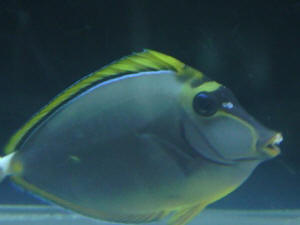
Naso Tang and Algae 5/20/15
Naso stopped eating
4/15/12 Blonde Naso Tang, frozen foods 11/16/11 treatment... Naso nutr. 2/5/11 Re Naso Tang/Naso Feeding 12/3/10 Blonde Naso Tang Will Not Eat, But Is Not Losing Weight --
10/26/10 Naso tang not eating. 2/18/10 Blind Naso needs help, fdg. 10/4/08 Good evening. A good friend of mine owns a fish store and this week someone dropped off a five inch Naso. The story that my friend was told, is a lunar wrasse ate out both of its eyes and now this tang is blind. By the looks of it, its the truth and i feel horrible. Could i have your opinion if it's possible for this fish to survive and is there anything I can do to help it recover? Once again thank you for your time and knowledge. Kevin <Mmm, there is a possibility, yes... this fish might well be trained onto accepting foods (mainly red and brown algae) "tied" or clipped to an area consistently along one upper side of the tank... Over time perhaps a "signal" (just lifting the tank top?) will be recognized, associated with presenting other foodstuffs. Bob Fenner> Naso not eating, reading 9/16/08 Four days ago my Naso stopped eating. The Naso resides in a 240g tank with Wavemakers, G3 skimmer, live rock, etc. Her tank mates include a blue jaw trigger, 6 chromis, lavender tang, orange fin tang, powder blue tang, Navarchus angel, lionfish, and dogface puffer. Up until four days ago the Naso was eating two to three times per day formula 2, spectrum, seaweed, and krill. She appears normal, color is good, swimming behavior has slightly changed as she is still active but appears more shy and occasionally extends her dorsal and pectoral fins. She has no signs of injury or sickness and does not appear to be being bullied. Her breathing is normal and the water parameters are perfect. She does show some interest in food but will not eat. Additionally, the Navarchus angel appears to be sympathetic to the Naso and has also began to show signs of reduce appetite. Recently both the Navarchus and Naso had eaten some Aqua Delite krill that is normally eaten by the dogface puffer and lionfish. Is it possible that this krill could have damaged their digestive systems or caused a blockage of some sort. Any suggestions? <Read: http://wetwebmedia.com/nasolfdg.htm and the linked files above. Likely summat amiss water quality wise. Bob Fenner> Naso Tang Not Feeding'¦Wasting Away -- 09/11/08 I recently purchased a blond Naso tang. <<A wonderful fish'¦for a suitably large tank'¦have one myself>> When purchased, he was fat and looked to be eating well. <<Looked?>> I have had him now for about 5 weeks and notice a considerable amount of weight lost. <<Not good at all>> When I feed my fish, all of them swarm the food except the Naso. <<Definitely atypical behavior'¦this fish is typically the 'alpha feeder' when food is present>> He will eat a piece here and there but definitely doesn't eat like the others. My first instinct told me to change up the food I was giving them. <<A good start'¦along with providing adequate variety'¦and ample vegetable matter>> I've tried Brine shrimp, Mysis shrimp, Romaine Lettuce, etc. All with the same results. Do you have any suggestions? <<I do'¦ Forget the Brine Shrimp (mostly water) and the terrestrial greens (little to no utility here)'¦replace these with New Life Spectrum pellets (can be a life saver if accepted), frozen Glass Worms (White Mosquito Larvae...a good nutritious enticement for finicky feeders in my experience), and Marine Macroalgae (Two Little Fishies Green Sea Veggies is an excellent choice)'¦I would also acquire some Selco/Selcon to soak the foods in to bolster nutrition and palatability (though most fish find the Spectrum pellets quite palatable on their own) I don't want to see the fish perish but feel that that will happen eventually if I can't get this guy to eat better. <<Most assuredly'¦ This fish may suffer from internal parasites or damage to its gut fauna (you haven't dosed copper or antibiotics by chance?), both of which are very problematic to treat other than feeding a medicated food (obviously a problem if the fish won't eat) or exposing it to other Tangs/large herbivores in the hopes of repopulating its gut fauna. But give my suggestions a try'¦especially the Macroalgae>> Michael A. Grande <<I wish you and your Naso luck. Eric Russell>> High Nitrates/Naso not eating..... -- 09/08/08 Hello Crew, you all are just fantastic, thank you so much for your help.. I have been reading FAQ's for an hour now on this subject. And not quite finding what I need, decided to write for much needed help. My 6" Naso Tang has not eaten for 4 days. She picks at her favorite seaweed I have tied to a rock, but she will not consume it. Concerned about chemical levels, I tested my water and all parameters are within normal limits except for the nitrates and ammonia. Nitrates are reading at 80. <Yeeikes!> Ammonia reads at 0.50. <Even worse... deadly toxic> I have a 300 gallon FOWLER with 200 lbs. of live rock. I have live rock in my 40 gal. refugium below. Other inhabitants are: 1 Long-nose Hawk fish 1 Raccoon Butterfly 1 Pearl scale Butterfly 7 yellow tail damsels 2 candy stripe shrimp 15-20 hermit crabs The tank cycled for 4 months, and the first fish was added in April '08. From reading all of your answers to similar "high nitrate" questions, I understand that my Naso is sensitive to that condition. <Yes> I just performed a 10% water change last week, <... need to change out a much larger percentage than this> the next day she stopped eating. I use filtered sea water from my local fish store. <... I strongly encourage you to have your own set-up for these changes locally (at your house, the tank itself)... for this size/volume system...> Up until last week, she ate everything, especially seaweed tied to a rock. Now she just swims right through the food given at feeding time. All other fish look fine, and are eating. I went on a 4 day vacation the day she stopped eating. I dropped a vacation feeding stone in there 2 hours after I noticed she stopped eating. Before I left, I frantically checked water parameters, sump levels, seaweed amounts tied to two stones, emptied/cleaned the protein skimmer, and my own anxiety level was so high, I ended up with a nosebleed. This was my first time leaving them for more than a day. I am also wondering if my high anxiety in and around the tank leading up to the vacation may have led to her feeling (my) stress? I don't want to lose my sweet Naso, please advise on how to correct this problem. She does not look skinny yet, but sometimes swims backwards a few inches before turning around and swimming in the opposite direction. That is a new behavior. Thank you in advance for such powerful information, it is appreciated! April. <Fix the environment here... pronto... and save your livestock. See WWM re NO3, NH4OH... Bob Fenner> High Nitrates/Naso not eating.....(an added detail) -- 09/08/08 Hello again, I neglected to tell you that this Naso tang has been here for 2 months, and has been eating and grazing on that algae since day one.. So this is not a new addition to the tank. She has been acclimated, and was eating the variety of foods offered. I also learned from the FAQ's section on Nasos that some will just not eat for a while, but will resume in a matter of days. How can I tell if this is the case, and not the high nitrate or my anxiety/stress that has caused her to stop feeding? Thanks again for your time, April. <See the prev. corr... Read, formulate a plan and act on it. Bob Fenner> High Nitrates/Naso not eating...part III -- 09/08/08 Hey guys, so sorry to add yet another p.s., but also, I noticed she is hovering in front of the power heads like you or I would stand in front of a cool fan on a hot day. Her mouth moves like she is gulping in air. Eyes and skin are clear, no difference in appearance from when she was eating 5 days ago. (I say she, for there is a lack of tail streamers as found on males.) April. <... Will soon be dead if you don't act to reduce the NO3 to less than 20 ppm, the ammonia to zero... RMF> Re: High Nitrates/Naso not eating (update) 9/8/08 Bob, Bob, Bob, Bob, Bob! <April> Thank you is simply not enough! I performed every suggestion you recommended, and my ammonia is now sitting at a big fat zero, nitrates are in the 20's range, and best of all, my Naso is back to eating her algae as if she's making up for lost time. Excellent, thank you, thank you, thank you. My LFS informed me that I was feeding the fish entirely too much. I was giving 4 defrosted frozen cubes, a pinch of pellets and pieces of cut up raw shrimp 3 x a day. And at night, I left in 3-4 clams on the half shell for the fish and crabs to munch on. They said the uneaten food caused that ammonia spike. <Yes, very likely> It had nothing to do with anything I'd previously thought. Whew! Now please excuse me while I go read every page of the "Conscientious Marine Aquarist" I picked up while I was out. <Heeee~! That'll take a while> I love the great illustrations, easy to follow advice, and the emphasis on the importance of responsible, humane fish keeping. This book should have been my first purchase, even before a single specimen. You all are so great over there, thank you so much! Your time and effort to help us are so appreciated. April. <Welcome my friend. Bob Fenner> Naso Tang... Not Eating After 3 Days. 08/26/2007 <Hi Tony, Mich here.> I recently purchased a 6-8" Naso tang (not blondy) from a local shop in MN. <I hope you have a big tank... These guys can get REALLY big, over 18 inches in the wild, a tank of 135 gallons or more is recommended. Oh, sorry I see below... this fish will appreciate the 6' length.> He came in from Hawaii. <I've seen many there, they are BIG and beautiful.> I ensured he was eating <Did you see him eat?> they said he eats algae sheets and a lot of Nori. <Typically.> they had the fish for 3 weeks before I got him. <Hopefully he ate while in their care.> Since putting him in my 6' 125 gallon tank he is not interested in eating anything at all. <No QT? http://www.wetwebmedia.com/QuarMarFishes.htm Hopefully no diseases immerge. Have you observed him picking algae from you LR?> He swims all over the place and is active all the time and still looks beautiful. <These guys typically graze constantly... sort of like cows...> It has been 3 days <May still be acclimating.> and I just don't want him to get sick or die. <Me neither!> What can I do? <Observe to see if he is eating anything that is growing in your tank, offer a variety of herbivore rations, i.e. macro algae, brown algae in particular, Gracilaria is often another favorite, Spirulina, Nori or other dried algae/seaweed sheets (also available at Asian food store) soaked in Selcon (vitamin supplement) and give him a little time, hopefully he will come around. More here: http://www.wetwebmedia.com/naso_lituratus.htm http://www.wetwebmedia.com/nasolfdg.htm > Tony <Hope he's nibbling soon! Mich> Re: Naso Tang... Not Eating After 3 Days. 08/26/2007 <Hi Tony, Mich here.> he grazes along the rock <A good sign.> but doesn't spend any extra time picking at anything specific. <He's eating, that's what's most important here.> I talked to the shop I got him from yesterday and they said it took him 2 weeks to start eating. <A while.> I was also told by leaving the algae sheets in the tank for more than a few hrs at a time I can pollute my tank is that true? <Yes, Generally, I would not leave any large amounts of algae sheets in the tank for very long. To get him to start eating you may want to leave the algae for a more prolonged period, but I would keep the quantity rather small. Living Macro algae such as Gracilaria would be even better as there is no risk of pollution, as this algae should not decay and it a particular favorite among tangs.> Thanks for getting back to me so soon <Welcome! A pleasure to assist.> Tony <Cheers, Mich> Naso Tang Hello Web Media crew <G'day> I recently bought a Naso Tang that is only grazing on the plant growth from my live rocks. He completely stripped the growth from some Fiji rock that grew a kelp like growth ( yellowish brown leave and stems) and is dining on other macroalgae - red color with narrow stems mesh like growth. I tried green and brown algae sheets, dried kelp from an Asian grocery - no luck. I also tried live brine shrimp and only my other fish ate that. Q. What might be going on? <He likes the real algae better.> and what is the next best avenue to take? <Keep offering a varied diet.> Fresh shrimp from the grocery ? I do not want to loose this fish. Looking to hear from you. Thanks. <Check out the links below for more information. http://wetwebmedia.com/naso.htm http://wetwebmedia.com/nasofaqs.htm> Naso Tang Not Eating Hello, I am fairly new in saltwater fish. I've had my 75gal tank since the beginning of July, cycled it with Damsels, tested the water, and it is perfect. I bought a Naso Tang, Kole Tang, and Porcupine Puffer Fish about two weeks ago. The Puffer is eating good. The Kole Tang has finally started eating pellets other than the live rock. But our Naso is not eating as much, especially since I can see his belly looks pinched in. He used to eat from the live rock, but will not eat the seaweed I have dangling from the seaweed clip. He doesn't seem to have any parasites on him. Any suggestions? I am getting worried. Will the fish actually starve themselves to death? I've tried green seaweed, brine shrimp, and putting Vitamin/HUFA supplements in the tank, which is supposed to "stimulate" their appetite, as my local fish store told me. Thanks. <<Good Morning, Barbara Taormina helping out while the majority of the crew is at MACNA. I'm sorry to hear your concerns with your Naso, one of my favorite fish. Naso tangs require large tanks and are known to sulk if they feel 'cramped', if there's been a change in the decor or if the tank is without strong circulation. You don't mention the size of the Naso or the amount of live rock present in your tank and my concern is that there isn't enough to sustain both the Kole and the Naso. This is a relatively new set-up and the amount of algae growth on the live rock may have been depleted. I would attempt locating some 'plant rock' from a local fish store. This is small pieces of rock with various types of Caulerpa growing on it or perhaps you know a fellow hobbyist that maintains a refugium that could share some macro algae. It can take some time for fish to become accustomed to a seaweed clip. I would try rubber banding the seaweed to a small piece of rock where he will hopefully find it while foraging. My Naso is particularly fond of Nori, (which can be found at Oriental grocery stores) and is also crazy about frozen cubes of 'Emerald Entree', Formula One & Two, and Mysis shrimp. The use of vitamin supplements is great, soak all foods for 20-30 minutes before offering. Best of luck, Barbara>> Naso only eats Mysid Before I get underway, I like to thank you for your valuable service especially as it is volunteer based. <You are welcome. Thank you for the acknowledgement> I recently purchased a Naso Tang. He is about 4". I've read your advice regarding buying one over 5" but I honestly couldn't afford it as the difference in price was quite significant. <Yes... understandably... due to the size of bag, water weight, oxygen it takes to ship these active fish... the bigger sizes take much more...> I did, however, wait two weeks before purchasing him and checked to see if he was eating. The problem is he only seems to eat Mysid shrimp. I've tried to get him to eat seaweed, marine algae, Spirulina, and flakes. Realizing that he needs a vegetarian element to his diet, I've also tried to withhold the Mysid in the hopes that he would change his singular tastes. All was to no avail. Also, he is not eating enough and has become somewhat emaciated. <Try soaking the seaweed in a vitamin mix (like Selcon, Microvit...) for a good fifteen minutes or more ahead of dangling it at the upper edge (with water wafting it about). Try different types of algae (from the oriental food section/store... reconstituted by soaking in water), particularly the softer Reds...> Do you have any advice? Should I continue to withhold Mysis until he turns vegetarian or simply keeping feeding and hope he develops a craving for green? <I would keep feeding the animal the mysids, but try making some homemade food (gelatin or other emulsifier based) into chunks and feed it mixed with other materials (algae, pellet...) to wean this animal onto other food types. Recipes for same can be found on the Net> Any help you can give will be much appreciated. -Limak <Persistence pays. Bob Fenner> Naso lituratus Care and Cyano 11/30/2005 Hello Crew, <Hi Steve.> Hope your holiday season is going well. Thanks for taking time to still tend to the questions posted here on a daily basis. <Thank you'¦and for me helping out here is actually a nice break from the hustle and bustle.> I recently added to the main display after a short QT a Naso Tang (Lipstick). The short QT was due to the fact that the 20 gallon QT tank was just too small and the Naso was not a happy camper in such small quarters. The Naso is between 6" - 7" long with good body thickness and great coloration. <Oh yes this was far too small even for a short term stay, for larger animals like this (when buying a larger tank is out of the question) I like to use plastic containers or even Rubbermaid tubs labeled as food safe can work.> I was told this was a Blonde Naso (male with streamers) and I have researched the species before so I am quite familiar with the general characteristics of this fish. One thing I read was that they are a very powerful and active swimmer which undoubtedly is the case with the specimen I purchased. <Yes I swam with these animals on the north shore of Oahu, HI. I'm a near Olympic caliber swimmer and could not hang for long in the rocky tidal zone with these guys, very powerful swimmers indeed capable of great speed.> He loves to swim and shows off his power every now and then in his 250 gallon (7' long) FOWLR tank. <Good size tank.> Other residents include a 4" Longnose Butterfly, 3.5" Chrysurus angel, 3" Chevron tang, 3.5" Orange shoulder tang, and 24" Zebra moray eel. I know for the time being the Naso has enough room, however if the other tangs and angel reach full potential length I will probably move one of the other tangs. <Yes and their may be some potential aggression with the Orange-shoulder tang due to similar appearance and habits.> Question: the Naso goes crazy for the daily feedings of Sea Veggies, Nori, and Seaweed selects (sometimes soaked in Selcon), as well as grazing all day on the 225 lbs. of live rock and substrate. He does not eat however the prepared foods that I feed the other fish in my tank, mainly frozen cubes of Lifeline, Ocean Nutrition's formula one and two, Mysis, as well as Angel formulations. <Well he may still be adjusting so I would not worry just yet. The Nori/sea veggies soaked in Selcon is a great food for this animal so since he's accepting that I am not too concerned. > <<Actually, this animal should be taking in a good deal of meaty foods as well. I would offer him some krill to start, see how he likes that. Marina>> I have also tried flake, Hikari Marine A pellet as well as Ocean Nutrition pellet food. I have tried soaking all of the above choices in Garlic Extreme and at times the Selcon or Zoe to entice with no avail. <Keep trying.> The only prepared food he has eaten (with vigor) is Sweetwater zooplankton. He has only been in the main tank display for one week and was only in QT for one week so maybe he will broaden his range of food, however I wanted to know if the Sweetwater zooplankton is a good enough food along with varied algae sheets if he never adapts to other foods? Any suggestions? <Well he is eating so as I mentioned above, am not to worried just keep offering. I bet he takes to the above food within a week or two, still being a relatively new specimen. The food you have offered is great, especially the nutritional supplements.> <<I would do what the LBAOP does - free feed romaine lettuce (they rubber-band it to a bit of live rock and drop it in the QT tanks, and in the displays use lettuce clips. Marina>> Second question: I recently removed the glass covers from the top of the tank and replaced with light grid (egg crate). I position the crate cover such that the skinny tapered section is facing up and the result was a substantial increase in light intensity in the tank. <How old are the bulbs? What is the Kelvin temperature?> I am trying to do everything I can to eliminate patches of Cyano that keep appearing on the substrate (DSB of fine aragonite). The Cyano has always limited itself to the substrate and I drain the frozen food, run Phosban, Purigen, activated carbon, skimmer is cranked up producing great skimmate, and a 40 watt UV sterilizer cleaned monthly. I also test all top off water (shows .1 Phosphate) and perform weekly 10% water changes with Coralife salt (aged for 1 week). <Where is your source water coming from is this tap or RODI? If it is tap I think that may be why your are getting the phosphate reading, if its RODI how old are your cartridges?> Ammonia/nitrite 0, nitrate 5, Ph 8.4, temperature 81 - 82 F, salinity 1.24, and dKH of 12. I hoped that the intensity of light being increased may help with the Cyano so I removed the tank glass covers. Any other recommendations on helping to remove the few areas of Cyano that are so bothersome. I have positioned the large SEIO powerheads to increase circulation to these areas, to the extent that it visibly moves the sand in these areas, to no avail. I have read all of the FAQ's regarding this and think I am doing the right things. Interesting side note: the sand that I can see under the caves within the live rock are perfectly white with no Cyano, which is perplexing because these areas are not receiving direct light, nor the highest water movement. Any thoughts on this? <Since the Cyano is limited to one area my first though was that these areas lack water movement and are accumulating detritus. I think you made a great move my adding those SEIO powerheads. At this point I would continue as you have with the water changes and I would also siphon these areas during those water changes.> Sorry for such a long email, however I am trying to give all of the pertinent information to help answer the email. <No worries.> Best regards, <And to you too.> Steven <Adam J.> Naso With Balance Problems >Dear Crew, >>Hello Allyson. You have Marina today, with my greatest apologies, I've just received your message in my inbox today and I sincerely hope it's not too late. >I love my Naso like a child. We've had him a few years and we bought him when he was approximately 6 inches long. We were stupid. It's too big a fish even for our 125 gallon tank. He belongs in the reef. Our water parameters have been stable for several years but tonight I'll check them again. He's just looking out of sorts. He frequently has a little ick in the mornings and the cleaner shrimps jump on him and it falls off by the end of the day. He's a fussy eater and will only eat Tetra marine flakes and Caulerpa. He eats these like a pig and the little guy is fat as a house. He still eats OK. There was a period a week ago when we skipped a meal for him (were away for 1 meal-we feed him a lot twice each day by hand). The temperature dropped 3 degrees. Our refugium where we raise Caulerpa and other macroalgae smelled bad and we changed most of the water. It smells fine now. I think the Caulerpa looked a bit unstable at the time but it's not sexual. >>If in doubt, prune it back heavily, being CERTAIN to remove by the full holdfasts, not just breaking off 'leaves'. >During that time, for several days, the fish's yellow face turned dark and he did not swim as actively. He barely ate. We raised the temp to 80 and his face got yellower and he swims and eats more. What is most disturbing is that since that time I see that he has trouble keeping himself upright slightly. It's very slight but he'll swim sideways at times and I see he has his alerting colors on (he gets blotches when he's frightened). >>It seems you're taking the best care of him you can, but I believe he's simply outgrown the system and is displaying the stress (you've made no mention of his current dimensions). This could explain the little bit of ich, the stress coloration, and possibly the 'balance' issues (swim bladder, possibly? Fish have no inner ear). He's definitely not growing old, these animals can live 20 years easily. >He just seems a little clumsier. He doesn't swim as fast or as agilely lately. I'm trying to see if it's worsening but it's inconsistent. He doesn't have any skin lesions and the ick is very slight and barely and occasionally visible. I've tried hospital tanks with him but the conditions are so unstable in such a small tank, he does worse so I've given up trying to treat the ick. >>Yes, also, treating him a hospital tank will do no good whatsoever if there are still other vertebrates in the system upon which the parasite can find a host. The only way for hospitalization to be effective is for the main display to go fallow for a minimum of 6 weeks, though this often proves not to be long enough. >I've done searches here and on reef central and I have not seen balance problems listed much. The few times it was with new fish and they died soon after developing it. I'm hoping he gets better and it was just a minor trauma/infection. >>You've listed no water parameters other than the temperature drop (amount), so I can't really offer much other than a guess and a mantra - when in doubt, do a water change. This won't help him at all if the problem is simply that he's outgrown this system, but it will if, in spite of the presence of the 'fuge, there is a buildup of nitrate or other chemicals we cannot measure without a full laboratory at our disposal. Even then, you might want to have an idea of what you're testing for. You haven't mentioned how big the fish is now, but Nasos grow rather large. Water changes on a large scale will not hurt, and can both replenish lost compounds as well as remove buildups of others. >We've also been administering Joes Juice to kill Majano so I wonder if that has something neurotoxic. >>Be VERY careful with that stuff! From what I understand they do not list any ingredients (proprietary?), and I've read many posts on reefs.org of folks losing their shrimps after using Joe's Juice. I have no idea of it has any neurological effect, this is such a new product and few are regulated in any manner. If you were my customer I wouldn't have sold you this product, and I would now suggest you stop using it altogether. >Bottom line, what could cause this? A vitamin deficiency (he won't eat garlic, Selcon, or any other flake or food than that Tetra marine stuff)? >>Garlic won't provide vitamins or nutrition to fish (think about it, how often do fish get their nutrition from garlic in the wild?), but it has been proven to have a slight to moderate antibiotic effect. The food he will accept can be soaked in Selcon prior to feeding, but you MUST be persistent. Also, Nasos do like some meaty foods, have you offered him the irresistible krill? Variety, especially with such a fish, is KEY. He is behaving like a pet poodle, and you'll have to stand your ground when it comes to sampling different foodstuffs. These fish can easily go several days without feeding - if he gets hungry enough, he WILL try it (assuming he's not actually ill, which I don't believe is the case at this point). >A transient parasitic infection (maybe the ick got in his balance system)? >>Doubtful, I've not read of such mild infestations affecting an animal's balance. If this were a problem you'd see flashing and rapid gilling, not just balance problems. >What scares me is that this might be a buildup in the Caulerpa toxins. >>Possibly, but again, I do doubt this. I didn't have a problem feeding C. taxifolia to my Z. flavescens, Z. scopas, or other tangs for several years. >I give him a little bit each day as a treat. He loves it. (Won't eat any kind of Nori, broccoli, spinach, Sprung's sea veggies, lettuce, spinach, bok choy etc. for greens). >>Again, he will if he's hungry enough, and again, offer him some meaty foods. >I decided to do this because this little guy has so few pleasures in our small tank, at least he should have that. What was the toxin in Caulerpa so I can read about it? >>This I cannot answer, try searching Anthony Calfo's writings (this is off the top of my head), assuming a general Google turns up nothing. >Thanks, Allyson >>You're welcome, Allyson. At this point, my honest assessment is that the fish is demonstrating end result of too small a system. I'm curious as to whether or not this animal has grown the tail 'streamers' for which they're noted, if not, this, along with the other symptoms you mention lead me to this initial conclusion. Marina Naso With Balance Problems - Happy Happy Joy Joy! >Dear Crew, >>Hello Allyson. >Oh happy day! My fish is slowly recovering with just good conditions!!! >>As nature intended. >We raised the temp 3 degrees because we saw that was the major change associated with his poor health. Immediately he looked happier (I think I mentioned this before). >>Yes, you did. >Last night he greeted me at the door like he used to. His swimming is slowly more agile. He continues to eat like a pig and is as fat as a house. >>This is very good news, and remember my mantra! When in Doubt, Do a Water Change! >Untergasser's chart (a book on fish disease) on swim bladder has in his chart on swim bladder a few differentials. At first all I saw was autopsy and I freaked. >>Yeah, well, there's only one way to get a postmortem. >Now that I look at it more closely, the most likely diagnosis, given the outcome, is that wall of the air bladder was hardened and inflamed (treated by raising the water temp by 3 to 5 degrees for 5 days). Alternative diagnoses are pretty grim. >>For a fish who's been in captivity for several years, yes, this is true. >At this point, there are several references to autopsies. The air bladder filled with purulent, bacteria-filled fluid-there are a few other presentations related to bacteria (refers to bacteria treatment chart). >>And treatment would absolutely require use of a hospital system. This *can* be done, but with a large fish it is not an inexpensive proposition. >Cysts are in the wall of the air bladder. Inclusions in the wall of the air bladder (no treatment possible). Protozoans are in the kidney and bloodstream. I discussed more details on Reefcentral, including a summary of Untergasser's bacterial treatment mash. >>Yes, I've just read it. Know this, you can go ahead and hypo the animal for ich, but as I said before, if you don't remove ALL vertebrate life, the ich will not be gone from that system. It's far better at this point to provide best conditions and nutrition. Know also that garlic is only proved effective as a mild antibiotic, empirical evidence claims appetite stimulation. My assertion is that if a fish is given proper quarters, best water quality and nutrition, nature shall do what she does best and the animal(s) will thrive. http://reefcentral.com/forums/showthread.php?s=&postid=3795821#post3795821 <please hyperlink!> Thanks for your thoughtful response. Please spread the word about this rare phenomenon. Allyson >>Through you, we shall! Thanks for the follow-up, too, Allyson. I felt terrible thinking that your message had been sitting and it might have been too late. I am VERY pleased that your pet is back on the road to recovery and a long life. Marina Feeding a Juvenile Naso Tang Bob, First let me thank you for your book The Conscientious Marine Aquarist. The information I have gotten from it has made it worth many times the purchase price. That said here is my question. I purchased a juvenile (3 inch) Naso Tang 4 days ago. I've tried feeding dried Nori on a clip and floating. Frozen Formula Two, Also Algae pellets. He picks at the rocks and gravel. However I don't believe there is enough growth to sustain him. Any thoughts? Thank you, Dan <You want to try to make the prepared foods appear more natural. Try attaching the feeding clip or the Nori directly to a small piece of liverock. Also, frozen Mysis shrimp, plankton, and bloodworms are all good too. -Steven Pro> Re: Naso Tang I bought A pretty good size Naso tang on Tuesday Oct.30. He is about 6-8 inches. The very first night I brought him home I fed him some frozen Brine shrimp. He ate like crazy, finished everything by himself, he looked like a Vacuum. The next day he didn't eat anything and today Nov. 1st he didn't eat a single thing again. He just passes right by the food. I give him Brine shrimp, Seaweed Selects Brown Algae and Spirulina Pellets and he doesn't want to eat anything. I even tried some frozen Plankton. Is this normal? <Yes, at least not abnormal... do keep trying the various foods, especially hanging a strip of algae near the waters surface... perhaps soaking it in a vitamin preparation as a feeding stimulant> If he wouldn't have eaten that first night like he did I wouldn't be so worried about him not eating. I would just think he is getting acclimated. All fish take like 3 days before they start eating right but why would he eat the first night and not anymore. He is healthy looking and shows no signs of any kind of infection. <Don't lose faith here. Bob Fenner> Tangs Dear Mr. Fenner, <Howdy> It's me again with another question I'm hoping you don't mind pondering for a moment. <Not at all> I've had a Naso tang in my 125 for about 4 months. He is the largest fish in the tank at about 7 inches. We recently got a red sea Sailfin tang, that is maybe 4 inches long. Since the introduction of the Sailfin, the Naso's appetite has slowly decreased down to nothing, and he's looking very thin. Do the two species not get along? <Usually do... FWIW, their ranges overlap> I don't see them fighting at all. Everyone else seems okay, and water tests are good. Any ideas? <Often Nasos do go "off feed"... a good idea to try other foods, and to soak them in advance with a liquid vitamin preparation. Please read here: http://www.wetwebmedia.com/nasofaqs.htm and on to the many FAQs re marine fish nutrition, foods, feeding. Bob Fenner> As usual, infinite thanks for any help you can offer. Tracy Naso tang Mr. Fenner, I am worried about my Naso tangs. I ordered a medium Naso tang from FFExpress and received a small one instead. <How small? You can read my numerous comments on this species, genus (Naso lituratus) posted on our site: www.WetWebMedia.com... ones under three inches rarely survive> So I had them take care of the problem after some initial problems and they sent me the medium Naso for free and told me to keep the small one. So now I have two Nasos, but that isn't the problem, they get along fine. It's that neither of them will eat a darn thing. The little one was already skinny doesn't look thick like a normal Naso) when I received it, and it will be two weeks tomorrow since I got him. I have tried everything I have read in your book and received some advice from others but I am still worried. I have offered the small Naso the following: flake food I knew it wouldn't eat it, but I tried it anyways), brown algae on a clip and tied to the live rock, red algae on a clip and tied to the live rock, dried toasted Nori seaweed from the oriental store section tied to a rock and on a clip, frozen brine shrimp, frozen krill, formula 2, and today I tried live brine shrimp. I even tried romaine lettuce on a rock and the Naso took a few small bites but didn't really eat. Nothing seems to work, and for the little guy, it's been almost 2 weeks. The big one about 5") and the small one about 3"), did not even bother to eat the live brine shrimp. I actually had to scoop them out of the tank because they were just clogging up the water. The only good thing I can get out of all of this is that they both munch on the live rock I have about 100lbs LR) quite often, but I don't really have any macroalgae growing on the rock. I have some hair algae and what looks like the stumps from the seaweed that used to be attached to the rock I think that's what they try to eat). But they can't be getting a whole lot of food from that. <Well stated, and taken... Do keep trying to orient these fish to the Nori... with a clip near the water's surface... in the front... of their tank... and do secure some "Red Algae" (like "ogo", "Rhodymenia"...) fresh, frozen/defrosted, live... to sustain them while adjusting to captivity... this is principally what they eat in the wild> I have had the tank up for almost 2 months and water parameters are as follows: ammonia 0, nitrite 0, nitrate 0-5, ph 8.1, sg 1.024, temp 78*. The tank is a 125 and has plenty of lr(100+lbs) for the fish to hide and eat. All those water parameters have been stable for about 1.5 months. From what you say in your book, my water is almost/is perfect. Both fish are healthy and swim around, except the little one, he doesn't swim around real fast like the big one does. All the Nasos I have seen, seem to swim very powerful from time to time, and the little one just kind of waltzes around the live rock and occasionally into the open areas of the water. They are both pretty shy, and I can understand why. If I was kidnapped from my house in the middle of the night, shipped to some warehouse, then sent half way across the world to a LFS and kept in a tank with hardly any protection or hiding spots and then put into a new environment, I would be pretty shy too. But 2 weeks, and he is still very skittish when I move near the tank, <Yes... they live in almost an endless space, just on/off main reefs... over vast areas...> try to feed the other fish he runs every time to his hiding spot and won't come out for about 1-5 minutes), come on, I think he is retarded or just really scared still. The freaking damsels are running around and only get scared for like 1 second and then come back. The big Naso was freaking out when I finally turned the lights on later in the day when I got him. I took about 1-1.5hrs to acclimate him, and had the lights off for about 3-4hrs, and when I finally turned the lights on, he started swimming up and down and back and forth real fast and freaky like. He kept banging into the walls of the tank and looking like he was trying to get out or fight himself in the glass. He is cool now though, but still very shy, and only swims around when I sit perfectly still. I have heard from so many people that Nasos usually won't eat for about two weeks and then they'll eat just about everything. They say don't worry, mine did the same thing, and now he eats like a pig, eats out of my hand, and is fat like a little piggy. Well mine isn't eating. He doesn't look like he is sick and he isn't getting any skinnier. The bigger one is already a big guy pretty thick), but not eating. He started munching the rock today got him yesterday), but won't eat the live brine shrimp either. What I'm I going to do with these two fish? Just keep waiting them out and offering food every few days? Or take action? You are the expert, and I remember your stories about your time in the pacific dealing with fish export companies. <Yes... and still go there every year.> You talked about how you were walking around on Styrofoam boxes and dodging missile jumping tangs. So I would consider you quite the expert, and your advice about what I can do and how to do it, would be greatly appreciated. Thank you very much, Ryan Fick <Please do the above (continue to offer algal foods) and read through everything on the acanthurids posted on the WWM site... and have faith... I do believe the larger specimen will "come around"... and have hope for the smaller one. Bob Fenner> Naso Troubles Thanks for the quick response! I apologize for asking another (unrelated) question, so soon on the heels of the last one, but I forgot to ask it last time. I have a Naso tang who seems to be wasting away. A friend took care of all of my fish for a few months, while I was in between tanks. When I got them back a month ago, they all seemed to be a bit on the thin side, but most have come back nicely. The Naso, however, seems to look worse. He seems interested in food, and vigorously attacks the sushi Nori that I feed every day, but he spits out whatever he chews. He does seem to keep all of the frozen and flake foods down. Is this something that you're familiar with? Can you suggest anything? Thanks again, Dan <Yes. Do try other "human intended" (especially Rhodophyte, Red Algae (though they'll likely look green...) species like Rhodymenia, Gracilaria... and soak all in Selcon (or other vitamin prep.s like Zoecon, Microvit...) a good fifteen minutes before offering them to your Naso... and some meaty foods you can suspend on a "feeding spoon" near the surface... Bob Fenner> Naso Tang Mr. Fenner, I have an unusual concern with my Naso Tang. For some reason when he relieves himself, even though he eats like a pig, he turns around and eats his own waste. Seems to me that it cannot be normal, have any suggestions on this problem? <Actually, not a problem... not unusual with this species, other related fishes (acanthurids in general), even some mammals (lagomorphs/rabbits are probably the best example). Don't worry about this coprophagous behavior. Bob Fenner> Food for Naso My Naso tang is about 4 in. long, I got him about 1/6/00. It started to eat some lettuce and some algae on the rock, then it stopped. I had removed my Sailfin to another tank. Maybe that will encourage the Naso to eat but I haven't got the result. I had tried different types of flakes, live brine shrimps, but he either eat a little or none. Bob, what can I do? My water quality is fine. <<Look for some "Ogo" (sold live, cultured in Hawai'i) or other brown algae... as the best taken food... some live rock as second, some species of Caulerpa as third... Nori sheet algae tied to something near the surface... Bob Fenner>> Naso Not so Good Hello <Hi, Ryan here> I have a Naso tang (lituratus) with streamers and he is not eaten since a couple of days, I have checked water parameters and they are all fine (still did a water change) except the ph that was about 7.8 I raise it to 8.1over a two day period ,the thing is yesterday the fish had ate a little bit not as much that normally eat!!!!( had not eat for two, tree days before that )and now today he stopped again and I notice that is lips are white (like a fungus or something covering the lips ) and he is staying on the top part of the tank all he other fish are fine and healthy and eating fine .????????? <Hi. A change in pH from 7.8 to 8.1 can have negative effects on sensitive livestock. I recommend you start to buffer your pH (sounds like you already are), and add something to stabilize your calcium and alkalinity. B-Ionic is simple as pie. As for feeding, I would try and offer some frozen Formula 2 and Nori. The white lips you are describing is probably a sign of a bacterial infection. Is this a new fish? I would take him out, isolate him and treat with a Furazolidone and Nitrofurazone medication, and follow the directions to the T. Good luck, Ryan> I am starting to freak out!!!!!!!!!!!!!!!!!!!! don't want to loose that fish !!! how many time can they stay without eating ? Would like to have any help or advice you think might help Thanks Neo Naso Notes I just got a 3-4" Naso tang and he just got added into the tank after a 3 hour drip acclimation are there any tips you can give me for raising a healthy Naso?<Yea....you will need to feed this potentially huge fish a lot...believe me I have a 14" Naso Vlamingi and a 8" Naso Vlamingi....they eat A TON OF FOOD!!! Also you will need to house this fish in at least a 6 foot aquarium because they are open ocean swimming fish. Also make sure water quality is very good. IanB> Re: Black Spot on Fin (NASO TANG) Bob, Thanks so much for the information ! I am removing all copper out of the tank. My Naso is doing better, however he stopped eating for a few day but I was able to get him to eat live brine shrimp last night. I suppose it was the medication in the water and now he seems to be coming around. (The black spots on the fins have disappeared). <You are very likely correct here> I have one more question! I have a 4" or 5"-saddleback clown that I bought from a dealer. <A large specimen... better not bought at adult sizes> I put in a QT tank for about 2 weeks and then put him in my show tank. I noticed some large white patchy raised spots on the tips of his fins (about 2 of them )and one on his side. He does not scratch them and he eats like a pig. I have read they are prone to parasites or Brooklynella? I am putting him back in the QT tank and removing the copper . What Do I treat with now? Formalin or anything? Dips? or wait and see! He has about a total of 4 spots on him. <I would NOT treat this specimen OR move it... but instead replace it to the main/display system, bolster its nutrition with the soaking of foods with vitamin complex (e.g. Selcon)... Not likely Brooklynella or any parasite here. Bob Fenner> HELP, CAPT. NEMO- Re: Naso Tang Hunger Strike, Black Spot... Bob, Hope everything is going well ! I wrote you last week about my 11" Naso Tang. I was running copper on the tank and then treated him with clout (for a black spot on his fin) about the 3rd day on the clout he quit eating! <If memory serves, I mentioned NOT treating this fish... and would cease to do so NOW> The puffer and the damsels in the 130 gal. tank are fine. The water is perfect and has been through the treatment. I am pulling everything out of the tank with carbon filters and activated carbon, all levels are much lower. <My friend... I can't tell what you mean by "perfect" or "lower"...> However, my Naso will eat very little if anything at all. It has been about a week and he is looking ok, but he has the pinched stomach. I have tried everything, live brine shrimp is the only thing he will even try to eat and very little each time if at all ! I am very concerned that he has been over medicated with the copper and clout. I have used Selcon on brine and live plants. Do you have any suggestions! <Yes... place this specimen back in the main tank if you have not already, try various algae on a "clip" near the water/air surface... Kombu, Nori, what have you, that you can get from the oriental food store or section in a main outlet> I am very worried that I am going to lose him. He is swimming around fine and breathing normal, yesterday he started staying on the bottom behind a rock (very unusual for him). <A very bad sign... Tangs rest on the bottom at night, but during the day are continuously active> If the light is on he is more active. help! <Move the fish, offer it prepared or fresh macroalgae. Bob Fenner> Re: Naso Tang Hunger Strike Bob, The fish that you told me NOT to treat and to move back into the main tank was the 5" saddleback clown. <Sorry re... think I've got you, your situation confused with something/someone else's that's similar> Which I did exactly what you said and he is doing great and some of the white cotton like spots have disappeared! He is doing great and eating fine! <Ahh, good> Unfortunately, the Naso had already been treated as of my writings to you. My local Fish Store owner is the one who gave me the clout and copper treatment idea for the black splotches on the fin (I know, don't believe everything you're told!!) <I discount most all... including when I'm talking to myself!> Nonetheless, I did pick up some Kombu and Nori and will try that tonight! <This species of Naso REALLY likes macroalgae... I have seen it with its head out of water (!) in Hawai'i munching away at intertidal thallophytic material!> My water has maintained a O ammonia, O nitrite, 8.2 ph. 20 t0 40 on the nitrate( large fish only tank). Thanks for the help! <Thank you for the clarification, input. Bob Fenner> Re: Naso Tang Hunger Strike Bob, Just a little update! My Naso is eating very well again! Thanks for the tip on the Nori & Kombu!! He is now eating everything again! Thanks for the help !! <Good news indeed. Thank you. Bob Fenner> Tang In Trouble? (Naso Tang Not Eating) Hi! <Hey there! Scott F. here today!> First would like to thank you all for the great site! I found answers to all of my questions there! <Glad to hear that! We have a LOT of good information on this site...Sometimes it just takes a bit of time to research stuff...> But now I got one question I didn't find. <Sure> I have a 230 gallon reef tank with 2 clowns, 1 wrasse, 1 damsel, 1 Bicolor Pseudochromis, 1 Bicolor Blenny, 1 Firefish, 1 Orange Shoulder Tang juvenile, 1 quite big Moorish Idol and 1 Naso Elegance tang (juvenile) Some hardy soft and hard corals along with some disk anemones and mushrooms. There is 130 lbs live rock in the tank (planning to get more next month). Tunze Turbelle Stream 8000 l/h powerhead (with air), Tunze 3130/2 skimmer, 36W UVC. I have this tank for 4 month now. I had much smaller fish only tank before (for 1 year). SG 1.023, temp 26C, Ammonia 0, Nitrites 0, Nitrates about 10, PH 8.3, KH 11.3, Ca 480 - all parameters seems to be fine. There is no "electricity" in the tank since I bought "grounded" pump and skimmer. The problem is with my Naso Tang. I've got him 4 days ago, along with Orange Shoulder tang (I waited 4 mount for the tank stabilizes). I did a 1,5 hour acclimatization for the new arrival with lights off until next morning and the next day both fishes was extremely happy with no signs of stress at all! They eat everything I gave to them - frozen brine shrimp, Mysis, Spirulina, sushi Nori, even broccoli! <Always a great sign! But I didn't see the word "quarantine" mentioned there...You really should quarantine all new arrivals- particularly tangs.> So I relaxed a little bit, thinking I gave them a good start in the new tank. Other fishes were very interested but not aggressive to the new tangs. Both new tangs were very active, they swam along together, picking food and rocks. However the day after my Naso tang showed completely different behavior. First it was hiding then later it came out and I noticed that he swims very strange - like he continues sleeping! He was swimming very 'passive' like fish do in the night in the stream, "freezing" in one point. He showed absolutely no signs of interest to food the hole day - it was very strange to me because the other tang was even more happy and hungry than the day before! <Not a good sign...> My Naso didn't eat for 2 days now and became very thin. He is doing this strange swimming the hole day and that's all! He ignores food and other fishes. I'm really concerned about him because it looks not good and I just can not lose him! I noticed that the same day he change his behavior one of my two starfishes (Linckia sp.) seems to be bitten. May be he tried it and poisoned himself with it's tissue? <Unlikely, but I suppose that it's within the realm of possibility...> There is now signs of internal/external infection or parasites... The other fish are fine and doesn't show any signs of aggression to him die to his size. I did read FAQ about Naso tangs found they can refuse food and so on. But I didn't found anything about this strange "sleeping" during the day. Is it en internal infection symptom or something else? I just have no idea what's wrong with him! What I suppose to do with my tang before it's too late? What else should I check? Please, help! Hope for a quick answer Mikael from Sweden <Well, Mikael- I agree that this is not normal behavior for this fish. It's never good to see a fish refuse food or act listlessly. The absence of external symptoms does not mean that the fish isn't ill, but it is something to be concerned about. These fishes do have difficulty adapting to new environments, although your tank sounds like the parameters are pretty good. If the fish continues to refuse food and continues to act listlessly, then you may want to consider removing the fish to a separate tank for further observation. If other symptoms manifest themselves (like obvious spots or sores on his body), then appropriate medical intervention is warranted. On the other hand, if the fish is simply listless and refusing to eat, then I'd do what I could to tempt him to eat again. Fresh macroalgae, such as Gracilaria, is an excellent supplemental food. In the confines of a separate aquarium, you could also administer some aquarium vitamins directly to the water (remember- marine fishes do drink) in the hope that he will obtain some nutrition in that manner. Provide a stable, clean environment and a large variety of nutritious food items, and hopefully he will come around and eat again. Don't give up on this fish. With a little extra care and attention, he can pull through this difficult time and thrive. Good luck! Regards, Scott F.> Tang In Trouble (Pt. 2) Good morning! <Hello again!> I would like to thank you for the immediate reply. <Glad to be of assistance!> Things are not going better with my Naso tang today. I took a closer look on him and he looks fine! Except he is very thin but there are no spots or scratches on his body. His breathing is ok and mouth and lips look good. <Glad to hear that!> Anyway I guess it can be some kind of internal infection or just stress (I hope!). He is still not eating. <Remain optimistic...> I will continue observations and offer him foods. To add some vitamins in the water is a very good idea! <It might just keep him going until he comes around and starts eating again...> While things are not going worse there is a hope! Thank you, Mikael P.S. I know that quarantine is a most important thing to prevent diseases. But I've got fishes from a very trustful shop. Those guys are really concerned about animals they sale and they are professionals in this. They do quarantine right in the shop (10-14 days in separate tanks with UVC and so on). You can look and book the fish during this period but you can buy it only when quarantine will be done and only if the fish looks good and eats well after it... So I skip quarantine when I buy fish from them. <Wow! That's my kind of shop! Good to hear that! Still, do always remain skeptical and vigilant when purchasing new fishes! I hop to hear more good news from you on the Tang soon! Regards, Scott F.> Thank you. Mikael Tang In Trouble (Pt.3) Good morning! <Hi there!> You guys are doing a very good job here! Thanks for the second immediate reply! <Glad to be of assistance> Today my Naso feels not better. His breathing is quite far from being ok- about 160 gill movements per minute! I guess that's it. It's not a stress, it's some kind of infection, isn't it? <So hard to tell without photos. I think that you'll need to look into the disease FAQs on the WWM site to make a positive determination as to what it is you're dealing with.> Poor buddy! What should I do now? I do have an extra tank to isolate him but the one problem is that he looks very weak and it will be just extra stress for him. And the main problem is to CATCH him! The tank is very big with a lot of rock in it. I spent 3 hours last time to catch my clown (but tangs are much better swimmers!). So can I perform something in the main tank now? Or should I try to remove him to an isolation tank anyway? Thank you, Mikael <Well, Mikael- this is a tough situation! The fish really needs to be removed to a separate tank for treatment. Treatment for a parasitic infection simply cannot be accomplished effectively in the display tank. Yes, there is a certain risk involved with catching and moving this fish to another tank, but it is definitely preferable to watching the fish die without intervention on your part! I'd try to catch him and get him into a separate tank for observation and/or treatment as required (if you suspect parasitic infection, formalin or copper-based medications are quite effective...). Regardless of the symptoms, do your best to make a diagnosis and proceed from there. Best of luck! Regards, Scott F.> Re: Naso Tang Ok, I will get a bigger tank, but how do I try to save him in between time. The yellow Naso tang is not eating. What other types of food should I consider feeding him... any suggestions.<Nori, Lifeline, Caulerpa, other macro algae> And are you saying I should only house 1 tang with a tank of the size I have?<probably yes> Oh I have a rock and fish only tank sorry for the confusion. If I get a bigger tank will this prevent disease outbreaks in the future...any suggestions<possibly if you Qt before hand> Janeiro <good luck, IanB> - Problems with New Naso Arrival - Hi WWM Crew, Two days ago I received a 2.5" Blonde Naso Tang along with a few other fish from an online fish store. All fish are doing very well in my quarantine tank -- except for the Naso. The first day in the QT it lightly picked at a piece of live rock but there is really not much life on this rock to sustain it. Since the first day, I have not noticed this fish eating anything. It appears thin to me, except for a slight bulge in its stomach. I had a similar problem with my last Naso Tang so I might just be overly-sensitive this time. My last Naso was about the same size and I watched it waste away without eating for nearly three weeks before it finally died. From what I have read on WWM and elsewhere, my best guess is that it possibly had some type of worms. This Naso is presenting nearly identical to the last one; it has no signs of external parasites, no wounds, clear eyes and appears completely well in every way except for not eating (and sometimes being dark brown / gray in color). I tried using Cravex (vitamin B12), a variety of foods, regular water changes and Paragon II with the last Naso. None of this had any effect. I am using Cravex with the current Naso and trying Formula 1 pellets, self-made food with Selcon (my other fish devour), Nori, Zooplankton and even brine shrimp (anything just to get it started eating). So far, I have not seen this fish eat. What do you suggest to entice this fish to eat? <You might try a trick taught to me by Anthony Calfo... seems to work pretty well with fish that pick. Take small pieces of live rock, preferably something that has some surface texture but not sharp. Using the Formula 2, thaw it out and press the food into the surface of the rock and then refreeze. Thaw slightly at feeding time and place in the tank. With some luck, this will allow for something close to their natural feeding habits, and it will clean off the rock. If the fish does start to eat this way, do put other foods in through the top at the same time so it will [hopefully] begin to associate the two.> It is currently in a 55 gal QT with a 5" Powder Blue Tang (no aggression issues so far), 3 Ocellaris Clowns, a Royal Gramma, a Long-nose B/F and a Lawnmower Blenny. All fish appear to be very mild mannered. Ammonia and Nitrites are zero, Nitrates are 10 PPM, Salinity = 1.0235 SG, Temp = 77 Degrees F. I am now considering moving this Naso to a 20 gallon QT and possibly trying to medicate using Clout as a kind of catch-all. <Hmm...> I do not want to just medicate indiscriminately but I also cannot stand to just watch another Naso Tang waste away. <Understood.> Please provide some suggestions. <I would hold off on treatments for the moment - do understand your desire to help this fish turn the corner, but think that the best way to do this 'right now' is to reduce stress as much as possible, and I think removal to another tank, treatment, et al. will exacerbate your problems. Try the feeding rock first... if that doesn't work, you might try more drastic action but I don't see a good end to it.> Now, following-up on a previous question -- I had asked about using Cu as a standard practice in a QT for all arrivals since I recently purchased a Purple Tang that showed no signs of parasites for the first day in the QT but looked like it had been sugar-coated on the second day. My concern is that new fish could be carriers of Cryptocaryon and have no indication of this for the entire quarantine period, only to bring the crypto into the main tank once moved. <Nine times out of ten, they will present these issues in quarantine. Most all parasitic issues are cyclic so that at some point in the two to four weeks the problems, if there are going to be any, will show up. Copper, especially with tangs can cause more problems that it's worth, so it's my opinion that it's better to hold off.> Again, I prefer to not medicate without a specific reason for doing so but, since crypto can be so elusive, my question is: "Are the potential risks associated with consistent QT use of Cu outweighed by the benefits of (nearly) guaranteeing parasite-free fish being introduced into the main aquarium?" <Varies on a case by case basis methinks. Copper, formalin, all these are toxic/poisonous in the right concentration so that you really should avoid them unless symptoms dictate the need.> Thank you for the help. I am looking forward to your response on the Naso so I can hopefully begin to do something to turn-around its appetite soon. --Greg <Cheers, J -- > - Problems with New Naso, Follow-up - Thank you for the
suggestion to try to get my Naso Tang eating. <My pleasure.>
Unfortunately, it is no longer even picking at rock so I think it might
be too late for even this option to work. <Well... it may be
convinced there is nothing there to pick at.> I will try this along
with regular water changes to maintain top water quality and hope for
the best. <I think this is your best bet.> I did read a few
suggestions about taking fish to a vet and having them tube fed. I
honestly think this is probably the only chance for this tang now but
there are no such vets in my area. I have pipettes that
would fit in the tang's mouth but it seems to me that this would
cause more stress to the fish than most anything imaginable and could
just push it over the edge. What do you think -- is it worth a try at
this point? <The tube feeding? I agree with your premise that this
will be too much stress on an already stressed fish.> Regarding the
QT and medication, I will leave all the fish in this tank un-medicated
for four weeks and hope they are not parasite carriers. I
did read that all fish are carriers of Cryptocaryon but it just remains
dormant until a time of stress. <I don't agree with that -
Cryptocaryon can't go dormant forever or until convenient, and if
you don't think capture and transport isn't stressful, then I
don't know what is.> If this is the case, it does
appear that I could be risking the fish in my main tank though and I do
not have room to keep my main tank fallow for an extended period.
<Quarantine will truly reduce these risks. If the fish is carrying
parasites, 99.9% of the time they WILL be expressed upon arrival,
whether in your main tank or in quarantine.> Once I eventually reach
the final stocking capacity of my main tank and no longer need such a
large QT, I would like to convert my QT to another display
tank. (I can't decide whether I want a reef or triggers,
puffers and angels so this would allow me to have both
setups). My concern is that many people say copper can NEVER
be completely eliminated from an aquarium once it has been used.
<I've heard this too and feel that tanks are cheap enough that
it's better to be safe than sorry - just keep it around as a
quarantine or for emergency use.> A few other people have told me
that use of a poly filter over an extended period of time will
eventually eliminate nearly all traces of copper. <From the water...
not necessarily the silicone.> If I do need to use copper in my QT,
will I ever be able to use this tank for a reef (assuming I remove all
existing sand and rock)? <Again, not a risk that I personally would
be willing to take.> I cannot image how glass or silicone could
absorb any significant quantity of copper. <Hmm... well I managed to
turn all the silicone blue in my quarantine tank, so it's obviously
absorbing something.> Even if they did absorb some amount of copper,
the amounts that would be slowly released would be diluted in 55
gallons of untreated water. It seems to me that this small release rate
(if any) would be more than offset by normal water
changes. Am I wrong? <I'm not sure you're wrong
and I'm not sure you're right either. Personally, I just like
to be cautious. I say try it... if you can't keep any invertebrates
alive, then you'll know the answer.> --Greg
|
|

|
Features: |
|
| Featured Sponsors: |