|
|
| Home | Marine Aquariums |
Freshwater Aquariums |
Planted Aquariums |
Brackish Systems |
Ponds,
lakes & fountains |
Turtles & Amphibians |
Aquatic Business |
Aquatic Science |
Ask the WWM Crew a Question |
| Please visit our Sponsors | ||||
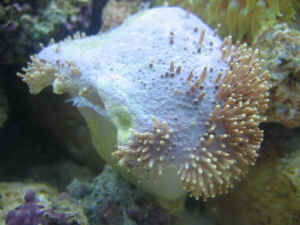
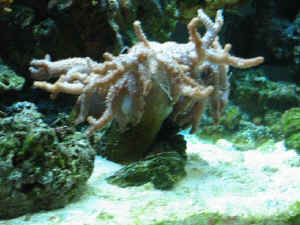
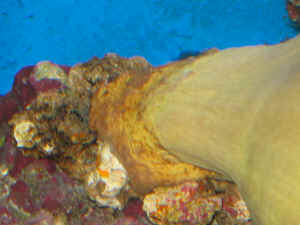
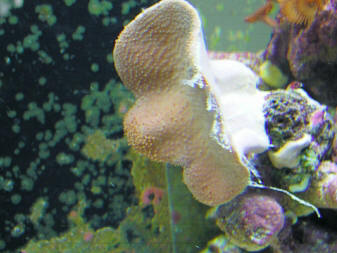
Injured Leather Coral 2/9/05 Today I bought a toadstool from fish store. One large one and one small next to it on one rock. After placing it in the tank I noticed a hole on the smaller crown almost in the middle. Is this something I should worry about? <Of bigger concern is the addition of any new coral, fish, etc right into your tank without quarantine first. High risk of (eventually) adding a parasite, pest, predator or disease to the tank. Please do take the time to read about and apply QT habits (see our archives on this topic)> How could I remove it from rock so I can place in my 30 gal for observation in case of spreading disease. <Moving a stressed coral at this point will only make it worse. And any contamination has already been done> Would I need to reattach it to another rock or will it do it on its own? <None of the above... just good strong water flow where its at and observe to see what may have caused the hole, what makes it worse, or if it simply heals> The hole looks like it goes into the stem. polyps are out and looks good I'm not sure what to do any help would be appreciated Thank you! Andy <Patience for now my friend... best to let this animal sit in place and heal. Anthony> Leather coral troubles First thing I love your site... << Thanks, but isn't my site ;) >> I purchased a mushroom leather about a week ago, Now it looks like it is melting, it is slumped over, with its head facing down. it's starting to rip on the top. Is there anything I can do. << Well, is it in moderate water flow? Do you have some nice lights over it (meaning pc/VHO/halide?)? What is the rest of your tank like? If it is just this one coral, I would wait it out and try to give it an environment similar to the tank it came out of. If this is the only coral in the tank, then we need to look at the rest of the tank conditions. >> Or should I just take it out of the tank. << Only if you are sure it is going to die. Otherwise I leave them in. >> Also how do you cut them to make more of them. << well Calfo's book is perfect for this. Basically I take and cut the head like a pizza/pie. I cut it into slices but don't cut all the way to the center. Now you have these pie shaped pieces all connected at the center. I wait two weeks, then cut them from the center and take these leather coral slices and rubber band them to a piece of rock. >> << I should mention that I don't recommend you do this. It sounds like you are having trouble with the coral, and I would also get more familiar with coral care in general before attempting to propagate them. >> << Blundell >>
Will my leather coral pull out of a high temperature incident? HI, I accidentally turned my tank up to 30 degrees centigrade for about 12 hours several days ago. Since then, my leather coral has been drooping and developing holes and it seems to be getting worse rather than better. << Not surprising, but unfortunate. >>Do you think its dying and if so should I remove it as soon as possible? << I would frag a few of the larger branches, in hopes of saving it. I wouldn't just throw it out, as I think many leather corals can make remarkable come backs. >> Thanks << Blundell >> Distressed Leather? (Removing An Aiptasia From a Leather Coral) Greeting WetWeb Crew! <Hi there! Scott F. here tonight!> Kudos to you all, for the time and effort that is put into this site. It helps people like me to better enjoy and appreciate this great hobby. <We're thrilled to be here for you...We have as much fun answering your queries as we do playing with our fish!> I've been reading your site now for about a year and have a 90 gallon marine tank for almost as long. My question is about a beautiful new mushroom leather coral I just purchased -Sarcophyton. The crown is about 4 to 5 inches across and is attached to an approximately 2 inch thick "stalk", about 3 or 4 inches long. On the very bottom the stalk is a piece of rock about the size of a quarter. Wedged in-between this piece of rock and the coral are a couple of nasty Aiptasia. Eeek!! If I am very careful, with a sharp scalpel, or Exacto-knife, could I or should I slice a very thin layer of the coral just above the rock, taking the Aiptasia with it? <I have experienced a similar occurrence with a Sarcophyton, and was surprised how easy it was to remove the Aiptasia without damaging the coral. The base of the Sarcophyton is surprisingly "tough", and you can practically scrape the anemone off of the coral without damaging it.> If so, what treatment should follow? <My best advice is to simply maintain very good water quality after this "procedure"> I have read in Anthony's Coral Propagation book that these corals are quite forgiving. I value your advice. What do you think? Thanks in advance, Brenda. <They are very forgiving! As Anthony and others have implied, you can practically run 'em through a blender and end up with a new coral. However, they do deserve the highest level of care we can offer, so try to be careful when conducting this "operation". Good luck! Regards, Scott F.> Sarcophyton Struggling with Bicolor Blenny Hi Anthony <cheers, my friend from Norway!> I have 2 questions that I need an opinion on. First I have a 6 inch diameter Sarcophyton, and all is not well.... it's just looking a bit beat. Extensions sometimes good, sometimes bad, and there doesn't seem much life in the centre. This might have 2 causes - inadequate flow, <this is the most common cause by far, yes. Is your tank getting 10-20X turnover minimum? Please do improve it if not. Aspire for 20X if possible> and it's become one of the favourite perches of a bicolor blenny. <Arghhh... yes, dreadful. Irritating to the coral, although some adapt in time. But blennies really are dubiously reef safe. Many will nip corals in time.> It's awful cute to see it's head peeping out but I can't believe it's helping. <agreed... on both counts> I have adjusted flow so there is some amount dropping down over and onto it. Tank specs - 30 Gallons, 75 degrees C, 1.025. Ammonia, nitrite 0,nitrate 5 -10. Ca 350, alkalinity 11, pH 8.0 (won't go up). Lighting by 2 10000K T5's , coral sits in 3 - 4 inches water. 2000 litres per hour total movement - 2 pumps + skimmer outflow. <not bad at all... maybe more adjustments of the delivery of the flow are all that's needed. Avoid laminar flow... try to get good random turbulent flow> I don't think it's the system as some frags are sitting next to it and thriving! Would iodine addition be of any benefit to it's health, or do I just have to live with the bicolor? <if you are not doing large weekly water changes, then yes... small daily doses of iodine will be helpful if not necessary IMO> Incidentally I am attaching the frags to milliput disk about 3 inches across. Is this too big. <no worries> My feeling is I want something the frag can grow on, but right now it's not pretty. <understood... the choice is dependant on how you are trading/distributing them. Different needs for different types of shipping/customers> Question 2. I have a 7 gallon acrylic that I am going to plumb into my 55 as an upstream refugium. I will have a double outflow. I wan to use it for pod growth and biodiversity, so will have thin layer sand, layer of live rock frags, then maybe Chaetomorpha on top, with a small PCompact (13 W) to light it. Will it work? <it sounds very good... although you will probably need to boost the lighting. And do try to adjust the water flow to get the Chaetomorpha tumbling always> I'm assuming a slow flow, maybe 20 gallons an hour, so I'm thinking will I need 20 or 25 mm (metric land) pipe for the outgoing water? <oh, no... please. This is a common mistake. Refugiums with slow flow become cesspools and do not produce well. They need good water flow... nearly as much as your reef. Try for at least 10X> cheers, Wayne Oxborough in Norway. <with kind regards, Anthony> Sufferin' Sarcophyton > Hi y'all, > << Hi, Blundell here. >> > In a 6-month old reef tank I have Zoanthids and a Sinularia that are > thriving (twice pruned, still monstrous), but my Sarcophyton elegans > is not feeling well at all. > The problems started when I had to move S. elegans in order to remove a > rock in hopes of catching a suspected mantis shrimp (false alarm, as it > turned out). Anyway the rock was replaced and the coral returned to its > former position but has never forgiven me for it. In my haste to > capture the "mantis" I was a bad aquarist and did not use gloves though > I tried not to contact the coral directly. > (The Sinularia is quite massive when fully extended but even then its > closest branches are 6-8" away from the Sarcophyton.) > OK, now it's been a month since the rock move and the coral remains > discolored and slightly necrotic in places around the edges. It does > open during the day, though not as fully as before, and interestingly, > the polyps only extend on the portions of the coral that are > discolored. << I would increase the water flow around the coral. >> I > have administered a 10-minute Lugol's dip (in aquarium > water). This seemed to cheer it up just a little. I have been trying to > trim and/or siphon off necrotic spots in situ -- the bad spots are only > about 1-2 mm across and I don't want to move the coral again unless I > have to. << Yes, I would wait and not try to do too much. >> > So my next move is probably going to be a freshwater Lugol's dip -- in > case of parasitic infection. There are one or two brownish areas on the > stalk but I don't know enough to declare them Planaria .. or anything > else... with any certainty. << I don't think I would do the dip. That > seems quite stressful to me. >> Yes...it was. After sending my last message, the next day the coral seemed worse. So I'm sorry to say that I tried a pH- and temp-adjusted dip. The next day (this morning) the coral was in shock and seemed possibly dead. Grey flesh, completely closed up. However the tissue was not soft at all but quite firm. Coral rigor mortis? << It is possible the tissue is contracting, and you can feel the corallites. >> I think the whole animal is dead but in desperation I fragged the whole thing and placed the frags at different locations in the tank. << Not a bad idea. That is what I would do. >> Will monitor. An earlier frag I had taken is still doing fine, BTW. > Any advice? << I would certainly do some fragging. It is amazing how > often a mother colony dies off in our aquariums, but thankfully the > cuttings in the same tank go unaffected. I would certainly do some > fragging and share with friends. >> I'm enclosing before and after > photos. > Thanks once again -- John > << Blundell >> Thanks for your input. I should have waited a day...once again haste makes waste in the aquarium. I suck! << Don't worry about it, I make mistakes all the time, just advising what I think I would do. Hope things get better. >> - John << Blundell >> Colt Coral Fungus Hey.<Hey Brendon, MacL here> I have a
colt coral that has a fungus on one of its branches. It's been
there for about two days now, hasn't spread or shrank. I've had
the colt for about a week and the first two days it was doing fine.
Then it shrank to about half its original size and then got this
fungus. Do you know what this is and how I should get rid of it.
<There are several things it could be but my suggestion would be to
either buy some coral reef dip or make some. I personally have good
results with Seachem's coral reef dip.> I asked this in the chat
forums but no one seems to know what this is. <There are some
specialized frag and coral websites, www.fragexchange.com comes
immediately to mind. If you think it might be better to cut the bad
stuff off or try to frag the coral and save what you have left of
it.> Thanks for any suggestions. <Good luck Brendon,
if possible a picture might be very helpful.> Not Enough Info to Help Hi, <Hello, Ryan with you
today> I'm concerned about my Devil's Hand Coral and my
starfish. I'll start with my starfish. It was perfectly fine, but
then I came back after a weekend away (I have an automatic feeder) and
the tips of two of it's legs were missing and it had a sore on
it's main body, I thought it must have gotten into a fight or
gotten stuck in the filter or something. I have 2 clownfish, 1 yellow
tang and a blue damsel. Is there anything I can do to help it, or
should I just wait for it to regenerate on it's own? <I'm
not convinced that you have the type of tank a starfish is going to
prosper in. They need large, established reef systems with
lots of room to graze. If this isn't your system,
I'd return him to where you purchased.> I'm also having
problems with my new Devil's Hand Coral. This is my first coral, so
I don't know if what it's doing is normal or not. The way I put
it in my tank made it sink off to the side of the live rock. It sunk
over so far that it detached itself from the live rock and fell into
the sand. I picked it up and put it back on the rock in a way that it
was secure. Now it's covered in some sort of white film that's
also attached to the rock. I don't know what to do, is this just
how it reattaches itself? If not what should I do? <You should
include some details about your system so that I may
help. What type of lighting are you using? What
are your water parameters at this time? You coral is going
into shock, and is excreting a mucus to protect
itself. Please update your question with the pertinent
information I requested, and we'll do our best to get these animals
healthy. Thanks, Ryan> Sufferin' Sarcophyton? (Leather Coral Staying Closed) I have a Toadstool with pretty long "tentacles" and I have had it for maybe 3 months. It always came out really nice, then within the last 3 weeks it has not come out at all. I have other Toadstools with no problem and other corals in my tank that are doing fine. Do you have any suggestion what could be wrong. I have a 55 gal tank with 4 65 watt power compacts. Thanks, Karen <Karen, I'm assuming that you're referring to a "Toadstool Leather Coral", Sarcophyton. If this is the coral that you're referring to, I wouldn't worry too much just yet. These corals are well-known for their behavior of "closing up" for periods of time while they shed a waxy organic coating. Sometimes, they can remain closed up for many days. Given good quality water conditions and proper lighting, they will often re-emerge to their former glory. Just make sure that the tissue is still firm and not necrotic. In fact, I just experienced this phenomenon for the first time myself on a two-year-old specimen that I purchased from IPSF. If this is really a cause for concern, do run a check of your basic water parameters, and consider the possibility that some environmental factor might have suddenly changed. Or, there is always the possibility of allelopathic competition (i.e.; "chemical warfare") with another coral nearby. Hopefully, it will simply be another case of the "sloughing" phenomenon discussed above. Keep an eye on things, and don't give up. Good luck! Regards, Scott F> OK, Who's eating my new Finger Leather Coral? 4/22/04 Hi Crew, Searched around the FAQ's and haven't had much luck. Would appreciate some help with this dilemma. <will do our best> I just bought a really nice looking finger coral from my LFS about 3 weeks ago. It has been doing great in my system, but began noticing that it was looking a little smaller than I had remembered. This leather is pure white (like hard boiled egg) with brown polyps. <pure white is not natural... you have a bleached animal that was stressed when you bought it my friend. Struggles you are seeing now may very well be the first signs of serious attrition or weakness to infection> I began to notice scalloped cut a ways (bite marks??) along the periphery of the coral and began to worry that someone was eating my new coral. <perhaps> Here are the usual suspects: Sparkey the Firefish - unlikely Nemo the clown (yep, Nemo, young kids really ruin the fun of naming fish, don't they??) - unlikely Bobo the clown (now there's a name) - unlikely Astro the Yellow Tang - not sure, but probably not Hermit Crabs - Hummm - don't know; I do have a rather aggressive one that is rather large - possible <do know that no hermit crabs are truly reef safe. They are all rather tricky in the long term> 3 large giant Turbo Snails - these guys made quick work of gobs of Caulerpa - won't think so Bristle worm(s) - set a trap for a couple nights; got nothing! - not likely <indeed, they are overrated as predators> I pulled the LR with the coral affixed from the main tank and put in my unpopulated quarantine tank. <I do wish this coral had gone into QT first for a solid 4 weeks on arrival. So many problems with pests, predators and diseases could be skirted if folks would obey this fundamental rule of animal husbandry. QT everything without exception!> Noticed a day or so later that there was some slug or Nudibranch looking creatures positioned around the coral. <yikes! Now this is a valid suspect> These guys (3 or 4 spotted so far) are pretty neat looking; very white, with projections coming from their backs that were topped with what look like snow flakes. Are these the dudes that are eating my finger leather?? <yes... quite possibly. The tassels on the back are cerata that evidence that they are carnivorous Nudibranchs. We have pics of these in our Reef Invertebrates book and you can see so many more online at the SeaSlug forum. More too in our FAQs and archives if you will take the tie to browse there> Not sure what to do. Should I remove the slugs and put the coral back in the main tank? <remove the slugs yes... but please (!) do not move this coral again in such a short period of time. Its a good way to stress and kill it. As it stands, it has been through no less than 4 different systems in the last month (perhaps more): wild to at least one wholesaler, then to your retailer, then to QT. No more moves please. Do let the coral stabilize for the next 4 weeks in QT> Should I remove the aggressive hermit? <a good idea to be safer in the long run, yes> What about the slugs? Suggestions please. <QT without exception for all new livestock in the future and you will spot these before they infect your tank> As always, I truly appreciate your help, comments and suggestions. Rick <best of luck, Anthony> Distressed Leather? I was wondering if you could help me. To give the general info first, I have a 55gallon tank. 2 x 400 GPH filters one at either end of the tank. Protein skimmer (getting lots of dry foam and getting at least 2-3cups a week). I have 130 watts of (50/50) light on a 12hr cycle, and another 80watts (daylights) on a 14hrs cycle (extra 1hr before and after) to simulate a bit of dusk and dawn. Water Info: Specific Gravity: 1.024 Temp: 79 KH: 12 PH 8.3 (evening measurement, never have time during the day) Ca: 400 Iodine: 0.6 Nitrate, Nitrite: 0 Ammonia 0 - 0.25 <Wooooahhh! Do re-check this! Ammonia should be undetectable in a healthy, established aquarium!> Phosphate: 0.3 (Can't seem to get this down despite many water changes) <Do check on your source water. Perhaps the RO membrane needs changing. Do revisit your feeding habits. Are you getting any liquid from frozen foods into the tank when feeding? Are you using lots of dry foods? Both of these can cause phosphate readings. As a remedy, you could also try chemical filtration media, such as Poly Filter, or, you could use one of the "Phosphate-removing" products out there, such as Rowaphos or Phosban. These are only "band aids", of course> The water is all RO+DI, 10% water changes per week. Water is prepared 72+hrs in advance and checked for temp, KH & PH before adding. I add Iodine, Strontium and Calcium, and Reef Builder (Alkalinity Buffer) to the water on scheduled intervals. <Sounds fine.. Do test to confirm the need for the additives used> I purchased a toadstool about 2 months ago. For the first 2 - 3 weeks it opened during the day and seemed to be doing quite well. One of my red claw hermits took a liking to climbing it and sitting on top, and after that it stopped opening up. <A common reaction to continued irritation> It still seems firm enough to stand on it's own, but it is covered with a green/brown substance, and hasn't opened in at least a month. <Hmm...Sounds like it might be algae growing on the coral. A good indicator that something is not right here. These coral do retract their polyps periodically, and shed a waxy coat. However, remaining closed for extended periods of time could be a sign that something is not right...Do review basic water conditions here.> Is there hope or should is this coral dead? Thanks, Derek PS: Have attached 2 pictures, hopefully they are clear enough to see. <Well, Derek- the pictures were a bit blurry to me. As far as sticking by this coral- I would not give up just yet. It is quite possible that it may return to it's former glory. Increasing water flow over the coral may help stimulate it and assist it in completing the "shedding" process of the aforementioned waxy coating. Do keep any eye on things, maintain high quality water conditions, and stand by the animal as long as it looks otherwise healthy. Good luck! Regards, Scott Leather coral troubles - 4/5/04 Hello- I tried posting this first, but no response..... My leather coral (looks like an upside down mushroom) had been drooping for about a week when I realized that he wasn't going to make it back to upright. I have had him for about a year and a little yellow goby had lived with him the whole time. The goby would perch on top and survey the tank. <this is a Sarcophyton correct?> Anyway, yesterday I took a glove and moved him to get a better look and saw that he was going necrotic on me. <Hmmmmm> I immediately took him out with some tank water and added some iodine all into my girlfriends Tupperware and cut off most of his stalk, which was decomposing. I sewed him up to a rock and he actually looked better with polyps a little extended. <Good move in my opinion> It seems that although the polyps are still extended the death is still spreading. Should I cut him down more? <Hard to say without seeing it but if the necrosis seems to be spreading then cut it about a 1/2 inch above the necrotic area> There were no parasites in his stalk. <Weird. Sounds like one to me> All water parameters are all good. Everything else in the tank is all good, from pulsing xenia to clams... Oh yes, there are no corals next to him or even close to him. <Excellent. Look through our FAQS on our site if you haven't already> The closet inhabitant next to him was a sponge that was about 4" from his base. <Well, never know. Sponges can be aggressive as well but probably not the issue though> thanks, <Good luck ~Paul> Miguelito Arias Toadstool surgery - 4/1/04 I purchased a toadstool leather from my LFS 2 weeks ago. It was a small loose piece with a stony base. All of my tank conditions are excellent. It has shed the white mucus 1 week ago, yet it has never extended it's polyps. <Somewhat to be expected when first introduced to a new environment. No need to worry yet. Read about them here: http://www.wetwebmedia.com/alcyoniids.htm > I noticed that there is a small loose piece of the coral that is not glued solid to the live rock. The base of the smaller section is moving with the current but is attached to the other part of the coral in a small section. Can the small loose section be trimmed off with out removing the entire specimen from my tank? <Yes! For sure, or you can glue it with Cyanoacrylate (Ross SuperGlue Gel)> And if so, how should I do it? <With a sharp razor or sharp scissors. Read more about toadstools in the FAQS at the link posted above ~Paul> Thanks Scott Necrotic Sinularia damage? I have a 3.5” tall Sinularia that that has grown large enough that it has started to rub on a small chunk of rock that sticks up next to it. Where the tissue is rubbing, there is a small black spot appearing, maybe 3/8” long by 1/8” high. The location of this occurrence is about ?” up from where the coral attaches to the rock. <yikes... the black necrosis can be quickly threatening to the coral and perhaps other corals into he tank. o address by cutting/pruning off the excess coral promptly> After perusing the archives, I have found two approaches to take here. 1) Cut the base of the coral, above the damage, straight through and reattach to a new rock. 2) Try to excise the bad material and watch to see if the coral heals ok. What is the current thought on this type of problem? <the latter at first and the former if necessary to follow> Thanks for you time. Don <best regards, Anthony> Sick (Dead) Toadstool? 3/13/04 Hi all, <Hi Kevin, Adam here. Sorry for the slow reply.> I have spent quite a bit of time looking for an answer to my question but have not run across a specific answer to date. On Feb. 19 (2 weeks+ ago) I received a rock with several Xenia groupings, two types of mushrooms and a toadstool. In bringing the rock home the toadstool seemed to have shed a waxy outer layer and the Xenia appeared 'burnt' in areas. The toadstool extended polyps for a couple of days and then appeared to go dormant and slouch over. <All sounds quite normal after being moved.> The Xenia disintegrated several days later and I cut them back quite close to the base rock. Since then the Xenia have started sprouting new arms throughout all of the areas that were cut back but the toadstool is inactive and the stalk is slowly taking on the colour of a bruise. I enclose two photos. <The coral doesn't look good, but as long as it doesn't start turning to mush or losing tissue, I would tough it out. These animals often take many weeks to recover from insults. If it stays in this state for more than a couple of weeks, despite water changes, etc., I would consider moving it to another tank. I have seen several cases where Sarcophytons suffer for months despite every effort only to quickly recover after being moved to another tank.> Parameters are: SG 1.024 Temp 77 PH 8.2 Amon 0 NO3 0-trace Phos 0-trace Alk 4.5 Calc 300 (attempting to bring up) The tank is a small 38 gallon with approx. 75 lbs. live rock, 12 times volume turnover per hour, 96 watt actinic (13 hrs) & 96 watt 10K (12 hrs). Dosing with strontium & iodine. <I would withhold the Sr and I for a couple of weeks. These are both easily overdosed and the experience of many aquarists who never supplement them proves that with regular partial water changes, they are not necessary.> Is this toadstool gone? How long should I wait to further signs of life? Thanks for the great resource. Kevin <I would perform a couple of 25% water changes, hold the Sr and I and see how it does, but don't give up yet! Best Regards. Adam> Toadstool not opening - 3/10/04 Hello, I have had a toadstool leather coral in my 90 gallon tank for about 2 weeks and today I noticed that it was not open and the color seems to be a little green/yellow on the surface. <Nothing to worry about just yet. See here: http://www.wetwebmedia.com/alcyoniids.htm and please use the blue links at the header for additional questions and answers> All other animals in the tank are doing great but I am concerned with the leather. <They do this from time to time> Water info is as follows. Nitrates = 2.5, ammonia = 0, nitrites = 0, PH = 8.3, Other tank inhabitants = 2 small clowns, 25 hermit crabs, 20 small snails, 1 green open brain, 5 small blue mushrooms and one rock covered with polyps. Can you tell me what the toadstool is doing? <Sloughing organics growth floc. Can take up to 3 weeks for some to shed. Use a soft bristle toothbrush to give it a hand and stimulate the coral. Read the above links. Don't touch it or move it for now. ~Paul> Ken I don't want my little colony to expire 3/8/04 Hi everyone, Pam here! <Hi Pam. Adam at your service.> I wish I knew the type of soft coral I have but I will tell you the problem first. They have closed their polyps. I've had them for 5 days. My Alk is low, about 120, maybe a bit lower, so I have added the Reef Builder to raise carbonates, yesterday and today to the tune of 1/2 tsp. each day. <When purchasing test kits, always look for those that report in the most familiar units. In the case of alkalinity, avoid test kits that report ppm, or low/med/high and choose kits that report dKH or Meq/L. Also avoid alk kits that instruct you to add a certain number of drops and compare to a color chart, instead look for those that instruct you to add drops until the color changes and then calculate the result from the number of drops used.> This coral is small, with the individual polyps about 1/8 inch round (when closed). When open, they are about 1/4 of an inch tall, and they are yellow. They have little hairy filaments at the tip. All else in the tank is okay I think, however my water is VERY hard, at about 400ppm. The ph is around 8.2, "O" Nitrates and Nitrites, (of course!). What would you say? I don't want my little colony to expire! Thank you Pam <It is impossible to even guess what your coral is, or weather it will survive without knowing more about your tank, filtration, lighting, etc. Correcting the alkalinity is a good first step, but we will need to know more about your system. Best Regards. Adam> Sick Leather - 2/27/04 Hi, I have problem with my toadstool leather. My leather seems to sliming and affecting my other corals. I have bubble tip anemones, gorgonian, brains. I would like to know the problem. <Your email doesn't help much with diagnosing the issue. Simply put, there is just not enough info. Tank parameters, tank age would help. How long have you had the coral, where is it placed not to mention this particular type of issue has been covered before on the site. Here is the best place to start to find answers to your particular question (see if any of the FAQ replies relate to your question): http://www.wetwebmedia.com/alcyoniids.htm and http://www.wetwebmedia.com/alcyonfaq4.htm and try a read through of other FAQ links at the top of the page for yet even more info that may apply. Thanks for being part of it all ~Paul> thanks
Sarcophyton suffering - 2/22/04 I have a mushroom leather coral in my reef tank. I have checked my water quality and all is well. I purchased this coral about a week ago and it appeared to be healthy. In fact, the first full day it was in my 75g tank it was in full bloom. For around the last 2-3dys it seems droopy and its fingers are not coming out at all. It does not have a film or algae on it. Can you send me a pic of what rot looks like, or am I over reacting? I don't want it to release any toxins into my water. <This has been covered many times before on our site so I am going to link the page here: http://www.wetwebmedia.com/alcyoniids.htm and here: http://www.wetwebmedia.com/softcorhealth.htm Feel free to read through the other FAQ links. You will find pictures and replies to this very issue. Likely either a parasitic snail in the stalk or just need time to acclimate. Could take up to four weeks to adjust to your water chemistry and lighting>
Toadstool leather not opening up - 2/4/04 Here is a picture of me Leather coral. <Thanks> It has been open for the last 3 weeks that I have owned it. <So you have had it for a few weeks only? there is a lot of information on our site about this coral and its habits. Also of note it looked a little damaged to me. Not of any concern though. A quick summary of advice. Don't move it for a while, use a toothbrush (soft bristle) and lightly scrub the slough (floc) that is being formed. Be sure it is not being pounded by laminar flow, and watch water quality. Lastly, of course, be sure it is not being stung by other corals nearby> About 2 days ago it has seemed to close up and not do much. <They do this from time to time. Could be closed for up to a month> The picture is about the most it's opened up. <I think it is healthy overall. A possible minor irritation bothering it somewhere> Ammonia and Nitrites are 0. <I hope so> Nitrates are about 10 ppm. <No worries> No phosphates. <Good> I have a 40 Gallon long tank with 260W of Power compacts. <Excellent> My sump turns about 700GPH <Excellent> and I have several power-heads creating current. Is this normal looking? <well, is normal behavior for this coral> I've checked the FAQs and have subscribed to patience as the best approach but I just want to make sure I don't need to take some kind of preventative action. <Likely fine. All the information I have mentioned is located in further detail in Sarcophyton FAQs> Thanks for your help. <Thanks for being part of it all ~Paul> Brian P.
Challenged Colt Coral? I just picked up a small
frag of colt coral from my LFS. I brought it home and promptly
acclimated it. I put it into a plastic cup and floated it in the tank
and exchanged the water back and forth for about 30 minutes before
placing it in the front portion of my tank were I believe the flow to
be of a medium pace. When I first introduced it, it opened up and I
stared at it for awhile and then left the house, only to come back
several hours later to an unhappy colt. This has not changed
a day later. It also looks a little shrunken. The coral is still erect,
but it is not showing its polyps. I believe the coral has some small
"blister like" areas on the stalk, but very small, maybe
it's sloughing? <Could be- a possible stress or shock reaction.
Not desirable-but not all that uncommon, either. Keep a close eye on
the coral..> This is my first REAL soft coral. It's in a 5 gal
flat back hex that has a load of Caulerpa in it, along with yellow
colony polyps and some encrusting gorgonian. I have a 2x55w retro kit
on top of it for the time being, as I am waiting for my pump on my
20. Sorry about the pic, my web cam is a drag. Any ideas? |
|

|
Features: |
|
| Featured Sponsors: |
 ... gone. B