|
FAQs on Parasitic Marine Worm
Diseases: Tapeworms/Cestodes
Related Articles: Marine
Parasitic Disease, Parasitic
Worms, Roundworms,
Related FAQs: Fish Worm Diseases 1, Marine Worm Parasites
2, Marine Worm Parasites
3, & FAQs on Marine Worm Parasites: Diagnosis/Symptomology, Etiology/Prevention, Cures That Don't Work, Cures That Do Work, Products/Manufacturers... Flukes/Trematodes, Leeches/Hirudineans, "Other" Worms and Worm-Like
Parasites... Paravortex/Black
Spot Disease, Anthelminthics/Vermifuges... De-wormers
(Piperazine, Praziquantel...) & FAQs, Yellow
Tang Disease, Parasitic Disease 2, Parasitic Disease 3, Parasitic Marine Tanks, Parasitic Reef Tanks,
Cryptocaryoniasis, Marine
Ich, Marine Velvet Disease Biological Cleaners,
Treating Parasitic Disease,
Using Hyposalinity to Treat
Parasitic Disease, Roundworms, Yellow Tangs, Tang
Health/Disease,
|
|
|
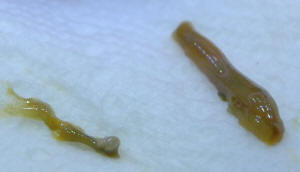
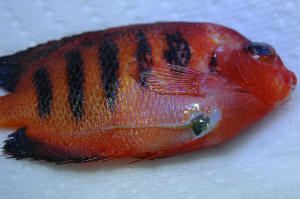
Sudden Flame Angelfish Death - Questions About
Parasitic Worms 11/18/11
Hello WWM Crew,
<Scott>
I wonder if I might ask your opinion about the very sudden death
of a mature flame angelfish in my SPS aquarium.
<Sure>
First, some data about my system for your reference - 135 gal SPS
which has been operating for about five years. Filtration
consists of a Euro-Reef Skimmer (with daily skimmate production
of about 1 dark cup) and an Eco-System 3616 mud refugium, loaded
with live rock and Chaetomorpha. Flow in the main display is
supplemented by four Vortech pumps, one of which flows directly
over another mass of Chaeto. The aragonite sand bed is roughly
3/4 inch and the aquarium contains about 150 lbs of live
rock.
Lighting is a mixture of HQIs, VHOs and LED.
Nitrate and Phosphate is undetectable, salinity and temperature
are at 35 ppt and 81 F, respectively. A water change of about 15
gallons is performed about once a week.
I have had the same five fish for three to four years; in
addition to the flame angel, the aquarium is home to a 4"
purple tang, 5" emperor angelfish, 4" bicolor blenny
and a 4" sunrise Pseudochromis.
Due to the refugium and the Chaeto in the display, there is a
generally a supply of various copepods and tiny brittle stars for
foraging by the fish, especially in the morning when the lights
first come on. They also tend to graze on the Chaeto, and some
other green macroalgae in the tank (I can't quite identify).
Supplemental feeding has mainly been large freshwater mysis
shrimp, soaked in Selcon.
Generally speaking, the system has been stable and all life
thriving (of course, now with the exception of the subject of
this email) for years.
Thanks in part to the strict quarantine regimen (learned from
your web site - thank you) I have never had any health issues
with these fish once in the display, except for one noteworthy
exception. About t six months ago I noticed a stringy white
discharge from the Emperor, which in hindsight may have been the
first indication of an infestation of some type of parasite.
Because the Emperor (and all the other fish) were plump, active
and displayed a very healthy appetite and vibrant color, I did
not take any significant remedial action at that time and the
symptoms dissipated.
Last night, all fish appeared healthy and had good appetites.
This morning, sadly, I discovered the flame which had died over
the evening. Upon removal from the display, I noticed a lesion
which did not look like the normal deterioration one might expect
under the circumstance.
Directly under the pectoral fin on one side was a discharge which
to my novice eye looked like a worm or some other type of
parasite (see attached photos). I pulled the discharge with a
pair of tweezers and took a couple of additional pictures for
reference/information.
My main concern now is to try to identify the cause of death and
treat as required to protect the remaining fish. Would you kindly
advise if you concur that this is an infestation of some kind of
worm?
<Yes; I do concur this is the remnants of a worm, a
Tape/Cestode very likely. It's origin? Likely was imported
in/with the Angel...>
If this is the case, I suspect treatment with some type of
vermifuge is warranted,
<Mmm... killing all the other susceptible/worm life in your
system? Not likely useful... not advised>
but due to the size of the fish a hospital tank may not be
practicable.
<I'll jump ahead here (and haven't even finished my
coffee) and state that I would NOT do this moving,
treatment>
Conversely, treating in the main display may not be feasible due
to the presence of the Sps, some soft corals and an assortment of
crab and snails.
<Yes; agreed>
My other concern is that I may be able to successfully treat the
fish in a hospital tank, only to have them re-infected once
returned to the display.
<Yes>
Can you offer any advice that may lead me in the right
direction?
<Many such endo-parasites are species specific, most have
complex life cycles that aren't fulfilled in
captivity...>
Thanks in advance for your reply.
Scott
<I would just continue w/ your system, livestock as you state.
IF concerned re further such parasitic involvements, consider
adding the vermifuge/Anthelminthic treatment as part of your
quarantine process. Thank you for sharing. Bob Fenner>
|
|
|
|
Parasitic worms I need some help! My Hawaiian
Dragon Eel stopped eating. I notice that he has thin,
tan worms all over his body. The worms are about
an inch in size. The part that doesn't hook into
the eel ends in a point. Please tell me what I can do
to treat this. I know eels are sensitive to many forms
of treatment. He is a full size eel. Thanks
so much for any advice you can give. Kelly <Mmm,
need to have a definitive identification of these worms... to the
phylum level. I suspect they're flukes of some sort, and
could be treated with an organophosphate. I suggest a pH-adjusted
freshwater dip (that will likely result in a bunch "letting
go" for microscopic exam.) at this point. Be careful with
netting the specimen and keep the dip tank covered and heavily
aerated during this procedure. The dip by itself will not effect
a cure... as the worms are likely of a type that have direct
development and will still be present in various stages in the
main tank when/if you return the eel. Bob Fenner>
Re: Parasitic worms Hi Bob, <Hi Kelly> Thanks for
your response. I did do the freshwater dip. It took 18
minutes for the leeches to let go. (not die, just let
go). Yes, I did say leeches. I took some of
the specimens to an aquarium today. I was told that
they were leeches. <Easy to see with some magnification (and
specimens!)> Unfortunately, these leeches like to
live in the substrate. I had 200 pounds of sand and
crushed coral in my tank. Well, with some help, I
actually removed all the substrate and bought more live
rock. The substrate is totally infected with these
leeches. Just looking at them makes my skin
crawl. I am treating the substrate with Clout in a
separate container. <This should "do it"> There
are no more of these leeches visible in the
tank. Although, he does have two of the leeches on
him. Compared to the hundred that were all over him
yesterday, I consider this a huge accomplishment. Once the eel
settles down and does not appear so stressed, I will try to pick
off the two remaining leeches. This has been a very
long project, but is well worth the effort to save this beautiful
eel. <Yes> We have a Titan trigger fish with the
eel. She was sick in the past and had to be
quarantined. We now think she was being infected by
the leeches as well. Since last night when we gave the eel a
freshwater dip, the Titan has been extremely protective of the
eel. She lies right beside him. If I am
working in the tank near to the eel, she goes completely
ballistic. I have to say a full size Titan trigger and
full size Hawaiian dragon eel are a nice
match. Although, I would not add anything else with
them. Take care Bob. Kelly <Thank you for the progress report.
Bob Fenner>
|
Tape worms Hello Guys; In the past 1 1/2 weeks, my Purple
Tang has passed 2 or 3 (2 1/2") long, clear "worms' that
are about the thickness of 1/64". Under magnification, they appear
to have a half circle head (like a round head screw). At first I was
not concerned, but I noticed that during and after the last one was
passed, the tang was not behaving normally. It would repeatedly swim
into the flow of a power head then dive to the other end of the tank
again and again. I have had the fish for 3 years and it is very
healthy, good color, etc. I also noticed that its fins were not fully
extended but not clamped either. The two Ocellaris Clowns and the
Orchid Dottyback look fine. I was thinking of treating with garlic.
Your thoughts please? <Wouldn't hurt... but don't promote
its use as a treatment either> I have 3 tanks and like feeding
frozen foods. Is there a way I can prevent the spreading of parasites
from tank to tank via my hand or the food i.e. will normal washing
between tanks work and should I cut the cube food into pieces or just
rinse it in cold water between tanks? <Best not to "wet"
the feeding gear or ones hands in-between systems> I do not want to
transfer Ick, worms, etc. Is it safe to dip my hands into either
Permanganate or formaldehyde solutions? Thank you, Tim <Not
necessary or advisable to use these... one will stain, the other is a
biocide (kills all life). All considered, more important to do ones
best on all fronts per here: http://www.wetwebmedia.com/mardisease.htm
and learn to not worry about these extreme aspects of vector control.
Bob Fenner>
Re: Tang Scratching Normal? >Thanks for the reply
Marina, after much searching I'm coming to the conclusion
that these spots were some type of nematode don't know if
they were what caused the demise. After looking at it a bit more
I can see them causing the scratching but they weren't around
the gills or any critical portion of the fish. Just sitting under
the skin. >>You're quite welcome, even though I'm
sorry I have provided little/no help. I did forward
your email to some others (as noted), and I spent a good 45
minutes this morning doing some searching, but everything I found
indicated that one would have some other external symptoms, not
just the creatures you observed subcutaneous. In one
of the links I found, they did note, however, that with
trematodes (can't recollect which ones right now) copper
wouldn't garner results, I believe they did outline what
would help, though. I'd consider q/t'ing the
others ASAP and treating. Good luck! Marina
<Curiosity begs the question: have you any training (biology
or medical, perhaps) that has given you access/skills in
performing a post-mortem? The vast majority of
hobbyists don't have tools/equipment for such a
procedure.> Other than some biology classes years ago in
college not really. I've been an avid fisherman
and fish keeper most of my life so kinda know what's supposed
to be there and what's not. Post-mortem was done with some
Exacto knives and a 30x microscope from Radio Shack that I keep
around to check out small life forms in the tank. Thanks Paul
Re: Tang Scratching Normal? >Hey again, >>Good
morning, Paul. As you see above, I'm sending this to some
others on "The Crew". >Thanks for the info this is
just an update not a very happy one but am on a fact finding
mission. Found the hippo this morning dead in his favorite hidey
hole. >>That was a rather quick demise. What a shame.
>While performing an autopsy found small black worm like
organisms under his skin. There is no visible head or tail just a
skinny worm all coiled up. (can't get a picture as they are
too small for naked eye) I know this isn't much info for an
ID but was just wondering if anyone would care to make a guess on
this. (am worried for the other fish in the tank.)
>>I would worry as well. I personally am not familiar at
all with this, clearly one would have to guess parasitic
infection of some sort. I own one book one fish diseases,
not-so-handily stored away. I'm going to kick this to Bob (or
anyone else willing) and see what they think. I've never
experienced anything like this. Curiosity begs the question: have
you any training (biology or medical, perhaps) that has given you
access/skills in performing a post-mortem? The vast majority of
hobbyists don't have tools/equipment for such a procedure.
>There were no external signs (other than scratching) before
he expired, eating, breathing, swimming normal. >>Yes, I
remember. This is, at this point, quite puzzling. I'm sorry,
and am also concerned for the rest of your residents. I'm
going to suggest trying some other sites as well,
http://www.reefs.org (the archives, library, and forums),
http://www.thereeftank.com IIRC there are some folks with
scientific backgrounds who frequent these places. One gentleman
by the nick of Galleon is one such who comes to mind. (He knows
me as Seamaiden should you find him.) I'm in the process of
searching via Google, I've found this initial
link--> http://www.wetwebmedia.com/parasiti.htm
http://edis.ifas.ufl.edu/FA033
And some others that may (or may not be) helpful. http://www.petlibrary.com/marinetrematodes.htm
http://www.wonbrothers.com/product/DrAqua/parasitic_diseases.htm
http://www.mysteries-megasite.com/main/bigsearch/parasites.html
Best of luck to you! Marina >Thanks again, Paul >P.S. There
is a utility out on the web called REEFCON
http://www.infinitysoft.net/ReefCon/ that is GREAT for logging
and keeping track of your tank. It also has a very nice reference
section with pictures and some info on keeping for a ton of
critters. Will also control X-10 equip if you have it. I suggest
this to all my friends who keep tanks as there is a free version
and the pro version ($19.00 for one version or $32 for current
and all upgrades) cheap in my book. >>Thank you, we'll
pass this on! >>Folks, I am entirely unfamiliar with what
this man has described in his post-mortem on his Hippocampus.
Anyone who has any ideas, or is familiar. ANYTHING, please weigh
in with your opinion. I'm having little luck finding
information on anything but the most common maladies one may
experience with their specimens. Could we be talking about
Monogenean trematodes (flukes) of some sort? Thanks,
Marina<< <A distinct possibility. Is there someone you
can borrow a 30 or higher microscope (dissection type preferably)
to give you/us an idea of the gross morphology of these worms?
Bob Fenner>
Re: Tang Scratching Normal? I may be able to go to the
local Community College and borrow a microscope for an hour or
so, if not have some friends that work at a hospital and will see
if I can sneak in there with a sample. *grin* Will see about that
in the next few days and see if I can get a picture. <Good. If
you can, bring a single edged razorblade (or scalpel) to make a
cross section near the head end (a tri-radiate esophagus is
indicative of nematodes for instance)> (have frozen the fish
we'll see how well the samples kept) All other fish in the
tank still looking good. Once again the dots look like a black
ropey worm all coiled up in a clear membrane. After opening the
membrane the animal that comes out is about 1-2mm long and looks
kinda like a very skinny black earthworm. Thanks Paul <Likely
Cestodes (tapeworms), but we'll see. Bob Fenner>
Re: Tang Scratching Normal? Hello again, Well just got
back some info from an instructor at the local CC where I sent
the sample with a friend. Good call Bob he said that
it was some kind of tapeworm but didn't know the exact
species and that he didn't think that they would have caused
the death of my fish. <Maybe a contributor to some extent>
So I guess this is one of those that I'm just going to have
to chalk up to experience and make sure that the wife doesn't
buy me any more fish presents *grin*. Thanks for the
help must say I'd have a lot harder time getting this tank
started without your book and the web site. thanks again Paul
<Glad to be of assistance> P.S. Just got Anthony's book
in the mail and am looking forward to studying it so I can get
planning on my coral to add to this tank and am waiting for the
new book to arrive. <Know you will enjoy, benefit by them. Bob
Fenner>
|
- Wasting Disease - <Hello, JasonC here...> Hi crew,
have a problem I haven't been able to find much on. Have a Sebae
clown, wild caught, about 4 years old; always been in perfect health.
Recently, I moved him to a larger tank, fish with some inverts, no
anemones (yet). About 2 weeks later he developed Popeye, one eye, which
I successfully treated with Epsom (thanks!). He still has a good
appetite, even still has that pearly iridescence around the white bands
that fresh-caught clowns have, BUT, he is beginning to lose mass;
first, developing the typical pinched forehead, now progressing
rearward both above and below the lateral line; no other clowns in the
tank, other specimens unaffected. He eats and comes out less but is
otherwise still pretty normal. <So you do see the fish eating... it
would seem to me with the other occupants, this fish might be getting
less that its fill.> His offered diet hasn't changed, if
anything is better because I am feeding a large French and Atlantic
blue tang, and very wary of HLLE, so they eat better than I do. My past
experience is that this guy is headed for checkout, but its been a
while, and if there is anything I can do I want to do it, so,
suggestions? <Well, isolation might help - make sure the fish is
eating well and without competition from the larger fish. Also, because
this is a wild fish, it is also more likely that it has an internal
parasite (or two) that are competing for the same nutrients, quite
possibly nematodes or Cestodes [tapeworms]. Both can be treated - you
should be able to obtain Praziquantel [for the Cestodes] and/or
Fenbendazole [for the nematodes] from your local veterinarian. I would
work with one of these at a time, and administer in baths for 2-3
hours. More information on these treatments can be found in the Edward
Noga book, Fish Disease, which while expensive is very complete... and
an eye-full.> Thanks, Steve J. <Cheers, J -- >
|
|

