|
FAQs on Parasitic
Marine Worm Diseases: Other Parasitic Worm Groups and
"Worm-Like" Parasites
Related Articles:
Marine Parasitic Disease, Parasitic Worms, Roundworms,
Related FAQs: Fish Worm Diseases 1, Marine Worm Parasites
2, Marine Worm Parasites
3, & FAQs on Marine Worm Parasites: Diagnosis/Symptomology, Etiology/Prevention, Cures That Don't Work, Cures That Do Work, Products/Manufacturers... Flukes/Trematodes, Tapeworms/Cestodes, Leeches/Hirudineans, "Other" Worms and Worm-Like
Parasites... Paravortex/Black
Spot Disease, Anthelminthics/Vermifuges... De-wormers
(Piperazine, Praziquantel...) & Vermifuges, Yellow Tang Disease, Parasitic Disease
2, Parasitic Disease 3,
Parasitic Marine Tanks, Parasitic Reef Tanks,
Cryptocaryoniasis, Marine
Ich, Marine Velvet Disease Biological
Cleaners, Treating Parasitic
Disease, Using Hyposalinity
to Treat Parasitic Disease, Roundworms, Yellow Tangs, Tang
Health/Disease,
|
Mmm, Nematodes/Roundworms,
Acanthocephalans/Horsehair worms.... quite a few more Phyla...
and many worm-appearing (mainly crustaceans like Copepod)
parasites.
|
Valentini Puffer; prob. nematodes 09/15/08 Hi!
<Hello Amy.> My Valentini Puffer, Stanley, is roughly a year and
a half old. He was in a 100 galloon, tank with several other fish. We
recently moved him to a tank, that is a much more stable environment,
i.e. water quality maintained, light conditions correct, etc. He is now
in a 75 gallon, with a goby, live rock and some coral. (He hasn't
decided to taste the coral... yet.) He has been in the new tank for
about two weeks. Stanley has been his normal, very friendly self
lately, but he appears to be lopsided. His belly has gotten enormous
(probably from over feeding.) I wasn't too worried about it until
the area around his left gill and pectoral fin became inflated. The
inflated area stretches from his belly up behind his gill to his dorsal
side just behind his eye. It is only on his left side. <Probably
nematodes and/or an internal bacterial infection.> He doesn't
appear to have nematodes (we can't see any under his scales).
<There are many different kinds of parasitic nematodes. Some live
under the skin, some infect various internal organs. Fast growth of an
unsymmetrical swelling is a typical symptom.> And I tried burping
him. He puffed several times (for the first time ever) but no air came
out of him. Any suggestions on what else could be wrong with him, or if
there is anything I can/should do? <Treat in a hospital tank with a
wormer for at least 3 weeks. Fenbendazole, Flubenol or similar
depending on where you are, what you can get, if you are willing to
consult a vet, would be good choices. Also see WWM re nematodes,
treatment options.> Thanks for your help! Amy < Im sorry but have
to tell you that this can be lethal. Good luck. I hope he gets well
again. Marco.>
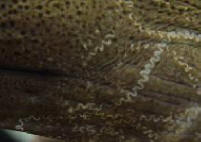
| Subcutaneous worms Bob what are your
thoughts on these worms? Nematodes? Are they
Nematodes? What is your best advice in form of
treatment? He is asymptomatic and seemingly unaffected by
them. Eating, doing well and has been in captivity for a year or
so. The rest of the inhabitants are uninfested , or at least
from outwardly perceptions. Fish only with live rock system
that is stable throughout. <Randy, I believe them to be
nematodes and the symptoms will be asymptomatic. My question is,
does the fish look underweight for its size. My mode of attack for
this problem would be to inject the eel's food with
Metronidazole and feed him 10 mg of Metronidazole per meal. This
might work but I am not sure. I will forward this to Bob Fenner and
maybe he will have something better. MikeB.> <Yes, very
likely nematodes... Perhaps Praziquantel... Metronidazole/Flagyl is
an anti-protozoal med.... Bob Fenner> |
|
|
|
My 6 line wrasse needs help
2/1/06 I am trying to save a 6 line wrasse I bought about 4
weeks ago. It had a large abdomen at the time but
seemed otherwise healthy. Over the last few weeks its
abdomen has swelled greatly. Its now has severe
buoyancy problems, it tries to wedge its self to stay upright and
flips upside down if not moving. Its vent is inflamed, and at
times a thick ivory colored mass seems to protrude then
retract. I am treating with MelaFix <Worse than
worthless> in a hospital tank, and suspecting an intestinal
worm or other parasite. <Maybe> The fish is still eating
well. Is there any thing I can do to help this
fish or is euthanasia the best option? Thank you for your help,
Kim <Only if in your opinion the
animal is "overly" suffering. I would add a level
teaspoon of Epsom Salt per ten gallons of system water here...
and see if "this too passes". Bob Fenner>
Re: my 6 line wrasse needs help
2/2/06 Hi Bob, Thanks for the response! I will try your
suggestion, I hadn't considered Epsom salt. <A
very useful, inexpensive, readily available, safe cathartic> I
did use Prazipro last night, which is fish Droncit and ordered
Discomed on line last night when no one in town had
it. I gave a brief, 2-3 minute dip, which it
didn't seem to enjoy much as it thrashed about, I removed it
when its breathing became labored. But right
away worms began being expelled. <Interesting>
They were almost ½ inch long, very thin on one end
with the thicker part the last to come out. <Likely either
nematodes or acanthocephalans> One was still alive but died
right away. I looked at it under a microscope and didn't see
any obvious segments. <Cutting a coronal section near the
distal (head) end and looking end-on may reveal a roundworm
definitive triradiate esophagus> The fish abdomen was much
smaller this morning and it seems a bit better able to maintain
its balance. Two more questions if I may: If it survives, I am
wondering how I will know when it is "cured" and safe
to go into a tank? <A few weeks...> This is my
first experience with this problem, so I am also wondering how
infectious this type of problem can be?
<Mmm, as in spreading to other fish species? Not very in
general... and all fishes (and humans for that matter) have gut
and parasite fauna> I had hoped the MelaFix would help with
the vent inflammation, I take it you're not a fan. I will
stop using it today. <I would (stop)> Looking
forward to seeing you again at the WMC, Morgan tells me he may be
coming as well. It should be a great time.
Thanks again for your help. Kim <Will indeed... and twill be a
hoot. See you then/there. Bob Fenner>
|
| Toadfish internal parasite -
1/18/07 Dear WetWeb Crew, I purchased a gulf toadfish this past
weekend and didn't notice this until I got home. The
fish appears to have some internal parasites. <Yes> There is
an outline of a worm in the abdominal area and 2-3 clusters around
the anus. Any idea what this may be? <As you state,
some encysted groupings of worms... likely Nematodes> What would
be the best means of treatment? Praziquantel or
Metronidazole? <The former, or other anthelminthic...> The
fish is in a qt tank and eating well. Thank you, Jason
<Do monitor water quality (of course)... If the fish is eating,
the "vermicide" can be administered via food... otherwise
injection. Please report back your experience. Bob Fenner> |
|
.jpg)
|
Nematode treatment, not Cu 11/4/07
Dear Crew, <Mark> My yellow tang appeared to have "small
strings" coming from its vent. I merely observed for 3 weeks, but
the fish started to hide excessively and become lethargic. Water tests
showed good water quality: pH=8.1 in a.m. - 8.4 in p.m. Hardness=9dGH
Ammonia=0 Nitrite=0 Nitrate<5ppm Phosphate<.5ppm So I captured
the tang and put him in a quarantine tank and treated with .50ppm ionic
copper. <Mmmm, I would not have done this> I know tangs don't
always do well with copper, but I like using it because I can test how
much is present vs. " the dumping and hoping you added enough/not
too much" method associated with most other treatments. <Good
point> I did not try a freshwater dip because I have had poor
luck/skill with its use . Anyway, my yellow tang seems to be responding
well to the treatment so far (2 days). So how long should the tang be
treated? And how long should the display tank (90 gallon reef) remain
fallow? Thanks, Mark <If you had a microscope... I would cease the
copper exposure and try an anthelminthic here instead... in both the
treatment and main tank... Prazi-.... see WWM re. Bob
Fenner>
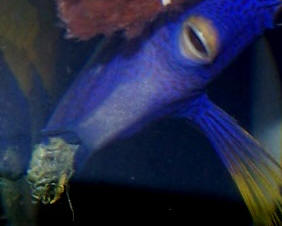
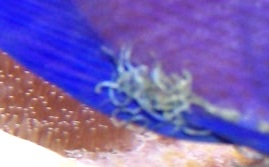
| ID - Please Can you tell me what is
hanging from my purple tangs rear end?? It's certainly not the
usual muck. Thank you, Julie. <Mmm, appears to be a good-sized
mass of worms... likely Nematodes... though it might be
Acanthocephalans... I would be treating this fish/system with a
vermifuge... Likely Levamisole... please see WWM re such. Bob
Fenner> |
|
|
| Figure Eight Puffer Parasite Hello Mr.
Fenner, I acquired several Figure Eight Puffers for a tank that I
recently finished cycling. The Puffers are the only inhabitants.
I've had Figure Eights for almost a year now in another tank,
so I'm pretty familiar with the usual health problems that crop
up with them, since most are wild caught. One of my new Puffers was
suffering from fungus, so I was treating the whole tank with MarOxy
as well as Maracyn and Maracyn ll for any infection that might be
present. Unfortunately, yesterday the sick Puffer took a dramatic
turn for the worse and died. I wanted to get a closer look so I
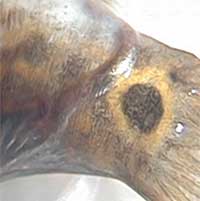
examined it under close-up magnification. Photos of what I found
are enclosed. The images are magnified approximately 34X. <Good
photo work> The parasites that I found aren't easily noticed
with the naked eye. One image shows an elongated lump near the tail
of the Puffer that is actually a worm living under the skin. Under
magnification I could see it moving. It's approximately one
inch long and 1/16" in diameter. There were A LOT of these
worms under the skin on various areas of the fish. <Yes...
nematodes> I was curious to see what might be lurking inside of
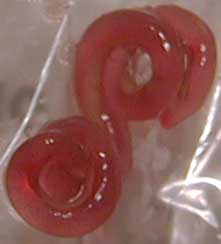
the Puffer so I sliced the stomach open. More worms rolled out of
the body cavity. These were in the body cavity and not in the
intestine (I hadn't yet perforated the intestine). The photo
shows one of the worms measuring between 1" and 1 1/4" in
length and 1/16" diameter. Interestingly, when touched the
worm retracts into a coil. <Typical> The other photo enclosed
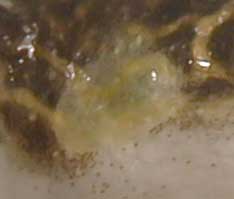
shows a yellow area that I assume is infection or irritation caused
by the worms. <Perhaps> I've had no luck identifying this
particular parasite. It just doesn't resemble the descriptions
I have found of other worm-like parasites of fish. I'm hoping
that you might know exactly what it is and also possibly recommend
a course of treatment. I'm stumped! Thanks in advance. JoAnn
VanDersarl <Hmm, where to start, or how to narrow down a
statement here... The infestation you describe and show is likely
resultant from an initial exposure from the wild... these roundworm
parasites typically have "complex" life cycles that
require one or more intermediate hosts... Maybe some lack in diet,
environmental challenge hastened the "winning" (and
ironically losing) phase of the worm parasites causing the death of
their host (and themselves), but perhaps not much... It's very
hard to access (unless you sacrifice and examine a significant
portion of a good size sample of individuals) how much of what
their parasite load is... All vertebrates (yes, including you and
I) have something of such a mix of organisms living in and on us...
Please read here: http://www.wetwebmedia.com/mardisease.htm and the
FAQs beyond for more of a general understanding of the
predisposition to these events. Bob Fenner> |
- Wasting Disease - <Hello, JasonC here...> Hi crew,
have a problem I haven't been able to find much on. Have a Sebae
clown, wild caught, about 4 years old; always been in perfect health.
Recently, I moved him to a larger tank, fish with some inverts, no
anemones (yet). About 2 weeks later he developed Popeye, one eye, which
I successfully treated with Epsom (thanks!). He still has a good
appetite, even still has that pearly iridescence around the white bands
that fresh-caught clowns have, BUT, he is beginning to lose mass;
first, developing the typical pinched forehead, now progressing
rearward both above and below the lateral line; no other clowns in the
tank, other specimens unaffected. He eats and comes out less but is
otherwise still pretty normal. <So you do see the fish eating... it
would seem to me with the other occupants, this fish might be getting
less that its fill.> His offered diet hasn't changed, if
anything is better because I am feeding a large French and Atlantic
blue tang, and very wary of HLLE, so they eat better than I do. My past
experience is that this guy is headed for checkout, but its been a
while, and if there is anything I can do I want to do it, so,
suggestions? <Well, isolation might help - make sure the fish is
eating well and without competition from the larger fish. Also, because
this is a wild fish, it is also more likely that it has an internal
parasite (or two) that are competing for the same nutrients, quite
possibly nematodes or Cestodes [tapeworms]. Both can be treated - you
should be able to obtain Praziquantel [for the Cestodes] and/or
Fenbendazole [for the nematodes] from your local veterinarian. I would
work with one of these at a time, and administer in baths for 2-3
hours. More information on these treatments can be found in the Edward
Noga book, Fish Disease, which while expensive is very complete... and
an eye-full.> Thanks, Steve J. <Cheers, J -- >
|
|