|
FAQs about Live Rock Hitchhiker/Creature
Identification 15
Related Articles: Live
Rock, Reef Systems, Refugiums,
Related FAQs: Live Rock, Answering
Some LR FAQs by James Fatherree, LR
Hitchhiker ID 1, LR Hitchhiker ID
2, LR Hitchhiker ID 3, LR Hitchhiker ID 4, LR Hitchhiker ID
5, LR ID
6, LR ID
7, LR ID 8, LR ID 9, LR ID
10, LR ID
11, LR ID 12,
LR ID 13, LR ID 14, LR ID 16,
LR ID17 LRID 18, LRID 19, LRID 20,
LRID 21, LRID
22, LRID 23, LRID 24, LRID 25, LRID 27,
LRID 28, LRID
29,
LRID 30, LRID 31,
LRID 32, LRID 33,
LRID 34,
LRID 35, LRID 36,
LRID 37, LRID 38,
& Non-Vert IDs 1, Tubeworm ID, Polychaete Identification, Live Rock 1, LR
2, LR 3, LR 4, LR 5, Curing Live Rock, Live Rock Selection, Shipping/Moving, Placement, Lighting, Water Quality, Live Rock Studies in Fiji Collaboration
& Charts, Copper Use, Marine Landscaping, Marine Biotope, Sumps, Refugiums, Faux
Rock,
|
|
|
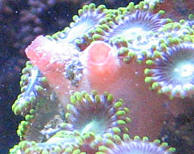
Red Tube Hitcher 02/19/2008 Good afternoon!
<<Hello, Andrew here>> I've noticed some strange
red tubes among some zoanthids today and I was wondering what
they were. I figure they are some sort of filter feeder, but
I'd like to know if they are harmful to my zoas. These tubes
shut and retract a bit if I touch them. I have attached a couple
photos of them. There are more on that rock, too, but all seem to
be connected to something in the base. Thank you for your time!
Zoë Stevens <<What you have there is a sea
squirt, or otherwise known as an Ascidian. These are a harmless
filter feeder and will not hurt your Zoa's. More info can be
found here and the linked articles and FAQ's.
http://www.wetwebmedia.com/ascidians.htm >> <<Thanks
for the question. A Nixon>> |
|
 Who you calling a squirt? Who you calling a squirt?
|
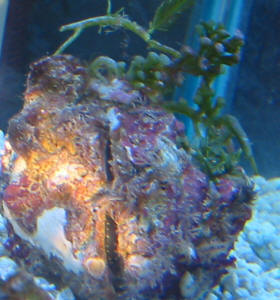
| New live rock really is alive! Using
WWM 2/14/08 Hi, <Hello there> A couple days
ago my girlfriend bought me a small (half pound) piece of
cultivated live rock for my tank. She got it to help my tank
rebuild the beneficial bacteria because I just broke it down and
started over almost from scratch. The tank is a 29 gallon and it
had been running for over 20 years but had barely been touched in
the last 5 years (my father took care of it before). After talking
to someone at a well respected fish store, he recommended I break
down the tank and replace almost everything (replace the crushed
coral, remove the under gravel filter, etc.). I took his advice and
bought new crushed coral, replaced the under gravel filter with an
Aquaclear 50 and SeaClone 100 protein skimmer. I also upgraded to a
high output 50/50light. For the moment I'm using the old
heaters and one of the powerheads for extra circulation. The only
inhabitants are a Damsel, a Clown, 2 Bumble Bee Snails, and a few
stalks of Xenia (which are the main reason I wanted to clean things
up in the tank). After I broke down the tank I put some of the old
crushed coral in a bag in the power filter to help with biological
filtering. Otherwise almost everything except the livestock is new.
The only problem I'm really having is that the PH is too low
for the Xenia. <See WWM re pH and alkalinity...> I think the
problem is that our water is a bit on the acidic side and even
though I ran some of it through a RO system, that only made the PH
worse. <... removed what little alkaline material there
was...> We do have some Nitrates in our water (<20ppm)
<This is more than just "some"... I would not drink
this water, nor use if for cooking> but I'm not super
worried about that right now. Otherwise all seems good so far with
the water quality, though I realize the tank will probably have to
cycle again. Anyway on to my main question. The piece of live rock
my girlfriend got me looks beautiful. It's a deep purple and
has a good bit of plant life on it (which I'm fond of and hope
will grow). <Not plant... algae... looks like some sort of
Caulerpa...> I think it also has a couple pieces of Aiptasia on
it which I haven't decided what to do about them yet. After I
realized the Aiptasia might be hurting my Xenia I moved the live
rock to the other side of the tank. A few minutes later I noticed
that the live rock seemed to be moving! After convincing myself I
wasn't crazy, I realized it was moving. A small rift had formed
in part of the live rock. I took a flashlight and looked inside and
saw what looks a lot like teeth. Beyond that it doesn't look
very "rock like" inside. I also noticed that it closes up
when I turn off the light, so I'm fairly sure there is
something in there. <Does look like a bivalve...> I've
asked a few people who might know and they are baffled. They say it
might be a Clam or Oyster but I can't find any that look
exactly like it. What could it be? I would suspect it must be
something fairly hardy to have survived in there through
everything. I'd like to figure out what it is so that I know
how to take care of it. I've included the best picture I have
of it. Do you have any ideas? Thanks. <Please read here:
http://wetwebmedia.com/bividfaqs.htm And learn to/use the WWM
search tool, indices. Bob Fenner> |
|
|
|
LR Hitchhiker: Sea Slug or Flatworm -
2/12/08 Hey WWM, (great site!) <Hey Bill, thanks!>
Today, my roommate and I were upgrading from our 28g reef tank to
a nice 46g bowfront. <Nice!> As I was moving the live rock
from the 28g, I noticed a very small critter crawling on the
glass. <How small/what size?> It looks like a slug of
sorts, two antennas, slug like body, with very small bright neon
green things running down it's back. <What kind of
'things' - stripes, bumps, ruffled/finger-like
projections (cerata), etc?> I was amazed to find yet ANOTHER
critter to appear, and in turn, it brought me directly to my
computer in search of an answer. Any help would be much
appreciated. <Hmmmm, it does sound like a sea slug or flatworm
of some sort but without a photo, that's about as close as I
can get to an ID. Most of these guys are obligate feeders that
hitchhike into our tanks, survive until the food source is gone,
then die out. Unless you have a tremendous number of these, or
are seeing some damage, I'd leave them and enjoy them for as
long as they're around. Please see WWM for more information,
comparison: http://www.wetwebmedia.com/seaslugsopisthobranchs.htm
http://www.wetwebmedia.com/nudibran.htm > Thanks Bill
<You're very welcome! Take care, -Lynn>
Re: LR Hitchhiker: Sea Slug or Flatworm -
2/12/08 <Hi Bill!> Thanks, for that great info,
<You're very welcome.> it appears to be very similar to
Flabellina exoptata, which I found through your link.
<Great.> I would say, it was about a centimeter long with
finger like projections running down it's back, just like you
asked. However, the colors weren't like anything I saw in
those pictures. Maybe it varies coloring as it ages. <Color
can vary quite a bit with sea slugs. I'm not sure whether it
varies with age, but it's possible. I know they vary
according to region, diet, whether they've just fed, or are
starving, etc. It's entirely possible, though, that your
little sea slugs could be another species within the genus
Flabellina, or in the same family, Flabellinidae. There's a
lot of red, orange, and violet in that family, but not much
green, however. I did find one (Tularia bractea) that had green
cerata. Here's the link for you to compare:
http://www.seaslugforum.net/factsheet.cfm?base=tulabrac Also,
here's the species page for the Sea Slug Forum. This is a
terrific site. If you have the time (and T. bractea isn't the
right species), you can look through, and compare the others
listed: http://www.seaslugforum.net/specieslist.cfm .> Thanks
again, and I'm sure you guys appreciate proper spelling and
punctuation. ;) <Heheeee! Yes, we do, and thank you! Take
care, -Lynn>
|
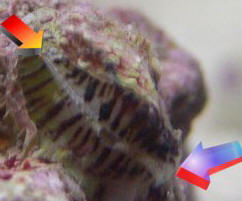
What is it? -bivalve ID 02/07/08 Hello WWM
crew, and hope your day is going well. We have a
"critter" on our live rock that we noticed some movement
out of about a week ago. The LR has been in the tank for about 4
months now and was fully cured when we got it. It almost looks to
us like some type of clam or something. It has a sort of
"tongue", for lack of a better word, that sticks out
where the bluish arrow is in the picture, and when we tap on the
glass it retracts and constricts. We also see it "close"
from the red/yellow arrow all the way around to the same spot on
the other side, almost like a clam shell closing. It is never
"open" more than you see it in the pic though, and we are
quite curious as to what exactly it is. It seems firmly attached or
fused to the LR and the only movement is when we tap on the glass
and sometimes when we approach the tank. So, oh wise and wonderful
WWM crew, what is it? Is it harmless or something to be concerned
about? <Well it does certainly appear to be some type of bivalve
(and a pretty cool looking one too!). I couldn't tell you which
specifically. Please see here for some help get a better idea of
what it might be: http://www.wetwebmedia.com/bivalvia.htm In any
case, I don't know of any such bivalves that could be any
problem. They're all pretty harmless.> Thanks for all of the
great info and help once again. <De nada,
Sara M.> |
|
|
Re: Unattractive Sand Bed, Lack of Coralline and Green
Live Rock 2-05-08 THANKS. THANKS, THANKS, Rich - you guys are
the BEST!!!!!!!! I would never have attempted the saltwater hobby
without WetWebMedia help. (I try to limit my questions to one post a
year, however long that post is! (LOL) <Ask Away!> Aleasha P.S. I
recently discovered what I believe to be two tiny sponges (white,
round, fuzzy puffy things) on my live rock AND what must be a
hitchhiker from somewhere - a tiny sea hare-looking creature about a
quarter inch long. Hoping this is a good thing, and loving discovering
new things to add to my tank's (lack of) biodiversity. <probably
tunicates or sponges. This link should help, follow thru all parts for
more info... http://www.wetwebmedia.com/sponges.htm > Thanks again
and will let you know how it goes after implementing your suggestions!
<Please let us know if things improve!-Rich>
Critter identification and questions
-01/30/08 Hello Crew, I commend you all in your vast source of
information you've put together here on the web. I've spent
countless hours reading through this material and quite frankly,
may have a case of information overload. I'm new on the
saltwater scene and loving every minute of it. I've just
finished setting up my 38 gal corner tank w/ a 4"-5" DSB
and I added 40 lbs of live rock a few days ago from the LFS. I few
things have emerged for the LR and I'm hoping you'll
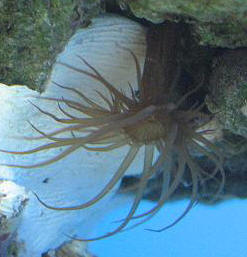
confirm what I think they are. I believe pictures 1 & 2 are
button polyps, <Pic 2 is an Aiptasia. Pic 1 looks more like a
button polyp.> although I'm not sure if they're the same
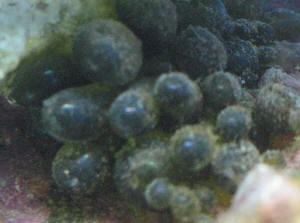
species. I think pictures 3 & 4 are the either bubble coral or
more likely bubble algae, <bubble algae for sure> but the one
in 4 may be dying. I'm also concerned that I may have partially
covered the mouth of #3 with LR (if it is bubble coral). <No,
this is not coral.> Can it move or reposition itself since I
glued the rock in? I've also seen some snails and a couple of
small bristleworms. What do you recommend I start feeding them all?
<Please see here:
http://www.wetwebmedia.com/ca/cav1i3/Progressive_Recipe/Progressive_Recipe.htm>
By adding cured LR, can I consider my tank "partially
cycled". What do you recommend should be the order of
additions? I thought I had read somewhere to add corals first, then
fish and finally invertebrates and the clean-up crew. Is this
correct, or does it really matter? <Maybe this will help:
http://www.asira.org/cycling Also, please do make use of the search
feature on this site for more info.> Thank you for your
help...I'm sure I'll be back again soon. MIKE <Best,
Sara M.> |
  |
LR Hitch hiker ID... s -- 1/28/08 Hi
Guys and Gals, I've recently gotten back into the whole
aquarium thing after a long absence, boy have things changed!
Anyway, I'm fascinated by this whole Live Rock thing. <Is
indeed amazing> In fact, in the 5 months that I've had the
tank up, the only fish I've added is a fire goby because
I'm so amazed by all the things you get for "free"
when ever I add live rock! Okay, now I'm realizing that
it's not ALL good. I'm pretty sure that I'm a proud new
owner of a Glass Anemone <Yes> So as part of the battle, I
bought a peppermint shrimp. We'll see how that goes. Please
tell me if I'm wrong about the ID on this little guy, I
wouldn't want to harm him if I don't have to. (Notice how
the pests are always "he"s?) <Mmm, yes... but
hurricanes are labeled for the tender gender...> Then I found
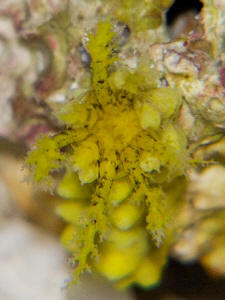
this thing on the back of one of my rocks the other day. It's
bright green with darker green longitudinal stripes. It doesn't
like the flash on the camera either and closes up when it goes off.
It's not hard shelled, but firm. It's about an inch long
and has a really solid hold on the rock and doesn't react if I
touch it. I was thinking some kind of sea cucumber, but I've
spent hours (at work of course!) searching the web and WWM, but I
don't see anything similar. <Looks like a Colochirus to
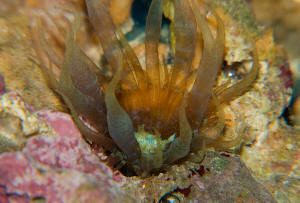
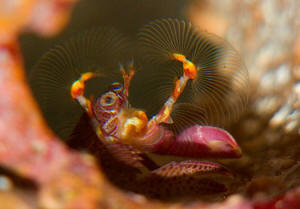
me...> Last but not least, there's this crab... At first, I
thought it was my scarlet crab out of it's shell, but now
I'm almost positive that that's not the case. The hole in
the LR he's in in this photo is about 1" in diameter. He
uses those fans as filters and grabs unseen stuff every couple
seconds. I'm suspicious that this might be what has been
beating up on my fire goby. This is the only time that I've
seen it. <Is a type/species of Porcelain (false) Crab... a Squat
Lobster...> any ideas on IDs would be greatly appreciated.
I'm hoping that I don't have to try to get rid of any of
this. <I wouldn't> I would like to eventually have a
mostly reef tank, mostly soft corals and anemones. <Do read re
this last...> Thanks for all your help! I've been reading
through other posts here for the past couple of months and it seems
like you guys have great info and big hearts for taking the time to
share it! Kirsten
<A pleasure, adventure to share. Bob Fenner> |
|
|
White bacteria/fungus growth on live rock... oh
yes -- 1/26/08 Hi Guys! Great website and a special thanks
from someone who's just getting into the hobby. I have had my 125
salt water tank for about 4 months and have enjoyed every minute of it.
My water conditions are: 1.025 salinity, 0 nitrates, 0 phosphates and
have various fish including a blue, purple and yellow tang, a few
clowns, 4 anemones, <Yikes...> a couple of yellow watchmen
gobies, pistol shrimp, about 40 snails, 25 Nassarius snails, etc. (they
all seem to get along. I think it's the way I introduced the more
aggressive fish later on). My question is about my live rock. I
supplemented my live rock with some dead base rock hoping the seeding
would work and it the base rock has started to turn a nice
green/purple. <Mmm, likely will in time> Recently, however, I
have noticed a pure white growth starting on the dead base rock and has
now started to grow on my purple live rock. Is this bad?! <Mmm,
nope> I took a rock out and looked at it more closely. It isn't
slimy or 'hairy' and I tried scrubbing it off with no luck.
Could this be algae growing that hasn't got it's colour yet?
<Yes... or... sponges... but likely a mix of species... algal and
otherwise... but no real worries> Any help would be greatly
appreciated. <Please read here: http://wetwebmedia.com/lridfaq14.htm
and the linked files above in the series. Bob Fenner> Thanks,
Pat
LR Hitchhikers 01/16/2008 Good evening Bob &
Crew, <<Hello, Andrew here>> I trust this e-mail finds you
all well. <<Very well thank you Mike, however your attached image
only shows a white square??>> It finds me confused, but I guess
you get a lot of that. I either just received a nice bonus from my LFS
or I received a problem. I'm hoping that you might be able to tell
me which. I recently purchased a Leather Coral of the Toadstool variety
3?- 4?across the top on a 6?stem and it is now in my 14gal. Oceanic
Bio-cube. This is a live sand and live rock cube with two small A.O.
Clowns, a tiny Common Cleaner Shrimp, four Hermits and a Short Tentacle
Plate Coral. I've just purchased the Oceanic Skimmer for this cube
but haven't installed it yet. So far parameters are holding at 78
deg., SG 1.023, PH @ 8.2, 0 ammonia and nitrites, 10 nitrates, calcium
over 300 (sorry, that's as close as I can get - cheap quick dip
test kit recommended by LFS will be changing it for standard kit next
trip). <<Good idea. The dip strip variety of testing kit are very
inaccurate>> To my recent findings. The Leather Coral came
attached near the edge of a small flat rock about 4? across. I had a
perfect spot for this on the substrate and all was well until this
morning when someone in my office asked me Is this what you mean by
Live Rock?? Camouflaged and encrusted, if you will, right into an edge
of the rock is a living clam just over 1" long. A boring clam I
presume Dr. Watson. There was no colorful mantle to give it away and
the entire clam, except for a thin darker line around the opening edge
of the shell, is the exact same color and height as the rock. It is
opening and closing ever so slightly and slowly and was barely
noticeable. <<Would need a photo to give you an identification of
the clam>> Now if that wasn't enough, when we were examining
this tiny clam, we noticed that in the middle of this rock (relatively
flat across the top) there is an area approx. 1?x 2?(also relatively
flat and again looks exactly like the rock in color perfectly
camouflaged) that was moving up and down like a diaphragm, again just
slightly and very slowly almost unnoticeable but definitely moving. It
looks like the middle of this rock is breathing! <<This will
either be a flatworm/Nudibranch/sea slug and again, a photo would be
needed to identify this for you. Review the attached links on
these>> <<http://www.wetwebmedia.com/nudibran.htm>>
<<http://www.wetwebmedia.com/seaslugsopisthobranchs.htm>>
<<http://www.wetwebmedia.com/flatworms.htm>> Now I'm
faced with a nice palm tree looking Leather that seems happy enough,
some type of baby Boring Clam and who knows what (sponge?) all on a
little flat rock about the diameter of a tennis ball. Mother Nature can
really pack it in, I guess, but the Leather sure had that cultured look
on display in the store. Did everyone along the way miss all of this?
<<Sometimes the hitchhikers are not that easy to spot and some
fish stores will only give live rock a cursory look for obvious
hikers>> I have a few concerns here. I have been unable to ID
this clam. Will it grow to 6? or 3 feet (if it survives)? It is still
getting direct light from the stock PC's on an angle because the
Leather is tall and not too wide across (but that might change soon)
and I have no idea what is slowly pulsating in and out in the middle of
this rock! <<If you can email more photographs of these, we shall
be able to identify them>> Is the clam at risk from partial
shading from the Leather? Could this pulsating ?thing? be some kind of
well camouflaged sponge of the type that can be harmful to clams? Can a
sponge look exactly like the rock? Could the Leather be at risk from
this as well? <<All these questions, and more light on the
subjects with pictures>> Folks, this one is beyond my limited
knowledge and powers as an aquarist. I need a surgeon and an exorcist!
Do you have either, or both, in your crew? I could just bring this back
to the LFS, but I doubt they will be bringing a Priest to the operating
room anytime soon either. They might just charge me more for the clam
and the creature from the deep that they missed! Should I get these
things out of my tank anyway? <<There should be no need to take
it back>> One just never knows what this hobby, and live rock,
will bring next. <<Its one of the wonderful aspects of marine
aquaria keeping, the little surprises we grateful receive on a new
piece of live rock, the diversity of life is immense> Any ideas?
Suggestions (other than Dr. Exorcist, that is)? Ok, ok, just one more
quick one if you don't mind (as if the first one wasn't
enough). I promise to make another contribution! (Don't worry - we
all know that's not why you ultimately do this) The LR in my newly
cycled 29gallon Bio-cube brought with it a ½? high white
stalk / stem about 1?in diameter and then the flat top is slightly
larger than the stem and sporting some tiny round brightly colored
medium green polyps? I can't ID this one yet either. Maybe it needs
to grow a little more to make ID easier, but in the mean time, I'd
like to be able to look after it so it has a chance to do so.
<<Sounds like it could either be a Zoa or a Paly, a photo again
would be better, as all I could do is just guess>> As always,
your time and attention are greatly appreciated. And now? my fish, my
corals, and the creature from the deep thank you. Mike from Canada, eh.
<<Thanks for the questions Mike, I hope to receive pictures by
return and we can get this cleared up for you as soon as possible and
give you an idea of what you exactly have. A Nixon>>
Live Rock ID Help, Sponge Perhaps 12/5/07 Hello
WWM Crew, <Hello> First off, thank you for the excellent
resource. WWM has helped me establish my 29 gallon FOWLR. <Thanks
for using it.> The tank has been up and running for 4 months now,
and things are going great. Tank params are currently: Salinity 1.026,
Nitrate 0, Nitrite 0, Calcium 410, Temp 77-79 (Natural light causes
slight rise during day). <Could bump up the heater so the
temperature holds steady at 79 if so inclined.> I have some
excellent coralline growth and have been told the recent molting of my
hermit crab is a sign of a successful environment. I recently switched
to 50/50 bulbs as my tank is relatively deep. Within a week of doing so
a bright orange growth appeared on my LR. This growth is approximately
3 inches in circumference overall and is composed of multiple tiny
(1mm) hex's or ovals. It is relatively hard (think Astroturf..not
soft like grass or hard like rock) to the touch and does not react when
touched (no "open" or "closed" state). A photo of
this growth can be viewed here:
[url=http://www.saltbucket.com/d/11549-1/DSCN0794.JPG][img]http://www.saltbu
cket.com/d/11551-2/DSCN0794.JPG[/img][/url] . The growth in question is
just north of center in the picture. The shape is not easily seen in
the picture, but the orange color is apparent. The 'hex" shape
is identical to the green growth surrounding the orange growth. I am
assuming both the green and orange are the same specie of organism. If
you could please help me identify what this is I would greatly
appreciate it. Thank you again for all of the information and hard work
you put into WWM. Sincerely, Scott Pasley <Looks like some sort of
sponge growth to me, hard to be more specific without using a
microscope. Will probably continue to grow as long as whatever
conditions favor it are maintained.> <Chris>
White Squiggle?-11/28/2007 Hello Crew! After weeks
of reading through your website months ago), I have decided to start a
Reef Aquarium. Can you say INTIMIDATING? I have a couple questions.
This is my first post, and I would appreciate any constructive
criticism. 1. My readings and tank specs are as follows. 55 gallon
standard aquarium. Seaclone 100?Protein skimmer Tetratec 30-60
mechanical filter w/carbon 2- 30 gal. heaters (maintaining 77-78 F) 2-
250 gph powerheads approx. 45-50 lbs. live rock 2- 65 watt actinic
blue? lights 2- 65 watt 10,000K whites salinity = 1.025 calcium = 360
(supplemented w/ Fuji Gold) <Hmm, I suggest using something else for
calcium and alkalinity adjustment (Kalkwasser, 2 part solution, and/or
baking soda, calcium chloride, etc.) ammonia = 0 nitrite = 0 nitrate =
0 2. As far as livestock goes; 1- lonely Mushroom A 3x3 in. colony of
green Zoanthids 1- Pulsing Xenia 2- different unidentified leather
corals maybe finger and toadstool) 1- serpent star 1- Cleaner Shrimp
(HUGE!) about 10 of each: Blue leg hermit, Astrea, and Cerith Snails.
1- False Percula (in quarantine) 1- neon cleaner Goby (in quarantine) I
also seem to have a sponge infestation (About 25, Sycon's I
believe... white, cotton looking, ovular shaped with a
"crown") I have a noticeable amount of little bugs crawling
around too, which from what I have read is good. (typical microfauna?)
<Yes, this is a good thing.> Onto my question. Last night I
noticed something extremely peculiar on a piece of live rock though. It
is a white, "squiggly" substance. It looks fairly porous, and
only extends about 2.5 in. Are these possibly eggs of something? I did
not find anything in your search feature that resembled this. And I
tried to get a picture, but had no success, it is too small and I
cannot get my camera to focus on it. Is this something I should worry
about? <Can you determine if this is a living thing? Does it retract
during the day? Honestly, it could be just about anything: mesenterial
filaments, egg mass, sponge, worm... it's really impossible to say
without a good photo.> Your help and criticism will be greatly
appreciated. This hobby is SOO extensive <That it is.> that it is
a great to know you are here to answer questions. Thanks a MILLION!
<My pleasure,
Sara M.>
|
|

