|
FAQs about Live Rock Hitchhiker/Creature
Identification 13
Related Articles: Live
Rock, Reef Systems, Refugiums,
Related FAQs: Live Rock, Answering
Some LR FAQs by James Fatherree, LR
Hitchhiker ID 1, LR Hitchhiker ID
2, LR Hitchhiker ID 3, LR Hitchhiker ID 4, LR Hitchhiker ID
5, LR ID
6, LR ID
7, LR ID 8, LR ID 9, LR ID
10, LR ID
11, LR ID 12,
LR ID 14,
LR ID 15, LR ID 16, LR ID17
LRID 18, LRID
19, LRID 20, LRID 21, LRID 22,
LRID 23, LRID 24, LRID 25, LRID 27,
LRID 28, LRID
29,
LRID 30, LRID 31,
LRID 32, LRID 33,
LRID 34,
LRID 35, LRID 36,
LRID 37, LRID 38,
& Non-Vert IDs 1, Tubeworm ID, Polychaete Identification, Live Rock 1, LR
2, LR 3, LR 4, LR 5, Curing Live Rock, Live Rock Selection, Shipping/Moving, Placement, Lighting, Water Quality, Live Rock Studies in Fiji Collaboration
& Charts, Copper Use, Marine Landscaping, Marine Biotope, Sumps, Refugiums, Faux
Rock,
|
|
|
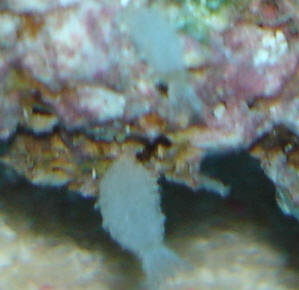
... ID w/ poor images - 7/23/07 No new news this morning.
However I do have 2 pictures of the bubble tip thingy. One first
thing after lights on, waking up, mouth closed. The second you
can see the tongue thingy hanging out and the base to the left. I
would say this is a coral except it moved once when we first got
the rock home and it has the base. The tentacles will expand with
water at the tips just like a bubble tip, they will also get
slender and stretch out longer. Took this from the top of the
tank after moving the rock it's on so I could get the shots.
Take care Bridget <Too small, blurry-unresolved to make out
definitively. Bob Fenner>
Need some help please on an Id - 7/23/07 Hi everyone! I
need some help, please, on a Marine query titled: "Re: Stone
crabs in my tank (not)". I've been helping Bridget with
(obviously) a crab issue, among other things, but now she's
needing an Id for something ) and I don't know what it is! It
doesn't help that the two photos aren't very clear, but
it's described as mobile, pink, almost BTA looking, but with
a "tongue thingy" that hangs out occ. What the heck is
that?! Anyway, I found the query this morning in my folder, but
kicked it back out to Marine. Thanks, ahead of time, for
y'all's help! Take care, -Lynn (Clueless in Seattle!)
<Thank you Lynn... I too can't really make out what these
are... need higher res., and sized images... The one is likely a
polypoid animal, perhaps an Actinarian, but... Bob Fenner>
|
|
.JPG)
|
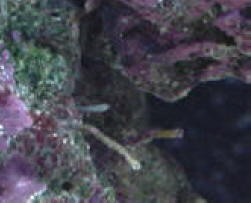
Bryozoans or feather dusters 7/19/07 I have
always thought that the really small thing growing on my LR where
feather dusters. But after reading about Bryozoans on you super site
I'm now wondering . Here is a picture and a link to a short video
31 sec.
http://s200.photobucket.com/albums/aa92/emccullough1/?action=view¤t=feather.flv
They are a little easier to make out on the video in the foreground.
Thank you in advance . Your web site has been the absolute best for
finding information on most every question I have. <Greetings!
Perhaps uniquely among the WWM crew, I've (slightly) studied
bryozoans and named a species, Jellyella eburnea, that encrusts
floating things in the sea (like Spirula and Janthina shells). But I
have to admit to not knowing the answer here. The video doesn't
offer enough resolution. Bryozoan "polyps" are normally very
small (sub-mm in size) and the tentacles (the lophophore) doesn't
really wave about in midwater. Each polyp fits neatly into a small
"box" and these make up the colony. The lophophore has a
bent, roughly horseshoe shape. Marine Bryozoan colonies are typically
calcareous or made from a tough, leathery substance; freshwater
Bryozoan tend to look like lumps of jelly. Either way, their appearance
is usually very distinctive. Colonial tubeworms are more varied and
while some build tubes from carbonate or sand grains others live inside
channels in rock or mud. The tentacles on tubeworms are either one or
two spirals of feathery tendrils, very different to the lophophore of a
Bryozoan. So, with all this said, I hope you can ID your beasties
yourself, or failing that, send along a close-up photo that might
reveal these salient features. Good luck! Neale>
Re: Bryozoans or feather dusters - 7/20/07 Thank
you for your reply. And believe it or not that is a close-up the
craters in the rock are about 1/16" to 3/32 " across the
feathers are not visible to the eye. But from your superb discretion of
Bryozoans I'm back to thinking they are some sort of tiny feather
dusters. <Cool. Glad to be of help. Either way, they look like very
interesting beasties. Cheers, Neale>
|
Invertebrate Id's - 7/18/07 Dear
WetWebMedia Crew -- <Hi there!> First, let me say thanks
for your website. We've learned a lot from reading all the
responses you've posted to everyone else. (That's a
fantastic resource.) <Why thank you!> We are brand new to
the aquarium game and have just set up a 55G tank with live rock
(live rock came cured, everything settled very quickly and tank
has been running smoothly for almost a month now), a few fish (2
scissortail goby dartfish and a dwarf tang, <(?)I'm not
familiar with this fish but I don't know of any tangs
suitable for a 55g.> ...will be adding more over the next
month), <Go slowly/conservatively when choosing/adding more
fish this early on, and be sure to keep an eye on water
chemistry.> ...and a couple of Aiptasia-eating shrimp (which
happily ate all the Aiptasia that came on our live rock over the
course of a couple of weeks). <Yay, I love it when that
happens!> We have a couple of questions, particularly about
the remarkable diversity of invertebrate life that came on our
live rock. <It's amazing, isn't it!> 1. In addition
to the feather dusters and the pulsing xenia that came on the
rock (xenia now seems to be growing slowly - new arms appearing
on its base), we just discovered a Discosoma (is small, flat,
approximately 1" when spread out, purple with green dots in
lines spreading from the center). <Sounds pretty!> It seems
ok, but our question is that it moves. It is sitting in a crevice
in the rock. During the night and much of the day, it pulls into
the crevice where we can't see it at all. For several hours
during the day (particularly late in the day), it emerges, and
spreads out to its full width. Is this normal? <Hmmm, not for
any Discosoma that I've heard of/seen. I'm thinking
it's probably not a Discosoma.> Is it ok? <Most likely
typical for whatever it is.> We haven't found any
indication of any behavior like this in the websites or books
we've looked at. <I'd love to see a picture of this
little guy. It sounds like it might be a type of anemone to
me(?).> PS. Our light cycle is 130W blue actinic for 1.5 hours
AM and 1.5 hours PM with 9 hours 130W white actinic in between.
Xenia started growing once we increased the lighting about a week
ago. <Yep, they appreciate more light.> 2. Last night, in
the dark, I discovered a brand new tentacle (4" long, single
tentacle, 2mm wide, broad bands of beige and dark, was beige with
black dot at center of end of tentacle). Weird thing is that the
tentacle hates light. <Heeee! I'm pretty sure I know what
this is! Don't worry, it's good.> I'm wondering if
it's an arm of a brittle star. <Don't think so!> If
so, is it dangerous? <Aaaahh, run for the hills! <Grin>
Sorry - no, it's okay.> Anything else it could be?
<Well, without a picture, I can't be positive, but it sure
sounds like a Peanut worm/Sipunculid. They're harmless little
detritivores that always remind me of elephant trunks sniffing at
the rocks. Color-wise, they are just as you describe, with or
without bands. The body/band colors vary from whitish to beige,
tan, brown, grey, and black. Please see these links for photos
and more information re:
http://www.wetwebmedia.com/pnutwrmidfaqs.htm
http://www.reefkeeping.com/issues/2004-04/rs/index.php. > It
was only one arm, moved slowly, but was very flexible, clearly
controlled throughout (i.e. it was not waving in the current).
<Typical for these guys.> Any sort of light I bring towards
it makes it pull deep into the rock until we can't see it
anymore. <Again, very typical.> (Can't get picture
because don't want to shock the other creatures in the tank
with the flash. <Understandable, and okay. Just check the
photos at the above links for comparison/confirmation.>
[I'm sure our corals are living on the edge having survived
shipping and the whole new tank thing.]) 3. We've seen a
small crab hiding in another crevice. We've only seen legs,
even at night. We've seen definite small black claws and what
look like hairy legs. I would guess that the current size is
1-2" including legs. <Hmmm, yes, watch out for crabs.
They're cute, and seem harmless, when they're little, but
most are opportunistic and can grow up to be trouble. Please see
these links for more information on crab ID'ing and advice
(see the Xanthid group at the first link):
http://www.reefkeeping.com/issues/2003-12/rs/index.php
http://www.wetwebmedia.com/marine/inverts/arthropoda/crabs/swcrabs.htm
> Thanks for your help (and for your wonderful website) Dave
and Laura <You're very welcome and thanks for being a part
of it! --Lynn>
Re: Invertebrate Id - follow-up - 7/19/07
<<Hi Dave and Laura! Lynn here again.>> Thanks for
your reply. <<You're very welcome!>> Here's a
picture of the "Discosoma" and some other
notes/questions. <<Okay, let's roll!>>
>>...and a dwarf tang, <(?)I'm not familiar with
this fish but I don't know of any tangs suitable for a
55g.> It's something called a "chocolate yellow mimic
tang". It's supposed to stay <6".
<<Gotcha, that one I do know! It's Acanthurus
pyroferus, and although they can actually get up to 10' in
the wild, they're apparently slow growers, and I've never
heard of one reaching that size in captivity (now that's
sad!). Depending on what size yours is now, you may be okay for a
while. Just keep an eye out for stress related problems down the
road (disease, aggression). Tangs need lots of space and
don't do well when they feel confined.>> >...will be
adding more over the next month), <Go slowly/conservatively
when choosing/adding more fish this early on, and be sure to keep
an eye on water chemistry.> We're adding an average of
less than 1 fish/week and tank chemistry seems good... at least
so far. <<Yep, sounds okay. Generally speaking, I
wouldn't add more than one fish every two weeks. It just
depends on the size/type of fish, set up, etc.>> We've
got both live sand and 70 lbs of Marshall Islands live rock (so
is high volume for weight) which had already been very well cured
at our LFS. <<Nice rock!>> >> appearing on its
base), we just discovered a Discosoma (is small, flat,
>>approximately 1" when spread out, purple with green
dots in lines spreading from >>the center). <Sounds
pretty!> It seems ok, but our question is that it moves. It is
>>sitting in a crevice in the rock. During the night and
much of the day, it pulls >>into the crevice where we
can't see it at all. For several hours during the day
>>(particularly late in the day), it emerges, and spreads
out to its full width. Is >>this normal? <Hmmm, not for
any Discosoma that I've heard of/seen. I'm thinking
>>it's probably not a Discosoma.> Is it ok? <Most
likely typical for whatever it is.> >>We haven't
found any indication of any behavior like this in the websites or
books >> we've looked at. <I'd love to see a
picture of this little guy. It sounds like it might be a type of
anemone to me(?).> Unfortunately, it didn't appear
yesterday, so we're worried it's died, but we've
attached a picture of it from a few days ago (purple1.jpg). Sorry
for the blurry pic. <<No worries, I know how difficult it
can be to get those pictures! It does look a lot like a little
Discosoma/shroom of some variety (possibly two there in the
photo), but I'm sorry, I just can't see it/them well
enough to tell. Hopefully, if/when it comes back out we can try
again!>> >>2. Last night, in the dark, I discovered a
brand new tentacle (4"... <Well, without a picture, I
can't be positive, but it sure sounds like a Peanut
worm/Sipunculid. They're harmless little detritivores that
always remind me of elephant trunks sniffing at the rocks.
Color-wise, they are just as you describe, with or without bands.
The body/band colors vary from whitish to beige, tan, brown,
grey, and black.> That's exactly what it is! Thanks!
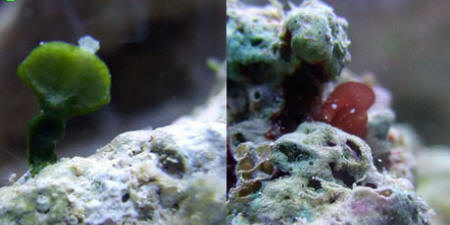
<<Yay, you're most welcome!.>> Also, any idea
what this is? (red1.jpg, red2.jpg) The big leaf came on the live
rock. The little (4mm tall?) pieces are spreading over the rock.
<<Both appear to be some sort of Rhodophyta (red algae)
although the larger pieces/whorls on photo 'red2' look
not too dissimilar from some corallines I've seen. I'm
sorry, I just can't quite see them well enough to
determine/narrow it down for you. One thing to note though,
it's a good idea to keep an eye on any algae that starts
spreading over the rocks like you mention. That's a pretty
good indicator of something that could get out of hand. Continue
practicing good husbandry, keep nutrient levels low, and if you
have a refugium with some competing algae, that's even
better!>> Thanks
Dave and Laura
<<Anytime! -Lynn>>
|
|
|
| Small tubes over rocks... Small Tube Snails
(Petaloconchus spp) 7/11/07 <Greetings! Mich here.>
Could you guys tell me what those small tubes are.
<Hopefully!> They are coming out all over my live rock? They
are hard, can't see anything coming out and some are linked in
a single cobweb texture. <At first glance, I thought these were
the calcareous tubes produced by the Serpulidae family of feather
dusters. However, your description more closely fits Caribbean or
small worm snails (Petaloconchus spp) and closer visual inspection
would also indicate this to be the case.> I used to have some on
bottom of rocks but they have started to multiply rapidly. <Not
uncommon.> <You're welcome from one of the gals!> |
|
|
Hitchhiker ID's and a couple other
questions -- 07/01/07 Dearest Crew- <Hello Ester! Mich
with you again.> Let me thank you again for all the knowledge
and support you provide! <On behalf of Bob and the Crew,
you/all, are welcome!> My marine life is probably the most
thankful since they are really the beneficiaries! <Very
true!> Tank Specs: 5-month-old 75 Gallon 40 lbs. live rock 1/2
inch fine sand bed (I am looking in upping this to 3+ in the
future) Remora Pro w/ Mag Drive 3 and skimmer box (I have to clean
the collection tube, twice a day, to get skimmate since it gets
buildup really quickly, but I do get brown skimmate every day since
I perform this task). Rena Filstar xP canister filter (cleaned
every Wednesday and Sunday) Two powerheads for circulation
Corallife 260 watt compact fluorescent lighting system (12 hour
cycle) 2 Ocellaris Clowns 1 Neon Goby 2 Peppermint shrimp 2 Cleaner
shrimp 8 snails of varying types 11 hermits Feed with New Life
Spectrum 1mm pellets in the morning and Mysis in the evening
(making sure that nothing is left after 5 minutes) <Wow! Nice
regiment!> I have not had any water quality issues due to my
regular maintenance and weekly water change schedule so my
questions do pertain to that, but if you need to know: Ammonia-0,
Nitrate-0, Nitrite-0, pH-8.2, specific gravity 1.024 <All
good!> My addiction in this hobby is for the live rock and all
the extras you get with it! <I love watching the new life
develop... A bit like magic!> But due to our limited budget,
which I think is a blessing at times since it has kept our pace
really slow, we can only get one piece a month. <Slow and
steady.> My goal is to focus on the live rock until I get my 80
lbs. I want, and then move on to more fish or possibly a couple
corals. <A wise, reasonable plan.> So (finally) question #1:
my newest piece of live rock is long and flat, so I can either have
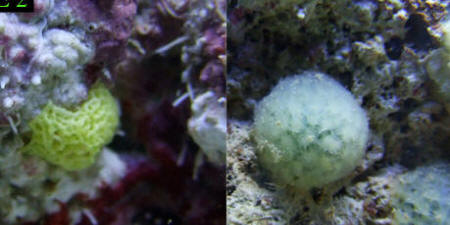
'side 1' up or 'side 2' up, but both sides have
some interesting algae, so if you can help me with an ID so I can
decide which side will be devoid of light... <Will try!> I
believe that the first one on the 'side 1' image might be a
type of Halimeda? The second, some type of red algae? <Yes. I am
in agreement with you.> On the 'side 2' image I think
the second one might be Dictyosphaeria cavernosa? and I have no
clue on the first one in this set. <I'm not sure of the
first photo on side 2, but I think both photos on side two are
sponges, the second photo may be a Spiny Ball sponge (Leucetta
sp.)> So which side do I put down and risk loosing the life do
to lack of light? <I think side two is likely to thrive without
light.> My other question pertains to HOB refugium... would the
large CPR AquaFuge 2 be worthwhile to the tank (my Birthday is soon
and I get to pick something out), or is it too small to really be
effective on a 75-gallon? I don't have the space under or
around the tank to get one that is not HOB. <Do you have a sump?
This is where I would put a refugium if space were limited, but any
refugium will benefit your tank. Though I'm not sure of the
cost/benefit ratio.> Finally, while I have you, our future fish
plans are for a Kole Tang and a school of Cardinals (5 maybe). Is
this overstocked if you include what I have currently? <I think
this would be ok, but I would go with one of the smaller species of
cardinals.> Especially if I would like to someday get a coral or
two? <Still should be ok.> Thanks again for your time, sorry
this was so long! <Welcome! No worries! Mich>
Esther |
|
|
|
|
Need help with identification 6/10/07 Hi
Crew! <Hi Liz!> I bought some cured live rock for my new 90
gallon tank (ammonia and nitrates 0, no fish in there yet) and need
help identifying the white things, for lack of a better word!
I'm attaching a picture, which you will hopefully be able to
see. <Nice picture.> I thought they might be Aiptasia, but
they do not move or shrink away when I touch them. They're
soft, squishy, and easy to rip off. What are they, do I want to get
rid of them, and what's the best way to do so? <They are
Syconoid sponges. You may read more here:
http://www.wetwebmedia.com/spongeidfaqs.htm You do not need to
remove them. They are harmless filter feeders. If for some reason
you do want to remove them, your rip off technique should
suffice.> As always, Liz
<Welcome, Alex> |
|
|
| Hitchhiker on a Rock, Blurry Photos --
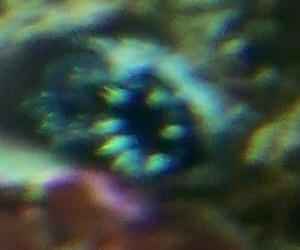
5/13/07 Hello to you, <And to you! Mich with you
tonight.> I recently bought a rock with star polyp. The day
after, I notice something on it, at first, I thought it was a
little piece of dead hard corals. But after looking at
it longer, I found that it was moving. Opening and
closing like a clam, with two holes, like a clam (the Tridacnid
Clams) and what look like lashes on one of the hole (again, like a
clam). So I dub it a boring clam since it moved inside the rock
when it feels vibration (that was me, kneeling too fast in front of
the tank to look), and I was amaze at how fast it moved and
disappeared, about an inch deep. But tonight, while I was watching
it, something was bordering it and it was moving itself with a lot
of freedom, squishing one side, then the next, up and down, like
somebody moving his mouth and trying to get ride of a fly. After
looking closer, I saw that it had no shell. Now the big
question, what is it? <Hmm, a very good question. I
do wish you photos were a little clearer. Does you
camera have a macro setting? Most do, the symbol often
looks like a little flower. This might allow you to
capture a better, more focused image.> Is it some kind of boring
clam, or something else? <If it doesn't have a shell, it is
likely not a boring clam. Perhaps an ascidian/tunicate
of some sort, better pics would help here.> I know from the way
it has two holes that it's a filter feeder, but should I
provide him with something to eat and what, phyto (DT's)? <I
would continue as you are.> Sorry for the pictures, it's the
best I could. <Look for the macro setting. It will
allow you to take better close-up pics and help us, help you to ID
your critter.> Thank you for your time. <Wish I could be of
more Karine |
|
|
| Re: Hitchhiker on a Rock, Blurry Photos, Now Not
so Blurry Photos... ID ? 5/15/07 Hello again,
<Hi Karine, Mich with you again.> I hope that this picture
will be more helpful. <Is clearer, thank you.> I forgot to
mention that the critter is half an inch from side to side. You say
it could be an Arcadian <Ascidian>/tunicate, but wouldn't
it be fix on the rock, this critter move very fast inside the rock
and far enough that I couldn't see it. <May not be an
Ascidian/Tunicate. Unfortunately I'm still not sure
what it is. Are you sure there is no shell? It does kind
of resemble a bivalve to me. RMF any
thoughts?> Thank you. <I apologize for the lack
of usefulness. Mich> Karine <<This newer photo
looks to me like a couple of anemones. Please read here re
discerning the major groups of Cnidarians: http://www.wetwebmedia.com/cnidaria.htm and the linked
files above and where you find them in-text. BobF>> |
|
|
A "Guest" Arrived on my Live Rock: Velvet
Swimming Crab (Necora puber) 5/13/07 Hi Guys, <Hi
Kim, Mich with you.> I just wanted to start by saying
your site has been a tremendous resource! It has helped me
many times. <Wonderful to hear!> I have tried hard to
find an answer to my question without having to ask but I'm not
having much luck. I hope you might be able to help me out.
<I will try!> I purchased 75 lbs. of live rock
recently and after about a week I found a
"visitor" I noticed a rather large (aprox. 2
inches) crab hiding in one of the holes in the rock. After
many attempts of trying to identify this crab I finally found out what
he is. It is a velvet swimming crab. <Necora
puber> His bright red eyes were the major give away on his
ID. <Ahh, yes, also called the Devil crab.> I
can't seem to find much information on him other than he is very
aggressive and gets about 4 inches across. I was wondering
what your opinion is on him. Should I leave him in the tank
or find him another home? <I would not keep this crab in
a tropical marine setup. It is not a tropical
species. This crab is typically found in the North East
Atlantic, off the shore of the UK! I'm not quite sure
how it ended up in your live rock. This crab can pack a
pinch that could bring tears to your eyes, so please be
careful. Perhaps a nearby public aquarium could provide a
suitable home.> The tank he is in right now is a 72 bow-front FOWLER
set-up. Thanks for your time. <You're
welcome! Mich> Kim
Re: a "guest" arrived on my live rock (Necora puber)?,
update: now Eriphia sebana. -- 5/13/07 I must apologize,
<No worries.> I just got a call from my LFS and they think they
may have found out that he is NOT a velvet swimming crab. <Ahh, the
initial ID did not make much sense, as Necora puber is a cool water
species, but stranger things have happened.> After doing their
research they now believe it might be Eriphia sebana. <This would be
more logical.> We have been working for over a month to ID this
guy. <Could have sent a photo here.> Which from what
little bit of information I can find on him makes more sense being that
they are from Fiji. <Yes, along with Australia, the
Maldives...> Could you tell me a bit about Eriphia
sebana? <Will try. Hmm, it seems I'm on a
toxicology run. What ever you do, don't eat this crab!
Ingestion can result in PSP Paralytic Shellfish Poisoning and I suspect
this potential for toxicity could also cause problems if the crab were
to die in you main system.> Should I leave him in or remove
him. <I would keep him isolated.> I do have an empty
10 gal. with live rock already set up and cycled for a hospital
tank....could I keep him in there? <I think this would
be wise.> If so...what should I feed him. <Most crabs
aren't too finicky. I would offer a
variety. Reportedly this crab eats algae during the day and
relies on predation for midnight snacks!> I'd hate to get rid of
him, he is very neat to watch at night. <Watch, learn and
enjoy! But be aware he can be an aggressive crab so between
the aggression and the toxic potential, you may need to keep this a
species tank.> Thanks again for all your help,
<Welcome! Mich> Kim
Strange Critter ID Please: Chiton
5/10/07 Hello there! <Hi Jo, Mich here!> I
know that you guys are really busy but I was hoping you might be
able to help me ID this critter. <Certainly will try!> We are
currently setting up our second reef tank. The LR is from Indonesia
as far as I know and this "thing" has showed up twice
now, both times at night with all lights off. It seems quite shy
and retracts slowly back in its hole as soon as the room light is
put on. I find watching the LR and the critters on it
one of the best things in this hobby. <Heee! Yes, I
would agree. One of my favorite parts
too! When I was setting up my tank most people just
didn't understand when I would tell them how excited I was
watching all the life emerge from the LR. I would get
comments, with undertones questioning my sanity: "So
you've spent the last hour staring at rocks?" > We had
new forms of life coming up in our 2.5 years old reef right up to
the end and managed to ID most of them but this is really unusual.
Any thoughts? It is flesh colour and I thought it was some sort of
bivalve but it seems quite soft, a bit like an anemone. <Looks
like a chiton to me. They are reef safe and generally
graze on algae. A lucky addition! Do enjoy
it!> Many thanks for your time and looking forward to hearing
from you soon Best regards,
Jo Vasey |
| Re: strange critter ID please photo now added,
Chiton 5/12/07 Hi Mich and thanks for
the quick reply! <Hi Jo! You are quite welcome.>
Are Chitons what some call "Stomatellas" (please forgive
me if I've spelled this wrong)? <No, they are two different
critters and your photo is not a picture of a Stomatella snail.>
I did a search on Google but the critter doesn't look much like
the search returned on chiton - the main difference being the lack
of a shell on his back. <Many different species, not all have
the "classic" chiton look.> The 2 black holes/openings
look a little bit like craters? <I think you will find there are
more than two "holes", there are likely 8
"holes" or eight linearly arranged overlapping
articulating plates, which make up the shell on his back.> Any
more thoughts? <Nope, I still think it is a
chiton. Please see similar photos here:
http://www.wetwebmedia.com/invertidfaqs.htm Chiton ID
9/9/03 and here: http://www.wetwebmedia.com/snailidfaq3.htm Prehistoric
worm...errr...??????? 1/30/04> I think I saw it last night quite
longer and stretched inside the rock which is very porous and you
can see through but could be wrong. <Likely so, they do tend to
stay in the same location emerging typically at night to
feed. The behavior you described in your prior email is
also consistent with a chiton.> It is really bugging me now. My
LFS is kindly looking after my livestock during house move and
upgrading the tank. We are getting our corals back soon - I am
trying to decide if I should remove the piece of rock with the
critter to the sump where it won't be tempted to munch on
anything? <Most are harmless algae eaters. If it were
me/mine, I would not be concerned.> Many thanks again and
looking forward to hearing from you again! <You're
welcome! Hope this gives you more confidence in the
ID. Mich> Jo |
|
.jpg)
|
LR Growths 4/30/07 I have live rock in my tank and noticed
white cottony like protuberances growing off the sides of the
rock. It looks like a feather duster in the making but the
tube is white and cottony. It does have "feelers" on the
ends. <Most likely a filter feeder of some sort, probably
a species of tube worm.> Could you please tell me what this is?
<Take a look here http://www.wetwebmedia.com/feather.htm > Is it a parasite?
<Extremely doubtful.> I am worried about
the cat shark. (it is the only fish I have in the
40 gal tank) <Much too small of a tank for this fish.>
Thank you so much, Allie <Chris>
Life on Live Rock - 04/20/07 I heard about your website
a little while ago and I have to say it's a great place to get some
great info. <Thanks.> Anyway, I was wondering about my live rock
in my 56 gallon saltwater tank. I have 40 lbs. of live rock in my tank
for about two months and everything went well with the curing process.
There is a little bit of coralline algae, but I was hoping you guys
could tell me how long it will take for more coralline algae and other
life to emerge on my live rock. <Mmm...depends on how caustic your
curing process was, how much die off you have. Id the water
parameters are acceptable it should not be long until life starts to be
apparent...it's already there, just not as noticeable as it will
be. Hold off on adding fish as long as you can (be patient)
as they will have a negative affect/impact on the microfauna
populations.> Thanks for your time and help. <Welcome, Adam
J.>
LR Growth of some kind... No Photo -- 4/10/07 Folks,
<Pete,> The more I read on your site the more I realize there is
to learn <Heee! Yes, the more you know, the more you realize you
don't know!> - thanks for such a terrific site. <Glad you
like it and are learning from it.> I have a 29 gal with 34 lbs of
cured live rock, 20lbs of LS, 1 lunare wrasse, <No! No!
No! The Lunare wrasse (Thalassoma lunare) needs plenty of
room to swim, and should be in a tank of at least 75
gallons. This is not a good fish for such a small system and
it may take a bite out of your brittle star and torment your other fish
...to the point of death. Please do more research before
assuming care for any living creature. This is not a good
fit. I do hope you are getting a larger tank in the near
future or can find this fish a more appropriate home. More
here: http://www.wetwebmedia.com/marine/fishes/wrasses/index.htm and
related links in blue.> 1 damsel, 1 tomato clown, 1 black
long-spined urchin, <Would be better in a larger system.> and 1
brittle star. All levels are good except for nitrates
running about 60 at this point and coming down. <Too
high! Please read here to reduce your nitrate
levels: http://www.wetwebmedia.com/nutrientcontrol.htm >
Whisper 60 filter, zoomed powerhead. All inhabitants and LR
will be moving to a new 75 tank within a few weeks. <Oh, much
better! Still have compatibility issue with the wrasse.>
The LR has been in the tank now for about 2 months and I noticed
something growing on the rock and I would love to know what it
is. It about the size of a quarter, grayish in
color. Looks like a bunch of circles all connected together
at their sides. The circles have at their center a darker
grey spot. If I can get a pic of this I will send but
don't have one available now. <Pictures make things much
easier. From your description I'm guessing you have a
tunicate or sponge of some sort. Without a photo hard give
much more.> Any clues what this might be ? <See above.> Best
regards and thanks in advance, <And to
you! Welcome! -Mich> Pete
Re: LR Growth of some kind -- 04/11/07 Mich thanks.
<Pete, you are most welcome!> Some more questions if you
don't mind. <Certainly> I have the new 75 gal tank
setup. <Yes, thank you for the reminder.> 80 lbs live
sand, 70 lbs fully cured Pukani, Remora Pro with Mag 3, 2 ZooMed
powerheads at opposite sides of the tank, and (don't laugh) a
Whisper 60 filter just for some additional water movement and
filtration. <Ok, not laughing, though amused.>
Lighting is currently a 50/50 fluorescent. The LR went in
the tank yesterday. Salinity 33 gravity 1.024 Ca 340 Po 3-4
<High!> Ph 7.8 Nh3 0 No2 0 No3 5. I know that the Ph
is a little low - so I added some buffering
agent. Question: Since I have so much live sand
and live rock in the tank - will it cycle or need to cycle before I can
put some of my 29 gal inhabitants in the tank ? <It may not cycle
per se, but I would wait a couple of days to see if you have any
detectable ammonia or nitrites.> I want to upgrade my lighting to
the Current USA Outer Orbit (150W). This seems to be a great
light - thoughts? <Definitely better than what you have
currently. Is a metal halide pendant,
correct? Other than that, I am not familiar with this
specific brand/light.> Also, based on the current setup of the 75
with NEW lighting could I place a few corals in the tank successfully
and a "janitor crew" of snails and shrimp? <Yes, you
should be able to successfully grow many types of
corals. Just, do some research before assuming care for any
living creature.> Thanks in advance, <You're very
welcome!> you guys (and gals) are the best! <As one of the gals,
I thank you for the inclusion! -Mich> --Pete PS - I tried
snapping a pic of the growth - batteries were dead in the cam -
I'll try again once they have recharged and then forward.
<Sounds good, I'll be on the look out!>
Re: LR Growth of some kind...follow up -- 4/13/07 The light
you asked about is a compact MH, actinic, with "moon glow"
LEDs. <Sounds good.> What would you suggest for a chemical filter
other then the Whisper. I don't want to go the refugium route yet
and WD seem to be a bad idea, no room for a sump yet either. <Ho
buoy! You're not making this easy. Again I
would highly encourage you to consider a refugium if not now, then at
some point in the future. As far as chemical filtration the
usually Carbon would be the obvious choice.> PO reading
you didn't like - what's is the expected range ? <Phosphates
should be undetectable!> Thanks again!
<Welcome! -Mich> --Pete Things that Suddenly
Appear... Out of the Blue... Waters...LR 3/21/07 Howdy!
<Doody?> Over these last few months, I
have become accustomed to things suddenly appearing in my
aquarium. <Isn't that cool!> So far, I have been
delighted to see a few nice big red mushrooms with green stripes come
out of nowhere, Mysis Shrimp hiding in the shadows, and a couple of
little colonies of polyps and small feather dusters suddenly sprouting.
<Sweet!> I've had a small hair algae
problem, which is slowly becoming less so, mostly because I was over
feeding my fish. Recently I bought an Aqua C Remora-nano
protein skimmer, and have been really surprised by the amount of gunk
it pulls out. I change out about 7 gallons of the 24 in the
nanocube a week, and seeing so much bad stuff in the water just kind of
shocked me. Anyways... I've been running
the skimmer off and on for about 2 weeks now, and I suddenly have some
Caulerpa taxifolia sprouting up on one large rock in
particular. At least, I think its C. taxifolia, as it looks
the same, but with shorter fronds that seem to me to have thinner
blades... Is it just now appearing due to the water
conditions finally being "right" for it, or is there a better
chance that it came in some other way and has gained a
foothold? <Not sure how it got there or if it matters,
but if it's on the live rock in your display, I'd be pulling
out as quickly as possible.> I don't want it to take
over the tank, but I do want to have some of it in there for good
measure. <You can have some, just keep it in a 24 hour lighted sump,
not in the display. It will take over if allowed to and is
very difficult to remove once established. More here and the
link in blue, especially the FAQS: http://www.wetwebmedia.com/caulerpaalg.htm
> What do y'all think? <Get it out! -Mich>
Darby
Re: ,,,hot pink, ID without photo or much info, not
possible - 3/12/07 Hi there: <Hello Barbara, Mich with you
today.> Found your site. Yeeha! <WooHoo! A hardy
welcome to you!> I bought a piece of L.R. On it, is what appears to
be a coralline algae? <OK.> It is "hot Pink",,, breathe
taking. <Very nice.> It would appear it closes up? <Mmm, not
coralline algae.> Opens at dusk? <OK.> When it is closed. The
creature looks like the rock it's attached to. <Hmm, many
possibilities here. Any chance you could send a photo?> I
hope you, are able to help. <With a photo, hopefully, without, not
so
much. Sorry.> Barbara
Pearson. <Michelle Lemech> Athabasca, Alberta. Canada.
<Gouldsboro, Pennsylvania, USA.>
|
|

