|
FAQs about Red Algae/Rhodophyte Compatibility
& Control
Related Articles: Red
Algae in General, Coralline Marine
Algae, Avoiding
Algae Problems in Marine
System, Algae
Control, Marine Maintenance,
Marine Scavengers, Snails, Hermit
Crabs, Mithrax/Emerald
Green Crabs, Sea Urchins, Blennies, Algae
Filters, Ctenochaetus/Bristle Mouth
Tangs, Zebrasoma/Sailfin Tangs,
Skimmers, Skimmer Selection, Marine Algae, Coralline Algae, Green Algae, Brown
Algae, Blue-Green
"Algae"/(Cyanobacteria), Diatoms, Brown
Algae, Algae as
Food,
Related FAQs: Red Algae
1, Red Algae 2, Red Algae 3, Red
Algae in General, Red Algae 2, Red
Algae 3, Red Algae
Identification, Red Algae
Behavior, Red Algae
Selection, Red Algae Systems,
Red Algae Nutrition, Red Algae Disease, Red Algae Reproduction/Propagation,
Coralline
Algae, Marine Macro-Algae, Use
in Aquariums, Algae as
Food, Marine Algae ID 1,
Marine Algae ID 2, Marine Algae Control FAQs II, Marine Algaecide Use, Nutrient Limitation, Marine Algae Eaters, Culturing Macro-Algae; Controlling: BGA/Cyano, Red/Encrusting Algae, Green Algae, Brown/Diatom Algae,
|
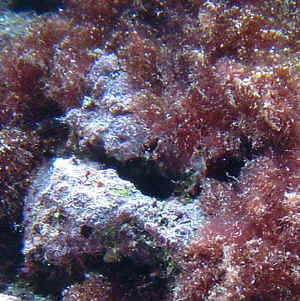
|
 |
New Print and
eBook on Amazon
Marine Aquarium Algae Control
by Robert (Bob) Fenner
|
Bob, I have had several different algae
blooms since running my 400l berlin system, caulerpa and green hair
algae for the most part, and the latest bloom is the one I am
having the most trouble with because it is so difficult to harvest.
Stripping it off the rocks by hand seemed quite simple until I
realised that small strands of the algae would break off and
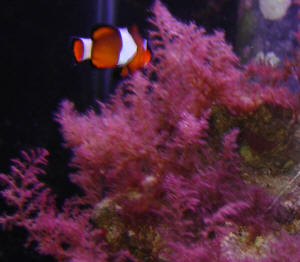
disperse throughout the tank. It is fluffy and purple in colour
(see pic) and seems to have the consistency of a fibrous algae that
when removed from the tank can be squeezed like a sponge until you
are left with just the dry fibrous material. It grows pretty
quickly and it seems to have coincided with a recent change from
LED back to Halide. I have increased the flow by investing in a
Vortech Pump (very powerful even at half way setting) and I try to
reduce feeding to a minimum but this stuff just grows and grows.
Where it is a little nicer to look at than the green hair algae,
due to its purple colour, I'm finding it a little invasive. Any
help would be very much appreciated! Thanks, Daniel
Let's see, I can make out your excellent image'¦ and
from your description, not being slimy, this third algae
proliferation is likely a red (Rhodophyte) algae of some sort.
There are a few standard approaches to controlling all algal
organisms: Nutrient deprivation, predation, competition'¦
along with some more drastic measures like blacking out all light
availability. I see you've already availed yourself of
increased/improved circulation; which should help, and likely made
less chemical food available through more conscientious
feeding'¦ Do you have tests, water quality measures for
the typical compounds Nitrate and Phosphate? These would help give
you insight as to what your efforts are doing.
How much of a discourse do we have time/space for here to elaborate
on the above moda for countering pest algae? One of the all-time
best counter-attacks involves adding a remoted, tied-in living
sump, a refugium, replete with a good-sized/depth DSB (Deep Sand
Bed). Are you familiar w/ this technology? Bio-geo-chemical
activity here can serve to deprive pest life of chemicals they
thrive on, produce Protists that feed directly on them, make
foodstuffs for your livestock, and much more. Here also you can
grow competing, better Macrophytes (large algae) to chemically
defeat noisome types in your main display.
Determining what might actually eat this algae is a bit of an
adventure. You could look under a microscope at a bit of this
material, try to discern its species, investigate in literature,
the internet re what might possibly consume it. Or, you could go
the experimental route, adding various organisms that might find it
palatable. To my mind all these approaches are worth considering,
implementing. |
Tenacity of Red Turf Algae, olde LR re-use 7/27/13
Hi crew!
<Hello Pam>
I have a question about the tenacity of Red Turf Algae.
Last January, I finally gave up a 6 month long battle with
RTA,....dismantled and disinfected my tank.
I have a new system now and it is doing beautifully!
The nearly 100 lbs of rock that was in this system, has been outside in
the cold, rain, snow and sun, since then.
I would love to use this old rock. Do you think in all this time it is
devoid of RTA and other contaminates.
Would bleaching in a weak solution be wise or should I just forget it
and let the rock live its final days in the sun?
<No need to let it spend its last days outside Pam. :-) I would
take it to a DIY car wash and spray it down good to remove any
residue on it. If you have a power washer at home then the trip won't be
necessary.>
Thanks for your expert advise! Which, I may add, I always follow!
<You're welcome. James (Salty Dog)>
Pam
Re: Tenacity of Red Turf Algae AND second opinion! 8/11/13
Hi Crew!!
<Hello Pam>
I understand that most of you have higher degrees in biology than I, and
logic tells me to follow your direction.
<I have only had one semester of biology in college because it was
required.
My course did not involve aquariums. :-)>
However, when anxiety kicks in, all logic goes down the tubes!
That said,...I respectfully ask for a second opinion about the tenacity
of red turn <turf> algae.
More specifically, if the rock (talked about below) has the remains of
the RTA clinging on, (despite a mild bleach bath and almost four seasons
outside, and scrubbing with a wire brush) is there any possibility that
this would come to life in my new set up?
<These are dead cells, red turf algae is not a Lazarus type of algae.
:-)>
James, will you pass this along?
<As I mentioned below, for aesthetic purposes I would power wash the
dead cells off the rock at a car wash; yes you will look crazy doing
this but I would do it.
Just do it quickly before someone calls a wagon for you. :-)>
Thanks so much!!!
<You're welcome. James (Salty Dog)>
Pam
Re: Tenacity of Red Turf Algae AND second opinion! 8/13/13
Lazarus,...had to look that one up! LOL!
Okay then,...I get it now and thank you for the second opinion, even
though it was from the same person!
<You're welcome Pam. James (Salty Dog)>
I'll power wash tomorrow,..quickly!
|
Mushroom <repro.>, New Coral <id>, and
Dragon's Breath <comp.> 3/4/10
Hey Guys!
<Joshua!>
I recently started up my refugium which is a huge victory for me!
lol. Been planning it for a long time. I had a couple questions
and an ID question I thought you might be able to help with
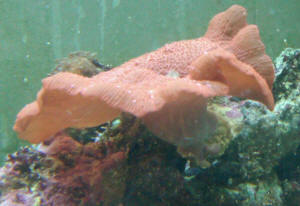
really quickly. First of all, my red mushroom usually sits on the
tank floor of my 90 gal display, just laying there looking nice.
I like to split my corals and sell them back to the LFS who has
been asking for them..A LOT...anyway, I don't particularly
like to cut my animals (I know, kinda wussy but it bothers me
lol), so I usually just move them to a precarious position where
they will move to another rock and leave their foot, thus
replicating.
<Ah, pedal laceration...>
It works really well without a chance of infection and dying.
Recently I moved my mushroom closer to the light and instead of
moving it just spread up and wide like the picture and was
wondering if it DIDN'T like the light or if it wants more. I
understood this species preferred deeper and less light.
<Need to define terms>
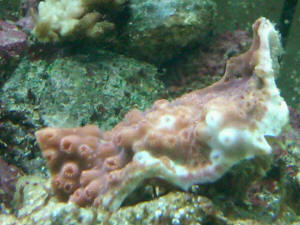
Second question, I just bought a new coral frag (pic#2) and I was
told it was a pagoda. Verifying it LOOKED like a pagoda,
<Might be a Dendrophylliid, perhaps a Turbinaria. Read
here:
http://wetwebmedia.com/dendrophylliidae.htm
and the linked files above>
at least to me, I have been watching it. From what I have read,
aren't they supposed to have polyps that extend for
feeding?
<Mmm, at night time, most all Scleractinians do>
I have yet to see them, and from I understand they require
supplemental feeding, unless this is a purely photosynthetic
sp.
<There are no such light-only species>
What do you think?
<That stonies are mixotrophic>
It is sitting on a rock off the bottom floor, but not really
close to the light. Lastly, I added a small ball of Chaeto and
some dragon's breath to my refugium. I attached the
dragon's breath to the side of the rock I have attached the
Chaeto, and also to the power head I have to create greater flow.
I have had a hard time finding info on it, so are there any
problems with this Macro that you have encountered?
<Mmm, no>
(I made the pics with smaller resolution but if you need higher,
let me know.)
Thanks Much!
Joshua Lucero
|
  |
Red Turf Algae/Algae Control 3/16/09
Hey Guys and Gals,
<Eric>
I hope the onset of summer is treating you all well, we're still
knee deep in snow here in Edmonton.
<Yikes, brings back unpleasant memories. Years ago I had landed
in Edmonton, then drove to Wetaskawin to set up some automated
welding equipment. It was the month of January and I couldn't
believe how cold it was. Geez, if you didn't plug your car in at
night, you were not going anywhere in the morning. Brrr!>
I look at my little slice of reef and imagine myself somewhere a little
more warm, where people were actually meant to survive, hehe.
<Amen.>
Quickish question about turf algae. That is what I believe I have, it
is red wine colored, about 2mm-1cm in length, and has little runners
that cling to the rock and make it impossible to move. I also have a
red algae that grows in horizontal plates, looks quite pretty but grows
everywhere. The hairy stuff started in a patch about the size of a
quarter and has since spread to more than half of my live rock. I'm
taking the following measures to get rid of it, just wanted your
opinion, and any suggestions.
<A picture here would have helped much.>
I read on your sight that red algaes don't like light and thus I
increased my photoperiod to 12 hours. I have a mix of T5 (2x18W,
10,000K) and CF (1x Actinic, 1x10,000K).
I upgraded my skimmer from a Prizm Pro to an Aqua C remora with a
MaxiJet1200 (amazing how much more gunk this pulls out).
<This improvement will help you here, don't expect overnight
results though.>
Changed the flow pattern in the tank (two Koralia nano powerheads both
on the back corners, pointing towards the front center of the tank),
about 500gph.
Using a phosphate removal media, and nitrate sponge, as well as
activated carbon, in a converted hang on back filter.
Trying to remove the really hairy bits, but it's on there
solid.
Way lowered the amount I feed to my fish. Once every two days now, a
mix of new life spectrum flakes, algae flakes from Betta, and a mix I
made myself of frozen seafood.
The flat algae is going from red to orange, and then white, and I pull
that out as much as possible, it was easier to remove and seems to be
dying first anyway. When most of it was gone, the red turf algae
rapidly increased it's growth rate, I'm assuming because the
nutrients the other algae consumed were now available for the surviving
algae.
<Likely.>
Rats. I have two Mexican turbo snails, an emerald crab, 3 blue legged
hermits, one scarlet hermit, and about 20 Nassarius snails.
<Nassarius are favored more as carnivores/detritivores.>
I'm thinking of getting more Turbos,
I've heard they like the red turf algae. Any other suggestions for
herbivores would be good, can't do fish though, it's only a 29
gallon tank, no sump, and has a full livestock load.
<What is your fish load? You may be importing nutrients faster than
you can export.>
The water chemistry has been fine, pH has been hard to keep up,
possibly from all the dead/dying algae driving it down.
<Also a sign of a high bio-load.>
I'm using Seachem Marine
buffer to raise it back up. Calcium hovers at around 400-450ppm.
I'd like to keep it around 350-400 as I only have polyps,
mushrooms, one leather and a few LPS corals. Alkalinity is also low,
until I add the buffer to bring it up, only takes a few days to fall
back down though. Temperature stays around 80, occasionally rises to
81-82 (I don't have thermostat control in this place, and they guys
downstairs get inexplicably cold occasionally....).
<Doesn't surprise me, I was cold taking a hot shower
there.>
Nitrates are always at 0, but I'm guessing they are just consumed
by the algae. Same with phosphates, they hover around 0.05-1.0.
I do regular 5gal water changes once a week, with R/O water.
It is quite frustrating... the water is beautifully clear, but this
algae just won't go away... any comments/suggestions would be
awesome!
<May want to replace the carbon with Chemi Pure, much more effective
and will aid toward raising your pH. Cleaning the riser tube in your
skimmer every
couple of days will increase it's efficiency. Do read here and
related articles/FAQ's.
http://www.wetwebmedia.com/algaeconMar.htm
http://www.wetwebmedia.com/nutrientcontrol.htm
James (Salty Dog)>
Eric
Re Red Turf Algae/Algae Control 3/16/09
Hey There,
<Eric>
Answers to those questions quickly. I'll try to get a picture soon
for you.
I have two false Percula Clownfish, a Purple Firefish, a Fire Shrimp
and a Coral Beauty Angel.
<In future queries, please cap the names of fish, inverts, etc.
Thanks.>
I've been putting off removing the coral beauty, as I realize
he's going to grow too big for the tank, but I was hoping to
eventually get a bigger tank to transfer him to.
<The Coral Beauty needs more room than a 29 gallon can
provide.>
It's a long story, but essentially our landlord won't let me
have anything bigger than a 29gal, I want to upgrade to a 72 gal
bowfront, or even a 175 gal bowfront (gotta dream right?). Of course
this would mean buying this house or moving, so things are at a
standstill (is wanting a better tank a bad reason to want a house?
haha).
<Nah, I'd buy a beer truck if that was the only way I could get
some beer.>
I think I may need to just bite the bullet and pull the angel out of
there... I love him but he has started to grow.
<Yes, he would be much happier in a larger system and will lower
your waste level.>
I change my carbon every week, so once it's gone I'll use the
Chemi Pure to give that a try.
I do clean the riser tube every day.... it pulls out more gunk in a day
than the old skimmer did in a week. Thanks again for the help, stay
warm! We got
another 5 inches of snow last night and I have to go unbury the car
now.
<Pain in the arsh, isn't it.>
Sigh.
<Cheers. James (Salty Dog)>
Eric
|
Red algae. ID, control, more --
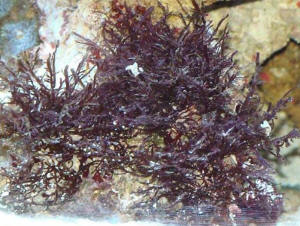
09/07/08 Hello WWM crew, <Hello Ed> My name is Ed,
and I have an algae issue in my 4 year reef tank, and I'm
going crazy trying to identify it and trying to halt its advance.
I have attached two photos of it. Hopefully you have seen this
type before and tell me if anything will consume it. I have
searched WWM in hopes of finding it with no luck. In one of the
picture's you will also see a type of starfish that literally
wraps itself around this algae. Don't mind the 3 year old
Mandarin as he is fat and happy... <I have seen this algae
many times. It is in my tank!!! I have been plagued by this algae
that seems to have originated from the Bali region of the
Indo-Pacific coming in on maricultured corals sold at local fish
stores. Eric Borneman and I have discussed this in detail. This
thread at his forum shows pictures and there is a large
discussion... http://forum.marinedepot.com/Topic71371-9-1.aspx
Eric has taken Trochus snails to overcome and control his algae
while I use sea urchins from the diadema family.(Black long
spines)We both feel that this only controls the algae as it can
have very small fragments growing in other areas of the tank we
can not see. In your direct case, I recommend the removal of any
rock with the algae present as it is very invasive. You can than
soak that rock in vinegar and strip the life off of it, allow it
to dry, and then return it to your system to become
re-established with life forms. If the rock is attached or
encrusted with corals, you can either frag(CUT) the coral from
the rock and attach it to another rock with Super-glue Gel, or
clean the rock as best as possible. If you clean the rock you may
have to repeat this procedure several times. Always clean the
rock in a separate container and rinse before returning to the
main system. This will prevent spreading fragments of the algae
thru out the system. The addition of Trochus snails will help as
the ones I have do eat it also.(Very well, too) Just make sure
they are Trochus snails as the other grazers do not eat it. Some
have reported that a Foxface Rabbitfish will eat it also. I have
not had such luck.> Tank parameters are good, Ammonia-0,
Nitrates and Nitrites-0, Ph 8.3, Alk is on the lower end at
2.97.<I would raise Alk to 3.5 and begin checking your Calcium
levels with your Alk levels. They work together and affect each
other.> Sorry for the second e-mail but, I have added tank
information for you. <No, problem. I deleted the duplicate.
Good luck-Rich...aka...Mr. Firemouth>
|
 |
Hypnea pannosa, Rhodophyte control, bio.
pred. 8/13/08 Hi Crew, <Campbell> Looks like I
have a lot of Hypnea Pannosa growing in my tank. I found some info,
surprisingly only one result, on the WWM website in a post by Sara
answered by Marco and Lynn. http://www.wetwebmedia.com/maralgidf19.htm
In Lynn's' reply she mentions that it's food for people and
fish but doesn't go on to say which fish? <Mmm... is used as a
source of Carrageenan, and consumed by humans fresh as
"salad" in places... I imagine "the usual suspects"
in the way of fish groups would consume it... esp. Acanthurids,
Siganids, Pomacanthids...> Although the algae is pretty it can be a
pain especially at harvesting time. Since it so brittle I usually leave
it until I can detach it in large clumps, any sooner and it breaks up
and clogs the pump intakes, where it promptly anchors and starts
growing again. Trouble with harvesting big clumps is the algae branches
are haven to large populations of Copepods, Amphipods and even
Bristle/Fire worms. Last time I harvested I spent four back breaking
hours hunched over a tub with tweezers and pipettes separating the
little critters from the algae so I could return them to the tank. I
hope to avoid this in future so I wonder if you could tell me which
fish genus and, even better, which particular species will eat this
algae. Failing that are there any crabs or snails that would do the
job? Many thanks in advance, Campbell <In how large a system, with
what other purposeful livestock? A "stock" choice would be
the Surgeons of the genera Ctenochaetus and Zebrasoma... Bob
Fenner>
Re: Hypnea pannosa, contr.
8/14//08 Many thanks Bob, <Welcome Campbell> The system is
about 225 gallons after displacement but I have no herbivorous fish.
The fish I have are mostly carnivores and planktivores. However, I have
plenty of Turbos, Astreas and Ceriths as well as Red Leg Hermits that
are doing sterling work as I have no Hair Algae or other nuisance
algae, assuming H. Pannosa isn't classed as nuisance, at all but
they don't go near the H. Pannosa.. <Mmm, in a volume this size,
I am very tempted to suggest a member of the genus Naso... perhaps the
most common... N. lituratus... It would, almost assuredly consume this
algae... to its exclusion> Now I will have a look at the fish
species you mention and hopefully I be able keep the algae in check.
Regards, Campbell <Please peruse here:
http://wetwebmedia.com/FishInd3.htm Scroll down to the Acanthurids.
BobF>
Re: Hypnea pannosa, tang. sel.
8/23/08 Hi Bob, How are you today? <Fine, Campbell. Thank
you> Thanks for the info on the Tangs. I have looked at the Lipstick
Tang, my tank is 8'x2'x2', plus 6'x18"x16"
sump, but I feel at 16" to 20" the Lipstick would be just too
big for the display when fully grown. <Would/will take a good long
while to reach about half this length... which would be about maximum
here> So I have been researching Ctenochaetus strigosus and
Acanthurus Japonicus and it looks like they would both be just a nice
size. Now I am trying to decide which one of the two to go for and the
I am leaning towards A. Japonicus. What do you think? Will A. Japonicus
eat this algae? <Mmm, not as likely as a Ctenochaetus species>
Lastly, what do A. Japonicus look like as juveniles? <Mmm, like
miniature adults... a bit lighter in body color, but the same markings,
colors> I am limited by my quarantine tank volume so must get a
juvenile at 3" or so, but can't seem to find any info or pics
on juveniles. <See Fishbase.org> Given their similarity, in both
looks and common name, to A. Nigricans and A. Nigricans relative
unsuitability for aquariums I want to make sure that I get an A.
Japonicus juvenile. Regards, Campbell <Easy to distinguish twixt
these two... at all sizes. Bob Fenner>
| Please help me beat this red algae nightmare!!!
5/4/08 I spend way too much time surfing your site and have
found lots of useful information. But, I still am having trouble
and hope you can help. <Will try> I have had a reef setup -
or at least that is the goal- up and running for 2 years, but have
not been able to rid my tank of this red nuisance algae since it
arrived with the live rock. (Please reference the attached photos).
<I see this> I have searched every site I can find on the net
to identify it, but no luck. It looks like a red fern; it has
numerous small branches making offshoots of a primary branch and
each "plant" appears to have 10+ branches. <Is a
Rhodophyte... but need a closer-up, better-resolved image to tell
more> It starts out a deep magenta and changes to a light pink
over time. It really is quite attractive when there is only a
little patch. However, it has taken over the tank! This is the
setup: · 75 gallon tank with 75 gallon package from
Tampa Bay Saltwater (live rock, live sand, brittle star, sea
cucumber, blue leg hermits, Astrea snails, unwanted gorilla crabs
still lurking in some crevices, lots of purple porcelain crabs)
· 2 Koralia 4 power heads for water movement in the main
tank · 2 Maxijet 600s for water movement in the main
tank · 4 VHO bulbs in main - two actinic blue and two
actinic white · under tank CPR sump. I know now it
isn't the best choice based on information on your site, but it
seemed like a good option at the time. with main pump that is
pumping at the max flow rate for the system - to the point that the
overflow can only maintain pace with the pump, so I am not sure how
many GPH. The sump also has a 2" sand bed <I'd increase
this to about four inches... For a few helpful reasons. See here:
http://wetwebmedia.com/dsbratuse.htm and the linked files above...
and add some Gracilaria, Chaetomorpha... to the same area... with a
light on during the hours your main/display is in darkness... See
WWM re these algal genera, the rationale for their use...> and a
few pieces of live rock - added to see if they would help. but
didn't · protein skimmer included with the CPR sump
with Maxijet 1200 pump · CoraLife power compact
fluorescents in sump that run off cycle of the main tank <Oh!
Good> · Chaeto mass (not really a ball and have not
been able to get it to tumble) in sump <Oh! I see you have this
already> · Use RO/DI water for top off/water changes
· Instant Ocean salt · two Ocellaris clown
fish · royal Gramma · coral beauty
· two Banggai cardinal fish · yellow tang
· two Mexican turbo snails (started with 5) ·
sand sifting snails (not sure which varieties and probably about 7
total left) · two peppermint shrimp · purple
long tentacle anemone · flower anemone ·
pulsing xenia · open brain coral · coral that
was attached to the live rock when purchased · various
pink, gray, white sponges that were growing on live rock
· mushrooms · Zoanthids · hammer
coral · 1 lone yellow polyp The live rock came with a
small amount of this algae which we decided to keep at the time,
since everything I read indicated macro algae is great for a
system. If only we had removed it then!!! This is the history of
what we have done to try to get rid of it, I know it is quite
lengthy, but wanted to let you know what we have tried. Our efforts
are based off of numerous searches on your site, on other reef
keeping sites, and recommendations from, what we consider a
reliable, saltwater fish store. The tank cycled without problem and
we had a normal outbreak of green hair algae to begin with. We used
the toothbrush-siphon method combined with 50% water changes and
ridded the tank of the algae with relatively little effort.
Evidently, we still have a phosphorous/nutrient source because the
red algae has grown out of control since a few weeks after removing
the green hair algae. We have tried to prune and remove as much of
the algae as possible. However, the algae is firmly affixed to the
rocks and can't be entirely removed (even with a toothbrush),
breaks in tiny pieces when pulled, and sprouts from each little
piece we can't capture. in other words it doesn't really
help! The algae grows so thickly together that I even lost a
clownfish in one pruning session. I pulled the fish with a handful
of algae and never new it until he didn't reappear. L
Determined we could beat this we started getting smarter on algae
control and tried: · weekly 30% water changes for 2
months. no change · raised the salinity level slightly.
no change (now at 1.025) <Is fine> · decreased the
lighting cycle to 8 hours/day. no change · used Rowaphos
- twice. no change · added GARF Grunge and additional
live sand (total of ~4" depth in display) to promote coralline
algae growth. minimal increase, no effect on nuisance algae <Is
worthless> · changed all light bulbs. no change
· increased main tank lighting cycle by several hours.
no change. currently at about 14 hours/day in the hopes of
"cooking" the red algae, per your site ·
rigged up a much bigger pump for the protein skimmer so it always
produced large quantities of skimmate. no change just a really loud
skimmer · changed all the filters for the RO/DI unit. no
change · added a Rabbitface Foxfish <Which
species?> hoping it would eat it, he wasn't interested and
become victim to a power head at his favorite hiding spot. Two
lessons learned, don't trust everything you read, and ALWAYS
have a cover on the powerhead intakes. · per
instructions for the bullet proof system at GARF, added Seachem
Calcium and Reef Builder to top off water to encourage coralline
algae growth...slight increase in coralline algae but no decrease
in nuisance algae <... not of use> · washed all
food - currently only Hikari mysis shrimp and no longer use any
flake food or low quality frozen foods from local pet store. no
change · reduced feeding to force the herbivores to eat
the algae - the would rather starve and the carnivores take it out
on the poor snails · added Mexican turbo snails in hopes
of seeing the mowed down algae paths others report. they are dying
off making dinner for the crabs or starving from refusing to eat
this red stuff · Changed 2 of the then 4 MaxiJet power
heads to Koralia 4s to increase water movement. no change
· let the tank go without water changes to encourage
some equilibrium and let the sand bed work. no change I know this
sounds like a lot of attempts, but trust that each one was carried
out independent of the next step to ensure we gave the system time
to respond. We can't seem to find anything that makes a
difference with our husbandry techniques or any animal that will
eat this stuff. I have tested the water and the parameters are all
within the specifications listed on your site. I can't detect
phosphate but the more reliable fish store we frequent tested the
water and reported slightly elevated levels of phosphates, but said
it wasn't high enough to cause significant concern or this
widespread of an outbreak. They recommended using Rowaphos and
changing RO/DI filters. I don't know what the phosphate level
was, but evidently we still have a phosphate or nutrient problem we
can't control. In the sump, the Chaeto hardly grows, <Being
suppressed by the Red...> instead we have red hair and red slime
algae growing on the sides of the sump and a slime coating
throughout the Chaeto. The Chaeto also holds a lot of detritus. I
am not sure how to remove this without tossing out the Chaeto and
getting a new ball after a massive water change and tank clean out.
<Pick it up during water changes, give it a good shake in a tub
of water> I thought if I can't beat the red stuff, I would
use the red nightmare to my advantage and put it in the sump. it
won't grow there!!! I assume the main tank uses most of the
nutrients and what is left is used by the red slime/hair algae in
the sump. The anemones are doing fine (the clownfish and the
Cardinalfish are hosting in the LTA) The xenia were growing like
mad, but took a hit somewhere in the cycle of ridding the algae. I
was so focused on the algae, I am not sure what step impacted them.
<Happens> The zoos are doing fine and have spread to several
rocks. The mushrooms are doing well and spreading, too. The lone
yellow polyp (the remaining transplant from a friend's tank)
refuses to grow which I don't understand since they are
supposed to grow like weeds. <Likely some Cnidarian negative
interaction. Likely the Actinarians/Anemones> Sponges and corals
on the live rock are doing well, too. I have not been able to get a
good growth of coralline algae, it won't grow on the glass, but
does on the plastic overflow and some of the rocks. The hammer
coral won't grow either. (I am hoping the combination of what
is growing well and what won't might give a clue of how to fix
things.) I have tried to clean the sand when I do a water change,
but don't have a good technique for doing this without
siphoning out the sand. So, I stir up the bottom and siphon out the
brown cloud. But, like everything else, it doesn't seem to make
a difference. Currently there are patches of the algae on almost
all of the live rock and on the powerheads. What else can I try,
other than tossing out all the rock and starting over? That is not
a financially or time-wise realistic option at this point. I would
rather give away the livestock and restart again later. I had
dreams of a beautiful reef setup with lots of corals, but I am
afraid to put any in the tank until it gets under control. Please
help!!! Thanks, Kristina <I would try another Rabbitfish,
Siganus stellatus (of small size, less than five inches overall
length if you can locate one)... and the "Kalk trick"
here... temporarily elevating pH to about 8.6 with successive
administration... to precipitate soluble phosphate (the source,
foods, water, of HPO4 is likely bound up in the Red algae...)...
try this three times (once a week)... and the Siganid... and
increasing the DSB depth in the sump with fine/oolitic substrate.
Bob Fenner> |
|
|
|
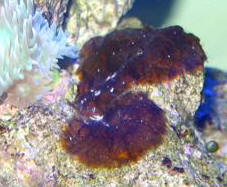
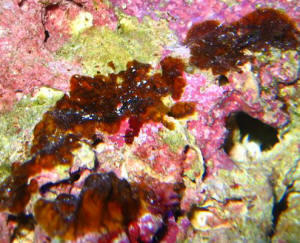
Please help me ID and get rid of this Brown Algae
8/22/07 Hello. I've been trying to id this brown algae in
my tank so I can figure out how to get rid of it, but haven't
found any pictures that look like this algae. <Mmm... not a
brown, but a Red: Peyssonnelia sp. An encrusting Red. Class
Rhodophyceae, Subclass Florideophycidae, Order Gigartinales,
Family Peyssonneliaceae.> Hoping you wonderfully knowledgeable
reefers can help. :) I have some dark brown algae growing in
circular patterns on my rock. Attached are 3 pictures of the same
algae. What concerns me, is how much it has grown in 6 weeks. I
looked at an old picture, and 6 weeks ago, there were a couple
spots on one rock that were about the size of the tip of my pinky
finger, and now they've grown into one spot about 2" in
diameter. I thought this algae wouldn't be removable because
it looks fused to the rock, but with some work, I completely was
able to remove one circle about 1.5" in diameter. Came off
in very small pieces. I thought it was slimy, but when I started
pulling off pieces, it actually looks and feels like seaweed /
kelp. My tank is pretty new....has been up and running for 4
months. My parameters are good, and I feed once a day and try to
only give enough food that the fish can consume within 5 minutes.
I use RO/DI water (Spectrapure MaxCap) with 0 TDS, and faithfully
do bi-weekly water changes (10%). The sand bed looks good.
It's just some good size patches of brown algae on the rock.
No hair algae or any other type of nuisance algae. I had a small
spot of bubble algae and turned the lights off for 3 days about a
month ago and it disappeared and hasn't come back, but
turning off the lights didn't do anything with this algae.
Any idea what this algae is and what is the best option to get
rid of it? <Please read here:
http://www.wetwebmedia.com/redalgcompfaqs.htm and the linked
files above> If I work on pulling it out manually, or using a
toothbrush, will little pieces of it that might not make it to
the skimmer, create an even bigger problem by spreading it around
the tank? <Maybe...> Just FYI.... I recently added a second
power-head to add some flow. (25x turnover now). I run my
T5's for 10 hours a day, and the 150w MH only runs for 4
hours a day (only softies right now). All bulbs are only 4 months
old. My parameters: Nitrates, Nitrites and Ammonia are all 0.
Phosphates are .1 PH 8.1 Alk 2.9 Temp 82 going up close to 84
when MH's are lit Calcium 330 5 small fish in a 53 gallon
tank. (2 small Perculas, 1 Purple Firefish, 1 Pygmy Possum Wrasse
and 1 Tailspot Blenny) Thanks! Pam <Mmm, a few possible
approaches here... Nutrient limitation... the growing of
competitive species... Greens likely... Read on. Bob Fenner>
Re: Please help me ID and get rid of this Brown
Algae 8/23/07 Thank you Bob. I'll start going
through the links on the page you sent me. It looks more brown to
me, than red, <Perhaps the photo itself has some artifactual
color influence here> in person...but I know in the photos I
sent, it definitely looks deep red. Any chance this could be
Lobophora? <Mmmm, not much...> It's not lifting up at
the edges at all, but maybe it hasn't gotten to that stage
yet? <Bingo...> If it's definitely a red algae, any way
that's best to remove it, or is manual removal the best
option? Thanks, Pam....also an avid diver! :) <Actually,
I'd enjoy it... likely increasing light intensity alone would
disfavor either a Red or Brown/Phaeophyte, over a Green... Bob
Fenner>
Re: Please help me ID and get rid of this Brown
Algae 8/24/07 Hey Bob. Thanks again for the quick
response. Hmmm...hadn't thought about increasing light
intensity. I thought the opposite, that algae would grow more,
with more light. <Mmmm, think about how the various Divisions
(the botanical equivalent of zoological taxonomies Phyla) are
semi-arranged... with some found/predominating more/less bright
et al. environs...> Right now, my four 24w T5's are lit 10
hours a day, and one 150w MH's is only lit for 4 hours a day
(all softies and LPS in my tank right now). What would you
suggest slowly increasing the hours my MH is lit and would you
increase it by an hour a day, an hour a week?? <I'd try a
few more hours per day... increase to perhaps 8,9...> I
don't find the looks of this algae very appealing, and if it
didn't spread, I'd be fine, but seeing how much it has
spread in 6 weeks, scares me. I'd much rather see more
coralline on the rock than this ugly algae. I do have one red
macroalgae that popped up on it's own that I love. Looks like
red lettuce or something. Really cool looking. I see one sprout
beginning elsewhere too. Just curious.... what made you rule out
Lobophora ? <A few things... one is that this and most browns
don't do well in captive systems unless they are administered
iodine/ide/ate... in quantity, regularly... Another, that it does
not look "soft" as this genus almost always appear in
aquariums... and lastly, the very distinctive
"ring-like" growth of Peyssonnelia...> I know
you're an expert reefer.... <Oh... I can be wrong... am
almost a few times daily...> so I completely trust your
judgment. <Mmm, please, don't> Lobophora was just the
closest thing I could find to what I have. Had no idea if it was
actually that or something else. Thanks again. Pam <Can be
determined pretty easily twixt being a Phaeophyte or a
Rhodophyte... do you have access to a simple microscope and
simple chemical tools? Bob Fenner>
|
|
|
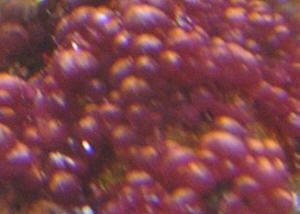
| Spreading red bubble algae! At my wits
end! 4/15/07 I am currently struggling with red
bubble algae in my 14 gallon BioCube. My tank is 6 1/2 months old.
I have been battling this red bubble algae for the last two months.
It is spreading and getting worse, as you will see in the attached
photos. <Can see this... does look like a Botryocladia
infestation... of epic proportions> It started off with what
looked like red/burgundy or even blood spattered looking stuff over
the top of one of my rocks. Then it turned into red bubbles. Hard,
solid bubbles. Now it has spread to the next rock. I was told not
to pop any of the bubbles because it will release spores into my
tank and cause it to spread more. I was told not to remove the
rocks and scrub it off and then rinse and return the rock to my
tank because it will continue to come back. I was told that putting
a small Foxface in my tank will take care of the problem, <Mmm,
not likely> but as soon as I took the Foxface out after it ate
all the bubble algae, it would come right back. I cannot even think
about this option because my tank is too small for a Foxface, and I
already have 3 small fish in my tank that I am quite attached to. I
was then told that my only option would be to totally tear my tank
down; siphon all water, remove the sand, rocks, etc... and start
all over again with everything new, after scrubbing my tank and
equipment clean. Is this the only way to get rid of the red bubble
algae? <Mmm, no... there are a few other approaches worth
considering> I am very frustrated with it at this point and it
breaks my heart if I have to start all over again. What do I do
with my current tank inhabitants and corals? <Mmm,
depends...> My tank inhabitants are a percula, sixline wrasse,
midas blenny, fire shrimp, 10 tiny blue legged hermits, pom pom
crab, 4 Astrea snails, 2 Nassarius snails, and electric blue legged
hermit crab. Coral-wise, I have a pagoda cup, star polyps, button
polyps/zoos, mushrooms, finger leather, xenia and Octobubble coral.
What causes this bubble algae <Like crimes... access,
motive...> and if I have to break everything down and start all
over again, how do I make sure that it doesn't come back? Also,
how harmful is it if "nothing" is done? <Might cause a
collapse... cascade event if something becomes rate limiting...>
I do 20% water changes every other Saturday using Nutri-Seawater, I
top off using RO/DI water. My parameters have all been consistent
for the last 4 months. Temp: 80.9, Ammonia: 0, PH: 8.2, Nitrite: 0,
Nitrate: 0, Calcium: 450, Salinity: 0.126. I feed my
fish twice a day during the week with frozen brine, mysis, emerald
entree, marine cuisine, (mixing it up from day to day) and on the
weekends, I just feed once a day. I have my lights on a timer;
actinics on from 7am-6pm, regular lights on from 8am-5pm, and then
the moonlights on from 6pm-7am. Is there anything that I can do/try
before having to tear down my whole tank? <All sorts...> I
was told to send you an e-mail because if anyone would be able to
properly advise me and help, it would be you. I am looking forward
to your response. Thanks, Kim P.S. The first pic shows
what the bubble algae looked like 2 months ago, the second and
third, from 1 month ago, and then the rest are from today. <Mmm,
there are a few places I would read before settling on a course of
trials, changes here... http://www.reefkeeping.com/issues/2002-02/hcj/feature/index.php
and: http://wetwebmedia.com/redalgcompfaqs.htm and the linked
files above, where you lead yourself... A multiple
"front" approach is advised... nutrient limitation,
macrophyte competition... perhaps adding a purposeful refugium,
DSB... Bob Fenner> |
|
 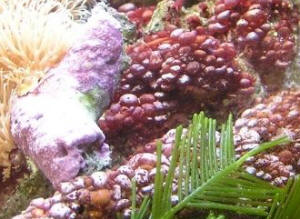
|
| Red algae herbivore? 3/7/07 I have an
outbreak of a red algae and I'd like to know what would eat it.
I think the algae is Hypnea ramentacea and I've tried an urchin
and a Zebrasoma scopas but neither seem interested. Should I get
another type of tang (maybe Bristletooth) or a Rabbitfish. Cheers
Gavin <Worth trying... though... if it were me/mine, I'd
harvest and sell this as an ornamental! Bob Fenner> |
|
Re: Red algae herbivore? 3/8/07 All
attempts at manually harvesting it just spread it more. As you
tear it off the rocks, small pieces are blown around the tank and
establish where they land. <Ah, yes... been here...
maddening> I don't think I can ever eradicate it so I need
a method of control. As per some other responses on your site I
will reduce nutrient input, increase water changes and get
another herbivore. I have read that a type of Hypnea has become a
pest in Hawaii and studies indicated a type of Siganus and sea
turtles eat it. So if I can't find a sea turtle :)
<Heeee!> I may have to settle for a Rabbitfish. <Maybe a
Siganid...> Do you think that growing a faster algae in the
sump would out-compete it and slow it's growth? <Yes...
often a useful technique> If so, what would be a suitable
species, Chaetomorpha? <A good choice... this and the genus
Gracilaria> Cheers Gavin <And please do read here: http://www.wetwebmedia.com/redalgcompfaqs.htm and
consider the ever-more popular seaslugs... Aplysiids... that
might well gobble all in quite a short while. Bob Fenner>
|
|
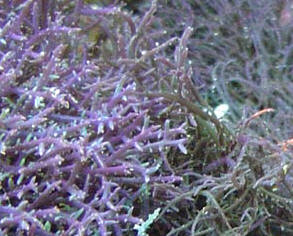
|
| Re: Red Algae.. Nuisance Or
Not 2/12/07 James, <Andrew> Thank you for the
reply and sorry about the image size. I resized it and
is now 255 kb. Hopefully that will fit your server limit
and show enough detail for my question. <Thank you for this.>
Again, I appreciate the response and look forward to any help you
might give me. Andrew On 2/9/07, crew <crew@mail.wetwebmedia.com> wrote: Thank you
for contacting us at WetWebMedia.com> Your reply is below Red
Algae. Nuisance Or Not 2/9/07 Hello guys, not sure who I am going
to get but thank you for taking my question! <Andrew, please
downsize the photo and resend, much too large a file for our
server, a few hundred kb will do. James (Salty Dog)>
I have had my 75g reef tank set up for a little over three years
now. I have unknowingly been sitting with a lot of
phosphates in the water for an undetermined amount of time and have
felt the hurt of my tank not flourishing as well as it
should. I am now attacking the problem with R.O. water
changes/ top off and PhosBan to remove the existing
phosphates. I know it is a long time to finally figure
this problem out but better late than before it was too late...
<Yes indeed.> Along with a couple issues, I have had a recent
growth in an undetermined (what I believe to be)
algae. At first I thought it was red bubble algae but
the pictures I have found don't match. I also
checked the forums here and did not find a match. I did
see a picture I thought could have been a match but it was not
clear enough for you guys to ID it. I have attached
a picture of this unknown, I hope it is clear enough to
ID. If this is a "bad" algae, what can I do to rid my
tank of it? Are there any inverts that would
like to feast upon this algae? Would the stabilizing
of my water conditions eventually kill these
off? Do I need to meticulously pick every last one
off? Is this a positive addition to the reef? Any help
would be greatly appreciated and again, I thank you for taking my
question. Keep up the great work, I should have come
here a long time ago to make sure I started in the right direction!
PS- Tank specifications are as follow: 75g Oceanic Reef
Ready 20g Sump (Bio Balls) with Rio 3100 (1 water exhaust with
splitter)<-- <With live rock, you can safely remove the bio
balls, but remove 25% weekly so as to give the bacteria growing on
the rock time to adjust.> Another e-mail to > follow soon
regarding this Nautilus PS (in sump) JBJ PC hood (4x65w; 2 dual
10K, 2 dual Blue 03) ~70 lbs live rock ~20 lbs live sand (2 inches)
<Without sand stirring critters, I'd have no more than one
inch depth, a good place to start a nitrate factory.> Mated pair
of Clarkii clowns (2 years) Pink Goby (1 month) Bicolor Blenny (3
months) Candy Hogfish (removing this week; destroyed organisms on
live rock. Bad advice form LFS) Eibli Angel (removing this week;
destroyed organisms on live rock. Bad advice form LFS)
Cleaner shrimp (2 years) Bubbletip Anemone (2.5 years) Kenya Tree
Coral (1 month) Colt Coral (2 months) Andrew <Andrew, forgot to
mention that your red algae is perfectly safe in your
tank. Too many things on my mind at the
moment...sorry.> |
|
Re: Red Algae.. Nuisance Or Not 2/13/07
James, <Andrew> Thank you for your response. I
appreciate the info regarding the live sand and the bio balls.
<You're welcome.> Looks like I have my weekend project
set for the next few weeks. <Can be fun.> I am still not
too sure what the probable algae is. Where you able to
ID it? <No, didn't try. Thinking it may be
Laurencia nidifica or a very similar species. Do
Google, I'm sure you will find.> If not, what would you
recommend I do with it? <Keep it, very attractive, nice
contrasting color for the tank. These type algae are
generally not long lived in the home aquarium (personal opinion),
so enjoy.> Thank you again for the advice. <You're
welcome. James (Salty Dog)>
Andrew
|
|

|
Red Turf Algae in my overflow box...acting as a
nutrient scrubber? 1/29/07 Dear Crew, <Russell> Yet
another red turf algae question... A few weeks ago I noticed a thick
carpet of red turf algae (after searching your website, possibly
Polysiphonia) growing in my overflow box, but barely any in my
tank. I thought to myself, "Hey...I have the answer to
this!" So I covered the overflow box with a piece of dark
Tupperware (high tech) and sure enough, in a week or so it
was dead. <Good going> Then, to my surprise, it started
popping out all over my tank in tight little bunches. Great stuff
this algae. Not so much an invasion, but just numerous little
tufts on the sharp edges of rock. I've tried not
to take it personally. <Heeee! Good attitude> My tank parameters
are pristine, although I suppose dKH is a little low at 7-8... but
I've recently backed off dosing 2-part additive. I was going
crazy with B-Ionic and the like, chasing numbers and turning my
sump into a pile of concrete. Now, I'm just going for water
changes instead, 10% per week. <Good> My skimmer is doing great
and I have a well maintained RO/DI system. I have a Chaeto
refugium. I've done a couple of 20% plus water changes with
maybe positive results. Also, scrubbing it off with a brush seems
to be keeping it mostly in check. Questions: When I starved it of
"sunshine" did it seek revenge by releasing spores?
<Likely so> Or was it possible the red algae lining of my
overflow box actually been acting as a nutrient scrubber? <This
too> It must have been growing there for some time. Besides
water changes, super-skimming, not over-feeding (I have a low
biomass, 3 fish and a half dozen corals... softies, polyps,
LPS) and perhaps bumping the dKH a little, any other suggestions
for keeping this algae at bay? <Mmm, do you have room, desire
to add another organism? I'd try a genus Ctenochaetus tang... or a
Salarias, Atrosalarias Blenny if they'll get along with what you
currently have> I've considered allowing it to grow back in
my overflow box. Could I possibly have too much light over my 75 gallon
tank? (2x250watts of 20K MH light 6 hours midday, 2x220watts 20K VHO
3hrs morning, 3hrs late afternoon)? Thanks, Russell in KY
<Mmm, no... not IMO... I'd do about as you have thus far... and
consider adding a/the purposeful algae eater. Cheers, Bob
Fenner>
Growing Macro Algae 1/24/07 Morning Crew :)
<Good morning Lisa.> We picked up this piece of live rock a
couple of days ago because the LFS said they
wouldn't/couldn't separate the anemone from the rock.
It's having no problem relocating itself. <Is the way to
go.> Anyway, the clown hasn't gone back to it's anemone
(the shine a light suggestion didn't work) <Give it time,
right now the clown is adjusting to new quarters.> but the rock
is covered with this red macroalgae. <Unfortunately, I cannot
open the file. Just appears as a square with a red x
(Bob, am I missing some software here to open this?)>
<<Right click James... see the "Show Picture" line?
Left click it. RMF>> It seems to be lightening up a little
from when we first got it. It's in a 90 gal bowfront
and I'm wondering if it's too far from the lights? Lights
are Dual Daylight 6,700k/ 10,000k Dual Actinic 420nm/460nm Lunar
Light Moon White Independent Control No Fans. <Stating the
wattage of the tubes is important here> Water parameters are all
excellent, SG is 1.025. Running a phosphate reactor,
protein skimmer in sump with refugium. <If growing macro is your
desire, I'd shut down the phosphate reactor. Macro
algae thrive on phosphorous and nitrogen.> Does this beautiful
red algae need to be placed higher in the tank or will it be okay
where it is? <If you have about 4 to 5 watts of light per
gallon, the algae should thrive. If not, try relocating
to the upper third of the tank. Try sending the pic a different
way, like through Kodak software or similar program. There are some
types of macro that do not fair well under aquarium conditions.>
Thanks, <Your welcome. James (Salty Dog)>
Lisa Hupman |
|
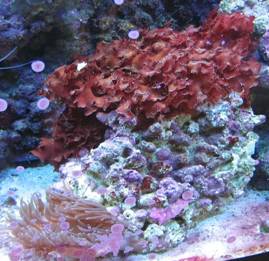
|
Unexpected Affinity for Botryocladia
12/14/06 Dear Wet Web Media <Hello there, Mich
with you tonight.> I love your site and
consult it often, thank you for all your work. <Thank
you for your kind words. Glad you find the site helpful.>
I recently moved and when I did I upgraded from a 55gal to a 180gal
tank. <Very nice!> I gave away all of my fish and
inverts when I moved and started over with the new tank pretty much
form scratch except for some live rock. <OK> So I
bought about 100 lbs more live rock and cycled the tank. Its
now been about six months and I've begun to add a few
things. My question comes because I've run into an issue
with my stocking plan. I was hoping to have a Kole Tang and
some type of Dwarf Angel in the tank at some point however an
unexpected thing came with the new live rock. On several of
the peaces <pieces> red macro algae began to grow ( I think its
Botryocladia sp. form what I found on your site - long red strands of
grape like balls ) Now the problem is that I've become
somewhat attached to the algae after these months and I'm not sure
that I want to introduce a fish that will completely wipe out the
algae. <How nice, an unexpected affection.> So is it
possible that a single Kole Tang could eat all of the
algae? <Hard to tell, but it wouldn't surprise me if
he did.> Or could the algae keep up with the grazing? I
always planned on adding clips of algae for grazing but wasn't sure
if fish prefer live food? <Depends on the fish.> And
also about the Dwarf Angel? Would the Angel graze
less? <Less than a Kole Tang.> Any help you could
give me would be great. <If you care about this algae,
which it sounds like you do, I would try to chip a piece of rock off
with the algae attached. Place it somewhere that the fish
won't have access to it. It could be in the main
displace as long as it is well sheltered (but still getting adequate
light and circulation) or you could try to grow it in another tank, be
it your refugium or sump, or possibly share with a friend.
Thanks again for the great site. <Nice that you feel it is
so. -Mich> Precision Metal Works Jonathan Lockard
Botryocladia (red bubble algae) 10/26/06 I bet you have
lots of questions like this. I did read the articles but could not
come up with a plan for my specific tank. I have a 10 gallon
tank, pretty small, live rock and sand are the mainstay. I have a
pump, a charcoal filter-mostly for flow and breeding area for
little creatures that look like 1/4inch size shrimp, and a air
stone. I have mushrooms, 1 type of polyps and a portion of a
frogspawn coral. Everything was happy for years. Then somewhere
I developed this red bubble algae, not to big of a problem I
actually thought it was pretty as it had almost a gold luminance. Now
it is so out of hand! It is growing on the small encrustations
that grow in the tank, these are small about 1/4 inch also. They
just came along. The only creatures in the tank are those small
things I mentioned, some bristle worms that came with the live
rock. The problem is that the red bubble algae is now trying
to grow on the frogspawn stalk and the polyps. I need help in
controlling how much of this grows. I did leave an area for this
to grow so that whatever nutrients it was taking in would be
used up however that did not work. It is extremely hard to
remove without breaking the sacs open or replanting these.
Also difficult to remove from the rock with the polyps. I
did not know if I should try a fish, or emerald crabs or
what and that is what I am asking. <Mmm, maybe...>
I do have a 75 gallon saltwater tank without any bubble
algae hair algae, much easier to pull out), this tank has
also been up and running reef tank with only 1 fish, a
pretty blue and yellow damsel. That tank has the original
frogspawn, xenia which likes to live everywhere), open
brain coral, slipper. All the parameters of both tanks are
where you'd want them, as is the lighting and temps. I
cannot afford RO water so use tap. hence the hair algae) Any
idea how to save the polyps on the rocks of the 10 gallon tank with
the red bubble algae, I am fairly sure it is of the: Botryocladia
(red bubble algae) species. <A few possibilities...
Please read here: http://wetwebmedia.com/redalgcompfaqs.htm> Sue <No
mention of nutrient levels... or alkalinity, biomineral content... I
would use water from the main tank, re-new/replace the LS, LR... Bob
Fenner>
Re: Botryocladia (red bubble algae) -
11/02/06 Before I sent my question to you regarding the red algae I
did read all I could find using the search engine on WWM, that is
how I found out what the algae was. I have also read WWM many many
times over the past 6 years that I have had both reef tanks, I
have found the questions and answers informative and helpful.
However, when I feel the tank is crashing and I cannot locate
the information that pertains specifically to the situation I am
in or perhaps I just do not realize that answer would apply to my
case too I have written in the past. Generally every one
answering was so nice, helpful and things worked out. <Good>
What I eventually did after reading 3 articles on red algae was take
all the rocks out into another container w/water from the 75
gallon tank, scrape off and remove the algae by hand, added a
green emerald crab, 3 margarita snails and 7 zebra snails.
<Good moves> Hopefully, they will be able to eat the young algae
as it forms preventing another out break. I then used water
for a small water change and added water from the 75 gallon
tank. While I probably have room for other creatures I have been
reluctant to get any as it is such a small tank, the LFS
were not encouraging this size tank as they can
quickly develop problems. But, I would end up with the odd
mushroom or polyp or frogspawn and put those parts into this
tank and they just took off doing so well. The mushrooms and
frogspawn took a beating having to do this. Hopefully, they
will have some resilience and perk back up. The polyps seem
to be lost and I do not know what will come of them. I would
not have sent an email requesting information on what to do
unless I searched and researched not just the WWW but Reef
Central and other online to feel I could not find
the information. I am not sure I have enough of the cleaner
crew but the LFS did not want to sell more for 10 gallon
tank. and have had to send email to WWM crew in the past.
Hopefully this will correct the situation. AND, hopefully my
mushrooms will live, the frogspawn is doing well and the
polyps return. Thank you, Sue <Please do keep me/us apprised. Bob
Fenner>
Making Ogo Go-Go! 8/11/06 Just a quickie: Is
there ANYTHING that will eat Gracilaria textorii?
<Umm....500,000,000 Tangs! LOL> The dilemma? It's a 24
gallon; LPS, and zoos. <Ahh...the problem.> All my fellow reefers
are out of ideas. Pygmy angel too big for 24 gallon. I am out of ideas
and ripping the stuff out constantly does not help. <Although my
personal experience is with G. parvispora. I'll make the assumption
(gulp) that its palatability is similar to other species. What that all
means is that you are really limited to Tangs, Rabbitfishes and
possibly, other harsh grazers (maybe Urchins)! Which of these would
live comfortably in a 24 gallon tank? Probably none of them. My
thinking is that you might need to "rent out" your rocks
covered in the algae to friends with Tangs in appropriate-sized tanks.
The other thought would be to remove the other photosynthetic life in
your tank and go without light for several days. Perhaps this might
knock off some of the macroalgae. On the other hand, if you do use this
technique, you'll need to keep water quality high as the algae die
off.> My tang worked wonders when it was a 220 gallon. But my
downsize after a move is letting the G. textorii get the better of me.
HELP! <Well, it's sort of an interesting problem...For some
people with Tangs, it would be a dream come true! Given your small
quarters, manual extraction and the aforementioned
"rent-a-rock" idea will help. Good luck! Regards, Scott
F.>
Getting Gelidium! Hello guys! <Scott F. your guy
today!> Hope all is well. Can you help me, I have red turf
algae (Gelidium pusillus) that is slowly taking over my rock. The
snails keep it short, but it is still a slow creep that covers up my
coralline algae and is becoming a general nuisance. Do you know of
anything other than tangs that eat this stuff? Inverts, crabs, slugs,
anything? <Grr...this is a miserable algae, which I've battled
myself. I have yet to find an herbivore that eats this stuff, although
a friend of mine swears that his Tuxedo Urchin has eaten the
stuff...> Once we get our giant skimmer setup that will slow it
down, but until then I need help! This stuff is impossible to get rid
of. You can't pull it off the rock, toothbrush scrubbing
doesn't work, and I can't take all my corals off the rock and
cure it. So what's a girl to do?? <There is a tactical nuclear
weapon that the Air Force has tested...Nah, seriously, I think that you
should continue with the tedious manual extraction until the skimmer is
in operation. You could try the urchin, but beware of the potential
collateral damage that this creature could cause...> Thanks! Luv,
M&M <Good luck! And do relay any success that you have in
destroying this awful stuff! Regards, Scott F>
Red Hair/Branching algae - Ceramium 5/31/04 Hello Bob,
<Anthony Calfo in his stead> I hope you're well and in a good
shape. <the more years that go by with me working in front of a
computer, the rounder I get. I'm thinking of strapping my laptop to
a treadmill <G>> I'm ok too, it could be better but it
could be worse.... <keep on keeping on my friend> I have received
a question about : "red algae Ceramium (???, do you know this
algae?) <the correct spelling is Ceramium with an "m". It
is a nuisance species... one of the many things called "red hair
algae". This one really is a doozy though. It naturally occurs in
high nutrient near shore environments and often lives as an unwelcome
epiphyte on other critters and substrates> The aquarist has a wild
growth of these algae and can't get rid of it. <no worries... it
can be controlled. Easily starved into submission with tighter nutrient
control. Really... it can disappear in 2-3 weeks with wicked protein
skimming. It probably got there because of poor protein skimming, weak
water changes and/or weak water flow which allowed sediments to
accumulate> He asks for my help. Al seems to be good in
his measurements but he has a Ca test of 600, to heavy I think. <I
doubt that the reading is even accurate. Indeed too high. And if his
Alk is not very low, then I am sure it is a misreading. Else, the poor
chap is having a precipitous snowstorm as we speak <G>> I ask
for my help and I ask for the help of the supreme chancellor....
<Hmmm... yikes! And we've just been calling him "Bob"
all along.> He said he had a problem with his Ca reactor a while
ago, what he did to help the problem, he didn't say, perhaps is the
solution knowing what he did.... Read You. Regards, the best. Claude
<Claude, do suggest in concert with starving the algae out, some
Diadema urchins (Pacific or Atlantic species). They will only be
treating the symptom and not the problem, but will give results fast.
They are marvelous algae grazers. One small urchin per 100 gallons if
you want to be conservative. Prost! Anthony>
| Nuisance red algae 4/5/04 Hey Anthony and
Bob - I don't know if you remember me but I am from the Rocky
Mountain Reef Club in Colorado and we had you guys come out and
speak with us. I also work with Barry at Aqua
Medic and handle all his website development and talked with you
about wetwebmedia.com. <cheers to all the Denver gang...
especially that sweetie Becky at Neptune's <G>> I am
having a very annoying algae bloom in my tank and I don't know
what it is or what I need to put into the tank to eat it or what I
need to change to stop it. Here is a picture: http://www.johnsreef.com/images/red_macroalgae.jpg
Any information would help. I would really appreciate
it! Thanks! John Michael <decent picture, but just not
clear/close enough to make a confident ID. Looks like it might be
the dreaded red turf algae, Polysiphonia to me. Do research that
name (know that there are many forms of it... stick to the hobby
pics/sites.) Best regards, Anthony> |
|
|
Botryocladia Predators Hello. <Hey, Mike G
here> I recently purchased a red grape macro (Botryocladia sp.) and
would like to know if there are snails that will eat algae, but not
touch my red grape macro. <An astonishing array of herbivorous
marine life will consume Botryocladia species macroalgae, I am sorry to
inform you. I would think it would be consumed soon after you began to
fill your tank.> Also, would a lawnmower blenny eat the red grape
macro? <I would think so.>
Fauchea for Tangs? 1/8/04 Hi,
Will Tangs eat Fauchea and if so, does it supply nutrition similar to
Tang Heaven? <it is not so readily accepted as
Gracilaria. I am not sure about nutritional value though. I've seen
the specs on Gracilaria (Tang Heaven), but nothing on Fauchea. My
advice is to stick with Gracilaria... Fauchea can be a miserable
nuisance over time. Somewhat noxious too> Red Fauchea looks like a
species that grows really well in a tank or refugium <yes... because
it is a nuisance <G>> (we've tried several times to get
Gracilaria to grow out for the tangs - no luck). Thanks! <do try to
find a copy of our "Reef Invertebrates" which has extensive
coverage of refugiums, plants and algae species (the most comprehensive
in the industry to date). But the crash course on Gracilaria is most
people do not give it enough light (5 watts per gallon minimum... 2-3X
even better), or enough water flow (very strong is needed to keep the
colony tumbling in suspension in the aquarium). This algae is line or
basket grown in shallow tropical waters under very bright light and
strong wave action. Anthony>
Anotrichum barbatum (The Red Scourge!) - 05/17/05 I have what
looks like red turf algae. Anotrichum barbatum was the name I was
given. <Is a red turf algae, yes.> Is there anything I can do to
get rid of it? All parameters are optimal (0 or correct levels).
Lighting is 300 watts of VHO, HOB refugium, and a mini 606 power head.
This tank is a 20L. Current inhabitants are a clown, Kenya tree, BTA,
lawn mower blenny, misc. blenny, scarlet hermits and blue leg hermits.
<You need much more flow, especially with that BTA. Please increase
water flow to 10x-20x the tank volume.> Is there something I can put
in there that will eat it? Possibly a Nudibranch of sort? <Not
likely. This algae can be very troublesome to eradicate. Elevate your
pH to 8.6 and keep it there for several weeks, this has proven
successful for some. I would also recommend adding a protein skimmer to
help with nutrient export...an AquaC Remora would serve you well
here.> Thank you very much, Stephen. <Very welcome, Eric
R.>
Tap water Rinse for Aiptasia? Another Infestation of
Aiptasia after Buying Gracilaria - QT! Dear Crew, <Paul>
After receiving in the mail, a half-pound of beautiful Gracilaria
parvispora infested with Aiptasia, I am at a loss as to what to do with
it. Currently, it is isolated in a bucket of saltwater with lighting
and aeration but the vendor does not seem to want it back. Is it
possible to completely kill the Aiptasia and its larvae by soaking the
Gracilaria for several minutes with chlorinated tap water? <Mmm,
no> I don't want to contaminate my aquariums but I hate to
simply throw out the Gracilaria. Thanks, Paul <I would go the route
of using a purposeful Glass Anemone predator with this red algae, while
still keeping it separate from your other systems. These
Aiptasia-eaters are listed on WWM. Bob Fenner>
Can I Get Some Ogo To Go? 09/25/05 Hello, I was at this site
called Indo-Pacific Sea Farms and was reading about "Tang Heaven
Red". They call it a natural red sea weed that our
tangs will love. Have you great people at W.W.M. ever heard of this
stuff. If you have is it easy to grow in an aquarium like they say it
is? <<Some Tangs love Gracilaria parvispora, also known as
'Ogo'. It is possible to grow Ogo though I would not say it is
easy. Please see this link http://www.wetwebmedia.com/redalgfaqs.htm). You could also
search WWM for "Gracilaria".>> Thanks for taking the
time to answer. Jim Jesko <<You're welcome. Cheers -
Ted>>
Botryocladia skottsbergii HELP!
Rhodophyte control in a nano 7/2/06 Hi Great website.
Its may mainstay of info. <Glad it is of use to/for you> I have
mainly all PICO and NANO sized tanks. I have two tanks with beautiful
growth of coralline and many zoos and other corals, however it being
over run with Botryocladia skottsbergii. At first
I did not mind it, but now its just gotten out of hand. Even my hermits
and snails all sport coats of the stuff...... <Yikes... "Attack
of the Sea Grapes"!> Simply stated. I need it gone or at least
a way to control it. I tired to manually clean it off the rocks, but it
seems to propagate it. Tanks are much to small for a tang
unless I "rent" a small one for awhile. I use I/O salt, SG is
1.026, temp 81 deg, cal 460, alk 11.6, ph 8.3, I use Chaeto
for nutrient export and run a protein skimmer as well. The
tank that is worst is a 12 gal nano. Is there any other small fish that
would eat this stuff.......that would be better suited than a
tang.......I sure do not want to ruin my live rock and its encrusted
life. Any help is greatly appreciated. Roy Hauer <Mmm, an excellent
discussion of various "bubble algae" here: http://reefkeeping.com/issues/2002-02/hcj/feature/index.php
including input on control means. Turbo species snails and small tangs
of the genera Ctenochaetus and Zebrasoma would be my first tries...
though these last can't live in such small confines indefinitely.
Bob Fenner>
Red Algae <<Greetings, JasonC here...>> Can you
give me some direction regarding where I am going wrong in trying to
control the red algae (probably Centroceras & Wrangelia) in my
aquarium? <<My guess would be BGA - Cyanobacteria, not really an
algae but certainly behaves like one.>> I have a 50 gallon tank,
Fluval 404, BakPak Skimmer and powerhead for circulation. I feed my 3
fish and 2 shrimp carefully. Readings are H 8.2, Temp 78-80, Ammonia 0,
Nitrite 0, Nitrate 10 mg/L. I do a 5% water change every other week. I
run 3x30 watt full spectrum and 1x30 watt actinic for 12 hours a day.
I've just added a couple of small pieces of Marshall Island living
rock and a small bunch of Caulerpa. However, the red algae covers
everything within a week to 10 days. How can I reverse this? <<I
would add one or two powerheads to the tank, perhaps more to increase
the water flow inside the tank. This is the best way as it makes it
very difficult for the algae to take hold. You will also have to
continue the manual removal until you gain the upper hand. Cheers, J
-->>
Red algae/plant Thanks for the feedback! My hermits, snails
and cleaner shrimp haven't touched them from what I can tell (but
maybe I just haven't seen it). <they are the wrong kind of
herbivore for this job... they feed on microalgae/diatoms. You need a
fish grazer likely> Any idea what might find this thing tasty?
<a Foxface/Rabbitfish or some tang species> When should I be
worried about it taking over the tank and possibly causing problems for
other inhabitants? <really just an aesthetic matter... trim back as
you desire/wish> Thanks again, Andy <best regards,
Anthony>
Fauchea Red Algae 11/3/03 Sorry, I do have one other
question. Have you heard of and know anything about Fauchea
Red Algae? Thanks, Paul <it is an interesting algae that can be a
plague in tanks without proper nutrient control. Have you referenced
this species on the website I sent you in the last e-mail?
www.algaebase.org see their links for this genus here -
http://www.algaebase.org/action.lasso
Anthony>
Macroalgae II 11/3/03 Thanks for the info. I will
research algae on your web site better. I just have one more
question about it. From what you said below, I take it that
I should pick one type of algae that I want to use, and use only that
one, correct? <correct> For example, if I think
Chaetomorpha is the one to go with, buy and use nothing but it.
<exactly... else one species will dominate the others and worsen
water quality in the process (during the fight). Anthony>
Botryocladia (red bubble algae) 1/11/04 New to the reef
thing!!! So the questions might be silly sorry. <no worries... keep
asking questions and learning> I have a 120 gal reef tank and about
130lbs of live rock. After buying the live rock I had run out of money
so basically have watched the rock grow with only a couple corals in
the tank and hermits and snails. <excellent. Not enough aquarists
have such time/patience to let the rock establish without fishes. The
quality of live rock is much(!) better for this> Anyway I have a lot
of what I think is Botryocladia skottsbergii over a lot of the live
rock. I don't really have any other "bad" algae problems
no slime in my tank very few of the big green bubble. 1. Should I be
concerned about it? <not at all... it is very desirable to most
aquarists. Rather hard to procure and somewhat "ethereal" in
existence. Enjoy it while you can> 2. Is there anything that feeds
on it? <actually... and overwhelming variety of herbivores will eat
it. It will disappear once you begin stocking the tank unless you take
the time to set up a refugium on the tank (very good idea) and remove
some that safe vessel for safe keeping. Anthony>
|
|
New Print and
eBook on Amazon
Marine Aquarium Algae Control
by Robert (Bob) Fenner
|
|
|