|
Related FAQs: Sponges, Sponges
2, Sponges 3,
Sponges 4, Sponge Identification, Sponge ID 2, Sponge ID 3,
Sponge ID
4, Sponge ID
5, Sponge ID 6, Sponge ID 7, Sponge ID
8, Sponge ID 9, Sponge ID 10, Sponge ID 11, Sponge ID 12, Sponge ID 13, Sponge ID 14, Sponge ID 15, Sponge ID 16, Sponge ID 17, Sponge ID
18, Sponge ID 19,
Sponge ID 20, Sponge ID 21,
& Sponge Selection, Sponge Compatibility, Sponge Systems, Sponge Feeding, Sponge Disease, Sponge
Reproduction,
Related Articles: Invertebrates, Live
Rock, Ascidians/Sea Squirts,
Review of
Tyree's "Cryptic Filtration" Bk
/The Best Livestock For Your Reef Aquarium:
Sponges, Phylum Porifera, Part 3
To: Part 1, Part
2, Part 4, Part 5,
Part 6, Part 7,
Part 8,
Part 9, Part 10,
|
|
|
By Bob Fenner
|
Principal marine
organisms
|
Genus Calyx:
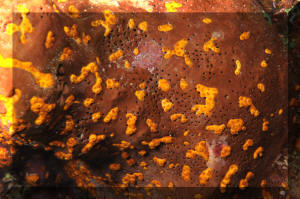
| Calyx podatypa Dark Volcano Sponge. Tropical West
Atlantic. Smooth surface, w/ volcano-like osculae. Often infested w/
Zoanthids as here in Cozumel 2012 |
|
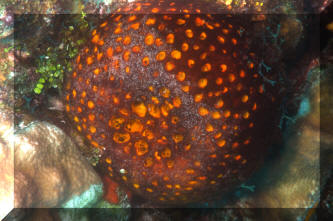
Genus Cinachyra:
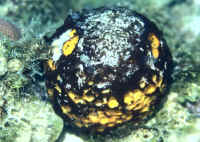
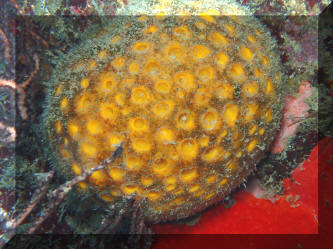
| Cinachyra sp. (Cinachyrella kuekenthali now) Orange Ball Sponge. Tropical
West Atlantic, to 100 foot depth, under ledges, in protected areas.
To about 1/2 foot diameter orange ball-shapes, with many excurrent
siphons riddling their surface. St. Thomas image. |
|
Bigger PIX:
The images in this table are linked
to large (desktop size) copies. Click on "framed" images
to go to the larger size. |
|
|
Genus Clathria:
| Clathria (Microciona) mima (Laubenfels 1954).
Indonesia. This one photographed in Queensland Australia. Below, in
the north of Lombok. |
%20mima%20QLD%20MD.jpg)
|
Bigger PIX:
The images in this table are linked
to large (desktop size) copies. Click on "framed" images
to go to the larger size. |
|
%20mima%20GIL%20MD.jpg)
|
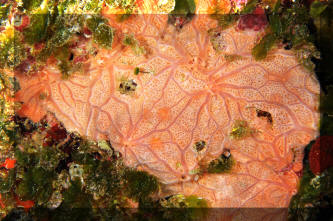
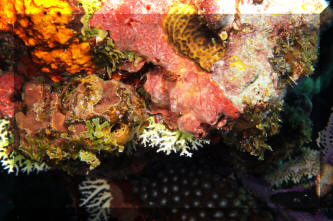
| Clathria (Thalysias)
venosa (Alcolado,
1984) .
Orange veined encrusting sponge. TiffB pic in Curacao. |
%20venosa%20%20CUR%20TiffB%20(2)%20MD.JPG)
|
Bigger PIX:
The images in this table are linked
to large (desktop size) copies. Click on "framed" images
to go to the larger size. |
|
|
Genus Clathrina:
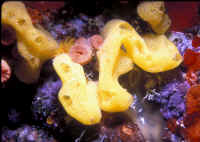
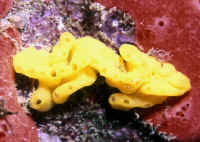
| Clathrina canariensis Yellow Calcareous
Sponge (Class Calcarea). A delicate, small (to four inches) bright
yellow organism, made up of intertwined tubes. Tropical West
Atlantic; usually found within caves or other shady spots. St.
Thomas, U.S.V.I. |
|
Genus Cliona:
| Cliona delitrix Red Boring Sponge. To a
foot in diameter. Large excurrent pores bore all the way down to the main
body. Cozumel
2014 |
%20MD.JPG)
|
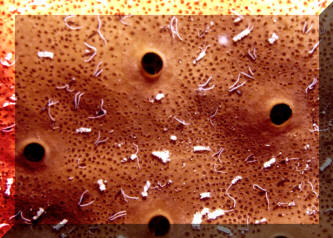
| Cliona vastifica Boring Sponges. Widely
distributed. About 165 described species. Here in the Red
Sea. |
|
Bigger PIX:
The images in this table are linked
to large (desktop size) copies. Click on "framed" images
to go to the larger size. |
|
%20MD.JPG)
|
Genus Crella:
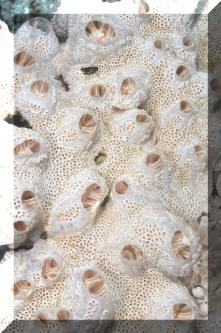
| Crella cyathophora Carter 1869. W. C. Pacific... Here in the Red
Sea 2019. |
|
Genus Cbibrochalina:
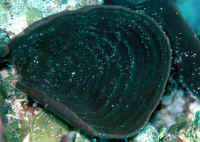
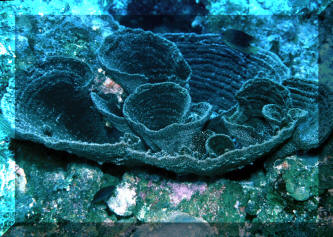
| Cribrochalina vasculum, the Brown Bowl
Sponge. Bahamas pix. |
|
Bigger PIX:
The images in this table are linked
to large (desktop size) copies. Click on "framed" images
to go to the larger size. |
|
|
Genus Diplastrella:
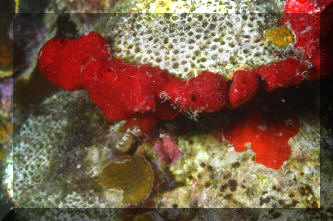
| Diplastrella sp. Red-Orange
Encrusting Sponge. Areas of tightly arranged collected areas of incurrent
siphons, with scattered larger excurrent. Caribbean. To ten inches, seventy
five feet in depth. Bonaire 2019. |
%20MD.JPG)
|
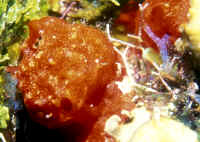
| Diplastrella megastellata Red-Orange
Encrusting Sponge. Areas of tightly arranged collected areas of incurrent
siphons, with scattered larger excurrent. Caribbean. To ten inches, seventy five feet in
depth. Found in shaded areas, even under rocks, overhangs. St.
Thomas, U.S.V.I. |
|
Bigger PIX:
The images in this table are linked
to large (desktop size) copies. Click on "framed" images
to go to the larger size. |
%20MD.JPG)
 |
Genus Drysidea:
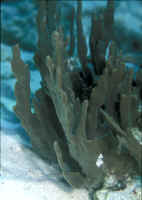
| Drysidea sp. (Keller 1889). Indo-Pacific.
Colonies as tough, encrusted upright blades, variable
texture. |
|
Genus Ectyoplasia:
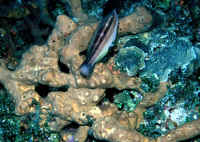
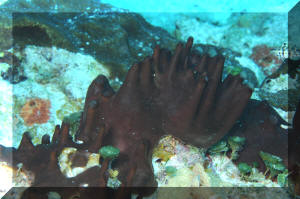
| Ectyoplasia ferox, Brown Octopus Sponge.
Occurs as both encrusting and in multiple-armed arborose
morphologies. Pale around excurrent siphons. Bahamas pic. |
|
Bigger PIX:
The images in this table are linked to large (desktop size) copies. Click on
"framed" images to go to the larger size. |
|
%20MD.JPG)
|
To: Part 1, Part
2, Part 4, Part 5,
Part 6, Part 7,
Part 8,
Part 9, Part 10,
|
|


 A Cliona sp. waning