|
|
| Home | Marine Aquariums |
Freshwater Aquariums |
Planted Aquariums |
Brackish Systems |
Ponds,
lakes & fountains |
Turtles & Amphibians |
Aquatic Business |
Aquatic Science |
Ask the WWM Crew a Question |
| Please visit our Sponsors | ||||
|
3 Gallons Mantis of Confusion/Overflows 5/25/09 Re: 3 gallons mantis of confusion/overflows
5/25/09 Re: Green haired algae: Attn Bob; magic magnet devices,
overflow boxes and not 03/19/2009 Re: Green haired algae: Attn Bob; overflow boxes and
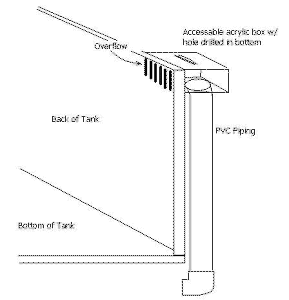
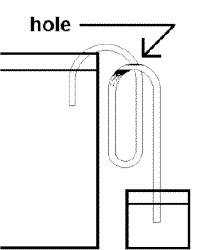
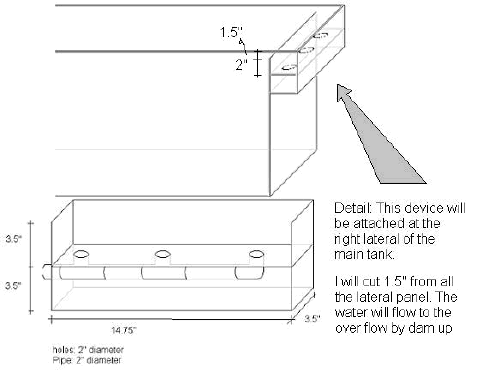
not 03/19/2009 Use A Siphon Overflow With A Wet-Dry Filter? -- 07/09/07 Hello, <<Greetings>> I just recently purchased a tank stand and canopy for my 75 gallon aquarium. <<Okay>> Currently I have an Emperor and Fluval that go through the top and back of the tank. I was just wondering though, when I put on the new canopy, the Emperor won't go over the back and I would have to buy a different kind of filter that I could put through the bottom of the tank where the stand is. <<I see>> I was thinking a wet-dry filter. <<Mmm, yes...not the best choice for a reef system in my opinion but can be useful on 'fish-only' systems>> My question is, in order for a wet-dry filter to work, do you need to have a tank with pre-drilled holes to connect the wet-dry filter? <<Nope...can be run/utilized with siphon overflow boxes, if this is what you have>> Is there another way? <<As stated>> What filter do you recommend for this situation? My tank is fish only. <<Actually, 'my' preference would be to utilize live rock (FOWLR) for bio-filtration but you can go this route if you wish...though you might find it cheaper/easier to install a fluidized-bed filter rather than the wet-dry>> Thanks <<Welcome. EricR>> Overflows 2/26/07 Whassup Crew - <Not much Michael; you?> Hopefully this will be painless. Built a 30 gallon sump for my 75g. I ordered a mag24, and after head pressure it should pump approx. 1300 gph. I brought two cheap HOT overflows <Errr... is human?> at aquatraders.com that are only rated for 600gph each (not the j tube style). Now here's the question - Can I drill bigger holes in the boxes to fit 1.5" bulkheads and will it work? <Not likely, or advised... what if one or both should fail?> I know the bigger bulkheads are capable of draining more water than 1" but will the HOT overflow box itself be capable of pushing more water through them. Or should I return one (still under 30 days for one) and get the bigger box they sell which is already built to handle the 1.5" bulkhead? <Mmm, I will skip ahead and just say I would return both and have the tank drilled... Bob "don't like water on the floor" Fenner> Equipment/Overflows/Design - 5/7/2006 Hello to all, <Hello Elvis> Thank you James for answering my last post on return pumps and such. Having so much experience to call on is really wonderful. Have looked all over for an answer to this question and have not found an answer. It's my understanding that dissolved organics tend to collect on the surface of the aquarium water. <Yes.> Targeting this area seems relatively important to the success of protein skimming, or at least it's efficiency. <Does help.> Have you ever seen or heard of a perimeter overflow? <Not aware of one.> Imagine a channel built completely around the perimeter of the tank, say about 1 - 1.5 inches deep and anywhere along this channel is a hole with a bulkhead fitting to allow the water to drain to the sump. Would this not allow the greatest possible surface skimming potential? <Sounds workable/expensive to do.> I know that leveling the tank becomes absolutely critical to the effectiveness of this design but the advantages should be rewarding. I would also think the secondary advantages of this is that it should be almost unseen to the viewer and that the overflow doesn't occupy any considerable volume, unlike the two or three common overflows built into aquariums. Is this just a complication of the overflow principal? Do the existing overflows skim the water at maximum efficiency; or at least as good as they'll ever need to? <With properly sized pumps and surface movement, I believe standard built-in overflows do work as good as they need to. Your design would need a very large pump to create effective surface skimming. Picture a 70 gallon tank with weirs completely surrounding the perimeter as you suggest, then figure out the combined square inches of all the weirs, when all the figuring is done (say with a 1000gph pump), very little flow will be going through each individual weir/slot. Myself, I believe the standard in-tank overflow would be better, especially when you compare manufacturing cost versus effectiveness.> I'm having a tank built and am wondering if I should build it with regular overflows or go for my own design. Figured I'd ask as you wizards of the water seem to have seen it all. Thanks for your time, <You're welcome. James (Salty Dog)> Elvis Wet-dry, overflow, pump... how do it work altogether? 7/13/06 I currently own an Amiracle Wet Dry filter that sits by the side of my 75 gallon aquarium and takes up space. I unplugged it about a year ago because every time I turned it on, I either had water that overflowed the sump or that overflowed the aquarium. When I called the manufacturer, they advised that if I installed the right return pump, I should never have this problem, and they recommended that I purchase a particular pump. However, the pump that they recommended had been discontinued. What do you recommend? Murray Meeker <Mmm, reading here: http://www.wetwebmedia.com/overfloboxfaqs.htm and the linked files above to gain a "good-enough" understanding of what you're up to here. There needs to be a balance twixt the total volume of water present and what is "in play" in terms of flow rate through the device/s used to get water from the main tank and back... Not a guessing or blind game of "who said what". Understand what you're doing, then act. Bob Fenner> Reef ready (built in pre-filter) vs. Over-flow box 11/18/05 Hello buddies, <Howdy> I have a 60R 48x15x18 acrylic tank that I scratched up a bit and I can't remove the scratches and retain the original luster. Anyway, I was thinking for about $200 I can get another clear-for-life 60G same dimensions except 2" inch taller which would give it more volume and larger vertical viewing. Since the length and width are Identical, I know I can use my stand and canopy. It's only 2" deeper (20") so my lighting should still be ok. While I'm at it should I get one with a built in pre-filter box? What are the pros and cons? (i.e. noise, flooding when main pump fails, takes up a considerable area of tank, better circulation of main water to sump, etc, I'm already using LifeReef's pre-filter box but I could use it in another tank. Thanks, Anthony <You've about covered the pros/cons... except there shouldn't be a chance of flooding... I favor this approach way over over-flow boxes. Bob Fenner> FOWLR Turnover & Circulation 1/18/06 WWM, <One of us> Your site is great -- thank you. I have been reading it almost every other day for about 2 months now. Think I am now ready to ask some (hopefully intelligent) Q's. I have a 125g glass tank (18'W x 72'L x 22'H) in the wall - planning a FOWLR. B4 I start ordering things (want to soon), I have some Q's. My goal is to keep $$ down w/o tank looking like crap or killing fish. Here goes: Turnover: Q1) For FOWLR tank: can I 'get away with' about 8X turnover (knowing 10X -20X is 'best')? I am thinking of going with a 1,200 gph capable overflow box, but I'd be limited to 8X if I go with a less power hungry return pump as below. <Yes> Details: I have 5.5' from floor to tank top, so I figure about 6' of head. I am debating return pumps between OceanRunner 6500 vs. Mag 2400. OR6500 flow is only 1,050 @ 6' (8X) but only uses 115 watts (annual cost of $140 for my area). Mag 2400 pumps a nice 1,700 gph @ 6' (getting me to 10X max of overflow box after gate valve reduction to the Mag), but the thing uses 265 watts costing me $315/yr !! <You are wise to consider energy consumption and cost> Since there's only a diff. of 2X turnover (unless I add a 2nd OF box w/ Mag 2400) , I'd rather not pay an extra $175/yr if I can get away with the OR6500 (but don't want to threaten fish or have noticeably worse water clarity). What to do? Beyond the 2X difference above, would adding a 2nd OF and getting the full 1,700 gph (taking turnover to 14X) be worth the extra $175/year in electricity in terms of fish health and/or noticeable water clarity? (or only if I ever go reef) ? <I would start with the smaller flow rate pump for now> Circulation Beyond turnover, not sure how critical circulation is for FOWLR tanks -- seems like a very big deal for reef tanks. Can I can get away with just the circ. from the OR6500 return or do I need some add'l in-tank circ.? <Can be added later...> If so, I'd probably build a top-of-tank manifold (unless I can hide powerheads behind my rock which seems likely tough with a tank only 18' deep). I'd only consider powerheads because 2 smaller powerheads + OR6500 would still be less wattage than the Mag 2400. If I go with manifold, I understand I would clearly need the Mag2400 or higher. <Likely so, yes> Overflow Q's: Not a reef-ready tank so must use OF box. Read bad things about CPR losing siphon so will use a box w/ J tube(s). Q1: I understand that in the event of a power outage, if sump has enough capacity to hold water draining from OF box & pipes, and provided return lines have anti-siphon holes, no flooding should occur in sump (please confirm). <This is a correct statement> How many, where & how large do the anti-siphon holes in the return line(s) need to be? <"Over the top", "inside the tank, just below where you might want to have your regular water level at its lowest> I thought I read two 1/8'holes on opposite sides of each 1' PVC return pipe about 3/4' below water level but can't find now? <This is about right> Q2: I understand that if the OF box siphon has broken, when the power comes back on & return pump starts, main tank could flood. But, if the water in the return compartment of a Berlin style sump is only a few gallons because of the sectional nature of the sump, then is that the max. amount of water that could come back into tank (probably not enough to flood) since no more coming from OF box? <Correct... but a pain to deal with such a small transit volume in terms of keeping the system "topped off"> Q3: If correct, then is 'worst case' of siphon breaking: a) potential pump burn out once water in sump return compartment is gone (does such burnout apply only to submersibles or externals too?), and b) hassle to restart OF siphon? <Does apply to both types of pumps... once run more dry, their time is limited. Not hard to re-start these siphons... top the tank off, suck away or fill lines and drop...> Q4: Is having two 600 gph OF boxes better than one 1200 GPH? <IMO/E, yes> If so, why, and I'm confused about something: <In case one goes, the other may save your pump/s, livestock...> If I have a 1200 gph return pump and two 600 gph OF boxes, and one OF siphon breaks but the other keeps working, don't I run the risk of main tank overflow (since the sump will still be getting 600 GPH from the working OF but the return pump will be pumping 1200 gph back to tank?) <Not much... you can/should try this out to determine your maximum fill mark in your sump...> Isn't this worse than having only 1 OF with a broken siphon (where water flow back to tank is limited to sump return compartment)? Or, is some equilibrium achieved at 600 gph due to compartmental design of sump as it only pumps back what is in the return compartment and this is limited to 600 gph? Would it be a 'jerky' flow (where water flows into sump return box at 600 gph & gets pumped out at 1200 gph, leaving the return compartment dry for a few seconds before it fills again? <Will oscillate a bit, with the pump losing capacity (air lock around the impeller), catching up and then losing...> Sorry I am so confused here, but trying to determine if 2 OF's is better than 1 OF box. Thank you, Paul H. <Thank you for sharing. Bob Fenner> Using two siphons and two overflows together? Blundell blunder Hello and thank you for your help. I have a 75 gallon reef tank that is undrilled which overflows into 30 gallon sump using a single tube gravity overflow box. The sump contains my EuroReef skimmer and a DSB. I have a 40 gallon refugium built and I want to add it to my set up. Would it be possible to use a dual overflow box that has two hoses, one to the sump and one to the refugium? I can see that balancing the flow rates may be a problem, or not, but have you ever heard of anyone doing this. Is it possible? < Yes, not a problem. I'd still make sure that each item can hold the overflow amount. Also, you may want to use two smaller pumps, instead of just adding another pump. Try it out and see what happens, but yes, it will work. ><<... An exceedingly poor idea... What happens if one pump delivers more water back to an it's "side" that has an occluded overflow? Will the other sump/refugium "hold" the excess volume? Will the tank itself overflow? I would NOT do this unless you fit an equalizer line between the two reservoirs underneath, and these were about the same "height" and they were tested to accommodate volume at rest and under power. RMF>> Thanks. Chris < Blundell > Refugium and sump... Justin's much better resp. Hello <Hi Chris, Justin (Jager) here> ...and thank you for your help. <no problem tis what we are here for> I have a 75 gallon reef tank that is undrilled which overflows into 30 gallon sump using a single tube gravity overflow box. <Yes very familiar with those, I use two myself.> The sump contains my EuroReef skimmer and a DSB. I have a 40 gallon refugium built and I want to add it to my setup. Would it be possible to use a dual overflow box that has two hoses, one to the sump and one to the refugium? <Yes, but you must drill both tanks or overflow one into the other to avoid flooding.> I can see that balancing the flow rates may be a problem, <You won't ever get it right and keep it right> or not, but have you ever heard of anyone doing this? <Yes, but their basement flooded with a lot of water.> Is it possible? Thanks. Chris <Well it is a lot easier, safer, and cheaper to get the 40 gallon and the thirty gallon drilled and run a connecting tube between them so that the water runs into one tank then when that one gets to the drilled connector, it flows into the next where the pump is and then returns to the tank, running a dual hose overflow box is highly difficult without this connector, and I have only seen it work once. and only until one pump wore out a bit and then it overflowed. it lasted all of 15minutes. The only safe way to do it is to have the sump and refugium connected so that if one gets more flow it will not matter as they balance each other out. My personal tank with a sump and refugium is set up with two overflow boxes and two separate hoses but does what you want to. Water gets pulled from both sides of the tank and then both hoses flow into the sump(1 for the wet/dry and one raw for the skimmer and DSB) which then fills into the PVC connector that was drilled into the side and then that falls into the refugium, this allows both tanks to stay at a predefined level using PVC pieces to change the level the water is collected at in the sump, and it allows for an emergency in case the pumps fail or the electricity shuts off as both tanks can absorb the extra water from the main tank. If one of your tanks is higher than your other then you can use an overflow box on the higher one to drain into the lower one but it is safer and cheaper to get them drilled by a professional, such as a glass supply or glass contractor as they have the correct drills and other tools. Good luck on this. Justin (Jager) > External overflows 4/4/05 Hey guys, I've asked this question on your forum twice and received two different answers, so I thought I would ask a third time! I'll then go with the majority!! Here's my problem: I bought an undrilled 155 gallon tank (second hand) with no overflow system. Unfortunately, I also inherited some fish Therefore, the tank is up and running with just live rock and a hang on skimmer. I am planning on adding a 56 gallon sump underneath and currently looking at CPR external overflows. I have a Mag 24 pump (return line 1") which after head pressure will provide a flow rate of about 1800-1900GPH. I'm going with two overflow boxes but here comes the confusion. Should the combined overflow rate match the pump rate or should it be slightly more in case one box gets clogged? I've heard both answers. Here are my options 1. 1 CPR 1400GPH which has 2-1" bulkheads each which is about 2800GPH with 4-1" bulkheads total or 2. 1 CPR 1600GPH box with 1-1.5" bulkhead and 1 CPR 800GPH box with 1-1"inch which is 2400GPH? <Let me really confuse you.... I would suggest that your overflows be able to handle slightly more flow than you expect to run through them, but not much. Extra capacity is nice in case of partial clogging, but if the flow through the devices is too slow, air can accumulate and break the siphon. That said, I would choose the option that gives you 2400GPH. In an ideal world, I would suggest setting up temporary quarters for the fish and drilling the tank.> My feeling is to go with the 2-1400CPR overflows. If I go with these, then all I have to do is mark the max water level in the sump to prevent over-flooding in case of a power outage. If I assume that this is what I'll go for, will the overflow boxes make too much noise? Should, or can I add a Durso standpipe? Any help would be appreciated, thanks again. Nilesh <Noise may be an issue, and "Durso" standpipes might help... if you can fit them into the overflows. There are other designs that accomplish the same thing as the Durso, but concentrically instead of with elbows. One of these may fit better. Good luck! AdamC.> External overflows part 2 4/6/05 Hey Guys, Boy do I want to do the right thing!! Well...I just found another overflow system called LifeReef overflows which swears that their overflows don't have problems like the CPR systems like siphon breaks and flooding problems. Have any of you used this system before? Is it true that this system is the answer to all of us who have not drilled their tank or is this a myth? <LifeReef has a top notch reputation (many consider them to be the best by a wide margin), but no overflow system is 100% safe from losing siphon or clogging. Good maintenance will further reduce the risk of problems. Give the hassle of tearing down the tank, a well maintained LifeReef overflow is probably a good option.> I've realized in retrospect that I should of drilled my tank...if I decide to drill and empty my tank, where should I have it drilled, on the bottom or on the side? What diameter should I have done? Thanks again folks for your continual support... Nilesh <This depends on your exact situation, but I almost always prefer drilling a wall rather than the bottom. If a bulkhead fitting in the bottom of the tank leaks, all of the water could come out. On the wall (esp. just below the water line), it can only drain to the bottom of the bulkhead. Also, there is far more stress on the bottom of the tank, so this is where I would least like to weaken it. The size and number of holes depends on how much flow you want. A 1.5" drain will handle up to about 750gph. A 1" drain will handle about half of that. (rough estimates). If you do have the tank drilled, estimate very generously. It would be quite a hassle to find that you didn't have enough drain capacity! Best Regards. AdamC.> External Overflows part 2 4/12/05 Well.. I had a chance to speak to the dude ( I don't know his name) over at LifeReef and it looks good. The design looks rather simple, do you think that with proper info from the net...that someone who is sort of handy can make it...or should I bother and just buy them from LifeReef? <Working with Acrylic isn't that hard, but does require a good table saw, a router (preferably with a table) and some basic wood-working type skills. If you are strongly inclined to do it yourself, it certainly can be done, but most folks find that the small cost savings isn't worth their hassle. There is lots of DIY info on the net.> As to drilling my tank, I'm going to find out what's involved from my LFS in my area. they just started to drill tanks for customers. Thanks again for the info. Nilesh <My LFS charges $15 per hole. A very cheap hole saw costs about $45. So, if you need three holes, you break even. Some stores will replace the tank if it breaks but most won't. Be sure to find out and give due consideration. Best Regards. Adam> 4 - 90's or Sumps, Pumps and Plumbing Greetings to the Salty Dogs, <Woof!> If possible, I was hoping for a little more advice for the plumbing situation on my new tank? (My original email follows for reference.) My 90 Gallon tank arrived today and is drilled for two 2" outputs and two 1.5" returns. My sump is designed with one 2" output to the return pump. I have purchased two Reef flo Darts for the system. One for the sump return pump and one to power a closed loop. I am now re-pondering my original plan to use both 2" Drains to the sump and instead converting one of them to feed a second pump for the closed loop. <You will likely need both the two inch lines to feed the sump here> Originally, the closed loop would be fed by an over-the-wall feed pipe and the returns would be in the same manner. <I would stick with this> It seems like simple physics in that having two 2" pipes feeding another tank (the sump) with only 1 2" exit leaves one of the outputs superfluous. Is this the case or am I missing something in my thinking in terms of the dynamics of the pump output? <You can try it and see...> I do realize that the pump is adding pressure but shouldn't the gravity feed equal out with what the pump can move back up into the tank to drain back down via gravity? <Mmm, if the pump had a very low flow rate, yes... In actual practice, pi R squared for surface area of the opening... gravity doesn't "suck" much here... especially if there is any horizontal plumbing involved...> I'm making myself dizzy with this question. <Take a tea break... I am> In your opinion should I stick with my original plan and use both outputs to the sump and feed the closed loop over-the-wall and keep the redundancy to the sump or go ahead and use one drain to feed the closed loop? <Stick with the original plan> Thank you so very much for the help! The Drunken Monkey <You wish! Bob Fenner> - Overflow Box Design - Good afternoon crew, I am in the planning stage of building a DIY internal overflow box. The design of the box is attached. Could you kindly look over the design and tell me if I have any design flaws? <I like it. I'd say it will need testing as having a pump running on a gravity feed from that siphon (I'm referring to the closed loop line) may run the box dry. Likewise, if the siphon were to break, you could damage the pump. Would probably be better to get the tank drilled for a bulkhead just below the water line and allow the closed loop pump to stay wet all the time.> Thank you in advance, Rainer P.S.: Many of my e-mails don't seem to get to you - is there some type of block or problem with programs you are aware of? I am not complaining, just trying to find a solution. T.Y. <Have no explanation for this. We do block excessively large attachments, but other than that... wouldn't know where to point the finger. The Internet is a big place and there are many places where email can fall on the floor. Cheers, J -- > Tank Drain Size And Overflow vs. Closed Loop - 06/20/05 Hi Crew, thank you all so much for your website and personal advice! <<A pleasure to assist.>> I'm overwhelmed a bit, but trying to read all that I can. My original plan was to use a somewhat beat up used tank, but now I've decided to buy a new 180g tank from www.glasscages.com. I can have it drilled custom, so I have some important decisions to make in the next 2 days (have to order first of the week to have it on their truck coming to Orlando). <<OK>> I'm doing a tank that is viewable from both sides and one end. I think that the whole "back end" will be totally closed off by the overflow wall. I want to be able to do 20X flow without powerheads. On my 180g that amounts to 3600 gph through the sump if I don't do a closed loop. <<Mmm...I'm leaning towards the closed-loop with a separate return pump for the sump in the 700-900 gph range.>> Is it realistic to put that much flow through a 24" long built in overflow and then run it through a 36x18x17tall sump (I'm ordering that tank also)? <<Can it be done?...probably. Would I want to do it?...nope.>> It seems a little scary to me! <<Me too <G>.>> Will it be too much flow for a refugium to be incorporated into the sump? <<Would likely "wash all away".>> If I don't pull it all through the sump, I'd need a closed loop, but I don't have any "back wall" space to drill for a closed loop. Is it a bad idea to try to do a closed loop that pulls from the overflow area? <<Actually, my suggestion would be to pipe the intake for the closed-loop in through the bottom of the overflow box, split it in to multiple intakes (2 minimum, 3 or 4 better) all the same diameter as the pump intake pipe (in other words, don't "reduce" the size), and plumb these through the sides of the overflow box so only just the intake screens protrude in to the tank itself. This will alleviate any concerns of the overflow handling the volume of the pump for the closed-loop...and the multiple intake ports will keep that 3600 gph pump from "straining" all your critters through the intake screens.>> If I don't pull from the overflow, my only other option is to pull from a standpipe somewhere out in the tank (there is NO "back" of the tank available for drilling). If I'm pulling from a standpipe around the middle of the tank, I'm worried that critters and stuff will constantly be getting trapped against the intake. <<A possibility, but can be addressed with more/multiple intake ports to create a "more gentle" flow through any one port.>> Next question - hole sizes. According to the RC calculator, I can get 1400 gph from a 1.5" drain and 2400 gph from a 2" drain. I was planning on doing two 2" drains and one 1.5" return all drilled inside of the overflow. That is a lot of flow potential but I'm not sure if I can pull that much flow over the overflow without it sounding like Niagara Falls. What is your opinion? <<Exactly...another reason to go with the closed-loop for the bulk of your flow. I do like your hole sizes, bigger is always better...if only for that margin of safety (sooner or later something WILL restrict/clog a drain.).>> Also - I may go to two 1" returns so that I can have two pumps. This seems like it opens more options as in one pump being a closed loop, and some redundancy in case I have a problem with a pump, etc. What do you think of that idea? <<Two returns is fine, but I would use one for the closed-loop and the other for the sump return (as mentioned previously). As far as diameter goes, use what is specified for the pumps you will be using.>> Thanks again for all of your hard work to promote this hobby. <<Hope this all makes sense. Try some key-word searches of our plumbing FAQs re "Closed-loop" and "drain size" for additional info.>> Sincerely, Randy <<Regards, Eric R.>> Re: Water Return Manifold 7/20/05 Dear Mr. Fenner, Thank you for your advice. But speaking about water returns I was reading through a lot of messages on WWM and saw a large number of messages that complained of sump overflows during power failures. <Mmm, real overflow "boxes" take account for such failures... they don't lose siphon> Since I also live in an area where we experience frequent power outages (rural Montana) I had to find a cure for all the spilled water. <... principally adequate (large) size/d transit volume sumps... not filled to capacity...> Since I use an older 30 gallon glass tank, drilling was out of the question. So I use the dreaded J-tube as my sump intake but instead of letting gravity do all the work my intake is connected to a Quiet One 1200 pump. It pulls the water into the sump but shuts off during a power outage. <Mmmm, I would NOT do this... far more trouble to be had...> And with a small hole drilled in the J-tube slightly below the display's water surface it eliminates back siphoning. <What if this becomes occluded...?> The sump's output is also connected to a Quiet One 1200 that (was) returning through a spray bar with a hole drilled below the surface. So I can leave my sump almost completely full and not worry. <... no...> By utilizing 2 identical pumps I found a cure for my woes. Plus there is very little adjustment needed since they both pump the same amount. <Almost laughable... but, "you'll learn"... Have seen, read about such arrangements... many times over the years... they eventually fail, flood floors>> I just thought I would try to provide a little info and some feedback to you guys for others to whom drilling is out of the question. <My emphatic message to all others who read this: DON'T try it> Though, there is some caution to this tale. I don't recommend it for the lax reef keeper (If there really can be such a thing) Because the pumps must be cleaned religiously in order to keep them both working in prime order. If only one stops...it can be potentially disastrous unless you use a very short intake tube. (I know that from experience... ) Best Regards, Andrew <You'll see... Bob Fenner> Re: Water Return Manifold 7/20/05 I agree very much with Bob... to the extent that I have repeated darn near a mantra on such matters that I would rather have no sump at all than use any kind of siphon overflow. Put another way, I don't want to sleep in a house that has a siphon overflow. As Bob says... they WILL fail in time. And beyond flood, there is fire hazard at times. I have seen this on one occasion thanks to a siphon overflow. Don't do it mate. The downstream features are not that badly needed nor so difficult to plumb upstream [the display may be inconvenient to drill... but a refugium or reservoir next to and slightly above your tank can be drilled to hold refugium life, skimmer, Ca reactor... anything that you would have fed with a siphon overflow) Please(!) reconsider. Anthony <Thanks for this Antoine... thought you might want to see, respond to this ongoing corr. BobF> Re: Water Return Manifold 7/21/05 Dear Mr. Fenner, Please forgive me for even causing you to post this on WWM. <Mmm, no worries... we post most all.> I have only had the system running for 2.5 months and haven't had a problem yet. I had no idea that it could actually pose a risk of disaster. <Oh yes...> I am relatively new to the hobby and the only thing that had been recommended to me was a J-tube setup by an aquarium store which I no longer shop at. I didn't know about putting the sump above the display. <Is generally safer... if practical to situate it so> Anthony mentioned this, and I would like to know how it is done. <... is posted... in places on WWM, our latest book...> If you could briefly explain it that would be much appreciated. Also, please don't post the letter if it may lead others into believing it will work. <Not to worry... You've likely saved a few lawsuits, broken marriages... and more...> I would hate to cause someone else to make a potentially disastrous mistake. Sincerely, Andrew <There are many ways to learn Andrew... direct experience of larger scale mistakes is not a good one. Bob Fenner> Thanks (and Overflow choices) Bob, I am new to this site. I stumbled across it on a web-surfing trip about a week ago. All I can say after much reading is WOW!!! With all the craziness in aquatics and all the mis-information, it is a pleasure reading your work, hearing your opinions and gaining some insight from all your real world experiences. The help you give to all the aquarist out there and the pets they will try to "hopefully" keep alive is admirable to say the least! It saves people time and money. It saves animals lives! They (the animals) did not ask to be placed in a glass/acrylic coffin and clumsily kept alive by a human. They came from a perfect system. It is our responsibility to them to do the very best we can to keep the alive and happy. That's what makes us happy, that's what makes us real hobbyist. From what I have read here, I know of no better site or person donating so much of their time and effort for this hobby. I am sure I speak for many people when I say "Thank you very much, your efforts are priceless and shall never go unappreciated!" <Wowzah. I SWEAR I did not write this to myself! Am taking this testimonial to the bank next time I'm out begging for a loan, and a copy in my pocket lest I make it inadvertently to the Pearly Gates to show St. Pete> Now for an actual question. Which is better, a built in overflow like the All-Glass design or hang on overflow? <Really... "six of one"... in general the built in ones are just as much of a pain to service (clean, replace particulate filter media...)and inflexible (can't be easily modified, added to) as they are more reliable than hang ons... which can at least be replaced... All things else being semi-equal, for big(ger) tanks (let's say hundreds of gallons) I do prefer built in overflow (and return) mechanisms...> thanks again my good man Brad Zimmerman <Any relation to Bobby? Thank you so much for "pumping me up". What a day brightener! Bob Fenner>
- A 'brief question - Pre filter/skimmer J-tubes losing prime <Greetings, JasonC here...> Hello and thank you so very much for providing the time to answer so many repetitive questions for all of us reef lovers :-) I'll try to make this brief so we can get right to the meat of my problem. <I looked ahead... it's not exactly what I would call brief ;-) > I have a 55 gallon acrylic fish/live rock/coral salt water aquarium with wet-dry sump (minus bio balls as this was causing a nitrate' fest so I pulled em out). The sump has a Berlin turbo skimmer and a few power heads for circulation and one leading to a 10 gallon refugium I have set up in the adjoining cabinet about 3 feet away with a gravity fed return to the main sump. The refugium is on a reverse daylight schedule and houses Chaetomorpha macro algae, as I am not a big fan of Caulerpa and all of the toxic headaches it has caused so many others in the hobby-addiction :-P Anyway, my problem is this.... I have the "dreaded" hang on the back prefilter box with two "J"-tubes as suction, leading down two 1 1/4" drain hoses into my trickle filter in the sump. Problem is, ........POWER FAILURES Ughhhhh!!! What happens is that the J-tubes seem to lose their prime when the power goes out, and the tubes partially empty, or sometimes fully empty. <That is the nature of the beast.> Then when the power comes back on, the return sump pump begins pumping water into the main tank and the tank overflows all 10-15 gallons of sump water all over my wood floor. Yes, ...that's what I love the most...warped wood. Anyway, I'm just not up to draining the main tank completely and drilling a bulk head fitting with a stand pipe and some form of internal filter box siliconed to the inside of the tank. I just cant do it. <Then instead perhaps you'll enjoy replacing the floors more so...> So, I am asking your professional opinion on how I can remedy this situation of the J-tubes losing their prime in the hang on back prefilter/skimmer. <You can't...> It's a typical setup that comes with most pre made wet/dry systems. you know...comes complete with the twin black drain hoses, etc. If you don't think you can come up with some type of reconfiguration of the J-tubes and housing, then perhaps I'll have to resort to the disgusting method of rigging a power head from the main tank via a tube into the sump, so that when power returns, at least the tank will have water "pumped" back into the sump. That's VERY unsightly and am hoping to get around having to do that. <You could always drill the tank ;-) > Please help if you can. <I think you already have a good grasp on how you can help yourself.> Warmest regards, and thank you again for providing assistance to those of us in need. Steve <Cheers, J -- > Almost made a big mistake (big tank plumbing) First off I'd like to say that today was the first time I've visited your site and I'm totally blown away by the wealth of information offered. I will definitely make this my first (and quite possibly ONLY) destination when posed with aquaria-related problems. That said, I am building a 300gal "freshie" tank to house my ever-growing Clown Knife, and would like to bounce my ideas off someone who knows their schtuff. My original plan incorporated a CPR Overflow Bow with two 1" outflow bulkheads rated at 1400 GPM. <Mmm, do make this two overflow boxes... just in case one fails... you are likely familiar with how "frisky" Clown knives can be during the night... One unlucky swipe at the single box might knock it out of commission... the pump/s below will continue pumping, overflow the main tank, drain the sump/s...> The 1" lines would run to two separate 30gal sumps, each containing a Quiet One Pump (an okay choice for freshwater I'm assuming). <Yes... but please do check around re this pumps reliability... and consider other makes. The bulletin boards are great here for input. Ours: http://wetwebfotos.com/talk/> The pumps(2) are rated at 750GPM at 4' head height, so with my head height of 5.5' I was counting on getting that down to under 700GPM per pump so that the CPR would keep up. <Best to tie those sumps together (thru-hulls, pipe) in case of mechanical failures... am an old worry-wart with plenty of water damage clean-up experience...> Now my problem: I've read over and over that siphon tubes (especially the CPR models) are nothing but trouble waiting to happen. I am re-designing my setup to incorporate holes drilled into the back of the tank just below water level to allow gravity flow to the sumps (which will be easy as my tank is of mostly wood construction w/glass front). Since the CPR box has two 1" bulkheads, and claims a 1400GPM flow rate, am I wrong in assuming that two 1" holes drilled in my tank will provide the same flow? <Please oversize them... 1 1/2" inside diameter is much better... easier to arrange to not make a bunch of noise> Also, if the holes are below the water line, and I make them too big, wouldn't that cause more water to enter the sumps than the pump could remove, causing sump overflow? <Mmm, no... at least if you don't "overfill" the sumps... the amount of water "in play" is all you're concerned with. Start the pumps with the sump and main tank full, mark the sumps at the level they drain down to with the pumps on, and never fill the sumps beyond this level... the transit volume of water is the difference in starting, pumping levels> Would using ball valves on the line to the sump and the line to the return head allow me to achieve a balance? <Don't count on this... or even float valves... count on gravity and what sources of blockage, trouble you can anticipate. Bob Fenner> Thanks for your help, Brand Smith - Anderson, Indiana Overflow via Durso vs. Back Wall.... Greetings to WWM, If you were setting up a new tank which would you go with... Either 2 1.5" overflows w/Durso standpipes or a couple of bulkheads at the top back of the tank? <Either will do the same thing. One is less expensive than the other unless you use overflow boxes in which case they are roughly equal in cost/flow/noise, depending on size (of box and plumbing/bulkheads), depth (of overflow box and how far, if any distance, the water falls into the boxes.> Rather than personal preference I am looking for the configuration which will A. minimize the amount of overflow in the case of power outage and B. minimize the amount of noise. <This depends on how the boxes are set-up and the height of the overflows/Durso pipes. The water will only drain as far as the top of the overflows unless it is designed differently AND if there are holes drilled in the *pump returns* just below regular operating water level so the pump return doesn't also siphon water into the sump, backwards through the pump.> Is there an inherent problem with having your gravity fed overflows high on the back of the tank? <No, unless you want to make them adjustable, in which case having a 90 degree ell (coming out of the bulkheads) and perhaps a threaded screen/pvc fitting will allow you to raise and lower them to the desired height.> I built a sump/refugium this weekend of about 18" in height and my first baffle is 14" tall so it doesn't have a lot of room in case of power outage which led me to the back drilled idea... any comments, suggestions? Thanks Guys! You're invaluable! <Just remember, gravity and siphons are very reliable. Make it work for you! Let us know if you need more assistance. Craig> Re: Overflow Question I'm looking into replacing my current 180 gallon aquarium with a new one. Would like to know the differences between the standard corner in tank overflow versus using standard 2" bulkheads (x3) drilled into the back wall along the top at water level. Obviously both will serve the sump below the tank. The main thing I'm concerned with is the noise level. The corner overflow in the current tank uses a Durso stand pipe, so it's relatively quiet already. Sincerely, Craig <There is no real difference between the two. The bulkheads can also be enclosed in a skimmer box like the corner boxes if you wish. The noise depends on how the overflows are vented and the size of the overflows/boxes, and how far the water falls into the overflows/boxes, if used. Hope this helps you out! Craig> Drill or overflow? Hi all, I have a 90 gallon glass tank that I need to set up for a wet/dry filter w/sump. There is a LFS that will drill it for me for $50. This expense, plus the cost of bulkheads etc. will about equal what I would pay for a good hang-on overflow setup. Which option do you think would be preferable? <drill it> Any particular weaknesses of either way? Appreciate any direction you could provide. Thanks, Jim <Hey Jim, I'd go with the drilled overflow, the hang on type will fail sooner or later and leave you with soggy floors. -Gage> U-tubes 2/5/04 Hi, from Barry in warm Canada (-45 deg Celsius). My first time on WWM. <greetings my friend... and welcome> I would appreciate your opinion on u-tubes. I work as a doctor in Canada, but grew up in South Africa where I kept marines in my youth. I wanted a INTERNAL drain that would suck off the bottom close to the sand. I felt this would suck up the larger pieces of crap better. <this is truly not necessary and generally overcomplicates plumbing. From an aesthetic point of view if none other. Easier and safer/better movement of detritus can be obtained simply by having adequate water flow in the aquarium that keeps all in suspension. In fact, the presence of much solid matter on the bottom is an indication of inadequate water flow> Thus we produced a U-tube that sucked the water up to the surface, went through 180 degrees and then drained downward through the bulkhead. <U-tubes are patently flawed and potentially (easily) prone to failure> We had no overflow boxes or filtration from the top of the tank. A hole of variable size was drilled in the very top of the tube, thus connecting to the air. The height of the tube determined how high you wanted the water level in your tank. The nice thing was that with a power failure the water only dropped to bottom of the U and then stopped flowing. <yes... but it can break siphon, and when the power resumes, the display overflows> Secondly the faster your pump worked the quieter it became because the water rose just above the air hole and occluded it. A pump with excess capacity would have to be gated to rate. Apart from the crap aesthetics can you see any major problems with this? <they very commonly overflow the display when the power resumes. I have often jokes that I will not sleep in a house with a u-tube on the tank: fire hazard> I am currently getting back into the hobby with a 135 g. I am going to phone the local physics professor and ask him to calculate the flow for a 1 1/2 " U-tube. Do you know of any company who could make a clear plastic U like that?. Many thanks. Barry <my strong advice is to have a proper/modern overflow hole drilled on the back wall of the tank (high) and sleep in peace :) Best regards, Anthony> Overflow Question Hey! How is everybody? <Beautiful day in San Francisco. Ryan Bowen with you today> Thanks again for such a great site! Got a question. I have an established 40 gallon tall and I want to add a sump but it just isn't possible for me drill holes for an overflow. <Hmm...Most overflows require no drilling at all> I'm not sure how to get the water movement correct. <Choose an overflow with about a 400gph rate. Since you're not going the drilling route, you will need a submersible pump, and don't skimp. The cheaper ones add a lot of heat to the water.> I have a ten gallon laying around that I was planning on using for the sump. <Go to PetCo, get a super-cheap 20-30 gallon instead. The extra water volume is the true reason for all this labor- 10 gallons is barely worth the effort.> I was thinking about using 2 of the same pumps (quiet ones, 300gph) to move the water to the sump and back up, into a SCWD wave maker, then into the display tank. <Hmm...I would use a CPR Overflow or a Tunze outlet. Look up some DIY Sump designs here: http://ozreef.org/ And then pump it back up with an adequate pump.> I don't about all the water pressure, gravity, calculations and stuff. <Trial and error can be pricey, so you may want to read the Circulation FAQs> The top of the tank is about 4ft off the ground. What can I do to make this work without drilling? <See above> My main focus it get everything I can out of the display and off the back of the tank. <Great> The health of the tank is good and I think a sump could make it much better. <Can't improve perfect health!> I cant afford a bigger tank and I want my 40. Any advice would very much appreciated. <Surely! Good luck, Ryan> -nick Internal Horizontal Overflow 2/22/05 Anthony, Hi! <cheers> I am planning on installing an internal Horizontal Overflow (I love that idea by the way)... <thanks kindly!> ...in a glass 75 that I am currently having drilled. My question is, can I silicone in a acrylic overflow in a glass aquarium, or do I need to have some glass cut to make the trough? <silicone does not bond to acrylic... merely "grips: and will fail in time. Not recommended> I know silicone doesn't work as well with acrylic on glass, but since this doesn't seem to be much of a load bearing application, I thought it might work. <agreed... and a fairly small matter to drop the water level and reseal later if need be> I am very comfortable working with acrylic, haven't worked with glass. <ooh... glass is much easier than acrylic IMO. More tolerance, less machining><<Mmm... no. Less tolerance, more machining... RMF>> But I don't want this to fall out in a couple of years. <I do believe it will :( Anthony> |
|

|
Features: |
|
| Featured Sponsors: |