FAQs about Toxic Water Conditions
9
Related Articles: Marine Toxic Tank Conditions , General Marine
Maintenance,Related
FAQs:
Toxic Situations 1, Toxic Situations 2, Toxic Situations 3, Toxic Situations 4, Toxic Situations 5, Toxic Situations 6, Toxic Situations 7, Toxic Situations 8, & FAQs on Toxic Water
Conditions by: Unknown
Causes, & Endogenous (from inside, e.g. Internal,
Organic Causes), Foods, Nutrients, Venomous/Poisonous Tankmates, Wipe-out Syndromes/New Tanks e.g.,
Exogenous (from outside,
External, Inorganic, e.g. Metals), Marine Algaecide Use/Chemical Control,
Toxic Copper Use
Situations/Troubleshooting, Insecticides, Cleaners, &
Troubleshooting/Fixing,
|
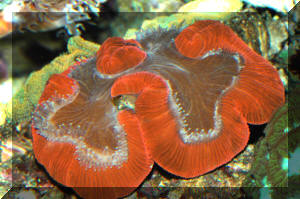
Look closely. Usually non-vertebrate life
shows signs of distress first
|
Copper panic... A timely lesson in the value of testing
3/17/20
Hello WWM Crew,
I've been a long time follower of this great site of yours, learned
so much. And as always many thanks. I'm in a panic and I've read
some FAQ about my problem but would like some reassurance. Yesterday
I did my usual weekly maintenance, vacuum the sand, change filter
media, floss, add a new PolyFilter in first chamber of sump after
the skimmer, clean the previous PolyFilter and place it in the last
chamber of sump. Then I do my water change about 22g for my 150g
tank. I get home tonight and do my usual check to find my
polyfilters have turned blue.
<? Interesting...>
I know that means copper.
<Mmm; not so fast w/ this assumption. Where would the copper come
from? Oh, I see this below>
I checked my trash can I use for water storage to find one of the
heaters was broken. The glass was intact, the coils and seal at the
top were intact, it was broken off at the wires. I dumped the water
that was inside the heater and black crud pour out. I had a test kit
for copper and checked to find no copper reading.
<Might well have been absorbed by the Polyfilter already>
I immediately added another PolyFilter and another bag of Purigen.
All fish are OK, I had 3 cleaner shrimp but can only find 2.
Possibly one died.
I'm filtering water now ro/di but that will take 6hrs to filter,
heat and aerate, then salt. Is there anything else I can do?
<Like the current SARS-CoV-2 virus; try to be patient. You've done
all that I would have done given these circumstances>
Very stressed. Thanks in advance for your time.
Brian
<All will likely be well. Bob Fenner>
Re: Copper panic 3/17/20
Hello Bob,
Wow lightning fast. Thanks so much for your reassuring words. I feel
more at ease now. What is in heaters that would cause that?
Are the coils made of copper and could leach into the water?
<Ah yes; and often the (bi-metallic) thermostats of yore, some
wiring... BobF>
Nuked tank >>RMF comments<<
9/9/19
Hi Guys and good morning from Thailand here,
<Morning Dirk!>
would like to bring the following story with an uncertain outcome and hope you
guys can follow me in my process of elimination and see if I took the correct
route and what more I should be doing now....Yesterday walking into the my
customers place taking care of his 1200Lt fish only (with full resin rock and
coral setup) we noticed several fish deaths (Harlequin Tusk,
Blue Lined Angel, Valentini Puffer, Large boxfish, Tomato Clown and several
regular clowns,..) All other fish seem to look struggling big time
hanging to rock and barely swimming around. Only 2 fish not effected seem to be
a powder brown and a big eye Soldierfish.... My first thought went out
to a longer power-cut and a failing of the installed backup system as it looked
like all fish behaving as in an oxygen shortage....checking on all logs from
installed Alexa and other electrical appliances in the house it seem like
nothing had logged any kind of power outage so I guess that was not it....
My second thought was 2 of the Heteractis >>RMF would have used
Entacmaea...<<(added about 3 weeks ago to get some (10) Clowns requested by the
customer and to protect them a little from too many predators in the tank) had
gone into any kind of nuke mode? Though it seemed that they didn't move at all
so sure not ended up in any power head or anything and that could not have
caused the death of all clown fish in the aquarium (included the tomato which
was housed in one of them) so I guess I could eliminate that as well as a
cause..... MY 3rd thought was with adding the 10 clownfish about 5 days ago I
have introduced an aggressive form of any kind of disease (Velvet maybe??)
<Maybe. Should have been quarantined>
Though some of the fish showing signs of itching when and if swimming around no
visible signs of any parasite was visible...Only fish showing any external signs
was an Emperor Angel showing red marks on his body.....So I contacted the
supplier but doubt that is this was the case as supplier is a very well
maintained breeding farm here locally in Thailand and the supplier who I know
very well mentioned he is not aware of any disease or parasites in his closed
breeding set ups....but then again can one be ever 100% certain...?? Now
I came to the thought of could a boxfish been hit by any of the anemones and got
so damaged he released his toxin....As I knew they could be toxin but
can they be so toxic wiping out a tank?
<If it released a large enough amount of the toxin, yes.>
Now with discussing this thought with my helper he mentioned that when removing
the death boxfish from the aquarium he seem to have been stock between one of
the resin rock and the side of the glass and was completely covered in a thick
white dust like substance....signs of the toxin maybe?? maybe he got stuck
between that rock and the side got in such a panic slowly dying not moving and
releasing his toxins in being super stressed...?
<Very likely this is what happened.>
Anyway, I decided to go that route, so did a 50% water change immediately and
added a huge bag of activated carbon to the system.....
<Good moves>
Guess I will go check later this morning on how the surviving fish reacted and
if they are all a bit more active now? So what you guys think do you think my
last thought was the correct one and did I handle appropriately or didn’t I do
enough to get rid of the toxin yet and should I do more water changes??? How
long is that toxin active for as not a lot (just that they are) is available on
the net on boxfish toxin in aquariums
<You did the right thing, though I’d do smaller (20%) water changes until things
get back to normal, I also advise you to add a high grade activated carbon to
your filter, this will help in eliminating the toxin remains.> >>RMF would have
and still would move the surviving livestock to another established system<<
... Thank for your guys thoughts...Dirk
<Cheers. Wil.>>>Note, both Wil and RMF have worked for several years in the
aquarium install and maintenance business. These "wipe out" events do occur.<<
Re: Nuked tank; puffer poisoning...
9/11/19
Hi Will,
<Hi Dirk>
might not have enough time do that what you propose
<I understand>
Today also died a blue tang, Emperor Angel, Bannerfish, Picasso
<Oh, sorry to hear/read that>
What more info is out there about that toxin? how long does it stay in the tank
and how to get it out effectively
<Hard to tell how long it stays in the water... As stated, water changes and
activated carbon>
Now with only 5 fish left in that aquarium I am actually thinking just take out
all the water and start all over new..???
<I do not think It would be necessary to empty the tank but yes to let it fallow
for a month or so and put the remaining fish in a quarantine tank >
Can this toxin get fixed onto the resin also or into the life rock that is in
the sump underneath the aquarium?
<The toxin is mostly in the water; not usually absorbed by substrates or other
surfaces.>
The fish still alive will be dying too or can they recover from the toxin as I
read it is a nerve toxin so I can imagine once effected they suffered serious
nerve damage and will all die sooner or later?? Non of the surviving fish right
now look its own normal behavior all showing skittishness and just hanging
against that rock work.....Dirk
<At this point, I am not sure the toxin is the culprit of the loses, most likely
some kind of disease not visible at first sight, might have been introduced
inadvertently to the tank...please do take a look at the following article, it
is worth reading...
http://www.wetwebmedia.com/QuarMarFishes.htm Cheers. Wil.>
I'm flummoxed and hoping for help
9/9/19
Hi WWM Crew,
<Hi Craig>
My question first: What would cause my Yellow Tang and Regal Tang to display
display what looks like difficulty in breathing (mouths open and fast gill
movement), and my Royal Gramma to open and close its mouth too?
<Normally, oxygen deprivation>
I realise this is a question with broad possibilities, so what follows are the
circumstances... Four weeks ago upgraded from a 4ft to a 5ft tank. I used ATM
Colony and transferred all fish on the same day. Ammonia spiked briefly at 2ppm
or so the test kit suggested, but did drop gradually over the next 7 days. It is
now undetectable (or under 0.1ppm) using a Salifert test kit and another I
cannot remember the name of. Unfortunately, when I transferred the inverts a
week later my small BTA who seemed to have had a purchase met it demise in a
gyre that evening leaving nothing to clean up.
I immediately placed carbon in the sump and left it there for a week. I
experienced a waterborne algae bloom which lasted a week while all fish were in
the tank, helped along with a UV steriliser. Things were uneventful for the next
two week aside from algae growth on rock and diatom on sand.
Then I introduced three additional Anthias. Three days later the additions were
dead as well as another. Then my shrimp goby died. My fish are the two tangs,
two clowns, royal gramma, a wrasse, 4 Chromis and 1 remaining Anthias - not a
huge bioload, or is it?
<Not a huge bio load but this system is clearly not mature enough.>
At the same time I noticed the difficulty in breathing. I immediately caught all
fish apart from the Chromis and remaining Anthias and put them back into my old
tank and they returned to normal within hours.
<Good>
I have plenty of surface movement created by two gyres, but had turned off the
skimmer due to over production of bubbles two weeks before this incident.
<I would not have turned it off>
I turned it back on when I thought this might be an oxygen issue. Noticing that
the Chromis and Anthias were unaffected overnight, and that the other fish had
recovered, I transferred them back again. Within hours the Regal had its mouth
open and gills going, as did my Yellow Tang? They are now back in my old tank -
apart from the Chromis and Anthias which still appear to be perfectly healthy.
They have now recovered in my old tank. I have had what appears to be the
beginning of dino, although my Mexican snails seem unaffected, as do my conches,
so without putting it under a microscope I cannot be sure. Both tanks are as
follows: Salinity 35 Ammonia 0 Nitrite 0 PH 8.2 KH 8.3dkh Ca 410-430ppm Mg 1410
- 1430ppm New tank has undetectable NO3 and PO4 Old tank has undetectable PO4
and NO3 at 5ppm I have decided to leave things as they are, let the system
mature for a few weeks before I try anything again but cannot put my finger on
what might be causing the breathing issue?
<Good call, leave it for at least a couple more weeks without introducing
anything, be sure to keep the skimmer operating at all times and do a water test
ahead of placing your livestock back and if needed, do a partial water change.>
Any pointers would be welcomed. Many thanks, Craig
<Hope this helps, cheers. Wil.>
Re: I'm flummoxed and hoping for help
9/9/19
Thank you very much for your input Wil, much appreciated.
<Glad to help Craig. Wil>
Nuked tank >>RMF comments<<
9/9/19
Hi Guys and good morning from Thailand here,
<Morning Dirk!>
would like to bring the following story with an uncertain outcome and hope you
guys can follow me in my process of elimination and see if I took the correct
route and what more I should be doing now....Yesterday walking into the my
customers place taking care of his 1200Lt fish only (with full resin rock and
coral setup) we noticed several fish deaths (Harlequin Tusk,
Blue Lined Angel, Valentini Puffer, Large boxfish, Tomato Clown and several
regular clowns,..) All other fish seem to look struggling big time
hanging to rock and barely swimming around. Only 2 fish not effected seem to be
a powder brown and a big eye Soldierfish.... My first thought went out
to a longer power-cut and a failing of the installed backup system as it looked
like all fish behaving as in an oxygen shortage....checking on all logs from
installed Alexa and other electrical appliances in the house it seem like
nothing had logged any kind of power outage so I guess that was not it....
My second thought was 2 of the Heteractis >>RMF would have used
Entacmaea...<<(added about 3 weeks ago to get some (10) Clowns requested by the
customer and to protect them a little from too many predators in the tank) had
gone into any kind of nuke mode? Though it seemed that they didn't move at all
so sure not ended up in any power head or anything and that could not have
caused the death of all clown fish in the aquarium (included the tomato which
was housed in one of them) so I guess I could eliminate that as well as a
cause..... MY 3rd thought was with adding the 10 clownfish about 5 days ago I
have introduced an aggressive form of any kind of disease (Velvet maybe??)
<Maybe. Should have been quarantined>
Though some of the fish showing signs of itching when and if swimming around no
visible signs of any parasite was visible...Only fish showing any external signs
was an Emperor Angel showing red marks on his body.....So I contacted the
supplier but doubt that is this was the case as supplier is a very well
maintained breeding farm here locally in Thailand and the supplier who I know
very well mentioned he is not aware of any disease or parasites in his closed
breeding set ups....but then again can one be ever 100% certain...?? Now
I came to the thought of could a boxfish been hit by any of the anemones and got
so damaged he released his toxin....As I knew they could be toxin but
can they be so toxic wiping out a tank?
<If it released a large enough amount of the toxin, yes.>
Now with discussing this thought with my helper he mentioned that when removing
the death boxfish from the aquarium he seem to have been stock between one of
the resin rock and the side of the glass and was completely covered in a thick
white dust like substance....signs of the toxin maybe?? maybe he got stuck
between that rock and the side got in such a panic slowly dying not moving and
releasing his toxins in being super stressed...?
<Very likely this is what happened.>
Anyway, I decided to go that route, so did a 50% water change immediately and
added a huge bag of activated carbon to the system.....
<Good moves>
Guess I will go check later this morning on how the surviving fish reacted and
if they are all a bit more active now? So what you guys think do you think my
last thought was the correct one and did I handle appropriately or didn’t I do
enough to get rid of the toxin yet and should I do more water changes??? How
long is that toxin active for as not a lot (just that they are) is available on
the net on boxfish toxin in aquariums
<You did the right thing, though I’d do smaller (20%) water changes until things
get back to normal, I also advise you to add a high grade activated carbon to
your filter, this will help in eliminating the toxin remains.> >>RMF would have
and still would move the surviving livestock to another established system<<
... Thank for your guys thoughts...Dirk
<Cheers. Wil.>>>Note, both Wil and RMF have worked for several years in the
aquarium install and maintenance business. These "wipe out" events do occur.<<
Re: Sailfin Tang Heavy Breathing, I2 poisoning
2/17/19
Hi Crew,
<Charles>
A much delayed update on this situation:
So I sent out my water for an ATI ICP-OES test. It came back mostly
good, with one huge and one marginal out of balance parameter:
Iodine was just under 40,000 micrograms per liter, nearly 1000 times
what it should be!!!!!
<?! Where did this I2 come from?>
Salinity was low - 29.76 PSU. I'm not sure this was a good measurement -
I ordered pinpoint calibration solution, recalibrated my refractometer,
and was still getting an SG of 1.025. Not sure why the large
discrepancy.
<Mmm; well... specific gravity is NOT the same as salinity... i.e., you
could have other dissolved solids that are raising the former that are
not salts.>
I think it's safe to say the iodine concentration was the cause of death
of my fish, as well as the decline of so many corals. I had been dosing
iodine, without testing.... bad reef-keeper.
<Aye yi yi... What is my mantra here? "Never dose/add something you
can't and don't measure".>
I had been dosing iodine for nearly a decade, in the same manner
(automatic doser for the last couple of
years) without testing and without noticeable issues - I had been under
the impression that iodine dosing was critical for crustaceans building
their exoskeleton.
<Well; yes; but very little. Many, likely most folks get by with the
little that comes in w/ new synthetic water changes, foods>
In the fall, I switched brands to the two little fishies iodine
concentrate and adjusted my dosing accordingly (I don't recall which I
was dosing before, may have been Kent). I'm not sure if something weird
happened at that time, or it was just accumulating over a very long
time.
Regardless, after more reading about iodine and the mixed information on
the need to dose for a healthy reef, I've decided to discontinue dosing
iodine altogether.
<Okay>
Now, to remedy the iodine issue, I started doing several large (30%)
water changes over the course of a couple of weeks. My corals started to
respond within a few days of the first water change. Still not doing
great, but starting on the road to recovery. I had also gone out and
bought a Red Sea iodine test kit. My first test was, of course,
completely off the scale of the test kit, which only goes up to 0.09
ppm. I wasn't surprised, really, when after 4 or 5 water changes, my
readings were still off the chart, since the starting concentration was
so high. At this point, I sat back and considered the fact that it would
take months of water changes to get the iodine under control. I finally
decided to just do a 100% water change. No fish in the system, and all
the other parameters were within reason, so
nothing to lose with replacing it all.
<Mmm; you might add a "pad" of PolyFilter or a bag of ChemiPure in your
filter flow path. These will absorb the leaching/back I2 over time.>
Finally, after the 100% water change (my dining room was filled with
buckets and bins, and I learned my total system volume is actually about
75 gallons....), I checked my iodine levels and.... still off the chart.
<Ah yes... see above>
Something seemed strange with how the test kit was functioning, since
the reaction is supposed to take 10-15 minutes, but seemed to complete
instantaneously. Lo and behold..... my reagents had expired 1 month
BEFORE I bought the test kit. I wasn't pleased. I did send a note to the
LFS to let them know of this issue. I expect they don't sell many of
these test kits, and a couple of forum posts indicated the Red Sea
iodine reagents expire very quickly. I decided that, since I had just
replaced all (except for a couple of gallons in plumbing, etc) of my
water, there was no way the iodine was at lethal levels. My coral had
already started to really respond and open up, regain color etc. So I
moved my two survivors (the clown and sailfin - who had survived a bout
of "black ich" in quarantine - thanks general cure) back into the main
display. They are now happily swimming around, and the sailfin is
starting to mow down an infestation of grape caulerpa that has taken
over since his eviction.
<Some good news>
It looks like I'm finally back on track. I'll likely never dose iodine
again - just not worth the trouble. Certainly won't dose without testing
again.
<Yay>
Once I go a week with everyone still happy, I'll set up the quarantine
tank again and begin to repopulate the tank - it just looks so lonely
with 2 fish in there.
Thanks for all your advice. Hopefully any future emails will be with
happier questions - like which dwarf angel I should put in there
(leaning towards flame or coral beauty, since I'll be moving in the next
couple of years and don't want to put a potter's through that stress).
Regards,
-Charles
<Thank you for your report. You've likely helped MANY other people to
come.
Bob Fenner>
|
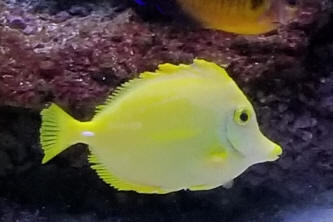
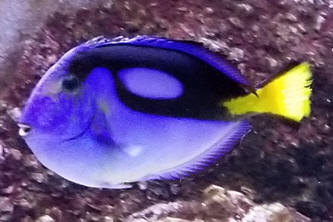
Fin rot or aggression? 11/18/18
I have a Yellow Tang and Hepatus Tang whose dorsal fins seem to be
eroding. The Yellow Tang's caudal fin is also in bad shape. Can you
tell if this is fin rot or aggression from another fish?
<Looks like some fish is nipping both of your tangs>
The water tests out fine.
<I need more accurate information here, also what size is your tank,
equipment...etc.>
The water is changed regularly. I feed high quality food with vitamins. The fins
have been like this for several months. I am at a loss.
<I don´t think this is a disease, more likely, as mentioned above, aggression.
Could you tell me about the other tankmates? species, size…>
Best regards, Steve DeFilippis
<nice weekend, Steve. Wil>
Re: Fin rot or aggression? 11/18/18
It is a 220 gallon tank. UV Sterilizer, Skimmer, bio sump under the tank,
Reactor.
<Decent size tank, don´t think aggression(if that´s the case) is due to space>
Here are the fish:
3 Percula or Ocellaris Clownfish (I am not sure which) 2-3 inches
Naso Tang 8-9 inches
Yellow Tang 3-4 inches
Hepatus Tang 4-5 inches
Flame Hawkfish 2 inches
Royal Gramma 3 inches
Coral Beauty Angel 3 inches
Blue jaw Trigger 3 1/2 inches
Tail Spot Wrasse 4 inches
A few small crabs and one larger hermit crab
<All of them can coexist. have you see any aggressive behavior?...maybe during
feeding or at night?>
Thank you.
<Welcome>
Best regards,
Steve
<Wil>
Re: Fin rot or aggression? 11/18/18
I have not seen any aggression. That's why I am puzzled. Fin rot would also seem
unusual given the quality of the water conditions. The Yellow Tang in particular
had beautiful fins before this started.
<Then the only thing that comes to mind is that it is an
environmental/nutritional issue, very likely HLLE, plus something in the water
you´ve been missing or that test kits don´t measure; try doing a large water
change(20% +), run activate carbon or Chemi Pure for a few days and add vitamins
A,D,E enriched foods/supplements to the water.>
>>Ahh; yes; THIS IS a type of HLLE... nutritional, environmental (water quality)
most often the cause. SEE/READ on WWM Re:
http://www.wetwebmedia.com/HLLESWCure.htm and the linked files above.
BobF<<
Best regards,
Steve
<Wil.>
|
  |
Restart aquarium 11/18/18
I had a FOWLR aquarium running for years until Hurricane Sandy knocked out power
for 2 weeks and everything died. Tank has been laying idle ever since, still
filled with water, sand, and rock. Pumps, skimmer, lights, etc have not been
turned on in 6 years. I want to start her up again. Any advice?
<Rinse the submersible equipment in a 50/50 solution of water/vinegar for a day
or two; put the rock and sand for 24 hrs in water with 10% bleach, after doing
this, just rinse and add dechlorinator, then you can reinstall the
tank. Wil.>
Persistent Flashing
11/16/18
Bob,
<Eric>
Hope all is well. I am having an issue with a few of my fish that are in QT.
They are continuously flashing and am not sure why. I have had them for 3 weeks
and my QT process is as follows:
<Mmm; flashing can be... "just natural" to extents, due to irritants of a wide
array: Water quality and parasites most commonly>
Freshwater Dip to check for flukes
7 Day Metro GC for flukes and worms
14 Days of copper than ttm into display
<Ahh, could be just the copper exposure>
Problem I am having though is my fish show no signs of white spot but are
constantly flashing at the gills. Tough to explain but my fang tooth blenny is
also spinning in a semi-circle to clean its tail. Not sure what else to do? Is
it a reaction to the copper, Healing from Ick or velvet, some copper resistant
parasite?
<Could be any of these. I wouldn't be overly concerned. With conditions and
health returning, the flashing behavior should subside>
Thanks for taking look.
Eric
<Welcome. Bob Fenner>
Possible Hydrogen Sulphide issue? 1/31/18
Hi Good evening from Thailand.
<Hi Dirk. Greetings from sunny southern California>
In our newest tank (about 5 months old) we had a huge Red Slime issue.
<No fun>
We let the slime do its thing for about 1-2 weeks in the hope it would go by
reducing nutrient additions etc... the slime only became thicker and
thicker till it almost took over the entire tank.
<Can be toxic; at times, very>
Now was the time to go chemical we thought so we first siphoned out most of the
slime and added "Red slime remover" this worked quit well with some smaller
patches left on the sand after about 48 hours or so.
<I do hope you are using chemical filtrants>
Now when we wanted to stir them up from the sand
<Best to do without livestock present, AND via gravel vacuuming, removing the
interstitial materials there>
(fine sand about 2-3cm thick) we noticed some places of the sand was clumped
together and had a much darker color (black-purple like) while steering it up in
fell apart creating some smaller dark clouds in the water column....
<Trouble; H2S...>
since then some of the fish ( Clownfish only tank....Ocellaris, Skunks, tomatoes
and Maroon) (Maroon looks like a white film is coming of its skin?) in the tank
have died...could this be a Hydrogen Sulphide issue?
<Oh yes; plus the BGA, plus the results of using the Algicide>
Can this be an issue in such a thin layer of sand (though under a layer of red
slime) in such short time...1-2 weeks?
<Of a certainty, yes>
Oxygen levels were upped during the chemical period so I doubt it was oxygen
issues that killed the fish....could it have been under feeding that caught up
with them after about 1-2 weeks very low feeding regimes...(mostly just once a
day) ?
<Perhaps a small co-factor>
Thank you for the advice...
Dirk
<Thoroughly gravel vacuum this system, move the rock, decor to get to the
substrate under and around it, remove about half the water this way. Use
ChemiPure, PolyFilter in your filter flow path/s. Bob Fenner>
Too Much Tinkering In My Reef - Please Help!
1/16/18
Hi WWM Team,
<Really like your subject/header here>
I hope all is well in the New Year! I am going through one of those
“tinkering too much moments” with my Red Sea Reefer 450. I have a mixed
reef tank and decided to add a 3 ½” Achilles Tang and 4”Watanabei Angel
within the last month. The fishes and corals are doing fine and my water
parameters were fine as well. I decided to be proactive and thought it
would be wise to add more biological filtration because of the new
additions.
<Can never have too much Biofiltration>
I bought a box of Marine Pure bioballs and a bottle of ATM nitrifying
bacteria (label states it treats up to 100 gallons – which is less than
my total tank volume). I’ve added the bioballs and the entire bottle of
ATM nitrifying bacteria into my tank last week. I turned off my skimmer
for 4 days as per instructions. My tank was instantly cloudy once I
added the ATM solution; I figured it is the bacteria in the bottle.
<Mmm; maybe secondarily>
As I wait for the bacterial colonization process, I noticed my Choati
Red Leopard wrasse was missing for a couple of days. She was always
active and eats very well. Again, I thought of being proactive is best
and have to go into the tank to search for her.
<Not by disturbing the sand bed I hope/trust>
I don’t want her to die and decompose in my tank, especially during this
tenuous stage of my tank. As I comb through the sand (about 1”
sand bed),
<I'd increase this by at least twice>
I could potentially disturbed some anaerobic pockets – loosened some
clumpy sand that had black residue rising up.
<Oooh, not good>
Long story short, I caught the Choati wrasse and relocated her to the
quarantine tank (unfortunately, the Choati wrasse died in the QT last
night). I tested my water in my main display and they are as follows:
Ammonia (Red Sea) = .2 ppm
Nitrite (Red Sea) = 0 ppm
Nitrate (Red Sea) = 16 ppm
PO4 (Hanna) = 0.06 ppm
PH (Red Sea) = 8.2
Alkalinity (Hanna) = 9 dKH
<All fine w/ the exception of the ammonia>
I decided to do three 20% water change in the last 3 days and added a
dose of Seachem Prime to lock up the toxicity of ammonia until my
mini-cycle completes itself.
<.... I would have just stopped feeding... >
I tested my water again, and it remains relatively the same:
· Ammonia (Red Sea) = .2 ppm
· Nitrite (Red Sea) = 0 ppm
· Nitrate (Red Sea) = 10 ppm
The water is still cloudy, which is surprising to me because I thought
the water changes would have rid the bacteria bloom in the water column…
<And the loss of ammonia, likely bumped off a good deal of nitrifying
population>
The livestock (both fish & corals) still looks fine - the fish are
eating & active and the corals are fully expanded. Anyway, what would
you recommend with regard to the mini-cycle and cloudy water?
<Just stop feeding till the NH3/NH4OH drops to 0.0 ppm>
As always, your insights and recommendations are extremely appreciated.
Many thanks in advance.
Best,
Dan
<Thank you for sharing. Increase, mix in more sand when the system
restabilizes. Bob Fenner>
|
Slime coat 7/20/17
I have a 180g fish only no live rock sw aquarium, 40g wet dry, protein skimmer
and 57w uv filtration. 10 inch orangespot Rabbitfish, smaller Foxface,
8 yellow tail damsels, a small purchase clownfish and 6 cardinals. When I clean
the tank or even in between there is slime coat floating around.
<Mmm; well Siganids are quite slimy... and stress does make them produce
more body slime>
I don't see fish scraping. I do see little bugs crawling around the tank at
times. It got bad once and I added copper and the amount I saw scaled back.
Circulation is at the moment a Mag 12 but I will be adding a Mag 9.5 next week.
Cleanings are bi weekly with 35 percent water changes. Here are some photos of
what I see. Some of the little bugs are actually on the slime also. This is
during a cleaning. A queen angel was in this tank for a year and a half or so
from a small 4 inches to 7 inches , one week got an infection on head that
spread to one side of its body along the lateral line. Few weeks ago saw
labored breathing and blood coming out of the gills as it was breathing in and
out.
<?! Something wrong here. I'd skip using copper... What is your
procedure for water changes, supplement, media use here?>
Tanks has been up for 6 years. Ph is at 8, nitrates are high I can't give you a
number ATM, no detectable nitrites or ammonia. I think its irritation from the
bugs but I haven't found what would get rid of them.
<See WWM re arthrocides used for crustacean diseases. Bob Fenner>
|
 |
Hello..... Ongoing... unclear
7/30/16
Hi Bob I've been doing this hobby for many years I'm in toto wipe out mode
There no flukes n the gills could it be plastic plans I've had man in my tanks (
I have five)
<... What sort of plastic (sic) plans? You mean plants? Are these made for
aquarium use?>
I've added some new plants to some tanks but only ne to main tank which is
running of separate sump I'm in crisis mode
I just don't get it m friend !!!!!
Dylan Masonre: Hello 7/31/16
Yes they are plastic for tropical and marine use my friend
<Good; then chemically inert Polyethylene... w/ no metal inside>
Dylan Mason
|
can you identify this disease please? ... Large reef,
poisoned via Cnidarian allelopathy 4/28/16
ok the situation is this.
The tank is a 1700 gallon system with loads of fish in it a few
corals.
All parameters are good with NItrates just showing a bit high at 40
<This is more than a bit high... by about twice. See/READ on WWM re NO3
reduction>
but should be no issue looking at whats in the tank I believe.
The tank has been doing very well for about a year now (for detailed
fish list you can check out the build thread of this tank here in RC)
<Don't do bb's. Worse than a waste of time almost always>
So all fish doing really well and eat like crazy look fat and all.
Friday I have a batch of dwarf angels for another tank and see I have
one in overtall
<?>
for that tank so add 1 yellow angel
<What species is this... a Centropyge? flavissimus?>
to the large tank. on Saturday we add 1 leather finger coral and
one leather mushroom to the tank
<.... how were these acclimated? Have you read my SOP re on WWM? Need to
be introduced over weeks time...>
and all is still good. Now Monday morning with feeding we see
fish are not feeding as normal and we see one of our powder blues stuck
on the overflow ready to die so at further inspection we see
many more fish struggle.
<Allelopathy... a cascade reaction... likely drop in ORP, DO...
change water, add GAC, Chemipure, PolyFilter... IF necessary move all
the fishes elsewhere>
Tuesday we remove 2 death butterflies, 2 death Anthias Wednesday we see
most tangs start to feed again though still reluctant and much more
skittish as they used to be hiding in the rock all the time only 1 death
clownfish seen. No today Thursday we film the clip of a clownfish
struggling and have 1 more Anthias lying on the floor as death though
when caught it was still alive though we removed it anyway as it is
dying.
On non of the fish any sign of Ick or any other skin lesions I think.
The clown in the clip as maybe not really view able the skin looks like
dry and rimpled and seem to have melted skin on his back fin?? in the
clip which is filmed on the side (so top of tank is actually left side
of the view) the clown goes up to the surface to let himself sink back
down over and over again. All other fish seem to be behaving the same as
last few days feeding reluctant and still hiding all the time??
<READ here:
http://wetwebmedia.com/CorlCompArt.htm
and the linked files above, NOW>
what could be wrong
<See above>
and what disease did I clearly introduce into this system though the
Yellow Angel (can a disease from 1 dwarf angel small size even spread
that fast??)
or through the rocks of the coral though they came from my own system
and have been doing in an ok tank for over 3 years now.
anyone can help so we know what to treat tank with if treatable? large
size of the tank does not help the situation here for sure I think
<Keep reading... and act accordingly. Bob Fenner>
Re: can you identify this disease please? Not reading...
4/29/16
Hi Bob, Thank you for the quick reply
so your thinking that one of the leather poisoned my tank?
<That and/or the Shroom>
Rather than the fish introducing some parasite?
<Not a fish parasite... the etiology is all wrong>
The fish introduced was a Centropyge heraldi. Both leather come from a
system I have at home and have been in that tank there for over a year and
have been doing well.
<Not with new... DO THE READING>
By the way both leathers look still ok. Should I take them out? Can 2 small
(each about 5-6" in diameter) colonies poison an entire system this large?
(118x40x63)
<Don't write: READ!>
Re: can you identify this disease please? Still not reading....
4/29/16
Hi Bob, also to my previous reply we made a picture of one of the
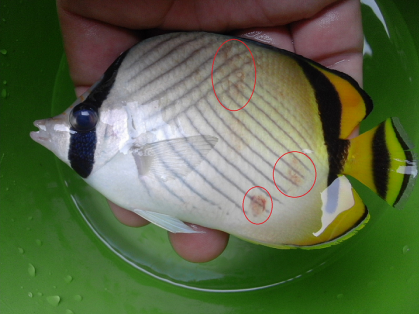
butterflies who showed the behavior most fishes show just before they die
just sitting on a rock with lack of movement the red spots on the picture we
were not able to see on any of the other fish previous (though they were
colored and much smaller) maybe this picture helps diagnosing?
<Can't tell anything definitively... Same answer. B>
|
 |
|
Re: can you identify this disease please? Not able to read?
4/29/16
Hi Rob, some more pictures this time from a suffering Butterfly we have in
there now.
<... mate; IF you won't read I/we can't help you. Your fishes are
almost certainly suffering from Cnidarian allelopathy; secondarily from?
This latter cannot be ascertained w/o sampling and microscopic examination.
STOP WRITING AND READ>
seem to not swim around though when trying to catch him he is still very
lively but will be a goner for sure tomorrow. He seem to come as close to
the glass as possible as he was saying take picture and get this diagnosed
hope they are more clear and can help you better to help me. Wonder what all
the red spots are all around his skin. Again here skin looks dry and
flaking.
|
.png) |
Eucalyptus oil toxic to marine shrimp?
4/5/16
Hi Crew,
<Thomas>
I have had a bad cold (and no, I don't believe my shrimp caught it). A
little over a week ago, my friend lent me a humidifier and some
eucalyptus "100% essential oil" to be used with the humidifier to help
with my congestion at night. The eucalyptus oil created an odor, as you
would expect, that lingered for days after the humidifier was turned
off, and pretty much permeated the whole house.
<Mmm; as it is wont to do>
After a couple nights using this humidifier and oil, I noticed the
Scarlet Skunk Cleaner Shrimp in my bedroom tank seeming lethargic and
not eating, then a day later I notice a similar problem with another
Scarlet Skunk Cleaner Shrimp in my downstairs living room (a different
room on a different floor, but on the same air circulation system).
Suspecting the eucalyptus oil as a likely problem, I discontinued its
use and moved it and the oil bottle to the garage. I also changed 20% of
the water, and replaced the activated carbon with twice the usual
amount, in my bedroom tank.
<Good moves>
The next day, the shrimp there seemed a little better, so I also
replaced the activated carbon in my living room (but did not change
water, as I did not have enough available).
After a few days, both shrimps seemed better and resumed eating, though
I had the sense that they were not 100% back to normal. Then, a couple
days ago, I found the shrimp in the living room tank dead on the bottom.
Today,
I noticed the shrimp in the bedroom tank being harassed by the Lemon
Peel Angel, who normally would go to the shrimp for cleaning services.
As I watched, I noticed that the shrimp did not seem to signal his
willingness to clean as he had before, and I wondered if this
inappropriate behavior (for a cleaner shrimp) causes the angel to
respond inappropriately. I also notice that this shrimp's tentacles do
not seem as straight as I remembered them being (he had molted a few
days before all this started).
<Good observations, reporting>
All my fish and hardy soft corals seem fine.
So, what is my question? Mainly this: do you think it is likely that
this airborne eucalyptus oil is the cause of problems for my shrimp?
<By inference and some otherwise deduction I do. The class of compounds
that include Eucalyptus "smell" have various and diverse biochemical
properties;
https://en.wikipedia.org/wiki/Eucalyptol#Toxicology>
Perhaps you don't (or can't possibly) know, in which case my email will
serve as a caution about a possible risk of using eucalyptus oil around
marine aquaria.
<Yes; thank you>
Thanks,
Tom
<Bob Fenner>
Need a parasite
ID/treatment recommendation... ... toxic situation
11/19/13
Hello WetWeb Crew,
<Ami>
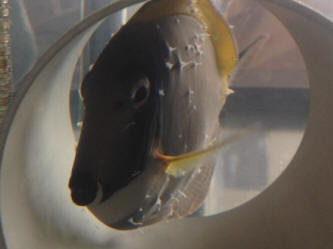
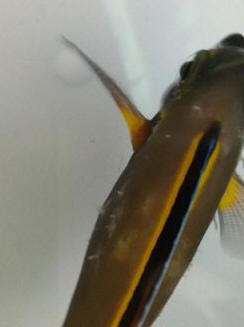
I seem to have come across an unknown parasite,
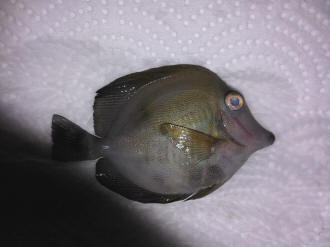
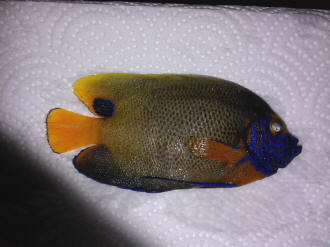
<?... the pix attached; show two of the more aquarium-difficult
Acanthurids... w/ a great deal of accrued body slime... exposed to what?>
and despite scouring the internet I've come up empty. I need some help in
determining what this is, and how to treat it. First of all, none of these
fish have entered my display tank - this pathogen has been confined to
quarantine. Also, I've now experienced it on three different fish
within three years. The first two fish (powder blue and brown
tangs) did not survive, despite months of attempted treatment and
troubleshooting with medications.
<Sans sampling and microscopic exam? Have you read the mat.s on WWM re
parasitic identification?>
I have attached photos of those two fish for your reference. I had hoped to
never see it again, but now here I am. I ordered a Red Sea Regal
angel, and he came out of the bag with 4 of these "growths." I did
not attach a picture of the regal because I'm having trouble getting a
quality shot, and there is no doubt that it is the exact same symptom. What
I've observed, is that these "spots" start out as a small speck on the fish,
bigger than Ich and wrong texture/shape
for Lympho. They then proceed to "grow" outwards from the body of
the fish and form a 2-5mm filament that hangs off.
<... almost assuredly reaction from something "in/of the water"...>
I've seen them triple in size within a day or two.
<... mucus, mucin... See WWM re body slimes of fishes (these four words in
the search tool; on every page)>
On the deceased fish, I've attempted to remove the growths via tweezers or
scraping in hopes of learning something about them, but there's no real
anatomy as far as I can tell. They don't seem to be worms. I've had mild
results treating with .5mg/l Cupramine, but the parasite manages to return
worse than ever after a week or less of symptoms disappearing, while still
in full dose copper. I have not observed the disappearing act that is
associated with Ich, once a growth appears it stays; though the delicate end
piece can break off. Any help at all or insight you can offer would be most
appreciated. A regal angel is just about the worst fish to try and
experiment with medications on. Thanks in advance
Ami
<Am almost certain this is simply body mucus... a reaction to... something/s
in your water... Sample it and see (under a 'scope). Some treatment, an
aspect or more of your system is poisoning these fishes... causing them to
become "very slimy"... that's what this trailing white material is, NOT
parasitic; not pathogenic period. Treatment... involves investigating,
eliminating the source of toxicity here... salt mix? source water? some
"treatment" misplaced here... Bob Fenner> |
|
Re: Need a parasite ID/treatment recommendation
11/19/13
Thank you very much for your reply Bob,
<Welcome Ami>
I had considered the possibility of excess mucous also, but there is
nothing (detectable)
<The operative word... I WOULD add a unit or two of both ChemiPure (or
eq.) and PolyFilter in your circulation, filter flow path... likely
whatever this is... will be sufficiently absorbed to make a difference.
Going forward I strongly suggest you look about for a source of metal
poisoning (a fitting, piece of décor...) and sources of aerosols... ask
your water supplier (number on your bill) for their analysis of your
source water>
in my water that could be acting as a toxin. Is there something specific
you would have me check for? The obvious parameters are all perfect in
my quarantine systems and display - Ammonia, nitrite, nitrate are all 0,
phosphates are undetectable,
<... How are NO3 and HPO4 rendered as zero? Chemical filtrants may be
the source of trouble here>
I run my salinity at 1.025, temperature is 78 degrees. These fishes all
exhibited symptoms prior to any medication being introduced, and within
a day of being moved; including the regal angel which came out of the
bag from LiveAquaria this way.
<Am doubly concerned then LA has very good livestock... they buy
exclusively from the best outfit in the US... and several friends in
turn supply them>
The two tangs came from the tanks of fellow reefers where they lived for
years, but had never been quarantined previously. I am well aware of the
difficulty level of the tangs, and I currently have powder blue, powder
blue hybrid, and achilles all living quite happy and healthy in my 520g
reef tank. I attribute my success to quarantine. These particular fish
that showed sloughing mucous seemed quite random. Also, what am
I looking for under a microscope?
<Structure; send along pix>
Verifying that it is indeed mucous, or the nature of said mucous?
<Amorphous, almost clear, w/ some slight thread-like inclusions>
I will need to pick one up as I don't have one on hand.
<See WWM re>
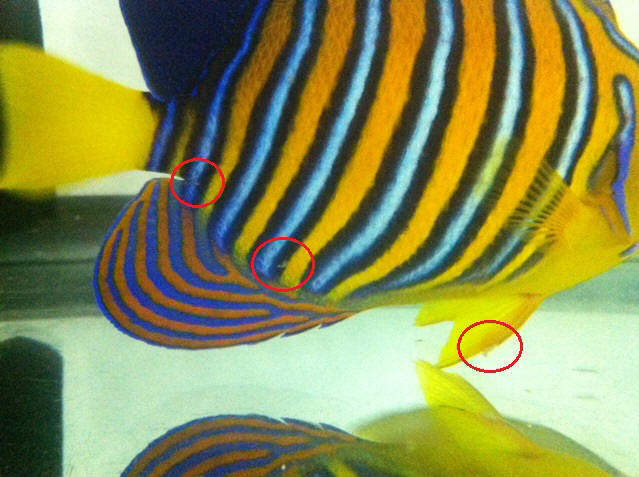
I have managed to take picture of the regal, the "mucous" blends in with
the pattern of the fish unfortunately, each area is about 3mm long.
<Can't make out much more than this>
I realize the picture looks pretty mild, but after experiencing what I
have in the past with this thing, I'm nervous to say the least. I am
also unsure how such excess mucous would manifest itself the same way in
such soft bodied tangs and the thoroughly scaled angelfish. For now I
will focus on getting her a healthy appetite. Thank you for your help!
Ami
<Welcome. Bob Fenner>
|
 |
|
Fish Dying in Reef Tank 10/16/13
Hi Bob,
<Joe, Aquaman! Shades of DC:
http://en.wikipedia.org/wiki/Aquaman >
In the hobby for 17 years and never experienced something like this.
I have an aquarium maintenance business.
<Ahh, I did this for 19 years as well>
One of the aquariums is a 155 gallon bowfront with fish and corals.
A month ago a get a call from the client saying all the fish are
dead. The soonest I could of seen the tank was in 2 days.
Upon arrival all fish were dead (Yellow Tang, Foxface, 5 clownfish,
Sleeper Head Goby, 3 Damselfish). Coral (Favia Brain, Mushrooms,
<Mmm; Shrooms... a prime candidate>
Pagoda Cup, Frogspawn,
<Euphyllia second>
Trachyphyllia Brain Coral) looked stressed but not dead. The test results
were Amm .05,
<Residual from the deaths>
didn't test Nitrite, Nitrate 40 (normally at 30),
<This too>
pH 8.1, Salt 1.023, Temp 81. The only change was, I reconnected
the Kalk dripping system that use to dose at night but I just plugged in
the timer during the day without adjusting for the correct time.
<Mmm, not likely problematical>
I ran 1 cup of carbon (probably not enough)
<We used a zillion "units" of Chemi-Pure... I'd do this and cut back on
water change percentages>
added a dose of "Prime". For the next 4 weeks I've done weekly
water changes of 50 gallons, and replaced the micron bag. So I was
to assume everything is fine. Water tests are inline Amm 0,
Nitrite not test, Nitrate 20, pH 8.0, Temp 80. I add two
clownfish, the next day..dead. Wait 2 days, add 3 damselfish..
next day dead. I'm in the process of making water for a 100% water
change.
<Likely warranted; a good idea at this stage>
I'm at wits end, your input would be greatly appreciated.
Joe
<This reads as a sort of classical allelopathogenic (biological
poisoning) case... Would like to know the order in which the fish died
for further evidence... but... "something" triggered a negative
interaction twixt the Cnidarians ("corals") here... eliciting their
poisoning the system for the fishes. Let's have you read both here:
http://www.wetwebmedia.com/cnidcompppt.htm
and the linked files above for background (the FAQs for the
Corallimorphs and Euphylliids), and here:
http://www.wetwebmedia.com/toxicwipeoutf.htm
Do write back if there are still questions, concerns. Bob Fenner>
Mysterious tank failure (urgent), SW
2/10/13
Hello, my name is Kevin Plath, and I am a long time fan of WetWebMedia.
Right now, I have an extremely frustrating problem on my hands regarding
my reef tank. The tank is a 20 gallon high running an AquaC Remora for
skimming, filled with 3 inches of live sand, and about 40 pounds of live
rock. We are using 3 400gph power heads for water movement. I started
the tank last year in August. The water parameters were all fantastic,
and the corals and fish were thriving. Then, the corals and inverts
began to wither and die. Large polyped stony corals and soft corals
melted into stringy white netting overnight, small motile inverts (
snails in particular) also died mysteriously.
<Something (internal, likely biological) poisoning this small system.
VERY likely a case of allelopathy, cascade event...>
The fish, however, had seemed unaffected. We began developing large
quantities of brown slime algae,
<Likely a BGA... occur in all colors>
and hair-like blue-green algae all over the tank.
<VERY toxic>
Since then, the algae problem had been solved,
<How?>
but various new livestock problems had all popped up. We have currently
lost over $3000 of innocent fish and corals seemingly out of thin air.
<?! In a twenty gallon system?!>
Even after 90 percent water changes, it still seems like the tank itself
is toxic.
<... time for a much larger tank... and to bleach, re-start this one>
I put in a detritus crew to boost biodiversity, but by the end of the day,
all of them were dead, including a Caribbean sea cucumber.
<What species? Some of these are trouble>
In addition, all of my Coralline algae on my rocks died after the brown
slime algae went away.
<... again, how was the algae issue remedied? IF by removing nutrient
chemically, likely the encrusting red/s were killed also>
Most recently ( last week), I did another 60 percent water change, and
added 2 pieces of coralline algae encrusted live rock, as well as 3 lyre
tail Chromis. When they were first released into the tank, the Chromis
seemed fine, swimming around actively. That night, 2 of the Chromis
died, with the 3rd passing on the next day. The live rock I added with
them had a small yellow sponge, and some thriving strands of purple
macro algae. The macro reddened and fluoresced over the course of the
next to days, and then finally became transparent. The sponge browned
and became covered in brownish black spots. We added a cardinal from
another rank, and it died within 3 hours. When a serpent star was added,
it died on contact. I tested my water parameters the other night, and
there are 0 phosphates, 0 nitrates, 0 nitrites, 8.2 PH, 11 DKH, and 0
ammonia. There is, however, a strange white film that peels off my
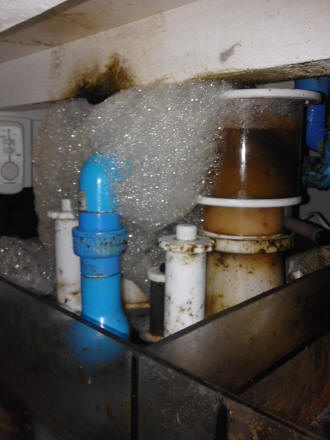
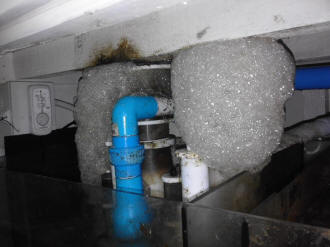
aquarium walls, and a white foam around my skimmer base. We use
pre-mixed reef-ready saltwater from a local dealer for all our water
changes. What scares me, is that I have a shipment of wild live sand
from the Gulf of Mexico coming in, and I can't have that die too. What
is wrong with my tank, and is there a low-cost solution?
Please help,
Kevin Plath.
<Umm, read here:
http://www.wetwebmedia.com/toxictkendof.htm
and the linked files above... for input, solace. Bob Fenner>
|
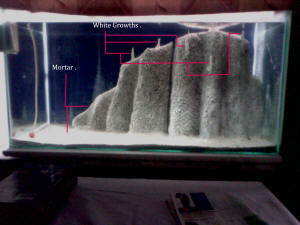
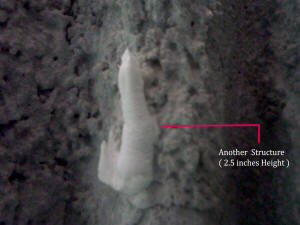
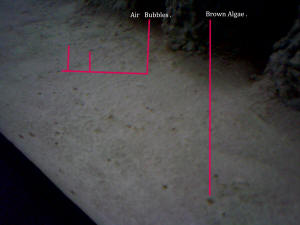
strange growths;19 days old aquarium... Cement and Fe decor
2/6/13
<BM... 13.5 megs of pix?>
Hello everyone.
I have tried looking for clues that could explain the strange growths
that have started popping up in my nineteen days old marine-aquarium,
but in vain. I have been keeping fresh water fishes for a decade now.
With this unexpected encounter right in the beginning while the tank is
cycling, that does not have any available records, its frightening.
Intend to keep a fish-only tank with Prolifera algae and, an ocellaris
clown, Andaman damsel and a Brazilian gramma( the last two fishes will
be added after about three-four months post clown-addition) after the (4
weeks) cycling is done. What I have in the tank are -
1. tap-water with salt from Red-Sea,1.0018 SG
<One zero too many here>
(intend to keep the SG at this, prior to opting for live rocks and
corals)
2. structure made of building sand, dark and white cement with iron-mesh
re-enforcement.
<... this will have to go... the cement is likely toxic, the iron
definitely so>
3. a cube of dry Tubifex worms, few three-millimeter sugar cubes added
thrice so far, for bacteria culture.
4. a power head and an air-pump for oxygenation.
5. strong, ambient day light in summer and, slight direct sun-light in
winter.
6. bottom is one centimeter solid mortar.
I could not provide the measurements of the gases, etc., as the tools
are not locally available yet. I am from India(West Bengal).My regrets.
<No worries>
Please take a look at the attached images and kindly help identify and,
meet the situation as required.
Warmest regards.
From-Anupam Biswas.
<Mmm, well, the "growths" are highly likely just "crystals" grown from
the cement, parts of the salt mix here... The pH, alkalinity are likely
sky-high (very)... Again, the construct you've built, placed won't work
in a biological system.
Bob Fenner>
|
 |
|
Re: strange growths; 19 days old aquarium
2/7/13
Thank you Mr. Fenner.
It was a pleasure conversing with you.
<Welcome... I would break off a piece of one of these growths and look
at it a bit more closely to be sure... Under a microscope if you have
one, or just a magnifying glass, loupe if not. Cheers, BobF>
Re: strange growths;19 days old aquarium
2/10/13
I will definitely try to do as you suggest Mr. Fenner the soonest and
send an update to you for your valuable input.
Cheers-Anupam
<Welcome. BobF>
|
Clown and royal gramma scratching 12/30/12
Hi crew! I've noticed over the last few weeks my Ocellaris clowns and my
Royal Gramma glancing off the oolite sand. Occasionally I'll see the
Clown scratch her face off the weir. There are no spots on any fish.
<Mmm, "some" scratching is "natural"... not indicative of trouble>
All fish are eating extremely well However, in reading FAQs I see
where it could be corals causing irritation. Could this be the problem
here?
<Yes; or other chemical/water quality issue>
I have various mushrooms, Sinularias, toadstools, paleos, green star and
daisy polyps. Also, I had a small breakout of Cyano but I siphoned it
up, added more water movement and did a large water change. I have a
fish in the QT and don't want to add it until I'm sure the DT is ok.
Thank you!
Jen
<I wouldn't be overly concerned here. Am glad to find you're aware of
possible/probable root causes; have done what you can to solve. Bob
Fenner>
Re: Clown and royal gramma scratching 12/30/12
Hello Mr. Fenner! You mentioned chemical/water quality issue...to that
point I recently add to do an emergency water change (about 10 gallons)
and did have my usual brand (Tropic Marin) on hand and used Instant
Ocean. Also the freshly made saltwater was only "aged" for a day. Could
this be the cause of the irritant?
<It could be; yes>
Thank you again, Bob! I hope you are bringing in the New Year somewhere
fabulous!
<At home... which is fab! Don't drive about on major holidays. Cheers,
BobF>
Tank disaster - what to do
now 3/28/12
Good morning,
<Steve>
Love your site, and hopefully you might be able to give me an answer on
this problem I'm having.
<Am hoping so too>
I set up a 55 gal saltwater tank about 5 months
ago. I cycled the tank and added live rock. After a month
or so I added a 3-inch long domino damselfish.
<Ye gods, what a monster! A really alpha fish
species!>
He did great, live rock was doing great, tank appeared to be healthy
and cycling normally. Coralline algae was spreading and all was
good. About a month later I added a maroon clownfish. It
was a mistake, because the clown had been a little beat up by a
triggerfish prior to me adding it.
Dumb, I know, but I really liked him and did the stupid thing and
bought him. The clown, however, seemed to be getting better, fins
looked good, he was eating, etc. He was a really cool
fish. After about 6 weeks, he started to slough off slime, and
started to appear lethargic. I moved him to a quarantine tank
where he battled the infection for about two weeks. I went
through different treatments - Furan-2, Erythromycin,
"Quick-Cure" (malachite green)
<And formalin, a biocide... kills all life>
, but to no avail. Afterwards, I concluded that he had clownfish
disease, but I don't know for sure.
<Too much stress... these two can't live together in this
system...>
By this time we had also acquired a small arc-eye Hawkfish. I was
hoping that the damsel and the hawk would be OK, and they seemed to
be. Tank is cycled, ammonia is zero, all looks well. Then,
last night I noticed that the domino looked bad - skin
"peeling", scales missing, eyes cloudy. I looked at the
hawk and he looked bad too, but not as bad as the damsel. He
looked pale, and just wasn't acting normally. I moved them
both to a quarantine tank and started treatment with Furan-2.
<Of no use>
This morning the domino was dead. Hawk is still alive but I
don't expect him to make it. I went from having healthy,
active and beautiful fish to this, literally overnight. So, now I
have a 55-gallon tank of invertebrates (some hermit crabs, snails, a
couple of anemones,
<? What/which species?>
some corals and tube worms that came on the live rock and are
thriving, and lots of live rock), all of whom seem to be OK. Do I
have a parasite or bacteria that will prevent me from keeping fish,
unless I start over or treat with some nasty chemical like Furan or
Malachite?
<Not likely... probably just an issue twixt the seemingly healthy
invert.s>
Is there anything I can do without starting over, without harming the
inverts. I'm just sick about the maroon clown and now the
other two. I do not want to start over since the inverts and the
live rock are doing so well. Any help you can give is much
appreciated. My local LFS is not much help at all.
Thanks,
Steve
<Do read here: http://www.wetwebmedia.com/toxictk.htm
and the linked files above. I am hopeful "something" will
jump out, become live to your consciousness thereby. Bob
Fenner>
Re: Tank disaster - what to do now 3/28/12
Bob, thanks so much for the response. I did check out your link
and saw some things that I should change with regards to my marine tank
hobby. It is a very useful link, and had some info in it that
I've not seen before.
<Ah, good>
As for the situation at hand - I think I've found the
problem. I did an ammonia test yesterday, and it showed zero
ammonia. I did another one today at lunch, and it showed 0.5.
<Mmm>
Somehow I screwed up the test yesterday. It may have even
been worse yesterday, because I did do a 20% water change by setting up
my 10-gallon quarantine tank for the hawk and the damsel. I did a
30% water change on the quarantine tank for the hawk today, and I will
discontinue the Furan-2 treatment. It will probably only make
things worse, and I've never known any fish meds to actually work
once a fish got sick. I must have had something die in the tank,
or left some uneaten food in the tank to cause the ammonia spike.
The other creatures in the tank are all inverts: 6 to 8 small
blue-legged hermits, 7 turbo snails (all about 1" in dia.), what I
believe to be a "curly-cue" anemone about 2"
tall, a number of small (unidentified) hard corals that are attached to
the live rock, a Condy "pink tip" anemone, about
4-5" tall. I think that's it.
My main focus is saving the hawk. At lunch his color looked
better, but he's breathing heavy. I'm hopeful, but not
very optimistic. I guess I'll continue to monitor the water
and hope for the best. Should I add any of that "ammonia
detoxifier" stuff to his quarantine tank?
<I wouldn't, no>
Are any of those products worth anything?
<In dire emergencies, yes>
Thanks again for your help.
Steve
<Welcome. BobF>
Re: Tank disaster - what to do now
3/28/12
One last thing that I forgot to mention. The feces from one of
the fish was white and sort of "curly". The clownfish
had the same thing. Does this indicate anything?
<Not really... search WWM re>
Thanks again!
Steve
Larger fish keep dying; poisoning of some
sort 1/31/12
Hello WWM Crew & thanks for all the help over the years...
I have a perplexing problem. Over the past year or more I have added
some larger species of marine fish to my 90g reef. All of them ended up
dead within a couple of months. I cannot figure out how to ameliorate
this problem.
<Mmm, let's see>
The 90 is about 7 yrs old. It contains 2 yellow tail damsels that are
original inhabitants, a pajama cardinal (2 yrs), ocellaris clown (in my
tank 6 mo.s; he is about 5 yr old per LFS). There are various red &
blue legged crabs & a few turbo snails.
Some fish that have perished are : yellow Sailfin tang, powder brown
tang (anth. jap.), Foxface, blue hippo tang.
As far as food goes, they were all fed dried seaweed on a clip about 2
x week,
<Of very limited food value>
various flake foods,
<Also>
different frozen meaty foods once every day.
Water parameters are generally Ph 7.8-8.2 (am/pm), CA 390-425, KH
2.0-2.5, TEmp 82F, NO4 >2.0, Nitrite always 0, AM 0, PO4 1.2-2.0,
water changes are 15 g/2 weeks, ATO with fresh RO/DI buffered to 8.2
ph.
I have a magnetic algae scraper that I use every other day to clean the
glass. Sometimes it stirs up the sand a bit.
Despite low NO4 & PO4, Cyano still gets on the substrate
<Toxic>
even though I have 3 PH's at 500gph each.
<... powerheads I take it>
The fish usually show no signs of outward disease, hide under the rocks
1-2 days before dying, darken in color, show rapid gilling once hiding
& not moving.
<Some source of toxicity... that your long-standing stock has
acquired tolerance of>
Death is usually within 2 days after hiding.
The fish have come from various LFS, and online at
Drsfosterandsmith.
<The last a good supplier>
I am about ready to hang this hobby up cause it's too frustrating
not knowing how to help these fish live.
Doug - Michigan
<Mmm, from what's been presented here... again, some source of
poisoning...
Cyanobacteria perhaps... but could be a metal... A few things could be
tried... Chemical filtrants like PolyFilter might give an indication
(through colour change)... Best to have you read here:
http://www.wetwebmedia.com/mardisindex.htm
the second and third trays down... Toxic, and "Other"
sources... Bob Fenner>
Re: Larger fish keep dying. Poisoning of some
sort 2/1/12
Bob,
I do see a rusting metal hose clamp on the return pump.
<Mmm, do run a pad of PolyFilter... make it known if you see the
rust color of ferrous contamination>
I also run carbon in a bag in the sump. I also have a media
reactor with FeO2 to control phosphates (although at 0.5 I could take
offline).
<I would>
Is the rusting clamp sufficient to cause slow deaths in a 90+sump
system?
<Could be>
How about the FeO2?
<To a lesser extent>
I wonder if allelopathy could cause fish death?
<Oh yes. Please read here: http://www.wetwebmedia.com/cnidcompppt.htm
and the linked files above, particularly re Compatibility FAQs for the
groups of Cnidarians you list below>
I have literally hundreds of green Corallimorphs (Actinodiscus sp.
mostly), a colony of Protopalythoa sp. (green/brown) & a small
colony of Palythoa sp. (ugly brown). Other corals are 4 very large
Montipora sp. (green)
<All except for the Acroporid could well account for the losses,
symptoms you list.
Bob Fenner>
Poisonous Tank? 11/4/11
Hello:
<Shelly>
First, thanks, as always, for your help. You guys are wonderful.
Next, here's my problem: I have a 55-gallon tank that was set up 4
years ago. The sand bed (was aragonite), crashed, and I lost all but 2
fish. These I moved to a QT tank.
I then totally tore down the main tank, scrubbed it out, washed
everything, and set it up from scratch. I used white Silica sand as the
substrate, 3 1/2" to 4" in depth (Home Depot) (this may be my
problem).
<Mmm, yes. Am not a fan of Silica/Silicates for a few good reasons,
posted on WWM... Not useful for buffering capacity, too sharp, and
"flat" (like poker chips) to allow for circulation for
aeration/denitrification, doesn't harbor much in the way of
interstitial fauna...>
I took out all the decor, replaced most of it with new stuff and what I
didn't replace, I boiled and then allowed to air dry for 2
days.
I added the sand I let it cycle and then returned the fish. At first,
they were fine, but over time, they've slowly gotten more and more
lethargic and now haven't eaten in 2 days.
(an Ocellaris and a blue Chromis). They show no signs of Ich and look
perfectly healthy, other than the fact that they aren't eating. I
also added 5 Nassarius Snails about 1 month ago and they seem to be
doing fine. For filtering, I have a Bak-Pac 2 skimmer, a power head
moving the surface of the water, and a Penguin filter - 350 gph. Fish
aren't gasping, just obviously not happy.
Param.s: temp: 78, SG: 1.023, ammonia: zero, nitrites: zero, ph: 8.4,
alkalinity: ideal (using test strips, so this is the best I can do),
nitrates: 20. Fish only tank.
<Then the slightly low SPG is fine>
I am SO confused! What is the problem with this tank, do you think?
<"Something" as you speculate is "off"...
chemically, physically here... but what?>
I don't have any idea what the problem could be, other than that
the sand may be leeching silica into the water?
Any ideas you have would be greatly appreciated.-
*Shelly Neumann
<A good part of the "strength" of our site is the
accumulated relating and responses over time. Please review
other's here: http://wetwebmedia.com/toxicwipeoutf.htm
and the linked files above.
and here: http://wetwebmedia.com/toxictkuf.htm
Does anything "jump out", come alive to your conscious from
reading here?
If no, then I would default to the use of chemical filtrants, urge you
to switch out the SiO2 substrate, consider adding a sump/refugium with
RDP, macroalgae culture, a DSB there... the last to do the
"ecology improvement bit" of enlarging, diversifying the
environment... with life itself absorbing, modifying the biological
make-up and dynamics of your present system. Bob Fenner>
Poisoning from silicone sealant
4/10/11
Crew,
<Rick>
Maybe somebody in the crew has had experience with this. I had
purchased a used aquarium that had apparently been resealed with
silicone that is not of aquarium-grade. (Same situation Neale addressed
a week or two ago.) I have since replaced the tank with a brand new one
(also bought new substrate), and I kept the affected fish inside a
breeder net in a known good tank for several days.
Most of the fish recovered quite a bit. Friday I began moving them into
the new 10-gallon tank, but they still seem to be impacted by the same
kind of poisoning, only slower, indicating a lower concentration. I
wonder if the anti-mildew chemicals might have seeped into the plastic
of the box filter, thermometer base, heater end caps, and perhaps the
plants and are now leeching back into the water?
<No. Just the non-aquarium Silicone>
Last night I did an emergency 90% water change and replaced the box
filter with a brand new still in the box, as well as replacing the
silicone air tubing and adding a filter bag with activated carbon above
the box filter.
The shimmying and fin clamping symptoms seem a little better this
morning, but I think I need to continue to do water changes at least
daily for a while. If anyone has dealt with this issue before, I'd
appreciate some insight on how long it might take to purge the chemical
down to a negligible concentration.
(Sigh. I lose way too many fish due to things other people have
done.)
Rick
<Can indeed be toxic. See WWM re. B>
Re: Poisoning from silicone sealant 4/10/11
Hi Bob, it's been a while since I heard from you. Nice article in
TFH this month, and I also found a copy of your book and am reading.
Excellent, but needs a freshwater companion volume! ;)
<I do wish the times (economically) were more propitious. It would
be greatly enjoyable to produce such a work>
As I said, the inappropriate silicone is long gone but the effects seem
to be lingering, which is why I think it may have at minimum adsorbed
onto some plastic/rubber surfaces. Maybe I'm already at a low PPM
but some of the fish probably still weak from the previous tank.
(Bought used, as I said, not repaired by me--I know better.)
Rick
<Do run some (a few ounces) of good quality activated carbon in you
filter or flow path. BobF>
|
Help please, reef toxic
situation 11/19/10
Hello All,
<Nick>
I am relatively new to marine aquariums little over a year now
and have just started to try and introduce soft corals to my
tank. I have a 30 gal tank with close to 30 pounds of LR running
at 79 to 80.5 degrees. My nitrates are between .10 to .20, phos
are at .02, ca is at 430
<And Magnesium?>
nitrites are at 0 as well as ammonia. My salinity is 1.026 cause
I have heard that running at that as well as having a temp of 81
can almost double the life span of inverts. I put in essential
elements every week and water change 5 gallons every two weeks. I
have a Aquatic life light system with 2 39 watt 10k and 2 39 watt
atnic.
Running a protein skimmer Red Sea Prizm deluxe that I just put on
last night. Living in the tank is 1 Arrow crab,
<Can become predaceous. Do keep your eye on it>
2 Perculas Clowns, 1 Scooter Blenny and 1 Algae Blenny, 4 Hermit
Crabs and 2 Snails. I am having such bad luck with soft corals (
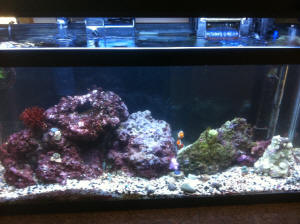
mushrooms and star polyps have died Ricordeas seem to be doing
well I have attached a picture of mushrooms in question.)
<I see these>
I recently read in one of your articles about not to worry to
much if they start to excrete out f their mouths but now one
started to almost melt and two more seem like they are starting
the same signs. The picture I took of the one that looks like a
ball now tied to a string just stretched out to about 8 inches I
am afraid to let it go I feel like I need to take it out of tank
before it affects something else am I right in this? Can you tell
me what is causing this or items to look for?
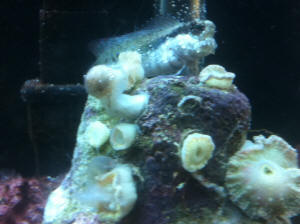
<Something poisonous... do try placing a pad of Polyfilter in
your hang on filter and report back the color/s that the pad
changes/absorbs. Oh, you can search on WWM re this line of
approach... use the search tool here:
http://www.wetwebmedia.com/Googlesearch.htm
with the search string: Polyfilter toxicity color
and read the cached views>
Thanks in advance for any help you can give me!
Nick
<Welcome! Bob Fenner>
|
  |
Sudden Fish loss!/Toxins?
11/8/10
Hello Crew,
<Hello Andrea>
I'm so upset and have no idea what is causing my sudden fish loss.
I have a 200 gallon reef tank with SPS, LPS, Soft Corals, and two
Anemones. Two of the corals are stinging, a very large Frog Spawn
(Euphyllia Paradivisa) and a large Short Tentacle Plate Coral (Fungia
repanda). I mention these in case it matters in helping me solve this
dilemma. The Anemones are a Long Tentacle Anemone (Macrodactyla
Doreensis) and a Sebae Anemone (Heteractis Crispa). I've had the
tank for a year and a half, and a smaller system for a few years before
this which many of the animals moved from. Yesterday I was performing a
weekly water change and before I started to put the new water in my Fox
Face Rabbit Fish started swimming laps. He never does this when I'm
cleaning, he hides. Then he started thrashing about and all of this
within one minute, and was upside down and died. He had been eating
that day and acting the same as always. No marks, no signs of injury or
disease. Then a Blue Green Reef Chromis died within another minute. The
Fox Face was thrashing about pretty wildly with his spines fully
exposed to all. I thought the Chromis could have been injured but do
not know if this could kill the little guy (or gal). I tested the water
and the results are, PH 8.2, Nitrite 0, Ammonia 0, Nitrate 0 , Specific
gravity 1.025, Temp 78 degrees. I watched the tank the rest of the day
and evening and did not see any of the other fish in distress or
flashing or hiding.... I was just stumped but glad it seemed to be the
end of the ordeal. Then this evening when I returned home I did a fish
count and no sign of my Bi color Dottyback, he is no where to be
found!! I am about to lose my mind here, my heart is heavy. I have not
lost three fish in five years now three in less than 24 hours. My other
fish are a Sailfin Tang, Maroon Clownfish, Six Line Wrasse, Star
Blenny, Lyretail Anthias, Green Mandarin, and Blue Green Reef Chromis.
Please tell me what you think it may be or what I can do. I already
have another batch of water in the making in case I need to do another
water change, but I'm not sure why I would, just feeling
desperate!!
<Mmm, I'd like to believe a toxin was introduced into the water
somehow and caused the deaths. Did you notice any reaction from the
anemones at the time? I'd put some Chemipure or a Polyfilter in the
system to remove any possible toxins that may be present. The anemones
you have (my opinion), aren't known to be potent fish killers
although it has occurred. If you had a Carpet Anemone, then it would be
very likely. May want to read here and related articles/FAQs found in
the header. http://www.wetwebmedia.com/toxictk.htm
>
Thanks for your help.
<You're welcome. James (Salty Dog)>
Dre
Re Sudden Fish Loss!/Toxins? 11/8/10
Hello again,
<Hi Andrea>
I wanted to send a follow up to the e mail I sent last night (I've
included the e mail below.) This morning my Bicolor Dottyback showed
up. Yay! So that makes it the two fish that I lost (Foxface Rabbit Fish
and Blue Green Reef Chromis.) I also forgot to mention that I put
carbon in as soon as the fish loss occurred in case it was a toxin.
<Good, Polyfilters are much better for this though.>
I'm still not comfortable that the issue is over because the
Bicolor Dottyback is not as active as he normally is. He is usually
front and center, or visible in his home, fiercely guarding it. He has
done neither. Also, my Sailfin Tang has started fighting his image in
the glass, which he has never done. I know he has to miss his swimming
partner, as do I, the Foxface Rabbit Fish. Also, all the other fish are
doing fine and appear totally healthy. All the corals are open, and
show no changes. The anemones are unchanged as well (both about 10
inches round) Thank you again for your wisdom, you time, and your
advice. I greatly appreciate your website and have gained much
knowledge reading it over the years. The unbelievable resources you
provide to the hobby, for free, is remarkable and unmatched. The prompt
response to your readers is tremendous. Thank you.
<You're welcome. I believe my original response should help you.
James (Salty Dog)>
Warm regards, Dre.
Re Sudden Fish Loss!/Toxins? 11/9/10
Hi,
<Hello Andrea>
Thanks for your response.
<You're welcome.>
I found a large, and very gross, bug in the refugium. I do have a
regular insect service, but they can not touch the area around the
tank, but that had me thinking. When the bug comes in from outside it
crosses the "bug barrier" and usually dies inside. Could that
have been the toxin?
<Quite possibly. The bug likely carried in some of the insecticide
and found its way into your refugium. Not spraying around your tank
does not make the insect service totally safe.>
Have you ever heard of such a thing?
<Oh yes.>
I'll invest in some Chemi Pure or a Poly Filter to keep on hand.
The anemones never reacted (thank goodness, whew.) Thanks.
<You're welcome. James (Salty Dog)>
AndreaA Couple Questions from a Noobie. Wherefore art thou
skittish SW fishes? 3/8/2010
Hi WWM,
<Scott>
Thanks for the service you provide for concerned aquarists and the
critters that they keep. Your website is a wonderful reference for a
hobby that surprisingly doesn't have many reliable resources to
rely on.
<Welcome>
I have a 47 gallon column tank with two false Perculas, one multicolor
dwarf angel, and one cleaner shrimp. I've noticed that all three
fish will randomly dart around while swimming as if they're being
shocked. Is there any explanation for this other than stray
voltage?
<Yes... can be a matter of "something/s" missing or two
much in the water, and biological interaction ("stings") from
incompatible forms of life present (and quite common) on/with live rock
and such>
I'm particularly worried about the dwarf angel. It was added to my
tank about a week ago and in addition to when it "darts around as
if being shocked" it also shakes every once in a while in short
bursts. I've also noticed it rubbing on the live rock--I've
only seen this happen three times over a span of a couple of days. I
thought maybe it might have ich so I started adding Garlic Xtreme to
its diet. But I'm concerned it might be flukes.
<Mmm, not likely a trematode species affecting all here>
I noticed a small white spot on one of its eyes. It also has some tears
in its fins, but I believe those are from one of my false Perculas
attacking when the angel ventured into the corner of the tank
they've claimed as their home.
<Also quite common, particularly in a small volume of the tall-high
make as yours>
The angel is readily eating meaty flakes and picking off algae/sponges
on my LR. It and my clowns don't seem fond of Mysis shrimp for some
reason.
They'll take a couple bites of the Mysis but then seem
uninterested, which is surprising given that they love the meaty
flakes.
One of my clowns has a black spot that has appeared on its side. I
think it may have been because it rubbed up against a frogspawn coral,
which I have since removed from the tank.
<Ahh! This Euphyllia could well account for the darting behavior and
more here>
I have no other coral in the tank and I'm assuming the spot will
eventually go away. Is this correct?
<Yes, should>
But I'm more concerned about some white/translucent spots that
appear on the head of the clown at night. I've seen the spots
during the day but most of the time they're only visible at night
and are limited to just the forehead/nose area of the clownfish. It
looks like white/translucent acne.
Is this just the result of stress that will disappear with time or
should I be treating for something?
<Can't tell, but I would be adding a good deal of activated
carbon, likely a pad of PolyFilter in your filter flow path here to
discount possibilities>
My last question concerns the water quality. My water appears cloudy
and I think it might be a mixture of both algae and bacterial bloom. My
tank is about seven weeks old.
<!? This is very new... likely not "totally" cycled at
this point>
I used a clarity product but it hasn't helped much. I have a
Aquaclear 110 HOB filter (rated for 90G) with just the filter sponge in
the chamber. I also have a Filstar XP1 canister filter (rated for 45G)
with just activated carbon and granular ferric oxide in it.
<I'd ditch the latter for now>
I have fine sand substrate and I wonder if this might be a part of the
problem?
<Mmm, from being stirred up?>
How can I get my water crystal clear and are all these problems
interrelated?
<Read here: http://wetwebmedia.com/CloudySWF.htm
and the long stretch from which you lead yourself through linked files,
learning>
Thank you for your time and patience with all these questions.
Best,
Scott
<Thank you for sharing. Bob Fenner>
RO water ph + tank ph = very stressed/sick fish?
Low pH in Marine System Causing Serious Damage to Inhabitants
1/11/10
Hello,
<<Hi Richard.>>
I am new to the salt water aquarium hobby, and am realizing there is
quite the learning curve!!
<<A large percentage of hobbyists quit the hobby within one
calendar year of beginning a tank, usually lack of research/knowledge.
We do what we can here to fix that.>>
I have a 150g reef tank and my fish seem very stressed (still eating
but white and black spots, cloudy eyes, more aggressive behavior) and
my Kole tang looks like it's on its last couple of breaths. Also my
hammer and
frogspawn corals have thrown off almost all their heads look like they
are almost dead.
<<There is indeed something wrong with the environment. (tank
chemistry).>>
I installed an RO system and an auto top off in November and since then
I've been having a few problems.
All my tank parameters are fine except ph. (Ca 420, KH/Alk 10.9, Mag
1250, sg 1.025, ph 7.80 during the day dropping to 7.70 at night, temp
78.0) The problem I have been having for the last couple of months is
low ph, and try as I might I can't seem to get it to come up.
Well today after reading all about RO water, I realize that I should
have been buffering my top off water, so I tested my
<<Indeed, this is the issue. Should be buffered and aerated for
at least 24 hours before use.>>
RO water and it has a ph of 6.62!
<<Sounds about right for straight RO water.>>
My question is could this be causing all my problems with my fish and
corals? Is there anything I can do for my fish immediately?
<<I would start with multiple water changes, perhaps 20% ever 12
hours or so until you can bring it up to within acceptable
parameters.>>
I will start buffering my top off water and weekly tank change water,
but is it too late to help my fish? Any advice is greatly
appreciated!!
<<See above, you are on the right track, and read here;
http://www.wetwebmedia.com/marphalk.htm
http://www.wetwebmedia.com/calcalkmar.htm
http://www.wetwebmedia.com/watrqualmar.htm
http://www.wetwebmedia.com/ca/volume_2/cav2i4/RO_systems/reverse_osmosis.htm
Good luck.>>
Richard
<<Adam Jackson.>>
Still major problems... Was poss. Cuke event, now
unspecified SW toxicity 12/23/09
Help!....a while ago I asked you about recovering from (what I thought
was) a sea apple poisoning by restarting my aquarium over with new sand
and water, using my same rock. You said good but cycle a week and try a
damsel.
<Okay...>
After 2 weeks, 1 ammonia spike and 1 nitrite spike,
<Not atypical>
I tried a damsel for over a week with success. I removed the damsel
into a hang-on quarantine container and added 2 clowns, a Basslet and a
small yellow tang. Just like every other time, everything was great for
a few days, only to find dead fish in the morning. All four fish are
dead or dying, except the damsel, while segregated, is in the same
water. Every death was like this, suddenly overnight. My water
parameters are fine, no ammonia or nitrite, and sparkling. I want to
think stray voltage,
<Mmm, no>
possibly from my heater, but I have a ground probe. Also, I have a
brown colt soft coral that has shrunk from about a foot high to a
couple of inches and will not come back (releasing a toxin?).
<Perhaps so>
What is going on and what can I do about it? I am so aggravated and
thinking of scrapping. Thanks, Jeff G.
<Time to let time go by here... a month or two... try adding another
damsel or clown. In the meanwhile, read here:
http://wetwebmedia.com/mardisindex.htm
the second tray down... re disease period and troubleshooting.
Bob Fenner>
Help with troubleshooting die-off
11/14/09
Hi guys,
<Riley>
I need some help in trying to troubleshoot an ongoing die-off event.
I've read through your FAQs and articles but am still at a loss on
isolating the problem(s) and saving our remaining livestock.
We've been keeping marine aquariums for about 5 years and over that
period only lost 2 fish (due to old age we think) until this event. For
the past 3 years we've had a 180 gallon reef tank with about 100
lbs live rock and 200 lbs deep sand bed. Fish: 1 dragon-wrasse, 1
maroon clown, 1 yellow tang, 1 coral beauty angel, 2 Banggai cardinals.
We also had 1 small frogspawn coral fragment and about 10 BTAs (clones
from 2 originals). No new livestock have been added to this tank in
over 2 years.
<Good info.>
About a month ago we experienced several systems failures in quick
succession which stressed the tank. The chiller failed (temps were
unstable/high for several days until we repaired it). Additionally we
had a pH spike while restoring our Kalkreactor which had been down for
awhile.
Around the same time our RO system clogged so we replaced the sediment
& carbon filters and RO membrane. These events seemed to
precipitate the following. First, we experienced an algae bloom (lots
of green, probably hair algae). It started covering the liverock and
coral. Then, we noticed what appeared to be ich symptoms with our
clownfish (swimming at the surface, covered with a coating of white
mucous, etc). We immediately removed her from the main tank, put her in
QT and started a 2 wk hyposalinity treatment (1.010 specific gravity)
to which she seemed to respond favorably. We opted for hyposalinity
rather than formalin over fears of toxicity.
<A reasonable concern>
Parameter checks in the
main tank at this point included pH, nitrate, phosphate, ammonia,
nitrite, dKH, calcium, and magnesium. All parameters were normal except
nitrate which was around 30ppm (has always been that high or higher in
this tank).
And we had a slight imbalance in ca/mg.
Then about 10 days ago, we found the yellow tang dead on the bottom of
the tank. There was no sign of ich symptoms. We executed a series of
30% water changes and got 3 other QT tanks running (against the chance
we'd need to extract the other fish). Three days later we found the
coral beauty dead in the same spot in the tank. Again, no visible
symptoms either before or after death. At this point we moved the
remaining fish from the main tank to the QT tanks and started gradually
decreasing salinity in the QTs until over several days we reached the
current 1.010 specific gravity in the QTs (3 days ago). Meanwhile I
continued large water changes on the main tank and ran additional tests
including for copper (wondering about metal poisoning), dissolved O2,
and silicates. I was concerned the RO system incident and rework had
led to contamination in our source water (the main tank has an auto-top
off from the RO system). Silicates were normal.
Dissolved O2 was inconclusive (bad test kit). There was a detectable
amount of copper (about 0.1 ppm)
<High! Am surprised your Cnidarians weren't showing
signs...>
so we installed a Polyfilter in the sump.
<Did this show any blue, bluish green colour?>
Also added 2 lbs of carbon filter. After a few days the copper was
undetectable. I checked the RO water in the QT tanks and could not find
signs of copper. I completely replaced the old RO system with a new
RO+DI system last week in an effort to isolate this. Am doing daily
water changes (25-80%) on the QT tanks to manage ammonia. Did a 50% H2O
change on the main tank a few days ago. Despite all this the inverts in
the main tank look bad (BTAs and frogspawn are always shriveled).
<Not good>
I fear we're about to lose another fish (one of the Banggai
cardinals).
She's laying on the QT bottom and/or swimming head down. Looks like
swim bladder trouble. Don't see any visible signs of ich, etc.
Other fish seem to be okay but main tank (now inverts only) still looks
bad.
It feels like we're missing something basic but can't seem to
find the problem. Plan right now is to let the main tank remain fallow
for 30 days (complete Nov 30) before returning the fish from QT. Am
worried we didn't move aggressively enough (if this indeed is ick)
but also concerned about continuing to make changes vs. letting things
stabilize.
Should we try more aggressive treatments in the QTs (formalin)? Are
there other tests we should be running?
<I would not try medicating, nor hyposalinity really. I fully
suspect the issue here is some sort of endogenous/biological poisoning
in your main display. Not parasitic or infectious disease at
all>
I fear if we don't figure out the root cause we could lose
everything. Any ideas welcome. Thanks,
Riley
<There's either some sort of microbial "wipe out
syndrome" or stress-effect result on your Euphylliids and anemones
that has changed your water/system to unsupportive. You can
"re-center" the system by continuing to use chemical
filtrants, spiffing up your skimmer, adding some new/er live rock...
But I would take a look at an important measure of system viability
here: RedOx, and possibly add an ozonizer to your standard list of
gear. Do take the longer read here:
http://wetwebmedia.com/mardisindex.htm
the second tray down, under the orange banner: Toxic Situations
And we'll be chatting. Bob Fenner>
Re: help with troubleshooting die-off
11/15/09
Bob, thanks much for the responses. Am running out of tricks and
greatly appreciate your help. We've been fans for years. You guys
are a critical resource. I will read the recommended link on toxicity.
In the meantime, updates....
I. QT tanks & fish
The surviving fish are in 3 QT tanks as follows. Tank-A: maroon
clownfish (3wks), Tank-B: dragon wrasse (2wks), Tank-C: two Banggai
cardinals (2 wks). The clownfish (who showed first symptoms of distress
-- white mucous covering and surface swimming) was subjected to
hyposalinity and no meds for 2 weeks (down to 1.010 sp-gr) - is now
back to normal salinity. She looks great (good color, energy,
appetite). Because of her symptoms and treatment response we (probably
incorrectly) suspected parasite infection from suppressed immune system
so (a week late) got the surviving fish out of the main tank and into
hyposalinity QT. In tank B the dragon wrasse shows no external signs of
disease but is spending more time laying around than usual - would like
to think he's just bored being in a small tank with no rocks to
throw (he's rather smart) but am wary. He shows no signs of
breathing distress (normal rate for him), remains gregarious and his
usual voracious wrasse appetite. Tank-C inhabitants (cardinals) are
suffering.
The male is carrying a brood (actually hatched one last night) and
looks good all things considered. The female is hovering at death's
doorstep.
Over a period of a few days she developed what appears to be a severe
bacterial infection (fins wasting, discolorations and wasting on body,
and white feces streamer). Her swim bladder seems damaged (went from
swimming head down to laying on the bottom). She's still breathing
and will swim away if approached but has stopped eating. Some of her
discolorations look like gold velvet so in response to these symptoms
(and the clown's) I diagnosed Amyloodinium and started treating
Tank-B and -C with CopperSafe and antibiotics (erythromycin/Maracyn in
QT water). Both tank-B and -C are currently at about 1.012 sp-gr and I
was planning to maintain that with the meds for 2 weeks unless you
recommend backing off on all or some of this.
<I really don't think the hypo is going to help; and the copper
exposure may well cause more harm than good.>
If the sick cardinal continues to suffer I will consider euthanasia and
in any event will do a post-mortem (microscope view of skin sample) to
look for parasites. Will discontinue the copper and/or slowly return
them to normal salinity levels if you think it's more risk than
benefit at this point. Getting an accurate reading on copper (both with
total and free copper kits) is difficult so I'm currently at the
mercy of the CopperSafe dosing instructions.
My daily QT protocol is to measure ammonia, feed all fish, watch their
response, perform 25-80% water changes, and add meds (again nothing for
tank-A at this point). Am also aerating vigorously. My plan has been to
keep the fish in QT (after the above treatment completes) until a full
month has elapsed (allow time for any parasites to complete life-cycle
in the main tank) and/or the main tank health has stabilized based on
response of inverts.
<Again... would like to have you confirm (microscopic examination of
body slime) parasitic presence>
Biggest concern at this point is not losing more fish. We've had
the dragon wrasse about 7 years and know they live longer. I'm
prepared to sacrifice the remaining main tank inverts to save him
(change to FOWLR) but am frankly anxious to get him back there as soon
as its safe (really tricky/risky maintaining a big fish in a 20 gallon
QT tank for an extended period). So any major reconfig on the main tank
that delays returning the fish is a concern.
II. Main reef tank
I just ordered yesterday a 2nd (200 gal capacity) skimmer to augment
our existing skimmer as well as an ORP probe for our Neptune
controller. Was planning to dig into RedOx next as you suggest.
I'll look into the ozonizer option.
<A good piece of gear for larger, more valuable (emotionally,
economically) collections>
As for tank status, after 2 weeks the poly-filter (in sump) shows no
signs of blue-green (copper) color and test kits (API and Instant
Ocean) show no measurable copper so I'm wondering if the source
water (old RO system, since replaced with new RO-DI rig) might have
been the culprit.
<Mmm, possibly... I'd be checking the checker/test kit as
well>
The surviving inverts appear to be in limbo (not getting worse but not
getting better either). BTAs are "cautiously open". I remain
concerned at persistently low pH (hovering around 7.9) despite the
frequent water changes and infusion of new aragonite sand last
month.
<Buffer the new/make-up water. Use SeaChem's fine line>
I've had the Kalkwasser drip off for about a month now.
<Mmmm, see WWM. Am not a big fan of in general>
Will try to manually bump up the pH slowly using buffer up while
I'm trying to sort out the chemistry but again, it feels like
something basic is out of whack. Algae remains a problem but nitrates
are slowly dropping (down to 20ppm today). Am periodically checking
ammonia and nitrites to ensure the system isn't cycling. I am
concerned about an as-yet mysterious water quality problem affecting
things at a microbial level.
<Yes... mysterious>
Thanks again,
Riley
<Thank you for this report, sharing. BobF>
Urgent Help re: Naso Tang --
11/02/09
Hi! Mark from the Philippines here.
<BobF in sunny S. Cal.>
I've always been a fan of your site as it's been a really good
reference for me. However, due to the urgency of the situation, I think
I need more personalized help.
I have a 3 year old blonde Naso tang in my 180g reef that suddenly
stopped eating today. What's weird is that he suddenly appears
really really thin today. He's breathing rapidly and is staying put
in a low flow area.
Yesterday he was his usual self, swimming everywhere, hogging all the
food.
He looks really bad and I'm not sure if he'll make it to
tomorrow.
<MOVE this fish Mark... Now!>
He looks perfectly normal, no wounds, etc. Just really really suddenly
thin.
He's my favorite fish, very fond of people and follows everyone
around the aquarium. I even hand feed him from time to time.
Recently, I've converted to an all softies reef and been stocking
up on corals. The other day, I added a few Brittlestars, and he started
nipping at one's legs. That's the only thing I've noticed
him do differently.
<Something this fish either has eaten or the new organisms are
releasing into the water is poisoning it... Again, it needs to go
elsewhere, stat!>
I'm lightly stocked, have a blue tang, 2 clownfish, a royal gramma,
and the Naso. All of them are around 3 years old so all of them are
quite large.
All the other fish and corals are okay. Water parameters are okay.
Any ideas what it could be? And any medication, dips I can do?
Thanks!
<Move it, move it. Bob Fenner>
Re: Urgent Help re: Naso Tang -- 11/02/09
Thanks for the quick response Bob
<I sensed the urgency>
It's already 12:30am in this part of the world. The lights just
went out a couple of hours ago. Should I turn the lights back on and
catch him now? He sleeps in a cave and I'm definite I won't be
able to catch him with the lights off.
<I would remove this fish now>
Also, all the shops are closed, and I can't get any medication.
<No medication necessary>
That being said, what do I need to do once he's in the QT? Any
specific medication?
Thanks again!
<None... just place this fish in a clean, large, established system.
BobF>
Re: Urgent Help re: Naso Tang -- 11/02/09
Hi Bob!
Sorry, just want to explain myself as it may sound odd that I know the
urgency of the situation, but then suddenly hesitating regarding the
transfer.
My main concern here is that waking him up after a few hours of sleep
then chasing him around the tank might stress him out and cause more
harm than good?
<Watch your hands, but remove this fish... w/o turning the lights on
if you can. B>
Re: Urgent Help re: Naso Tang -- 11/02/09
Hi Bob
Just finished moving the fish. When I turned on the lights he was
resting on the sand almost motionless.... not a good sign.
<Actually Mark... this is what they do... at night, in the wild.
Larger Nasos are collected during the night in just such a fashion. Not
to worry>
He didn't put up a fight as I easily netted him on the 2nd try.
<Good>
He's now in a 20g tank, swimming around. Just turned the lights
off. Hope he gets a good rest.
<... I fear I'm not being clear. This fish NEEDS to be put in
another six foot, plus length system. NOT in a small body of
water>
Still hoping for the best...
Thanks again,
Mark
<BobF>
Re: Urgent Help re: Naso Tang -- 11/02/09
Actually Bob, right now I don't have many options. The 20g spare
tank is the only place I can transfer him now.
I'll ask around fellow reefers who have large tanks tomorrow who
can hold on to him and hopefully nurse him back to health.
I can't thank you enough for your help and speedy replies...
<Welcome. Sleep tight. B>
re: Urgent Help re: Naso Tang
Got it! Thanks! I'll keep you posted!
<Real good. B>
Re: Urgent Help re: Naso Tang -- 11/03/09
Our Blue Tang has stopped eating today as well. I'm trying my best
to remove it from the tank. I feel really disheartened...
<I would remove all fish life from this system. ASAP>
From what I've read, I think it could be flukes. Symptoms include
abrupt cessation of feeding, and the eyes do look a bit cloudy.
If they are indeed flukes, could they have been transferred to the tank
by the new corals?
<Mmm, unlikely these are flukes... affecting so many species of
fishes...
They tend to be... Well, read here:
http://wetwebmedia.com/fshwrmdisflukef.htm
BobF>
Mysterious fish deaths SW Likely Toxic Water
8/8/2009
Hello Crew,
<Hi Ben.>
I am a long time reader for all things I need to know about marine
aquariums. I am having some trouble with my aquarium and cannot figure
out what can be going on.
<We shall see what we can do.>
I have a 75 gallon display with 15-17 gallon refugium/sump. I have had
my tank since February. I employ my sump as a living and mechanical
filter. In my tank I have 2 gold barred maroons one is about two inches
the other about an inch and a half. I have a Entacmaea Quadricolor
anemone. I have three blue green Chromis the largest about two inches.
I have a fridmani Pseudochromis. I have a peppermint shrimp.
<Peppermint shrimp are not exactly reef safe, they are frequently
used to remove (eat) Aiptasia anemones, They will make no distinction
between them and your new bubble-tip anemone.>
I have 5 blue legged hermits, 2 olive snails. As of yesterday I had a
Blonde Naso Tang about 3inches, that was eating well but he died this
morning after seeming well yesterday. And yesterday I lost my
bicolor
Centropyge angelfish about 4inches. The angel and the tang were my most
recent additions I obtained them only one week apart, starting on the
24th of July, 2009.
<Neither fish was appropriate for a 75 gallon system. The Naso tang
needs hundreds of gallons, and Bicolor angels have a dismal survival
record in captivity, mostly due to method of collection>
<Read here: http://www.wetwebmedia.com/naso.htm and here:
http://www.wetwebmedia.com/marine/fishes/angels/centropyge/ >
I tested all my water parameters and could not find anything wrong.
Ammonia:0-0.25 Nitrate:0 Nitrite:0 Temperature: 79 F PH: 8.1 Specific
gravity: 1.022.
<Ammonia needs to be at zero. Anything above zero can be toxic.:
http://www.wetwebmedia.com/ammmarchemfiltr.htm and
http://www.wetwebmedia.com/toxictk.htm >
I have also I run charcoal in one of my baffles in my sump. I have a
Jebo protein skimmer in my sump I clean once every two weeks. I have
about 60-70 pounds of live rock. I have a 4-5 inch sand bed in both
sump and display.
Nothing has changed except that I added more sand to the setup two days
ago from an older setup that had been torn down.
<This may have been the source of the ammonia.>
This was my wife's classroom setup before we had to move it home.
About 20 pounds of sand. I do not think it was ich, I thought about
flukes as both fish were visiting the peppermint shrimp to be cleaned.
I do water changes every 2 weeks in about 8- 10 gallon range plus top
off water with RO\DI\UV sterilized water. I am tired of losing fish
when I cannot find anything wrong. The only thing I noticed was the
visits to the shrimp and a kind of decrease in the activity level about
8 hrs ahead of the passing of the fish. Please any advice or help is
appreciated.
<What you are describing is consistent with toxic water. The fact
that both fish were visiting the cleaner shrimp often is indicative or
parasites, but this was not likely the cause. In the future, following
a regimen of dips and quarantine will reduce the numbers of these
parasites and greatly reduce the risk of them infesting your tank.
http://www.wetwebmedia.com/dips_baths.htm >
Thanks Ben
<MikeV>
|
|