|
FAQs on Betta Diseases/Health
19 & 20
Related Articles:
Anabantoids/Gouramis & Relatives,
Betta splendens/Siamese Fighting Fish,
Betta Systems,
Betta Diseases, Improved (Better?) Products for Bettas!,
Related FAQs:
Betta Disease 1, Betta Disease 2, Betta Disease 3, Betta Disease 4, Betta Disease 5, Betta Disease 6, Betta Disease 7, Betta Disease 8, Betta Disease 9, Betta Disease 10, Betta Disease 11, Betta Disease 12, Betta Disease 13, Betta Disease 14, Betta Disease 15, Betta Disease 16, Betta Disease 17,
Betta Disease 18,
Betta Disease 19,
Betta Disease 21 Betta Health 22, Betta Health 23, Betta Health 24,
Betta Health 25, Betta Health 26, Betta Health 27,
Betta Health
28, Betta Health 29,
Betta Health 30,
Betta Health 31,
Betta Disease Causes/Etiologies:
Determining/Diagnosing, Environmental (By far the largest cat.),
Nutritional, Viral/Cancer, Infectious (Bacterial, Fungal) , Parasitic: Ich/White Spot, Velvet; Senescence/Old Age, Cures/Curatives/Treatments,
FAQs on Betta Medicines:
Betta Medicines period, Antibiotics/Antibacterials,
Anti-Protozoals (Metronidazole,
eSHa...), Copper, Formalin, Malachite Green, Anthelminthics, Organophosphates, All Other Betta Med.s (Mela-non-fix,
Quinines...)
|
|
 |
Betta Success
Doing what it takes to keep Bettas healthy long-term
by Robert (Bob) Fenner
|
|
Can't Find What
I'm Looking For - Sick Betta 5/27/2008
Hello. I've spent several hours online
trying to get a specific answer about one of my new fish, and
can't find what I'm looking for. Please help! I've
never had fish before. I bought a 28 gallon aquarium with
everything (including 3 goldfish and 2 Corys). I traded in the
goldfish for some tropical fish at the local petstore, which has
always been an excellent store. First, I did some reading and
changed most of the water in the tank, put in a new filter,
cleaned most of the algae ( I was told to leave a bit because
it's healthy for fish), and added Cycle (good bacteria) and
some water conditioner. The tank has quite a few fake
plants/rocks/caves which I also carefully cleaned. It has a
waterfall-type filter with a sort of bag that you empty little
pouches of carbon-stuff into. I bought a water heater and set up
the tank at 24 degrees Celsius. I read that many tropical fish
don't like too much water movement, and the guy at the pet
store said I didn't actually need the separate air pump with
so few fish plus a waterfall-type filter. The air pump was also
noisy, and made the tank slightly vibrate, so I took it out. The
Corys seemed to be fine with everything. I bought 6 cardinal
tetras and a Betta (one of those frilly black/red/blue ones). All
of them were healthy and were already in the same tank at the
store. I didn't know that fish should be left in the bag for
a while, and the bag floated in the new tank, and the new water
slowly added so the fish have a bit of time to get used to the
new water - I just dumped them right in (oops). They all seemed
very healthy for about 2 weeks. I noticed the water heater
didn't seem all that accurate, but have kept a close eye on
the separate tank thermometer I bought, and the temperature is
generally around 24 degrees. I fed the Betta fish pellets for
Bettas, and the other fish regular flake food, with the
occasional freeze-dried shrimp for variety. I have been
conditioning and adding the bacterial stuff to the water
regularly, plus changing a bit of the water once in a while, but
not a lot at a time. I ended up buying 5 more cardinal tetras and
adding them to the tank (also dumped them in - still didn't
know about doing it slowly), as the first ones got along well
with the other fish, and apparently they do best in larger
groups. They were the remaining cardinal tetras from the exact
same tank at the pet store where I bought the first batch.
Shortly after I bought them, I noticed the Corys being very
lethargic and sitting at the bottom of the tank (I realize they
do this on occasion, but not all the time). The Betta, who was
active and had nice fanned fins before, has started spending all
his time in one of the "caves", is spitting out the
pellets and only eating the flake food, and his fins look dull,
flat and "glued together". I have tested the pH, which
is just under 8.0, and the pet store staff tested the water for
everything else. All levels are completely fine. The fish guy at
the store said their water is also a little alkaline, and the
fish do well at the store, so this shouldn't have shocked my
fish. Four of the tetras have died. They looked fine, I just
found them dead. The pet store guy told me, as the tank was clean
and all measurable water levels were healthy, that my just
putting them into the new tank without giving them time to adjust
might have shocked them and that could have killed them, but
he's not absolutely sure if that's what's wrong. I
think he may be right, and the four dead fish are likely four of
the five newest fish I bought. However, I don't understand
how this could have affected the Corys and the Betta. I have been
adding a fair amount of the Cycle, and the Corys seem to be doing
better. I haven't found any more dead tetras, and the
remaining ones are eating, although they are quite timid, so
it's difficult to really check them out. They look like
they're swimming fine. I keep the fluorescent light off most
of the time, and the tank gets a decent amount of natural light
during the day. As it's been hot, I've kept the curtains
in that part of the room closed, and the temperature in the tank
hasn't varied by much more than a degree. What I don't
understand is that the Betta is not doing well. He doesn't
seem to be getting better at all. He has no visible symptoms
other than the ones I described. Since I got home from work
today, I've noticed when he comes out of hiding to try and
eat (which he isn't doing very much of) and he accidentally
touches the tank glass or a rock or plant, he freaks out and sort
of jumps away. He looked fabulously healthy when I bought him. I
have looked everywhere online, and seen pictures of other
lethargic-looking Bettas, but they always have some other visible
symptoms, so this isn't helping me. My Betta's fins
aren't falling off or getting shorter, his colour is the same
as always, he has no growths, bloating, spots, fluff or visible
parasites. I keep reading that many fish have bacterial
infections, and this is a result of poor tank conditions, but
both the pet store tank and mine are well-maintained and have
healthy levels of stuff in the water. Should I be getting
something for bacterial infections? What, exactly? I also read
that sometimes these medications can do more harm than good.
I'm at a loss. Do I just wait and see what happens and hope
my fish recovers? Do I get an antibiotic medication? It would be
a shame if he died, but I am not sure if I should medicate or
take a wait-and-see approach. Do you know what might be wrong
with him? Any suggestions? Sorry about the length of this
request, but I wanted to forward as much information as possible.
Thanks for your time. Evelyn <Hello Evelyn. Given you have a
variety of fishes that have died/show sickness symptoms, and
across a range of species at that, it's almost certain that
water chemistry and/or quality is at fault. It is very important
to use your own test kits and not rely on the pet store. At the
very least, buy a pH test kit and a nitrite test kit. Use them.
While pH itself isn't of particular importance (most
community species are fine between pH 6 to 8) what *does* matter
is stability. Between water changes pH tends to go down. Ideally
the drop should be minimal, but under poor circumstances the pH
drops much more quickly. If the pH varies like this, you run the
risk of sick fish. Use your pH test kit to test the water out of
the tap, after a water change, and then once or twice across the
following week, and then again before you do the weekly water
change. This will give you an idea of how stable pH is. Nitrite
is a good indicator of how well your filtration system is
working. There should zero nitrite in the water. Sometimes people
(including retailers) mention "safe" levels that
aren't zero. They're wrong. Any nitrite (or ammonia) is
bad. You need to use the nitrite test kit a few times across the
day, because levels will change depending on when you last fed
the fish. Temperature variations aren't all that important
for community fish, so don't worry about that aspect of
things. In the wild water temperature obviously goes up and down,
and fish are able to tolerate a certain amount of change. For
community fish, provided the temperature is somewhere between 22
and 26 C, it doesn't matter much precisely the number.
Cheers, Neale.>
Re: Can't Find What I'm Looking For -
Sick Betta 5/29/08 Thanks, Neale, for the quick reply. I
already have a pH test kit and will test the water over the next
weeks like you suggested. I'll also buy a nitrite test kit
and check out those levels myself. I'm glad you don't
think I killed my fish by shock. :-) Thanks again. I'll email
you again if this works or not. Evelyn <Hello Evelyn. All
sounds like a great plan. Let me know if I can help further.
Cheers, Neale.>
Re: Can't Find What I'm Looking For -
Sick Betta 6/5/08 Hi, Neale. Just wanted to let you know my
Betta is now doing great. <Well that's good news!>
He's almost back to his former self and is looking better
every day. I only have 4 of the original 11 cardinal tetras left,
but they are also very healthy now. I did test the water levels
several times throughout the day for a while, like you suggested,
but pH didn't fluctuate and nitrite was consistent at zero.
<Sounds as if you have things under control.> I think what
happened is I cleaned the tank TOO well (the pet store fish guy
says to clean fish tanks like a man, and not like a woman ;-) )
before I put in the new fish. I mean, I SANITIZED the thing, and
I don't think a capful or two of Cycle was enough... <You
don't really need Cycle if you clean the aquarium in the
correct way. Whether that's a "man's way"
rather than a "woman's way" isn't for me to say
(though the analogy is perhaps quite insightful). The main thing
is that you replace lots of water at each clean, but leave the
filter media largely untouched. Lots of people go crazy cleaning
and replacing filter media. The "art" to cleaning
filters is to rinse off the silt (the brown stuff that makes the
water cloudy) in a bucket of aquarium water. Then put the media
back into the filter and switch it back on as soon as you can.
You never let the media become dry, and you never leave it inside
a filter switched off for more than a few minutes because the
bacteria will suffocate. If you must leave the filter switched
off (e.g., because you're deep cleaning the tank) then put
the media in a shallow, open basin of some sort so lots of oxygen
can get into the media.> I think the fish were very healthy
when I bought them, and it took a while for them to really get
sick. I didn't know until too late that it takes weeks for a
tank to be properly conditioned for fish. I also think the
nitrite/ammonia levels may have spiked due to not enough bacteria
in the water? By the time I took water to the store to be tested,
the fish were already dying and I had dumped half a bottle of
Cycle in there, so no wonder everything looked fine. <Hmm...
I'm actually cynical about Cycle -- but we'll let that
pass for now. I think your analysis makes a lot of sense
otherwise.> At any rate, everything is going well, and I'm
slowly going to start adding fish again (carefully this time). I
wanted to thank you again, and I think you guys have a great and
informative site. I'm amazed you help people out for free,
but I sure do appreciate it! Evelyn <Glad to have helped, and
good luck, Neale.>
Re: Can't Find What I'm Looking For -
Sick Betta 6/13/08 Hi yet again, Neale. This is NOT a
high priority question, so if you have a ton of requests,
don't answer this one - just looking for some specific
recommendations. The original email I sent was about Corys,
tetras and a Betta all being very sick. Of course, it had to be a
tank problem rather than a specific disease as you said, due to
no visible symptoms (other than fish looking ill and dying) and a
range of species being affected. Water levels are still fine, the
Betta looks very healthy, and I bought two Otos last week.
<Otocinclus are not my favourite fish. These are very
difficult to maintain for any length of time, and feed pretty
much exclusively on green algae, which you won't have unless
your tank is really well illuminated (they don't eat diatoms
or hair algae). Most specimens die in aquaria from starvation,
though before that happens they often become "vampires"
scraping at the bodies of other fish, eating the mucous and
perhaps the blood. Otocinclus are very sociable, need to be in
groups of 6+ or they end up pining away. Very much fish for
highly expert aquarists able to provide the soft, highly
oxygenated water they need. For the average aquarist, if you want
a "small algae eater", opt for something like a single
dwarf Panaque like Panaque maccus.> I've been carefully
and regularly maintaining the tank, and this problem is specific
to the tetras, so I don't think it's tank condition. The
4 remaining tetras have lost most or all of their RED colour (the
blue stripe is fine). <Not good. Likely doomed.> It's
3AM (so please ignore any gibberish you read here) and I
can't seem to focus enough to read up on the scientific side
of things, but is the red colour from blood vessels, and a sign
of sufficient oxygenation and circulation? So---stress or poor
oxygen supply? Maybe it's neon tetra disease, as I started
with a school of 11. <Quite possible. I've long since
given up with Neons, and never recommend people keep them. In my
humble opinion, they're a waste of money. Like Dwarf
Gouramis.> However, I think that's a lot of cardinals to
die from the disease, and especially over so long a period of
time (these 4 are part of the original six I bought about 6 weeks
ago). <Yes indeed, Cardinals (and a few other tetras) can be
stricken by the disease.> They are also by turns lethargic or
swimming like lunatics, and one seems to be gasping for air. As I
read tonight, these fish can be difficult to keep, especially for
someone new like me, so I guess it could be any of a number of
causes, but I'm going to go with stress or oxygenation
(unless you say otherwise, of course. :-).) I'd like to get
more tetras, as I just read that reduces stress, but don't
want to just have them get sick and die too. <If you want
hardy tetras, choose your species carefully. X-ray tetras
(Pristella maxillaris) for example is virtually indestructible,
very peaceful and not too big. There are other good species; a
little reading around will reveal them. I happen to be a great
fan of Bleeding Hearts (Hyphessobrycon erythrostigma), though
that species is likely a little big for the small aquarium at
about 5 cm/2" when mature.> The temp is 24 - 25 degrees,
so that should be OK. <Very slightly too warm for Neons, which
come from fairly cool water around the 22-24C mark.> pH is
high (close to 8.0), but the pet store has the same water and had
these tetras for several weeks before I bought them, so they
should be OK? <Most tetras prefer soft water, and if you have
pH 8, you likely have hard water. There are exceptions, like the
X-ray Tetras mentioned above, which will do well in soft, hard,
or even slightly brackish water.> I also don't want to
mess with pH unless I have to. <No aquarist should ever
directly change the pH unless they have altered the hardness
first. My advice is simple on this -- if you don't know how
to change the hardness (or can't change the hardness) then
leave the pH alone. Fish don't really care about the pH
itself provided it is stable, and messing about with "pH
potions" is one way to really make your fish unhappy!>
The tank has lots of "vegetation" for the fish to hide.
The waterfall-type filter is the right size for the tank, but do
I need to pump air in there too? <Not really.> I was told
"no", and was glad to hear it, as the pump that came
with the tank is very loud. If you feel the tank needs additional
oxygen, will you please recommend a system that works and is
relatively quiet? <Aeration doesn't actually do anything
much. What oxygenates the aquarium is circulation, i.e., moving
water from the bottom of the tank up to the top where it can
absorb oxygen and discharge CO2. Provided the water is moving at
all levels of the aquarium, your work is done here. Any decent
filter should circulate the water.> Also, any recommendations
for another product besides Cycle, as you're cynical about
it? <Time is the best healer! Cut back the food, do water
changes every day or two, and wait before adding any more fish.
After about 3 weeks the aquarium should be settled down all by
itself.> I thought it was useful, like probiotics for fish?
<Many of these products are untested, and the claims are
pretty difficult to verify anyway. The best aquarium maturation
products contain live bacteria. But how long they live in those
bottles, and how readily they "infect" the filter once
added, is a bit up for grabs.> Hmmm, I wonder if Consumer
Reports ever did consumer research on Best Fish Tank Products?
<Perhaps they should!> Thanks! Evelyn <Cheers,
Neale.>
Re: Can't Find What I'm
Looking For - Sick Betta 06/14/08 Wow, thanks Neale, for
the in-depth and quick response! No reply necessary for this one,
just wanted to thank you! I guess I'm in a learning curve,
and will just have to do research on fish before I go to the pet
store, instead of relying on the staff... <Indeed, and why we
recommend investing in an aquarium book. There are many, at all
price points, and your public library should have a selection
too.> and doing research after I already have fish (like the
Otos -- I have a bright tank that's also in a sunny area, and
LOTS of algae, but too small for more Otos -- I definitely
don't want unhappy, starving fish...my mistake again) <It
isn't impossible to keep Otocinclus, but do be aware they are
difficult to feed. Algae pellets (sold for feeding Plecs) will
help, but do encourage the growth of green algae and basically
limit your algae removal program to cleaning the front glass.>
I believe people should own animals only if they are in the
position to PROPERLY care for them, so the onus is definitely on
me to not cause harm to fish through my own ignorance. <Quite
so.> I was told freshwater tanks were easy and relatively
maintenance-free, which has proven not to be true, but it's
too late 'cause now I'm hooked and am really enjoying
these fish and learning about them. <Fishkeeping can be very
easy. But it all depends on doing your research first and
starting off with a reasonably large aquarium (say, 75 litres/20
gallons). Imagine you randomly picked three animals from a zoo
and dumped them into a single small cage. You could end up with
an elephant, a beetle and a penguin. Would you expect them all to
get along? Nope. What people new to the hobby don't always
appreciate is that retailers offer a selection from literally
hundreds of species trade. Some are easy to keep, some difficult.
Some have very specific water chemistry requirements, others are
adaptable. Some get along with other fish, some do not. Some are
small and inactive enough to do well in small tanks, some need
lots of space. I have 10 gallon tanks that require nothing more
that occasional water changes and daily feeding. The animals
thrive (and breed) and the plants grow vigorously. The secret of
success is carefully choosing the right species for such small
tanks appropriate for my local water chemistry. In this case, I
have very hard water, so I keep small livebearers such as Limia
and Dermogenys halfbeaks, cherry shrimps, and various unusual
snails like Nerites and predatory whelks. The tanks are decorated
with species of plant that don't need much light, like
Cryptocoryne spp. and Anubias. The result are beautiful, easy to
look after tanks that provide lots of entertainment value and
very little hassle.> So, thanks very much. I will do ALL my
own research in the future, and will only email another question
if I'm truly desperate. You know you guys make It WAY too
easy to get quick advice with minimal effort ;-). <We try!>
FYI, I wasn't sure what to do last night and was concerned
about oxygenation, so plugged in the pump. This morning the
tetras are bright red again...????? and seem to be healthy and
are eating. If aeration doesn't make a lot of difference,
maybe the filter (which the people I bought the tank from said
was from Wal-Mart -- yikes) is not working as it should and the
aeration made just enough difference? <Aeration isn't
necessarily the thing, as I mentioned last time, but circulation
is. If the filter is inadequate for the job at hand, the water
may be stagnant near the bottom of the tank. Adding an airstone
circulates the water, but lots of aquarists misunderstand why
this is. It has NOTHING much to do with the bubbles. Not much
oxygen diffuses into the water from the bubbles. What actually
happens is that as the bubbles of air rise, water is pulled up
with the air bubbles, and so brought to the top of the tank.
Water from the top of the tank is drawn down to replace that
water that was pulled up. In other words, you get circulation.
And it's that that helps. It sounds as if your filter
isn't up to the job. If ammonia and nitrite are zero, the
filter may be adequately powerful for water quality purposes, but
not strong enough for circulation of the water.> It's so
weird -- they were completely colourless yesterday! I guess
it's off to the pet store for a REALLY GOOD filtration
system, and guess what? I'm going to RESEARCH it first! :)
<Many options here. Plain vanilla air-powered systems such as
sponges and box filters are cheap and effective, though they are
somewhat unsightly. Undergravel filters work very well, but
can't be used with plants that have roots (they're fine
with floating plants or plants that are attached to rocks/wood).
Electric filters come in two sorts. Internal canister filters
tend to be easy to use and often relatively low cost, but are
poor value in terms of turnover per hour. (Ideally, for a small
fish community you want a filter that turns the water of your
tank over 4 times per hour, i.e., if you have a 10 gallon tank,
choose a filter with turnover 40 times per hour.) External
filters are more complicated and often more expensive, but are
better value in terms of turnover, hence tend to be preferred by
expert fishkeepers. Regardless, the German brand Eheim is
generally considered the very best filter manufacturer in terms
of reliability and value in the long term. Remember, a filter
needs to run 24/7, so reliability is an issue. Air-powered things
are usually very reliable, though the diaphragm on the pump will
need to be changed every couple of years. Electric filters are
usually very reliable, but if you read around the various
tropical fish forums you'll quickly learn that some brands
have a less than stellar reputation than others. Hope this helps,
Neale.>
|
Betta meds... ongoing...
reading 5/28/2008 Thanks again
this really helps. <No prev. corr. BobF this time> Last night I
put him in a different container with 100% different water
<Mmm...> and washed him off <?!> with the new water
thinking this would greatly help lower ammonia and help him. This
morning I looked at your reply and realized I shouldn't have done
this. He seems to be doing alright. Although he is stressed. I was
going to get ammo-lock or something similar I couldn't get it
today. His old tank is here should I put him back or leave him in the
new water Jar that's 10 L but not 10L at the moment (maybe 7 or
so). There is Bettafix in the new water and in the older water in tank.
Should I leave him in the Jar or put him back into his tank. <Needs
to be in heated, filtered circumstances...> I have fungus medication
it contains 22mg Neutroflavine and a Povidone/colloid mixture.
Hopefully when I go back to the pet store I can find one of the meds u
suggested. How would I go about getting him of the Bettafix and on
another med properly? I know the water ammonia level is most important
so I'll take care of that first priority but I'm confused about
administering the med when already used Bettafix. <Please read here:
http://wetwebmedia.com/FWSubWebIndex/fwlvstkind2.htm
the second tray down... Bob Fenner>
|
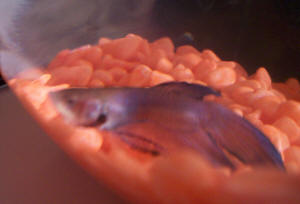
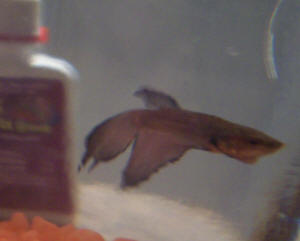
pictures of my Betta 05/09/08 I
just took some photos of him and attached them so you can maybe
see how severe the illness is. I would really appreciate any
advice you guys have. <Yikes, that's one sick Betta. It
definitely looks like it's starving. If you're feeding it
well, then this would be a symptom of something else. Here are
some resources: http://www.bubblenest.com/ http://www.wetwebmedia.com/FWSubWebIndex/bettadiseases.htm>
Sara M.>
|
|
|
|
Re: pictures of my Betta... in an unheated,
unfiltered bowl... hypochondria sans knowledge 05/14/08 Thank you for the
links! From your website, I've discovered that he has fin and
tail rot which I'm treating him with Bettafix for. He seems
to be getting some of his color back and he's spreading his
fins out occasionally again. However, I'm worried about the
lump under his chin. What do you think it is and what can I do
for it? <Can't tell...> The fish specialist at PetSmart
said it could be an internal infection or ulcer so she
recommended "Anti-bacteria food by Jungle." <I would
just wait...> I've been feeding him this for about 4 days
now and I don't see any significant changes except that he is
blowing bubbles whenever I'm near him or I try to feed him.
He only eats a tiny piece of the crushed up pellet and sometimes
none at all. It's almost like he's too preoccupied with
blowing his bubbles to eat and I'm worried that he's
dying because he's always eaten like a pig, until about a
week ago when I noticed he was really sick. I would give him
Maracyn because that is supposed to treat Finrot and lots of
other infections, but he is in about a 2-quart, little fish bowl
with no heating or filtration. <... this is the root of the
trouble... Read here:
http://wetwebmedia.com/FWSubWebIndex/fwsetupindex.htm the third
set down... Betta Systems... you're killing this fish> The
fish specialist at PetSmart said it would be too strong for him.
Would you recommend that I get a small tank with a heater and
filter for him so I can give him the Maracyn, or can he be healed
in the bowl with just the medicated food, a pinch of aquarium
salt and Bettafix alone? <The fish will die prematurely in the
present circumstances. It does not need "medicines">
I would worry about transferring him to a new tank with a new
temperature in his condition. I guess what I need to know is what
can I do that would be the best for him? -Erika <Keep reading,
save your medicine money... Bob Fenner>
Bettafix not helping fin and tail rot
05/09/08 Hi! This question is for Bob. I have a smaller
male Betta fish with quite a serious case fin and tail rot,
I'm pretty sure based on what I've read on here. I have
had him since last August and he has about a 2 quart bowl with no
filter or heating system. I used tap water with Prime by Seachem
brand conditioning drops that remove chlorine, Chloramine, and
ammonia, and detoxifies nitrate, and nitrite, and provides a
slime coat. The room temperature was always sort of on the colder
side about 65-70 degrees because I was living in a college dorm
with a roommate who liked the room cold. I didn't know that
colder temperatures could be harmful to Bettas. I would change
the water about every 2-3 weeks because it would develop a
slimy-cloudy film on top. I always fed him one food pellet a day
and sometimes an extra one because he always ate like a pig.
Around the middle of this past April, I noticed parts of his fins
starting to disappear like they were being torn off and he was
not spreading them out like he used to. I immediately changed his
water and didn't think that it was anything serious because
he was still acting normally. Then a few days later, I brought
him home with me from college for the summer. My house
temperature is much warmer (about 77-79 degrees.) A few days
after I was home, I noticed that he didn't seem to be feeling
well and a little more of his tail and fins were missing. I went
to Petco and asked the fish expert what it could be and what I
should do. She gave me Bettafix medication. I changed the water
to my home tap water and added the prime and Bettafix medicine as
directed. I continued to add the Bettafix for 7 days without
changing the water as directed. On the 8th day, I noticed he
looked like he was getting worse. So I changed the water and some
tiny pieces of his fin came off in the net. He also looked very
pale, he's an aqua blue color, but he looked like a
pale-translucent-blue-grey I went online and looked up Betta
diseases and fin and tail rot seemed to match my fish's
condition. I freaked out and rushed to PetCo to get a better
medication. I told them the Bettafix they gave me before
wasn't working and what was happening to his fins. The fish
"expert" told me that he probably wouldn't make it
and gave me a different type of Bettafix and aquarium salt. I
changed the water, added the prime conditioner, a pinch of the
salt, and the new Bettafix. This was yesterday (5-6-08.) Then I
fed him and he ate like a pig as usual. This morning he looked
like he was feeling better, he was vibrant aqua and his fins and
tail were spread out. Then, this afternoon he started to look
sick again with his fins and tail clumped together. I tried
feeding him but when he tried eating the pellet, it was like he
couldn't get it in his mouth. He kept missing it or he
wasn't opening his mouth wide enough, or it was too big. So I
cut the tiny pellet in half and he finally was able to eat 2
halves. Eating has never been a problem for him before so I'm
really worried. So, I went to PetSmart and I learned that the old
Bettafix I used and the new Bettafix I was using was the same
thing in a different bottle. I checked both of them and they both
have .2% of Melaleuca in them. I read on the internet that
Bettafix is good to treat fish who have mild cases of fin and
tail rot or who are recovering from it, and in secondary cases,
they need something stronger. The girl at PetSmart told me that
any other medication would be too strong for him because he is in
such a small bowl. But if he has a serious case of fin and tail
rot, then will the Bettafix be enough to stop it? I read that
online that I should try Maracyn-TC by Mardel, is that a good
choice? Please tell me what I can do to save him. -Erika
<Erika, "Bettafix" and other tea tree oil-based
products are indeed very unreliable and (in my opinion) not worth
using. Maracyn would be a much better bet for fixing Finrot on a
Betta. So yes, use that. Salt is neither here nor there when
treating Finrot, but do remember that lowland Betta species like
Betta splendens like quite warm water so certainly maintain the
tank at around 25-28 degrees C. Frequent water changes and good
filtration are also critical, because ultimately Finrot is caused
by poor water conditions. Don't force food into the poor
little chap, and if he doesn't want to eat right now,
don't worry about it. When he gets better, his appetite will
return. Cheers, Neale.>
Re: Bettafix not helping fin
and tail rot 05/14/08 Thank you so much for your
quick response! I bought a 1 gallon tank with a pump and filter,
<Read again... tropical fish... needs a thermostatic
heater> and some new stones to go at the bottom. I also bought
Maracyn two <Stop!> because the diagnosis guide said it was
for sick fish who won't eat and it treats internal infections
as well as the fin and tail rot. I transferred him to the new
tank with the Maracyn two (I had added 1/5 of the powder in the
packet because it is 1 packet per 5 gallons.) The water
temperature is about 76-77 degrees F. I gave him some freeze
dried mixture food that includes bloodworms, mysis shrimp, and
daphnia. He ate a small piece of it. Then he just laid in the
bottom of the tank, completely listless for a couple of hours.
Then he went to the top and he was just floating at the top of
the tank, letting the water move him. He looked like he was in a
trance or on drugs or something. When I would go up to him and
talk to him he would swim a little and he ate a couple more tiny
pieces of food. Is this trance-like state something I should be
worried about? Is he healing or is he having a bad reaction to
the Maracyn? What signs can I look for that will tell me if he is
recovering? Thanks for all your help! -Erika <Read, stop
pouring money into medicines... the real problem here is
environmental, not pathogenic. BobF>
Re: Bettafix not
helping fin and tail rot -05/15/08 Hi Bob! <It's
Neale today.> Thanks for your advice! In regards to the
heater, I bought a thermometer that sticks on the outside of the
tank and it has been reading 78-80 degrees F. Do I still need a
heater? <Unless you home is heated to a constant 25 C/ 77 F,
then yes, your aquarium needs a heater.> If so, I'll go
out and get a 5 gallon tank because the smallest volume that the
heaters at the pet store will take, but I don't want to over
heat him. <Indeed not. Look at the cost difference between 5
and 8 or 10 gallon tanks; the difference in price is usually
trivial, but the difference is hobby value is dramatic. With an 8
or 10 gallon tank you could add plants, snails, shrimps...
generally make a nice little "underwater world" instead
of a bowl.> I would have bought the 5 gallon tank to begin
with, but he's just one tiny fish. Should I look into getting
a tank-mate for him? <Usually not a good idea to mix fancy
Bettas with other fish, and certainly never add any other kind of
fish to a tank a mere 5 gallons in size.> I'm not sure how
he would respond to that in is ill condition and I'm afraid
even another tank change could be too stressful for him.
<Moving him to a bigger, healthier tank can *only* benefit
him. Remember, he's a fish, not a person. He doesn't care
much about "familiar surroundings", but what does
matter is clean water, the right temperature, etc.> From what
I've learned from reading, I need to get a gravel vacuum and
sponge filter right? <Gravel vacuum cleaners are a gimmick,
and total overkill in a 5-10 gallon tank. But sponge filters are
ideal for Bettas.> Also, are you sure that he doesn't need
medicine to get well because if it's an infection, than
doesn't he need an anti-biotic to kill it? <Antibiotics
are for treating bacterial infections. If he has Finrot, then
yes, antibiotics are important. But otherwise there's no need
to use them.> Or do you think he has no infection? <Not
obvious from these photos. Finrot is very distinctive: frayed
fins, white/pink decaying tissue, often streaks of blood vessels
obvious along the fins.> I'm afraid if I don't give
him the medicine, he'll die. He's hanging in like a
champion for all he's been through the past 4 weeks. I know
he had fin and tail rot, but his fins have stopped shrinking and
are strengthening. <Then he's improving. Finrot is a
"symptom" of poor water quality; it's a sign the
fish's immune system was overwhelmed by the normal bacteria
in the water. In poor water, the immune system is stressed, so
these bacteria that normally don't cause problems end up
damaging the fish.> The other symptoms he had a few days ago
led me to believe he had another type of disease (listlessness,
not eating, black/swollen gills, loss of color, clamped fins,
lump under throat.) So, the Maracyn two seemed necessary. Today
is day 3 of Maracyn treatment and he appears to be doing much
better. The Maracyn two seems to be helping. He is eating small,
crushed pieces of food now instead of just blowing bubbles when I
put the food in. I crush one pellet and sprinkle a pinch of the
freeze dried melody in there once in the morning and once at
night. <All sounds pretty normal. Take care not to
overfeed.> I think I should lighten up a little though because
he doesn't appear to be having bowl movements. He also looks
a little bloated near the end of his body, he might be
constipated. I was so concerned that he wasn't eating that I
may have been feeding him a little too much the past 2 or 3 days.
What do you think? He's also out of the trance like state he
was in those 1st few hours of the Maracyn two treatment. He's
constantly at the top of the tank, swimming around (he likes the
bubbles from the pump.) <Fish actually *don't* like
bubbles much, and fish farmers use bubbles as "walls"
to block fish into particular areas. You've perhaps also seen
those whales that make bubbles to corral small fish into dense
schools that can be eaten easily. So when you see fish attracted
to the bubbles, it's much more likely the fish isn't
getting clean, well oxygenated water. The aerated water with the
bubbles is the healthiest patch in the tank, so that's where
the fish goes.> He also looked like he was getting some of his
shiny aqua color back this morning. I think he is healing, but I
could be wrong. What should I do? Should I stop giving him
Maracyn two? <Always a good idea to *finish* a course of
medication.> Should I get him a 5 gallon tank with a heater?
<Yes, or even a bigger tank with some Cherry Shrimps or
something else that will be harmless but fun to watch.> Should
I keep him in the 1 gallon tank? <No. 1-gallon tanks are death
traps. They're a con, and shouldn't be on the market.>
I know I've spent quite a bit of money, but I'll do
anything to keep him alive. <Unfortunately, ALL animals are
expensive to maintain. If your retailer told you this was a
"cheap" pet they were misleading you.> I appreciate
all of the links, articles, and FAQ readings, I've learned a
lot from them and I understand you and the crew spend tons of
time telling people the same things over and over again, It must
get tedious. <Only tedious to know that lots of people
don't read, and treat their pets as disposable ornaments.
Those who ask questions, however often, aren't tedious at
all, and are welcome at WWM anytime.> However, my fish is in a
very specific situation, and if you could, please tell me what I
should do for him. I've attached some pictures I took just
now. Thank you for helping me rescue my baby! <Cheers,
Neale.>
|
|
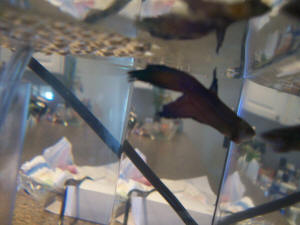 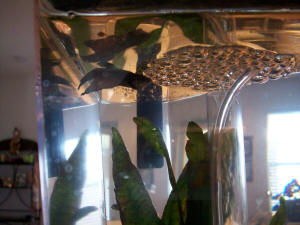
|
|
Re: Bettafix not helping fin and tail rot
5/12/08 Thank you for your advice. It's been a few
days and he seems to be getting better with just using the
Bettafix and an Anti-bacteria food by Jungle the pet store fish
specialist recommended. <Bettafix is almost completely
useless, but food with antibiotics may help, provided the fish is
eating a sufficient quantity.> They advised me to stay away
from the Maracyn because it is meant for larger tanks and would
be way to strong for him in his little fish bowl. <Think about
this for a moment, and judge for yourself. A concentration of 1
mg/l is one milligram per litre whether it's a swimming pool
or a thimbleful of water. Logically, provided you dose the
correct amount of medication relative to the volume of water,
there's no risk of any kind whatsoever. If you overdose --
that may well be a bad thing. But that's a risk in any tank,
whether a bowl or a jumbo aquarium.> Now I'm concerned
about a lump under his chin or on his throat that I just noticed
could be related to his eating problem. <Simply looks like a
very underweight, sick Betta to me.> I brought him to PetSmart
and the fish specialist said it looks like it could be an ulcer,
or some type of internal infection and that's when they
recommended the special food. <Hmm...> I've been
crushing one anti-bacteria food pellet and sprinkling it in his
water about twice a day. Sometimes he eats a tiny piece, but he
doesn't seem too happy with it. <I bet.> The food
bottle says "Do not use other foods during this period and
use exclusively for 5-10 days. After 5 days, should I let him
take a break and feed him a treat like bloodworms? (I've
never fed him anything but pellets before.) <By all means let
him eat something else once you've finished the
treatment.> Also, what could this lump be? <No idea.> Do
you think he has a more serious infection along with the Finrot?
<There's *nothing* more serious than Finrot. Let's be
clear about this: Finrot is a secondary infection caused (almost
always) by poor water quality. It means that Aeromonas and
Pseudomonas bacteria in the water, where they normally do no
harm, have overwhelmed the fish's immune system. They start
by damaging the fins and skin, which is Finrot, but those same
bacteria work their way inwards, ultimately leading to a blood
infection (septicaemia) that kills fish. You MUST treat Finrot
aggressively. I'd use Maracyn in this instance REGARDLESS of
any (imaginary) risk because the fish WILL die otherwise.> And
can special food heal him alone? <Unlikely if he's eating
so small an amount.> Are the pet store people right in saying
that Maracyn is too strong (because if his fins keep healing like
they are and his color keeps coming back like it is then will
Bettafix be all I need? <Bettafix is Tea Tree oil. If you had
a septic wound, would you ask your doctor for antibiotics or some
kind of herbal remedy that hadn't been tested by doctors and
hadn't been validated scientifically?> Also, one more
little thing I've noticed. Whenever I'm with him or
talking to him or feeding him, he goes up to the surface, takes
big gulps of air and blows bubbles. <Normal behaviour; these
are air-breathing fish, and every minute or so will have to gulp
air.> I read online that blowing bubbles means Bettas are
happy and would like to mate, but if he's sick, it
doesn't make any sense. <You're thinking of bubble
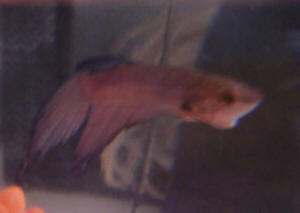
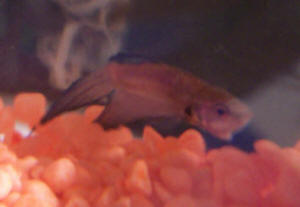
nest building, which is quite different.> Can you help me
solve this mystery illness?-Erika <Well, I hope this helped!
Cheers, Neale.>
|
|
|
|
Betta with very persistent tail rot - your help
is greatly appreciated. 5/4/08 To whom it may
concern, Hi, I was given great advice in February 08 by Merritt
and so I'm back with another Betta question. <Merritt
seems busy, perhaps with school. I'll give this a go> I
recently got a new Betta fish which I've named Opie. <Am
whistling the theme from Mayberry R.F.D. now... imagining losing
even more of my hair, and directing blockbuster movies> Opie
had some tail damage when I bought him but I thought it was just
from being in those horrible little cups the pet stores sell
Bettas in. <Does occur> After having him for a while, it
became obvious that his tail was getting worse . . . tail rot.
First, I treated him for 5 days with Maracyn 2 resulting in no
change. I switched to Maracyn and began to see slow results.
After ten days of treatment (the maximum the directions allow) I
stopped and it seemed like his tail was growing back, then
overnight, his neighbor Erroll seemed to catch the bacteria and
had significant tail loss very very quickly. Additionally the
progress Opie's tail had made disappeared. At that point I
figured that I cross contaminated the tanks with the cleaning pad
and net I use. (Since then I've been careful to clean the net
and pad with copious amounts of salt and MelaFix between use on
the different fish that I own.) I started another round of
treatment on both fish. This time with Maracyn and Maracyn 2. I
also put a divider between the bowls because it seemed that their
displaying was causing their fragile fins to tear. <Yes... too
stressful to be in constant view> They completed 5 days of
meds. By this time Opie's tail was totally grown back but
still clear and fragile and Erroll's was slowly starting to
return so I halted treatment with both medications. Today (about
three or four days later) Opie's tail has totally digressed
again! I'm so bummed out, I hoped I had finally got him
healthy. Erroll seems to still be healing but I did keep him on
the Maracyn two additional days because I had two additional
doses open already. Is there a stronger, better gram positive
antibiotic out there for Bettas? <Mmm, yes... posted on
WWM...> Should I continue to treat for both + and - bacteria
as a precaution? <Gram negative almost always is at play...
all that needs to be treated for> The Maracyn directions say
not to treat for more than two 5 day cycles. Can I treat longer?
<Neither a good idea, nor efficacious> Unlike the Maracyn 2
directions the Maracyn directions don't indicate that water
changes are required after treatment but I've done complete
changes anyway. Could this be contributing to the relapses?
<Yes...> I don't think it's related to the water
quality. I really think Opie brought it home from the pet store.
I'm good about cleaning their bowls regularly. <... this
is part of the problem as well... Need tropical, filtered
settings... NEED. Read here:
http://wetwebmedia.com/FWSubWebIndex/bettasysart.htm> I've
never before had any fin rot with my fish so I'm really
motivated to finally solve this problem but it seems to be a very
very persistent case. My fish and I would appreciate any advice.
Please help if you can. Thank you in advance for your time and
your thoughts. I'm very grateful for any help you can offer.
Kind Regards, Andy <There really is no "sense" of
trying "other medications" w/o providing adequate
environment... Fix their world... and they will heal. Bob
Fenner>
|
|
|
|
Kinda
worried...(Betta, first aid)
4/27/08 I just got done cleaning my
fish's fish aquarium, and I was going to put the fish back
into the aquarium when my red beta fish freaked out, and flipped
onto my desk. I got him back into the aquarium, but when I got
him back in the aquarium, part of his back fin was ripped. I hear
that their back fins can grow back, but now it seems like he
can't control the way he swims anymore. He kind of starts
swimming, but then he kind of floats on his side and "plays
dead". When he floated to the top the first couple times, I
thought because of the fall, he got a scratch somewhere, and it
killed him. So I go to get my net, so I can get him out of the
tank, and he swims away. I don't know if he is in pain, so it
made him kind of depressed. Will he die if part of his fin ripped
off? Will he die of depression? freaked out and a worried fish
owner. PLEASE HELP, Brogan <Brogan: jumping out of a tank is
unlikely to kill the fish, but secondary infections caused by
superficial damage can. So your main job here is to [a] keep the
water quality perfect (i.e., zero ammonia/nitrite) and [b] use an
appropriate Finrot/Fungus medication such as Maracyn or eSHa
2000. Don't waste your time with salt or Melafix. Assuming
the fish doesn't become infected with a secondary infection,
yes, the fin will heal and yes, the fish will recover. Cheers,
Neale.>
Re: Kinda worried... (Betta, first aid)
4/29/08 thank you. He's swimming better now, but he stills
plays tricks on me still. I'll try to get medication for
Beauller (my red fish's name) ASAP. <Ok. B>
|
Protruding Scales, Betta, using WWM
4/26/08 Dear WWM, Hello; I have a Betta for
2 1/2 years now. Is Dropsy the only fish illness that can cause a
slight case of protruding scales? Thanks for your help in advance -
Jean <... Dropsical conditions/Ascites... can be borne of a few
factors... Use the search tool: http://wetwebmedia.com/WWMAdminSubWebIndex/question_page.htm
read the cached views. Bob Fenner>
Beta Fish Problem -
Very Docile, Swimming Problems, Not Eating - No reading
4/25/08 Hi, <Hello> My girlfriend was
given a beta for her birthday last December so have had him for just
over 5 months. I have had a bit of a look/search through your website
and others looking for some relevant info but have had no luck and am
sufficiently worried that I have decided to email you hoping that you
can get back to me quickly before it is to <too> late. He came
with a kit - smallish tank (approx 3+ litres) some rocks, plastic plant
and some food (is a dried food in small pellets that floats on the
surface for a while - ingredients being: white fish meal, shrimp meal,
soybean meal, wheat flour, rice bran, wheat germ, yeast, vitamin etc)
and 2 additives for his tank used when changing water (BettaRelax and
Tension gon) The water has been changed fairly regularly and he has
been eating the food quite happily up until about 4 - 5 days ago, we
were hoping this would pass and he would get back to normal but we are
quite worried about him now. The symptoms are as follows: He is very
subdued, has been resting nearly permanently on the bottom of the tank,
swimming around (with trouble) very rarely. He does not seem to be able
to make it to the surface to eat and we have not seen him eat for a
couple of days. His top fin (dorsal I think) is not standing straight
as per normal but flopping down (hanging to the left). He does not seem
to be able to swim very well, is swimming on a bit of an angle and
looks like he is really trying hard to swim but not succeeding (when he
does try to swim - which is not to often). He does not have any unusual
colours or growths or anything that indicates to me some sort of
disease, through his colour does seem slightly paler than usual though
I am not 100% sure that it actually is. His tank is not filtered or
heated <... this is the real problem...> is rather small and does
not contain any lighting. The temperature here in Australia has been
dropping the last couple of weeks as well (coming into winter). I was
originally worried about the lack of filter but as it was a kit I
assumed that it was not required. I have read that temperature can be
important but alas I do not have a thermometer available to me at the
moment. If you can help in anyway we would be greatly appreciative as
things do not currently look to good for this poor beta. Kind Regards,
Luke B Perth, Western Australia <Read here: http://wetwebmedia.com/FWSubWebIndex/bettasysart.htm
and the linked files above. Bob Fenner>
|
|
Betta Success
Doing what it takes to keep Bettas healthy long-term
by Robert (Bob) Fenner
|
|
|

