|
FAQs on
Betta Diseases/Health 17
Related Articles:
Anabantoids/Gouramis &
Relatives, Betta splendens/Siamese
Fighting Fish, Betta Systems, Betta
Diseases, Improved
(Better?) Products for Bettas!,
Related FAQs: Betta Disease 1, Betta Disease 2, Betta Disease 3, Betta Disease 4, Betta Disease 5, Betta Disease 6, Betta Disease 7, Betta Disease 8, Betta Disease 9, Betta Disease 10, Betta Disease 11, Betta Disease 12, Betta Disease 13, Betta Disease 14,
Betta Disease
15, Betta
Disease 16, Betta Disease 17, Betta
Disease 18, Betta Disease 19, Betta Disease 20, Betta Disease 21 Betta Health 22, Betta Health 23, Betta Health 24,
Betta Health 25, Betta Health 26,
Betta Health 28,
Betta Health 29,
Betta Health 30,
Betta Health 31,
Betta Disease
Causes/Etiologies: Determining/Diagnosing, Environmental (By far the largest cat.),
Nutritional, Viral/Cancer, Infectious (Bacterial, Fungal) , Parasitic: Ich/White Spot, Velvet; Senescence/Old Age, Cures/Curatives/Treatments,
FAQs on Betta Medicines: Betta
Medicines period, Antibiotics/Antibacterials, Anti-Protozoals (Metronidazole,
eSHa...), Copper, Formalin, Malachite Green, Anthelminthics, Organophosphates, Salts, All
Other Betta Med.s,
|
|
 |
Betta Success
Doing what it takes to keep Bettas healthy long-term
by Robert (Bob) Fenner
|
Betta, Possible Fungal Infection -
02/08/2007 I looked around the site, and I admit that I may have
not looked hard enough or that I may not know the correct terminology,
however, I couldn't find a solution to my problem. <Jorie here -
I'll try to help!> My Betta, Kappa, has been with me for a
little under a year. He began his life with me in a gallon sized tank,
and over the summer got to move into a larger two-and-a-half gallon
tank. The gallon sized tank had an undergravel filter, while the new
tank has a larger whisper filter. <An excellent upgrade - I'm
sure Kappa is very happy in his new, more-spacious quarters!> Onto
my fish. Kappa has been doing very well lately. I change his water at
least once weekly - usually twice - and his tail and fins were growing
back after a bout with tail/fin rot (due to me not being around for a
week and a half and leaving his care up to my roommates). <Yep -
tail/fin rot is almost always caused by poor water quality. Sounds like
you are on top of that, though, and you are keeping his
"home" very clean...> His tank water is conditioned with
API Stress Coat, as well as a small amount of Doc Wellfish's
Aquarium Salt. <Sounds good.> Yesterday and today, Kappa has been
looking less than ideal. He barely moves, preferring to stay at the
bottom of the tank, and when he *does* move he swims to the top of the
tank and then returns back down. He swims sideways. He looks as though
he is having trouble breathing, taking in great big breaths of water.
<Would you describe this behavior as "yawning"? If so,
when was the last time you changed the water? Or, alternatively,
I'm wondering if something toxic could have found its way into the
tank. What you are describing can often be caused by pollutants in the
water...first thing I'd suggest is changing the water, and changing
the filter media.> I haven't seen him eat. His colour has
darkened and dulled, and it looks like he has a white coating on and
around his tail. <I've looked at your attached pictures, and I
don't see any obvious signs of fungus, but that's what you are
verbally describing here. With regard to not eating, Bettas can go up
to a week without food; clearly, though, your fish isn't feeling
well at the moment...> There has been no change in his tank aside
from the day long stay of an angelfish, who is showing no signs of
disease. We moved Sakura into her own tank after Kappa attacked her.
<Good idea. A 2.5 gal. tank is far too small for an
angelfish, even by herself...> I have just cleaned Kappa's tank
(a 50% water change and a new filter without carbon in it) and I have
added API Melafix to his water. The temperature is at 80F and has been
staying at that level. <These are all the things I would have
suggested...> Is there anything else I can do or is my poor Kappa
headed on his way out? <Even though I can't see it, these are
all signs of a fungal infection. Since the water condition
seems good, I'd suggest treating your Betta with something like
Jungle Fungus Eliminator, as per the instructions. With
regard to Kappa not eating, what do you usually feed him? If you
haven't already tried, frozen, then thawed bloodworms and Mysis
shrimp are a favorite of my Bettas. If the days keep
crawling on and Kappa still doesn't eat, you may have to resort to
live black worms or bloodworms, but I'd save that for a last
resort...> Thanks a million. 'Chelle <Hope I've
helped. Sounds like you are taking very good care of Kappa,
and with your attention to details, we've hopefully isolated the
problem soon enough so that it can be fairly easily rectified. Best of
luck, Jorie> PS - the pictures I have attached are of Kappa - the
first one is him before all of this, and the following ones are what he
looks like now.
Betta, Possible Fungal Infection - II - 02/09/2007 Thank you for
that advice and I will keep it in mind for my future
fish. Unfortunately, Kappa passed away last night.
<I'm sorry to hear that.> After cleaning out his tank
completely, and replacing the filter cartridge, I bought a new Betta.
His name is Sigma. He's a beautiful Betta, dark in colour, however
he seems to have some strange light-coloured spots on him that I
don't recall being there when I bought him. Could those be from
stress? <Many times Bettas don't show their true colors in the
little cups they are kept in in most fish stores - it could be that he
was stressed before, and now that he's got some room to swim,
he's adjusting and happy. Just keep a close eye on him - that's
the best suggestion I can give you.> Thank you for all of your help,
and I apologize for bothering you. <'Tis not a bother - I truly
love helping our little Betta friends out there. One
question for you - is Sigma's tank heated? If I recall correctly,
you did mention that the temperature was around 80 degrees, which is
ideal for a Betta, but it is important that the temperature doesn't
fluctuate during the night (or any other time). If you
don't have a heater, I'd recommend getting a submersible 25watt
for the 2.5 gal. tank you have - otherwise, your Betta setup is quite
nice, and Sigma should be very happy! Good luck, Jorie>
Betta with eye problem 1/31/08 Hi Crew I have a
beautiful Betta who last night developed a film over his one eye. I
have read through the questions and answers on your site and see that
many people have Betta's with Popeye but I'm not sure if this
is what mine has. <Pop-eye is specifically where one or both eyes
sticks out further from the head than normal. It's caused by
swelling inside the skull that's pushing the eyeball outwards. It
is very obvious. If the eye is simply cloudy, then that's more
likely an infection of the skin over the eye, for which a Finrot remedy
would be appropriate. There are certain flukes that infect the eyes of
fish, but they're pretty uncommon.> The film is not transparent
- its murky - can only just still see his eye beneath it and the film
seems to have got more bulgy over the last 24 hours. <Hmm... does
sound like an opportunistic infection. Most usually caused by poor
water quality and/or mechanical damage (e.g., rough handling).> He
is eating fine but spends most of his time just below the water level
with his bad eye up against the side of the container. Please help me
diagnose and treat. I love my Betta and don't want him to die.
<Good.> Regards Debbie <Cheers, Neale.>
| Ich or velvet? Betta dis., no useful data -
1/24/08 I have a Betta that I purchased from PetSmart for about
two weeks now. His name is Pluto. Last Friday I noticed that he has
several orange spots on his back. <I see these> Then white
spots gradually spread across his body. The white spots are smaller
than the orange ones on his back. Now he has developed a large
white spot on one of his gills. Today, I treated him for Ich even
though I am not very sure what it is. <What for treatment?>
Pluto is eating well and still poofing up and attacking his
reflection in the aquarium. He also has what appears to be a
stringy orange thing on one of his bottom fins. He is still very
active, but he darts around his 2 gallon tank spastically. <Is
there a heater present? Need to elevate temp.> He also is
rubbing up against the filter that sucks the water in. He positions
himself so that his fins are being sucked to it. He also seems to
be yawning quite a bit. Should I treat him with a parasite medicine
as well? What does it look like he has to you? <Ich... but could
be something else> The spots seem too big to be Ich but not all
of the spots are orange so I'm not convinced that it's
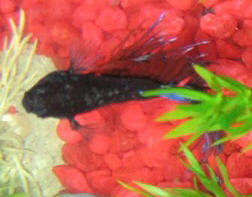
velvet either. I have attached three photo's of Pluto. The
first one shows the dangly thing on his belly, the second shows the
all over spots, and the third shows the one large spot on one of
his gills. Thank you so much!!! ALM <Read here: http://wetwebmedia.com/FWSubWebIndex/fwsubwebindex.htm
re Betta Disease, Ich... Bob Fenner> |
|
|
|
Fish Bump? 1/15/08 Good Afternoon- <Hmm... it's
21:20 here in England, so more a "good evening" kind of
thing really. But hail and well met, anyway.> About a month
ago in early December I emailed you about a problem I was having
with my Betta fish and puffer fish who weren't cooperating:
now that problem is solved (the puffer was returned), but my
Betta has a big bump on the side of its body- I have no idea what
it is and I'm hoping maybe you can help me. I've attached
some pictures, I hope they helps. <Looks as if it's
overfed, to be honest. Or possibly constipated. If the fish is
otherwise happy and healthy, i.e., swimming about and eating,
then switch to a high-fibre diet of things like live Daphnia and
brine shrimp. Feed sparingly. See if the weight goes down. If
there's no improvement in, say, a week, get back in
touch.> Thank you so much, -Elizabeth <Cheers, Neale.>
Re: Fish Bump? Betta dis. f'
2/2/08 Hello- I contacted you a couple weeks ago about my
Betta fish having a weird bump on its side, and I've been
feeding it brine shrimp flakes and trying to switch its diet up,
but it is still there, and I think it may even be getting
bigger...might it be a tumor? Thanks, -Elizabeth <Could be.
I'm not sure "brine shrimp flakes" are really all
that laxative though. The idea of a laxative food is that it
isn't processed, so that the bulk is there to give the
intestines something to push. If you process something into a
flake, I can't see how that's a good thing in this
situation. It's live brine shrimp, and even better, live
daphnia, you want. Moreover, if your fish enthusiastically chases
these live foods, that's a very positive sign. But if it just
sits there looking glum, that's not so good. In any case, how
old is this Betta? While they can live for several years, wild
fish are basically annuals, and anything over a year in a home
aquarium is doing well given that male Bettas are something like
3-6 months old by the time you buy them (any younger and they
don't have their full fins yet). Bettas are also pretty
inbred and mass-produced, so when you buy one, you're not
really getting much of a long-term investment. Worse still,
conditions in the standard issue Betta jar are pretty poor, and
the fish get little exercise and nothing like optimal water
quality. Cheers, Neale.>
|
|
|
Help with my Betta 1/14/08 Dear Crew, I have
a Betta for a about 3 months in an established tank of 6 months old.
Water Parameters Ammonia 0 Nitrites 0 Nitrates 15 Ppm Water Temp - 78F
<All seems fine. How big is the tank? What sort of filtration? Any
other fishes in the tank?> From last 2 days he would want to eat his
pellets but he would spit them out immediately. I was thinking its some
kind of a parasite/bacterial infection. Checked his body for any
visible signs like any spots or extra body growth. He seems to be fine.
<Hmm... do try another type of food. Feeding any fish a single sort
of food all the time isn't a good idea. Live foods are usually the
best things to please a jaded palate. Try live Daphnia or mosquito
larvae -- these are adored by most Bettas! If you can't get those,
frozen (not freeze-dried) bloodworms worm well.> I am thinking of
treating him with some medications but I am totally lost as he
hasn't exhibited any known illness. <Don't treat a fish
until you know the disease. Randomly using medications is
dangerous.> I also did a 30% water change and added some aquarium
salt but nothing had seemed to improved. <How much water to you
change per week? In a very small aquarium (less than 40 l/10 gal) a 50%
water change per week is essential. There's no need to use salt in
a freshwater tank; Bettas do not come from brackish water. Instead,
concentrate on water quality and water chemistry. You say nothing about
hardness or pH. Big, regular water changes ameliorate the natural
acidification of aquaria over time.> Pls advise, how do I save my
little one. Best Regards, Vamsi <Hope this helps, Neale.>
|
Betta with body bloat
1/10/08 Dear Mr. Fenner, <Nicole> We have a beautiful
crown tail Betta. My husband promised to keep up on the
maintenance, but did not follow through to my expectations and
now our dear Steve Johnson (named by our 4 year old) has body
bloat and is hiding under his rocks. He lives in a 4 gallon tank
by himself. I'm going to get a heater in the morning as well
as a more diversified diet. <Mmm, yes... this improvement will
likely "do it"> I recently cleaned his tank and
while he was jarred during cleaning I put 1/8 tsp of Epsom salts
in the jar. He seemed to liven up but he's still bloated.
<Raise the temperature to a steady mid- 80's F...>
I've been putting Epsom salts in his tank. Can I also put the
sea salt in or do the two contraindicate one another? <Just
one will do fine here> How often and how much water changing
is needed for a 4 gal tank? <Some, like a quarter to half,
once per week> Can I continue to add Epsom salts daily until
his bloating subsides? <A two week use will do about all the
good it can> I really enjoyed your article. Any help would be
much appreciated. Nicole <The heater... nutritious food... Bob
Fenner>
Re: Betta with body bloat
1/12/2008 Dear Mr. Fenner, Thank you so much for your quick
response. <Welcome Nicole> I've heated and changed
Steve Johnson's water and he's stopped hiding and spends
more time at the top of his tank, but now it seems he's
leaning on his decorative plastic plants and rocks. <Will take
a while to recover completely... a few weeks> When I got home
from work this evening, he was on his side resting near the top
between two leaves. I thought he was dead, but then he saw or
sensed me and flitted away. He'll often "drift" to
his right before he leans over to rest on something. Also, his
left fin works, but when he's drifting it kind of folds back
toward his body. <No worries> He doesn't seem to have a
buoyancy problem, so I don't think it's his swim bladder,
he had that once recently, but recovered nicely. This drifting
and leaning is strange. He's still bloated, though I
didn't expect an over night recovery. <Good> As for his
diet change, I tried a flake with blood worms, krill, squid liver
etc and some vitamin called Nutrafin Max Betta Food by Hagen. He
didn't seem interested. He'd much rather eat his Hikari
Betta Gold pellets. <This is an excellent product. Completely
nutritious> I read about and tried peas, but the pieces of
thawed frozen ones just sunk to the bottom and didn't
interest him. I read someone gives his Betta the broccoli tops. I
would imagine that the fresh "flowers" of the broccoli
would float better and look more like the pellets. Would that be
beneficial? <I would stick with the Hikari product> Thanks
again for your knowledge and help. Nicole <Thank you for this
follow-up. Bob Fenner>
Re: Betta with body bloat -- 1/18/08 Dear
Mr. Fenner, <Nicole> Thank you for all your help. Steve
Johnson, while still a bit bloated, is doing much better. Thank
you so much. Nicole <Thank you for this update. BobF>
|
|
Re: Betta with body bloat, & euthanization
f' - 1/24/08 Hello again Mr. Fenner, I'm
worried about Steve Johnson. His eyes seem "vacant",
his color is not great, and he is still spending the majority of
his time leaning on his plants at the top of the tank. Tonight,
when he didn't have a plant to support him, he kept leaning
so much so that he almost went belly up before he gulped some air
and righted himself. He did this a couple times before he found a
plant to lean on. Last night he sat at the bottom of the tank for
quite a while. Is he still trying to recover or is he dying?
Thanks again, Nicole <Just keep doing what Bob suggested, only
time will tell whether he will get better. Optimise water
quality, do lots of water changes, keep him nice and warm
(especially the air above the tank), and hope for the best.
Cheers, Neale.>
Re: Betta with body bloat - 1/24/08
He's definitely dying. He's got a pop eye now and
can't keep himself from floating. Thanks for all the help.
Nicole <Too bad. If so, please use a painless destruction
technique to prevent further suffering. It's not nice to
watch a fish die by inches, especially if the only reason we
don't destroy the animal quickly is because we're
"squeamish". See here: http://www.wetwebmedia.com/euthanasiafaqs.htm
Cheers, Neale.>
Re: Betta with body bloat - 1/24/08 Thank
you for the compassionate advice, I did not know there was such a
way to do this for them. I'll get the clove oil and ease his
suffering if he's not gone already by the time I get home.
Nicole <Hello Nicole. Destroying a pet is never pleasant, but
being able to end an animal's suffering is simply one of the
most important aspects of being a pet keeper. Clove oil does the
job well and apparently painlessly. Good luck, Neale.>
Re: Betta with body bloat, & euthanization
f' 1/25/08 After reading all accounts to
humanely euthanize poor Steve Johnson. I decided to go the Clove
oil/Vodka two step process outlined on wisegeek.com. I went to
Whole Foods and got some 100% Clove Bud essential oil. Is that
the same as what I would get as Eugenol at the Pharmacy? <Yep,
exactly the same.> I called several pharmacies and they would
have to special order it. <Pah! It used to be used widely for
treating toothache and such. It's a very useful thing to have
about the house, having quite strong pain numbing properties.>
I don't want SJ to suffer anymore. <Indeed.> If
it's not right, I guess I'll use the hypothermia method.
<Eek... this probably isn't a nice way for a fish to
die.> Thanks again for the help. Nicole <Cheers,
Neale.>
Re: Betta with body bloat 1/25/08
Thanks again. You all are so great during this awful time.
<We're happy to help. You *can* become attached to fish,
just like any other animal. Not everyone expects that. But just
because something is "only a fish" doesn't mean it
can't suffer, or you can't feel compassion towards
it.> I did not want to do the freezer thing b/c I too thought
this was an awful way to die, especially if you don't feel
good to begin with. <Quite so.> Anesthetic and vodka--numb
and drunk I'll take that over freezing myself.
<Indeed!> Nicole <Cheers, Neale>
Sad ending... Re: Betta bloat...
euthanasia -- 1/26/08 Greetings Mr Fenner and Neale,
Well, I did it. Steve Johnson is now a memory. Everything went as
described in the 2 step emulsified clove oil, vodka process. He
did not flop more than 2 times due to the presence of the clove
oil. He calmed right down, belly up and then fell asleep and
dropped to the bottom. After a few moments he was still breathing
once or twice every 60 seconds, I put the vodka in. He expired as
peacefully as he could. I feel horrible. He was so beautiful. He
was just so miserable looking for the past couple days. He used
to wiggle his tail when he'd see me but he'd just barely
moved his eyes to look at me lately. I hope I made the right
decision for him. <I'm sure you did.> We haven't
broken the news to our 5 year old son yet. Any advice?
<Honesty.> Of course I won't tell him I was the one to
do the deed. <Why not? It's a good lesson to learn that
animals don't live forever, so you shouldn't take them
for granted any more than people, and cherish the time you do
have. It's also worthwhile that children should understand
that pet animals depend on us, not just for food and exercise,
but also for kindness and, when the time comes, to be relieved of
any pain and suffering that disease brings on. Animals aren't
"things", but creatures that live and suffer just like
us, and so when we get a pet, it's not like buying a toy or
computer game, but a responsibility as well as a source of
pleasure.> He's got a good grasp that death is part of
life. My mother died of brain cancer and he was a witness to some
of the process. <I'm sure a difficult time for him, but a
growing one too.> As I was looking over your site for future
fish I have a few questions so that this doesn't have to
happen again. <Sure!> SJ was kept in a 4 gal Baby BiOrb by
Reef One by himself. Is this what you call a fully cycled tank?
<It should be by now... but you'll need to keep it thus!
Add a pinch of flake every day or two until such time as you buy
another Betta. The bacteria don't care where the ammonia
comes from, and rotting fish flake is just as good as fish
waste.> How do I know if it is or is not? <Nitrite test
kit: if the reading is zero, even when you add some flake food,
it's cycled.> If it is not can I make it one and how?
<Time. From zero to hero takes about 4-6 weeks for the average
aquarium, assuming the tank receives some ammonia either
directly, through fish, or from rotting food.> Is this a good
tank for Bettas? <Small tanks are *by their very nature* less
easy to maintain than big ones. I personally find the 8-10 gallon
tanks just about the minimum for a really stable, reliable
aquarium. Bettas are distinct in the sense they're
air-breathers and to some degree adapted to swampy conditions,
but still, they're not immortal, and their mortality in
"Betta Bowls" is alarmingly high. A 4-gallon tank with
a heater and filter would be, in my opinion, borderline for any
fish. That said, many people keep Bettas in similar tanks without
incident. A lot depends on maintenance: if you're changing
50% of the water every week, your chances of success will be a
lot higher than if you did the usual 20-25% every other week a
lot of people seem to go for. Simply having a heater and a filter
is a significant boon, too.> If not what fish would be more
suited? <Very small tanks work best with things like Cherry
Shrimps and small snails, to be honest. If I *had* to choose a
fish for a 4-gallon tank, I'd perhaps go with something like
Sparkling Gouramis.> What is a proper pH for Bettas? <Not
at all critical, but in a small tank I'd recommend hard water
simply because that will help you maintain a more stable
environment. So aim for at least 5 degrees KH and a pH around
7.5.> What is the best way to sanitize the tank for re-use?
<Ah, a tricky issue. If you sanitise the tank completely
(which is easy enough to do just by cleaning under a warm tap and
a bit of scrubbing and then thorough air drying) you'll kill
the filter bacteria. The tank will then need to be re-cycled for
up to 6 weeks.> How long should the new tank be prepared with
conditioned water and temp before getting a new fish?
<Conditioning the water is instant, and assuming the water
isn't icy cold, the heater should warm it up in a few
hours.> What should be tossed out and replaced? Filter
cartridge? Plastic plants? Ceramic media? Decorative
"rock" (plastic) hide-out? <Anything removable like
the plastic plants and rocks can definitely be washed and air
dried. Most of the pathogens that trouble fish are not tolerant
of dry air, and assuming you wash away the algae and sludge,
they'll quickly die when exposed to dry air and especially
sunlight. But anything that is left un-cleaned, such as
"live" filter media, is a potential refuge for
pathogens.> How often do I test for pH, ammonia, nitrites and
nitrites? Anything else I should test for and how often? <The
two things any less-experienced aquarist should do is test the
nitrite and the pH on a weekly basis, at least for the first few
months. If you have nitrite in the water, you have a biological
filter problem, and if the pH fluctuates, then you have a water
chemistry problem. Everything else refines things, letting you
dig deeper into the problem, but these two are excellent
first-pass indicators.> What is the best way to introduce a
new Betta or other fish to his new home? <The best way is
this: put new fish into a bucket with water from the bag it came
home in. Make sure the bucket is no more than 1/4 to 1/3 full.
Put a lid (or magazine, or towel) over the bucket to stop the
fish jumping out. Every 5-10 minutes, add a cup or so of water
from the aquarium. Do this for anything up to an hour. What
you're doing is gradually filling the bucket with water from
the aquarium so the fish can adjust to the temperature and water
chemistry. Use a net to lift the fish out of the bucket into the
tank. Discard the water in the bucket. This way you minimise the
risk of letting parasites from the shop get into the fish tank,
and more importantly, none of the horrid ammonia from the bag
water gets into the tank either.> I have only one tank, so how
do I get him used to the proper temp (78-82 degrees F???) from
his confining little cup from the pet store to the tank? Is there
anything else I should know? <Do read some of the Betta
articles here. I'm sure there are some nice Betta books out
there... see if your public library has one, or else buy one.
Bettas are interesting fish in their own right, what with the
history of breeding and "fighting" and all, and having
a handy reference is always a plus.> I want to thank you again
for your help and compassion. This site is the best!!!! You truly
care about these creatures as do those seeking your advice.
Nicole <Glad to help, and sorry the outcome wasn't the one
we were hoping for. Cheers, Neale.>
|
Betta dry skin 1/8/08 Hello, <Terri> I
have checked in the FAQs and couldn't really find anything specific
to this please help if you can. <Okay> I bought a Betta 2 weeks
ago and I thought he looked ok, but upon closer inspection I noticed he
has a sort of grayish dust on its cheeks, under his "chin"
and on his body near his head. It looks like old thick dusty grey dry
skin, it is not "fine" in texture, does not look like powder
and easy to see with the naked eye. The skin on his body looks dull,
dry and mottled (this does not look like a "natural color"),
his body color is non-uniform from this "dryness" but his
fins are colorful and iridescent. In spite of this he is quite active,
responsive and eats fine (4 pellets x2 day), no clamping of fins,
flashing or spastic swimming. I shone a blue led light on him and I
didn't see gold dust, but I'm not sure if you have to have a
white light on the fish or what to see velvet. <Mmm... not
likely> Is this velvet? <Would be dead if so> Is my Betta old
now? What's wrong with him? He is about 1.5inches long. Sorry I
don't have any pictures. <Is likely your sharp vision and the
fish's color cells and development> Setup is a cycled 5 gallon
with lots of fake plants, a small piece of driftwood, with blackwater
extract additive, 1 tablespoon of salt, <I'd skip this> and
fed Hikari Betta pellets, heated to 78, filtered and 50% water change
once a week with standing dechlorinated water. <All else
sounds/reads good> Previously had start of Ich 3 days after receipt
but treated with Jungles Ich Guard and cleared in 48 hours. The dry
skin was present before Ich. Thank you very much. Cheers Terri <I
would not be concerned here. You have read/searched on WWM re? Bob
Fenner>
Overfed Betta? 1/5/08 Hello, I need some
help regarding my Betta. During the holidays I gave my Betta a week
feeder since I wasn't going to be in town. I made the mistake of
using a generic feeder for all types of fish because the pet store was
all out of the little Betta feeders I usually get. After being away for
the week I came back to find my Betta's belly very large and it
seems that one side is fatter than the other. I stopped feeding him for
four days and the belly still hasn't gone down. I also did a 50%
water change and gave him part of a pea for the past two days. Could he
still just be suffering from overfeeding or have I done permanent
damage to him? Thanks, Lisa <Does indeed sound like he enjoyed the
Christmas feast a little too heartily. Stop feeding and see what
happens over the next few days. If by the end of a week he isn't
back to his normal slender self, get back in touch and we'll
discuss options. Fish can go many days without food, even weeks, so
it's almost always better to skip feeding during vacations rather
than relying on machines or neighbours to feed them in your absence.
Fish aren't like cats or dogs, which need regular, daily meals;
Goldfish here in England will spend the 3-4 months of winter without
food and it actually does them good! Cheers, Neale.>
With a very heavy heart... Betta loss,
sys. 1/3/08 Hi Everyone, It is with heavy
heart that I write this news. My beautiful, glorious female blue and
aqua Betta of 2.5 years drowned in the wee hours this morning. Upon
springing Domino from her captive single cup home, she was introduced
to a glorious 7 gallon tank, heated, filtered and kept absolutely
spotless. A plecostomus on board does his job well and was a fixture of
hers for quite a while as she poked around him as if to say 'swim
with me'! My tank has live plants and gravel, one small castle that
the Plec. lives in and a big plastic rock that Domino used frequently
to freely swim in and out of. As Domino grew she used the larger holes
and I didn't think about the smaller ones. To my sadness this
morning I could easily tell what had happened. She went in the rock
through a large hole and tried to swim out a small hole. Her head and
front fins were wedged out so she could not swim forward or backward.
Please heed my warning to avoid sadness in your tank. Do not put
decorations with holes into tanks, no matter how safe they
"look". Domino's death was 100% avoidable had I just
remembered that fact. Sincerely, Elizabeth <Hello Elizabeth. Your
story is very sad, and I do hope others read and act accordingly.
I've seen the same thing myself, with a Corydoras getting stuck in
a seashell-type ornament. Obligate air-breathing fish like Bettas and
Corydoras are at risk from drowning if they get stuck. As you say, such
fish are best kept in tanks with very carefully selected ornaments.
Cheers, Neale.>
My brother's Betta... Spots under eyes...
beh. 12/30/07 Hello, Bob. Thanks for all of your insight on
the webpage. I gave my brother a Betta for Christmas because I have
enjoyed having the simple company of my Betta, Alexander, since I moved
into a smaller apartment downtown. <Very good.> They certainly
make for lovely pets. <Yes indeed.> I am writing because my
brother is chronically ill and loves pets but is not able to take care
of something like a cat or a dog which requires more maintenance. He is
so pleased to have Mr. B, as he calls him, and his cleaning lady feeds
him when my brother can't. My only concern is that (Mr. B is a
red/orange Betta) he has white spots under his eyes. <These could be
a variety of things. As Bettas age, they sometimes get grey or white
patches. But equally these things can be Whitespot/Ick, velvet, Finrot,
fungus, etc. So you need to identify the problem and then act
accordingly.> I would hate for my brother to get attached to Mr. B
if he is sick. Is this something we should worry about? Best Regards,
Brett Christine Holaday <Quite possibly. Do review this handy dandy
disease ID chart, here:
http://www.wetwebmedia.com/FWSubWebIndex/fwdistrbshtart.htm Cheers,
Neale.>
Betta hlth... need for data, pic 12/25/07
Hello, my name is Lex, my Betta has this odd symptom where he has this
small orange ball-type-thing trailing from a white chord-string-thing
from his abdomen. if you have seen this before please email me back.
-Lex <Hmm... no idea what this might be from the description. A
photo would help! Cheers, Neale.>
Betta with larger eye 12/24/07 Hello.
This is my first time asking a question at WetWebMedia, so thank you
for listening! <Welcome> I have a male Betta splendens that I
bought about 2 years ago at a local fish store. He was at least half a
year old judging from his size, <A common age/state> and appeared
healthy except for having what appeared to be a healed case of fin-rot.
Turns out he gets fin-rot every once in a while because he has a habit
of biting or blowing his own tail when he gets excited. About a month
or so, I noticed that his eyes had begun to bulge out slightly. Still,
they looked within the norm for Betta eyes, since they had been kind of
sunken before and were now "normal" looking. However, over
the last couple of weeks, his right eye has grown more and is now
slightly bigger than his left eye. It isn't cloudy or filmy, and is
size difference is really only visible if you're looking down on
him from on top. He appears to use the eye and has full range of
vision. His appetite is fantastic and he does happy "feed me"
dances whenever I come up to his tank. The water parameters in his 2.5
gallon, heated and filtered tank are 0, 0, and 10 for ammonia,
nitrites, and ammonia. Tank is kept at 78 degrees. The tank has one
"Betta bulb" plant, some java moss, and a mystery snail. I
make 50% water changes once a week and vacuum the gravel while I'm
at it. I feed him a pinch of brine shrimp, blood worms, or 4 pellets of
Betta bio gold once a day. Is this eye change a sign of pop-eye? Or am
I being overly worried? Thanks. Andrea <"Popeye" is akin
to a "cold" in humans (and other animals)... a symptom rather
than a specific result from a given contagion/cause... I don't
think this is likely an infectious form of exophthalmia... not really
"treatable"... other than the good care you list already...
Your Betta is however "getting old"... I would not try a
chemical cure here... Bob Fenner>
Re: Betta with larger eye 12/25/07 Thank you for the
response. I'll keep up with keeping his home warm and clean and
just keep an eye on him. Thanks! -Andrea <Real good. BobF>
Betta with possible fungus or columnaris... No heater,
salt use... reading 12/12/07 Hello, <Ani> I have
had my Betta, Monet, for about 9 months now. He is in a 2 gallon Hex
tank with some hornwort and java moss, and an under gravel filter. I
live in a very warm climate (South Texas), so generally I use a light
to heat his tank (the light seems to keep his water temp at around
78°), because I am afraid that a heater in such a small tank
would be over kill. <Uh, no. Is absolutely necessary to assure the
temperature stays tropical... Stable> I do 25%-50% changes roughly
once a week and always use aquarium salt. <Not a good idea... see
WWM re...> Lately he has been lethargic and has been staying near
the top of his tank. This morning I notices a white cottony fungus on
his back, and I did a quick search on the web, assumed it was fungus
and treated him with Rid'¢Fungus, <... not good> did a
water change, increased the salt slightly and changed to a slightly
stronger light bulb that upped the temp to roughly 82° Now I
am doing a bit more research and it seems that this could be columnaris
as the places where I did see the whitish "fungus" I see
spots on his scales that seem washed out in color, and I also see these
pale patches under his neck near (but not on) his gills. I have 2 other
tropical tanks and have been told that with pretty much any illness,
increase salt, increase temperature. <... no> Now I am seeing
that increasing the temperature for columnaris is a big no-no, but if
this is a fungus, then I should increase the temperature. I am so
confused. I want to make my poor Monet better, but I don't want to
hurt him in an attempt to help him. How do I know which to treat for?
Also, what should I use? I'm slightly limited on what I can get my
hands on because I live in a fairly small city that has limited
selections. Also, I got him a new 5 gallon tank with a filter, but I
don't want to put him in it till he is well, as it seems treating
him in a 2 gallon tank would be easier than in a brand new 5 gallon
(the 5 gallon is cycling now). <I would move all... including the
existing water, gravel even if you don't mind... to the new system,
add a heater, ditch the salt...> Is this thinking right? And if it
is, when I move him to his new home, should I move his plants with him,
or are they possibly infected with either the fungus or columnaris?
<Root issue is environment... If fungal, bacterial... these are very
secondary...> And once I move him, do you have any suggestions for
keeping his water temperature constant, or is it time for me to get him
a small heater and see how well it does? <Get a heater, stat! A 25
watt unit will do for the five gallon> I'm sorry that turned out
to be so many questions. I am just so very confused and quite frankly
overwhelmed. Thank you so much for any help you can offer! And Monet
thanks you in advance as well! -Ani <Please read here: http://wetwebmedia.com/FWSubWebIndex/bettasysart.htm
and the linked files above till you understand... Bob Fenner>
Re: Betta with possible fungus or Columnaris 12/16/07 Thanks
so much for the help with my Betta. <Welcome> He is still in his
2 gallon tank, but I am cycling his new 5 gallon and added a heater to
it. I stopped using salt and I started treating Monet with a Betta
"cure-all" called Betta Revive <Looked for... here:
http://www.uskoi.com/betta_revive.htm> that my LFS recommended.
Monet seems much more lively and the Columnaris or fungus seems to be
going away, but the whitish patches on his back and belly are still
there. <Will take time to heal> I just had a couple questions,
Should I wait till the levels are right in his new tank to move him, or
just go ahead and move him and do frequent water changes until the
water is right? <What do you mean by "right"? Did you read
on WWM re...> Also, you suggested moving his plants, water and
gravel. Right now his water is being treated with this Betta Revive
stuff that has malachite green and Methylene blue in it. Should I move
his water anyway, or could I use water from one of my 30 gallon
tropical tanks? <I would do the latter> And another problem I
have is I live in a fairly warm region. The water in both his current 2
gallon and new 5 gallon seem to go up to about 80 or 82 in the day and
as low as 74 at night with out heaters. <This is way too much
vacillation> I know the new heater will help the problem of it going
so low in the night but is 82 too high during the day? <It is not
too high...> Should I set this heater so that it keeps the water as
high as 80 or 82, <Yes> or is there a way for me to keep the tank
slightly cooler during the day, closer to 78 or 79? <Not really...
the low 80's F. is ideal> Thanks so much for the help. I greatly
appreciate it. -Ani <Pleased to assist your efforts. BobF>
Re: Betta with possible fungus or columnaris 12/20/07 Thank you
again for the help. Monet is now in his new 5 gallon. As I couldn't
add the medicated water from his old tank, I used water from my 30
gallon, <Good> plus a terracotta pot from it that my platies
don't use. The heater is keeping his water at 78-80° day
and night and I ditched the salt. The ammonia is at roughly 0.5,
<Deadly... don't feed till it's zero, zip, nada> the pH
is roughly 7.5, and both the nitrates and nitrites are nil. I plan on
doing water changes with at least part of it from my 30 gallons to try
and get the nitrates up. <Mmm, not necessary... but to dilute the
ammonia, yes> Also, the Betta revive didn't seem to work. The
columnaris subsided then came back stronger, leaving a red mark on his
back for a day. I immediately ditched the Betta revive and started
treating him with Maracyn. The fungussy cotton stuff is gone, and the
color seems to be returning to his chin and belly, but the patch on his
back remains white, but I'm sure that will clear up with time. His
coloring is much more vibrant now too. For quite sometime he seemed to
be dark blue and brown, now his fins are brilliant royal blue and
bright red and his body is more of a rust color, getting closer to its
original wine red color. Thank you so much for the help. I really
appreciate it. I just wanted to ask if there was anything further I
could do to speed Monet's recovery and conditions or if I seem to
be on the right track? <Just patience...> Thanks so much for
being patient with me, Ani <Welcome. BobF>
Depressed Bettas. Actually FW fish poisoned with
Algicide 12/9/07 Hi crew. I hope you can help me.
Last weekend I treated my 1 gal Betta tank and my 2.5 tank (some Corys
and tetras reside with Betta) with Tetra Algae Control. <Mmmm... not
a very safe product> Unfortunately I did my math wrong (directions
for 12 gal tank) and I over dosed. Once I realized, I quickly did a 50%
water change but had to use tap water treated with Aqua Safe. I lost
the Corys and a tetra and no both Bettas are very depressed and
don't seem to be eating. they used to come up to med at feeding
time, now they are listless. I changed more water today, what else
should I do? Thanks, Tamra <Monitor nitrogenous waste accumulation
(esp. Ammonia, Nitrite), read on WWM re controlling these if
they're measurable, cut way back on feeding, use some activated
carbon in your filter flow path, and hope, be patient. Bob
Fenner>
Betta Euthanasia 12/1/07 Dear Chris, <Hello>
I am very sad as I have done all I can for my Betta fish Strauss, but
he is dying. <Sorry to hear.> It is taking a very long time - he
sleeps all the time, comes up for food, but his swimming seems jerky
and slightly disorientated. <Sounds typical of old Bettas.> How
can I mercifully put him out of his misery? I cannot bear hit him on
the head, so is there something else that would cause him little
suffering, or at least less than he is experiencing now. Thank you Pam
<A few choices here, can be frozen in a bag of water, which most
believe to be fairly painless, or an overdose of clove oil, which is an
anesthetic and available in most grocery stores. A few drops of this in
a cup of water should put him down quite peacefully. Sorry to hear
about you situation, it is one of the toughest parts of the hobby.>
<Chris>
Re: Betta Euthanasia 12/3/07 Hello Chris, <Hello> Thank you
for your advice. I have only had Strauss about three months, so I must
have been sold an old Betta. <Perhaps, or otherwise unhealthy
one.> Does this sort of thing happen in pet shops?
<Sometimes.> How can I tell the difference between and old and
young Betta? <Mostly just by their size.> Thank you again for
your advice. I do not wish to see him suffering anymore. Regards Pam
<Chris>
| Re: frogs and meds, now Betta hlth., water qual.
11/29/07 I have moved the frogs into the male Betta tank for
now just to be safe. I have one question about the problem I am
having with the Betta's gills. I attached 2 pictures a little
fuzzy but you can make out the 2 lines down the outside of
Betta's gills. The gills are not swollen, that is the only
visible symptom on the fish, <Appears to be a physical injury to
me... maybe a "bump" into the rock in the background>
and their color looks good. The guppies have no visible signs of
problems other than scratching. <Some such behavior is
"normal"... too much a sign of irritation> The other
Betta's gills have the same outline but it is more red in color
(not photographed because you cant see the symptoms through the
camera), instead of a lighter color with some red (that is the one
photographed). The one photographed scratches against the rock the
most and seems most agitated of all the fish. <Perhaps some
aspect of your water quality...> When I treated with Jungle
Parasite clear, the scratching would stop that night and then
resume in the morning. I have used The parasite clear 2x, 4 days
apart, with a 40% water change before the second dose. When I
talked to some one at the LFS, they stated it was a bacterial
infection, and recommended triple sulfa. <I would cease with
these treatments> So here is the question, do you think this is
parasitic (I was thinking gill flukes) or a bacterial infection?
<I'm guessing, but this is very likely environmental... just
being made worse by "medicines"> I have Jungle
parasite clear, triple sulfa and Melafix. What do you recommend
using? <None> If you think it is gill flukes, I heard those
can be somewhat difficult to remove. Ammonia, nitrites= 0, Nitrates
about .15. Ph hovers around 8, <Too high...> if I added some
Sparkletts, PH around 7, will that help bring the PH of the tank
down? <Ah, yes... do read on WWM re pH et al. starting here:
http://wetwebmedia.com/FWSubWebIndex/fwmaintindex.htm
the second tray down... and the notes re mixing source water,
adjusting water chemistry...> Please help my itchy fish. Thank
you for all of your help, <Welcome. Bob Fenner> |
|
.jpg)
|
Sick Betta 11/22/07 I used your bio site to get
your e-mail address. (hope you don't mind). I have seen your name
on the web in many Q&A's related to fish care. Your answers
have been very helpful to me in the past. I live in Ottawa, Ontario and
we have many pet stores and aquarium specialty shops however I have
found that the advice that I have been given in the past is often
conflicting. It is a little difficult to put my finger on it but often
I feel like the attitude from some working in these places is
condescending. <Well... they do "know it all"! After
all> In other words I feel like a monster because my fish is sick
and I have to ask a question. All that to say that I don't know who
to ask for advice on a sick, weak, male Betta. I bought this poor
little fellow from a department store last weekend because I felt sorry
for him. I have other Betta's and have a done a fair bit of
research on how they should be kept, fed etc. I am by no means an
expert but I try hard. When I first brought him home he was laying on
one side (maybe a swim bladder problem) so I thought it best not to put
him in a 5 gal. Filtered tank. Instead I put him in a small 1/2 gal.
Container with plants so he could rest near the top. I took over an
hour to move him from his dirty store container to the little tank and
he made the transition. The next day I noticed he was no longer on his
side but was not able to swim very well. He also has a terrible case of
fin rot (almost none left) very sore looking red eyes (but not
bulging), and grey fungus (maybe bacterial) around his mouth and gill
area. He is very listless and stays near the top most of the time. It
seems to perk him up when I do a little water change and he moves
around a bit and eats a little but not enough. I added aquarium salt
and a little Melafix. Last night I also added a little PimaFix as well.
Each day I change only a seventh of the water because I am afraid that
I will shock him. By keeping the temp. very high in the kitchen I am
able to keep his container at 76 (I know he should be warmer).
<Yes> I have a feeling that the Melafix is not strong enough but
I am not sure if I should try something stronger like Maracyn. Maybe my
decision to keep him in something small is wrong, or maybe I should be
changing more of the water'¦..I really would appreciate your
advice. Thank you Jeanette <Am decidedly not a fan of the leaf
extracts mentioned. I would seek out, use "something
stronger" here... The mix of antibiotics that are Spectrogram or
BettaMax... you can read re these and their application by perusing our
site directly or using the search tool here: http://wetwebmedia.com/WWMAdminSubWebIndex/question_page.htm
Cheers, Bob Fenner>
Re: Sick Betta 11/26/07 I was
out of the office on Friday and only had a chance to read your message
today. You are very kind to get back to me. The Betta is still hanging
in. I managed to find a small heater (Marineland - for containers up to
3 gals.) to use until I can safely move the little fellow to a larger
home. Again thank you for advise and the link. <Welcome. BobF>
Jeanette
Red "bulbs" on a Betta's tail? No useful
info. 11/22/07 I have a Betta that appears to be in
perfect health, but I noticed he now has what appear to be very tiny
red balls attached to the tips of his fins. These do not look like they
are just coloring of the fins. I have done a lot of research and cannot
find what these might be. Any ideas? <...? What re the system,
history of care, water quality, nutrition? Likely an env. prob....
Please read here: http://wetwebmedia.com/FWSubWebIndex/bettasysart.htm
and the linked files above. BobF>
|
Very worried about fin rot and fungus ..
Prev: Re: GH/KH concern with new Betta 11/15/07 Hello,
I am hoping desperately that you can help me. My Betta (so much
like a dog that I can't bear the thought of losing him) has
come down with fin rot. <Unusual to "come down" with
such> It seemed identical to what I read about bacterial fin
rot (e.g. very ragged loss of fin, reddish brown almost dirty
edges, clear fin area). So I began treating him with oral
tetracycline. <...?> Now, I notice what appears to be
increased pigment, dark dark grayish in color on his
"chin" and around his gills, almost like dots and
semistripes but not moving. It looks like a growth of some kind,
as I haven't noticed it before. [There's some blue
looking stuff that looks like it's glowing which doesn't
seem to make sense, but I've seen it on his tail too, so
I'm hoping it's just the way the florescent light is
touching him. He has a reddish brownish patch on his head, but
he's had it for about a month (since I got him I'm pretty
sure), so I think this is pigment. He's a larger size, so I
figure he's older and not just gaining pigment.] I have held
off on salt because I'm using Attison's Betta spa which
says not to add salt (it lists sodium chloride as an ingredient,
so I figure they don't want people using too much. <Yes...
good> I don't know what to do at this point. It sounds
like true fungus or false fungus?, <Is there an image?> and
both of these seem to require different meds from the
tetracycline. I don't know if I can add salt to the Betta
spa? It helps me keep my ph down in a 50/50 spring/purified
mixture (7.2), so at this point Merlin is used to it, and
anything else would alter my PH likely. Please, if you have any
suggestions, I will do anything for him. I took him out of his 6
gallon, heated, planted tank (with ammonia 0, nitrate 0, and
nitrate under 5; been in this biospira'd tank for a couple
weeks now) and put him in a 10 gallon, heated tank with about 4
gallons of water. I did have more gravel than I should have for
the live plants originally is the only thing I can think of.
He's eating the tetracycline in the food, but spits some out,
which is why I was going to continue until Friday originally.
He's doing better with consumption since I began adding it to
frozen brine shrimp, but it takes so many shrimp to soak up the
Tetracycline, I'm worried he'll constipate. What would
you say is a normal amount of frozen shrimp in a feeding? <A
few individuals... 3-5 pieces> Please let me know your
thoughts. I know overmedicating is bad, and I just don't know
what to do at this point, and I'm terrified of not acting
fast enough. I don't know whether to wait a week (after
Friday) and then remedicate with an antifungal agent? Or whether
to stop the Tetracycline now (started on Monday, but he
didn't really get much in until Tuesday). I read that Fungus
clear is actually an antibacterial, so I don't know if
there's any point to using it. I saw something about a pheno
something or other being useful to treat both (true and false
fungus)? Or if what I described sounds definitive of something
specific? Anything at all, whatever the cost, that will be the
safest thing for him, please let me know. Forgive me for being
garbled. Thank you so much, Patricia <I would like to see a
photo... there are better multiple treatments... BettaMax,
Spectrogram... IF indeed this is treatable. BobF>
Re: Very worried about fin rot and fungus .. Prev: Re:
GH/KH concern with... Betta -- 11/16/07 Hello, My
husband tried to get the picture of Merlin, but he said the
Merlin just got scared and he wasn't able to get a decent one
to come out. Merlin is still swimming around alertly, playing in
the low filter current, and eating like a madman. I know fin rot
tends to come from bad water quality, but I thought my tank was
cycled after a few weeks of BioSpira (Ammonia 0, Nitrates 0, and
Nitrates a little bit above 0 but under 5). He did have more
gravel than necessary because of the live plants, but I also
recall seeing clear finnage on him soon after getting him from
PetSmart; so I figure it was bacteria hiding in the gravel or he
may have already had it. I've been giving him the gel-Tek
Aquarium Products, medicated food version of Tetracycline. His
fins seem to be growing back and with more color than before (I
don't know if this is the Attison's Betta spa or the
Tetracycline). A couple of days ago though, he got a white pimple
looking protrusion in the middle of his gill, there was also a
raw, red area (like skin had scraped off). This area no longer
looks as raw, but then another white pimple looking thing showed
up underneath the bottom of his gill flap. His gills are not
working hard at all, but when I'm about to change his water,
he'll take what looks like a deep breath (twice I've
noticed this). I'm changing his water by 50% every day and a
half, and watching the ammonia levels daily. I just did a full
water change this morning after starting Tetracycline treatment
on Monday. The 1st white pimple thing almost seemed like it has
dried up, but I'm afraid to hope; the red doesn't look as
bright as it did. But the second white "pimple" under
his gill flap is definitely present though not irritated looking
any longer, and the gill area doesn't look great, almost
dead-like possibly (or maybe drying?)? And he still has these
dark grey areas on this gill area only, that I don't think
I've noticed before. All the internet readings say that
disease at most will appear light grey, so I don't know what
that could be, or even if it's just new coloring (though he
doesn't look like a young Betta). I keep looking at him with
a flashlight because I've noticed goldish/rust colored dots
along his back, but it seems like these dots are in a 2 line
formation down his body. They are definitely slightly (very
slightly raised), but most of them seem like such a straight
line, that I don't know if it could be velvet or not? <Not
likely... The fish would be dead by now> I bought Mardel's
CopperSafe, Maracyn 1 and 2, Bettafix, and a Jungle product
called Lifeguard to be ready to act; and I am now trying to
figure out what to do next, as I know overmedicating is just as
bad as doing nothing. <Holy hypochondria!> I don't know
if the grey stuff could be a fungus? I don't know if the
white pimple looking thing could be a parasite? Or if I should be
worried about Velvet, even though he's swimming, eating, and
very alert (always swims up to greet people and beg for food). I
am debating on 3 possible ideas: to stop Tetracycline and add
CopperSafe and Maroxy to address potential parasites and fungus
OR just add CopperSafe to the Tetracycline to see if gills clear
up of white pimple things OR to continue with the Tetracycline
for a total of 10 days (bottle says 3 days but internet readings
have suggested 10), since his fins look like they're
regrowing? Lastly, I found out that Attison's Betta spa uses
only about 1/12 teaspoon of salt per gallon, and so I was also
thinking of adding salt to the tank? But I've read that
Betta's don't do well with salt (e.g. kidneys struggle to
remove it from their bodies)?, so I don't know if this would
be a bad idea? And finally, I'm using quite a bit of tiny
looking Hikari frozen brine shrimp to soak up recommended food
medicine dosage (Aquarium products told me this was okay), how
many shrimp do you think is acceptable for him to eat without
threatening constipation? This morning I gave him a thawed pea as
he still seemed a bit larger than usual from last night's
feeding. Do you have any ideas for where to go from here, I
don't know whether to add a medication or stop and wait?
He's behaving fine, but the things on his body have me
terrified I'm not going to catch something in time, and I
figure his immune system is compromised due to the antibiotic..
Thank you for any thoughts, Patricia P.S. I have just found the
articles on your website and am going through them all; thank you
again for such a great resource and such direct access to a
source of help :). <I'd keep reading... and leave off with
adding any of the above. BobF>
Re: Very worried about fin rot and fungus .. Prev: Re:
GH/KH concern with... Betta hypochondria -- 11/17/07 Hello
Bob, Thank you for your quick response. I will keep reading. I
have been reading nonstop actually, every moment that I have not
been at my job or working with the tank for the past week.
I've become unbelievably attached to this fish. I'm still
not finding a solid course of action unfortunately. <Wu wei...
doing non-doing... "if you choose not to... you still have
made a choice"> Do you know what might cause skin to have
shredded off at the gill area (leaving a patch of raw, red skin)?
<Perhaps initiated with a physical trauma... maybe aging is a
factor...> Or what might cause white pimple looking
protrusions in the gill area? Any of your knowledge of
possibilities might help me to narrow down my broad search that
has left me with many medicines, but just as much fear of using
them. I will certainly wait on any further action, but would like
to know what to be on the lookout for if I have to act fast. Any
ideas would be appreciated, Patricia <Don't act fast...
RMF>
Re: Very worried about fin rot and fungus ..
Prev: Re: GH/KH concern with -11/18/07 Hello Bob and RMF, I
just received my response, which now reads in the subject heading
"Betta Hypochondria." I just want to say that I truly
am sorry that I have clearly been bothering some/everyone, but I
guess I'm a bit confused as to why being concerned about
white pimples (not looking like Ich, but now a couple more have
developed on the face), raw bloody looking patches on the gills,
and now "pinholes" would be seen as mere
"hypochondria." <A comment on your having purchased
so many med.s> Thank you RMF for letting me know that aging
could cause the red, raw looking patches or physical trauma. I
purchased several medications because I wanted to be ready in an
emergency and wanted to develop a first aid kit as recommended
through my readings. Again I apologize that my correspondences
have been deemed inappropriate, and I will not bother you
further. Thank you for your time, Patricia <Not a bother, I
assure you... But I hasten to add that your Betta is much more
likely to suffer or even expire if exposed more and more to these
chemicals. They are indeed harsh. Bob Fenner>
|
|
F. Betta with Popeye 11/5/07 Hi
Everyone, <Elizabeth> My female Betta has Popeye and it
seems as though she is now blind. I have her in quarantine and am
treating her with Ampicillin GEL-TEK, following the bottle's
instructions. She isn't eating (I think) and is losing her
color. I know fish have a really good sense if smell but I put in
a pellet and she swims right past it. She lays at the bottom of
the tank, then jets up to get some air then settles back down.
Three times I have seen her swimming like crazy in a circle (her
quarantine bowl is round) then she stops and hangs out at the
top. Are her eyes sensitive to light? <Perhaps> How can I
treat her if she won't eat the gel? <Need to use something
that can be applied to the water> I can't find Ampicillin
in capsule form. <Is about... on the Net> And how is she
still alive after 7 days of this? Her bowl is one gallon, heated
with a heating pad to a perfect 76 degrees. <Is it
filtered?> I have to come clean and say that even though her
main tank (6 gals) is filtered, water changed and vacuumed, while
I was recuperating after an accident, I didn't get to REALLY
clean her tank they way I usually would as I had reconstructive
shoulder surgery. I feel awful. Very awful thinking that I have
caused her sickness. <Is possible> What is your suggestion?
<I would return this fish to the six gallon... the better,
more stable conditions are much more likely to bring about a cure
than those presently. Bob Fenner> Thank you, Elizabeth
Re: F. Betta with Popeye 11/07/07 Hi Bob,
<Elizabeth... would call you Liz if I knew you better...>
Found capsule Ampicillin online, thank you. She will be returned
to her big, heated, filtered tank ASAP. Thank you, Elizabeth
<Ahh! Good. Thank you for this news. Bob Fenner>
Re: F. Betta with Popeye 11/13/07
Hello Bob, <Liz...> Returning Nigella to her big tank was
an excellent idea. She may be hard of seeing but she seems
happier. Fins finning, blowing bubbles and being back in her home
has already helped. Her Ampicillin just came and the water has
been treated. <Ah, good> It seemed logical to take some
tank water in a small clean jar, add the dose of Ampicillin in
that water and shake it up then add it back to the tank. In any
case, that's what I did. Now we are waiting to see how well
she reacts to her real medicine. <Good> I'll keep you
posted on her recovery. Cheers, Elizabeth, Liz, Betty, Libby, the
list goes on. Feel free to call me Liz:) <Thank you for this
update! BobF>
|
Deceased Beta, Getting a New one... env.
11/5/07 Hi! <Hello> My family recently owned a purple beta
named Cuebert (I don't know what kind of beta he is) who lived in a
bowl with a plant on it. (Sorry, I don't know what type it is
either, but it used to have white flowers.) <Not terribly important,
but I have to say these vases make terrible Betta homes.> I found
him at the top of his bowl floating like he was standing on his back
fin. While I was looking up diseases, I left him to get some peace.
When I checked back on him, poor old Cubie was lying on the bottom, not
breathing. <Sorry> His color was a little gray, but it had been
that way for a while. Was this a sign of some long-term disease? We had
him for 3-4 years, so it might have been old age. <I would say
definitely old age, anything beyond a couple years is quite
unusual.> He was never extremely active, never made a bubble nest,
or jumped. Was there something we were doing wrong? <Not
necessarily, but they do need heated, filtered tanks to really
thrive.> If we were to get another beta, where would we get them?
<Most fish or pet supply shops carry them and most come from the
same breeders, so where ever you can find a healthy looking
specimen.> Some are half-dead at the time of purchase! :( <All
too common.> (One last question, sorry this is so long!) Do beta
fish need tops on their "houses"? There are a few I saw hat
have none. <They can jump so it is a good idea.> Thanks so
much!!! -Laura <For your next Betta I suggest upgrading his home to
a small filtered and heated tank, where he can really thrive. Most
people consider those vases a death sentence to the fish, although your
did quite well.> <Chris>
Crown Betta's swollen belly 11/4/07 Hello, I
hope you can help me. My mother-in-law's Betta looks a little
trouble. He has a swollen belly. This is the first time I have ever
seen this. She has a small Betta tank for it, and cleans it every week.
She feeds it 8 pellets twice a day. I thought this was a bit too much.
He doesn't show any other signs of sickness, so I am confused as to
what is wrong with him. Can you please help us? Thank you Vee <Hello
Vee. It's difficult to say from the information you've
supplied: tell me the temperature, ammonia concentration, nitrite
concentration, water hardness and pH and I might be able to say
something more useful. Bettas commonly get sick because people keep
them in poor conditions. They can't be kept in bowls at room
temperature, for example. Bettas need an aquarium (ideally at least 15
litres in size) with some sort of filter (a simple air-powered sponge
filter is ideal). Water temperature needs to be a steady 25 degrees C,
and one of the oft-overlooked aspects of their care is the need for
humid air above their tank. Placing their quarters somewhere draughty
is a very bad idea. Bettas need very little food; they don't move
about much. Eight pellets per day sounds a lot, but if the Betta is
eating them, then the main thing is to check the water quality. The
filter should be adequate for removing the ammonia produced by the
fish. So check the ammonia concentration. Anything above 0 will cause
systemic problems with the fish. Some folks do keep them in unfiltered
bowls, but I don't recommend this, and the mortality of fish kept
such way is far too high to be acceptable. Those people who do keep
them in bowls only really have success where at least some of the water
is changed *every day*. Cleaning the bowl once a week simply won't
work; do an ammonia test a day or two after the water change, and
you'll see what I mean! Live plants also have a positive effect on
Bettas, both psychologically (providing shade and cover) and physically
(by absorbing ammonia directly, improving water quality). While
you're here at WWM, please do read some of the many articles on
Betta care. A good starting place is this: http://www.wetwebmedia.com/FWSubWebIndex/betta_splendens.htm
Cheers, Neale>
Possibly Sick Betta and Algae Issues... just poor
env. 11/4/07 Hello! <Hi there> What follows is an
unusual story. I have tried searching the web and have not been able to
find another case such as mine... <That is unusual!> For the past
10 months I have had a male Crowntail Betta. About three months ago, I
noticed that there was a little bit of algae growing on the top of my
tank. At this point, I should mention that I have a one gallon tank
with an airstone, and a 5W bulb as a heater. <Uhh, no good... what
happens when the light is off?> Seeing the algae, I started leaving
the tank light on for less time every day, and for a little while the
algae cleared up. But, at the beginning of September, the algae came
back full force. It coats the gravel, the sides of the tank, and the
airstone tube. I started performing 25% water changes every three days
and draining and cleaning the whole tank about once every ten days, as
the algae accumulates so quickly and obscures the sides of the tank so
I can't see my fish. The light stays on only for about 2 hours each
day now, and it still does not curb the algae growth. <Mmm, other
ways to counter algae... depriving it of nutrients (from the get-go and
from filtration) adding competing photosynthetic life (plant
material...)...> This is making the temperature of the water cooler
(about 70 F) <Too low...> which I know is not the best condition
for Bettas. Also, when I do water changes for about the last three
weeks, my Betta has started freaking out - swimming rapidly around the
tank at odd angles, then lying listlessly at the bottom for about two
days afterward. He does this whenever I add or remove any water - it
can be as little as 1/4 cup of water that makes him do this.
<Yes> I should also say that I use tap water, first boiled to
remove chlorine and contaminants then treated with Betta plus bowl
conditioner, and left to sit for about 5 days to condition. This is a
never-ending process, and I am scared to do any more complete water
changes and cleaning, as this all seems to be affecting him in a
negative way, so right now the algae is very thickly coating the tank.
I am sick of the algae, and want my Betta to be happy - is this the
time to resort to using a chemical algae fixer? If so, could you
possibly recommend some brands that would be available in Canada?
<Not recommended... toxic and not really a fix> Some days my
Betta seems really happy, and is active, and then on others he is
listless and pale. He always seems to eat well, even if before and
after he just lays on the bottom of the tank. So, I know this email is
long, and I hope you can help me out. If you need any more information,
just let me know. Thanks, Liah <Thank you for writing... so well and
thoroughly. What your Betta really needs is a heated, filtered
environment. Please read here:
http://wetwebmedia.com/FWSubWebIndex/bettasysart.htm and the linked
files above. Bob Fenner>
My Beta Fish... test fish? Betta reading
10/29/07 Hey, I've asked you guys a question before and you
were very helpful so I was wondering if you could help me again. My
Beta fish's top fin has a few tears in it. He is in a 1.5 gallon
tank all by himself with a few soft plants (I know the plastic ones can
tear fins). There is no white edging and I have been doing weekly water
changes. The only thing I can think of is that he may have scratched
himself on the filter or heater (he likes to go behind both, but I have
it set up so he can't get stuck) Please give me any possible causes
and things I can do to fix the problem. Thanks! Samantha <Mmm...
might be "just" age here... Next likely, some sort of
nutrient deficiency... I'd use the Google search tool here:
http://www.wetwebmedia.com/WWMAdminSubWebIndex/question_page.htm with
the terms "Betta, torn fins..." and read the cached views.
Bob Fenner>
|
My Betta has a cyst, is listless... is in a
bowl -- 10/28/07 I've noticed that a cyst (I think)
on my Betta's dorsal fin is getting quite large, and it
appears as though his fin has gotten rather small and droopy.
Since then he has been very listless, floats at the top of his
tank, turns grey occasionally, and only rarely eats. I don't
know if it has to do with the cyst, with his water, or with his
diet (he will only eat pellets, when he does eat). <Likely the
water... the environment in general... not likely to live well or
long in a bowl... Bettas need heated/stable, filtered systems>
He tends to get his blue color back after water changes (I use
filtered water and let it sit out 24hrs with a few drops of water
conditioner), but it doesn't last more than a day. And he
does another funny thing: he nuzzles right up to his tank-mate
Leisel (snail), and will float with his face right up against her
foot for a an hour or so, then he'll dart about really
frantically for a few seconds and return to floating on the
surface for the next few hours. Attached is a photo of the cyst
and his droopy little dorsal fin...Poor Seth! -Faith <Please
read and heed here: http://www.wetwebmedia.com/FWSubWebIndex/bettasysart.htm
and the linked files above. Bob Fenner>
|
|
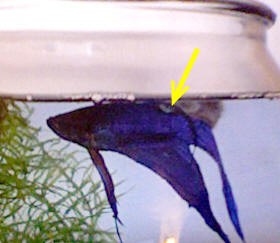 "Poster Betta" "Poster Betta"
|
Sick male Betta... no data,
reading... 10/24/07 My male Betta has been very
lethargic for the past few days, and recently he stopped eating. Now he
just sits listlessly on the bottom of his tank. I've had the water
tested and the environment outside the tank is fine otherwise, so I
don't know what's happening to him. He seems to be dying. His
color has paled dramatically, and he just floats around, rather than
swims. Now and again his body will jerk wildly. Any advice? Anything at
all would be greatly appreciated! <... Is this system heated,
filtered? What do you feed? Please read here: http://www.wetwebmedia.com/FWSubWebIndex/bettasysart.htm
and the linked files above. Bob Fenner>
Betta's got white dots on the eye
10/22/07 Dear WWM crew, <Kathy> Hope I can get some advice
from you in treating or helping my Betta. <Will try> I read most
of the information about eye fungus and cloud eye on WWM site, however,
I am not sure if this is exact problem my Betta has. I have had my
Betta for about a year. He's living alone in a 3 gallon tank with
bio-wheel filter. I noticed a white dot in the middle of his right eye
about a week ago. It's a solid white dot on the outside, not
inside. I have seen white cloudy eye on one of my mollies before. This
one is not like the haze, white film over the eye. <Okay> I have
been treating him with anti-bacteria medicine (Furan-2) but it does not
seem to improve the condition at all. The white dot seems to become
larger day by day. Today his left starts to show a tiny white dot as
well. My Betta is eating and swimming fine. He made bubble nests last
night. Please give me some advices. Thanks a lot. Kathy <Mmm...
perhaps this is/has become an entrenched bacterial involvement,
following a traumatic injury (a bump into something)... The age of your
Betta may be a factor as well... I would likely try addition of
aquarium salt here. Please read: http://www.wetwebmedia.com/FWSubWebIndex/saltusefaqs.htm
and search on WWM using the cached version: Betta Disease, Salts... Bob
Fenner>
|
Moving Betta Fish to a Bigger Tank/Fin
rot 10/21/07 Hello, <Hello!> I got a Betta
fish about a month ago- my college had an event and they gave
away Bettas for free. The bowl he came in seemed "too
small" so I got him a larger (half gallon) bowl, which
he's been living in since then. However, reading on your site
(I know, I should have done my research *first* but I assumed
that since people in my dorm in previous years had Bettas in
those little bowls that it was okay for them) I got him a 2.5
gallon tank with a heater and filter (it's a charcoal filter
type, rather than a sponge...is that okay?) and some largish
cloth plants. <Carbon isn't really useful in this
aquarium. You're going to need to change 50% of the water
weekly (at least) and doing that will remove the dissolved
organic wastes through dilution. Since carbon is used to remove
those wastes, the carbon is rendered obsolete. Carbon also
removes medications: you cannot use fish medicine in an aquarium
with carbon. So, replace the carbon with *biological* filter
media instead. Sponge would be ideal, but ceramic hoops or filter
wool will work too.> My question is, from what I've seen
you're supposed to cycle the tank before putting the fish in,
but that can take up to 6 weeks. <Yes.> But it seems like
even an uncycled heated and larger tank would be better for Kappa
(my Betta) than his small cold bowl. <Correct.> Is it safe
to put him in now, and just change the water often (I'm
thinking every 3 days with a 50% change- in his old bowl I was
doing 100% changes every 3 days), or is it better to wait for the
new tank to cycle? <Your plan sounds ideal. Move the fish, do
water changes regularly, and test the nitrite levels periodically
to check things are OK. When fish are exposed to high ammonia and
nitrite levels, they are prone to fungus and Finrot, so you want
to keep them as low as possible, preferably zero.> Also, I put
the plastic plant and the gravel from his old bowl in, with new
gravel and a couple larger fabric plants- will that help the tank
cycle faster? <Marginally, if at all.> (I don't know if
there was anything beneficial on them, in order to get the waste
off the gravel I'd been swishing it in tap water when I did
his water changes, and rinsing off the plant <Arggghh! Never
wash anything under the tap you want bacteria to live on. Always
wash biologically active filter media in a bucket or bowl of
water taken from the aquarium.> I did notice some sort of
stringy whitish stuff on the plant though, is that good or bad
growth?) <Likely algae (if green) or bacteria (if grey/white).
Either way, harmless though perhaps unsightly.> I don't
have any tests for ammonia/nitrates/nitrites yet, but I am
getting some as soon as I can find them (the store I went to was
out of a lot of stuff). <Get the simple combination
dip-sticks. They're cheap (here around £10 for 25
tests) and you can slice them down the middle to make twice as
many tests. Each dip-stick has nitrite, ammonia, nitrate, pH and
hardness (at least) making them extremely useful for quickly
judging the conditions in the tank.> I'm especially
concerned about leaving Kappa in the old bowl because he's
had a chronic case of fin rot since about a week after I got him.
At first he lost about a quarter inch of the 'webbing' on
his tail, and I got him some aquarium salt and tetracycline
gel-food medicine. <The salt detoxifies nitrite, which is
useful when a tank is immature. I'm not convinced
Tetracycline food is beneficial, given it is an antibiotic for
internal infections, and Finrot is an external infection. I think
you need to add a Finrot medication to the water.> The
medicine said to give him 5 drops per serving (2x a day) but I
could never get him to eat more than 2 drops (the brand was
"aquarium products gel-Tek tetracycline", for what
it's worth). It seemed to stop the fin rot, and it started
growing back but as soon as the medication period (3 days) ended,
within a day the tail had rotted back to about where it was the
first time. <Curing the symptoms -- Finrot -- while not fixing
the cause -- poor water quality -- locks you into a cycle where
every time you cure the fish, it gets sick again soon after.>
I tried the tetracycline again and this time he'd hardly eat
it (I think he just doesn't like it, he loves the Hikari
pellets and frozen bloodworms that are his normal food). The rot
didn't really get any better, so I stopped for a couple of
days then switched to Jungle Fungus buddies (which said they also
treat fin rot). That has helped more, but by this time his tail
is about half the length it used to be. <Oh.> Anyway, the
tail has been stable for a couple of days but after I switched
Kappa into the 2.5 tank, and he swam around for an hour or so,
the webbing that had been regrowing has fallen out again. Will
the better conditions help him (he's still on the Jungle
medication), or do I need to do something else to get this
cleared up? <I think at the moment you're "running to
stand still" because high levels of ammonia and nitrite in
the aquarium are putting immense stress on the fish.>
(I've been trying to find Maracyn (2) since that seems to be
highly recommended on your site, but I can't find it in
either of the pet stores here.) Other than that he seems healthy
and active- he was very curious about everything in the new tank
and comes over to me every time I get near. Also, pretty much
every time I changed his bowl water, he would make a bubble nest,
so he couldn't have been too unhappy...? <In other words:
when water quality improves, he's happy; when water gets bad
again, he stops being happy.> Sorry this is so long, but I
wanted to give as much detail as possible. Thanks for your time,
--Kyra <Do water tests, replace carbon with true biological
filter media, ensure ammonia and nitrite settle down to zero
levels. Don't overfeed, and do regular water changes. Keep
treating the Finrot. Once the water is good, you'll see the
Finrot won't come back. Do read the articles here at WWM
about Bettas. Cheers, Neale.>
Re: Moving Betta Fish to a Bigger Tank/Fin rot 10/22/07
Dear Neale, Thanks so much for your help and the quick response.
I'll be looking for a new filter and ammonia/nitrite/nitrate
tests for Kappa's tank. You guys run an amazing site, and
I'm sure I'll be referencing it a lot in the future.
Thanks again, --Kyra <Kyra, thanks for the kind words, which
I'll be sure and pass on to the Crew. Good luck with your
Betta! Neale>
|
Betta Fish Popeye 3- Ampicillin Dose
10/19/07 Hi Crew: Neale answered my question last time, suggesting
Ampicillin . I wrote a few weeks back about my Betta with Popeye. Tank
is 2 gal, filtered with BioWheel. Tank tests at 0 ammonia, 0 nitrite, 5
nitrate ( this is the tap water) and 8 pH (also local) I age and
dechlorinate the tap water. Temp is 80 degrees. <All sounds good.
Aging water, by the way, is redundant now if you use a good
dechlorinator. Though there's no harm doing it if you want!> I
began treatment with Epsom salt, moved to Furan and we are now on the
second dose of Ampicillin. <Very good.> Poor Chip (we have had
him for 18 months) cannot see, so I have been taking him out during
tank changes (50% every other day since this started 6 weeks ago using
a siphon) and giving brine shrimp, bloodworms initially. But the last 2
weeks, he misses them completely, even with me using an eye dropper, so
I am using Betta flakes so he can easily grab them. He has not eaten
the last 3 days - he swims around blindly trying to grab them, but
misses. <Be persistent, but don't panic too much... fish can go
days without food.> Jungle antibiotic food did not work - he spit it
out initially since it was so hard and he didn't like it.
<Common problem with small fish. Much medication is formulated for
big, expensive fish like Koi that people are likely to spend effort on
healing. Common attitude with small fish is they're
"disposable". Shame.> He has been sitting on the bottom
completely since I started the second dose, moving every so often and
coming up once in a while to grab some air. (Before he would often sit
on his plant near the heater.) He now won't come up for food. His
breathing is rapid since I started the Ampillicin. I stopped the Epsom
salt and gave 1 1/2 tsps of sea salt to see if it would perk him up. It
has in the past, but not this time. <I'm not a fan of randomly
adding salt to aquaria.> I have 250 mg of Ampillicin dissolved in a
gallon of water. With the help of the math teacher brother-in-law, we
have calculated that it is about 13 oz of water per gallon to dose the
tank safely. I have given him a dose every other day as instructed on
the package, with the water change, I have not used a new Ampicillin
pill each time, but just used the treated water which is sitting in a
plastic milk jug. I am concerned that maybe I should be using a new
pill each time to ensure it is fresh. <Possibly, but I wouldn't
worry too much. Store unused medicated water in a covered jar in the
fridge though. Excess heat and light could certainly alter the
drug.> Should I not change the tank water, but just take out enough
to replace it with the Ampicillin water? This would increase the
dosage. There is no carbon in the filter. <Hmm... in this instance
I'd minimise water changes through the course of treatment. Though
in practise, the medication is probably metabolised by the bacteria in
the filter very soon after you pour it into the tank. But I've not
used Ampicillin, since it isn't freely available in the UK, and my
honest (and by UK standards, legally acceptable) advice has to be to
consult with a vet. Not very helpful to you, I'm afraid. To be
honest, it probably doesn't matter much either way, whether you
change a bit of water or a lot, since I'm fairly sure the drug will
be entirely metabolised by the bacteria within 24 hours.> So, is
there anything else to do? <Pray to the Fish Gods.> I have
thought we were at the end several times already, but he is still
hanging on. To review six weeks of care: Water changes ( I am heating
the water to 80 before returning him to the tank) Meds tried: Epsom
salt, Furan, Ampicillin Feeding in small space to ensure he eats
Thanks, Asa <You're doing everything you can. Stick with it, and
hope for the best. As I say, treating small fish, especially in small
tanks, is difficult and the results variable. The very nature of small
fish that by the time we see a problem, the strain on their internal
organs is often very severe. An adult Koi carp at least has some
reserves of fat to draw on, and so various therapies can be tried out
until you find one that works. But something as small as a Betta may
only have a few days within which you can find the "silver
bullet". Good luck, Neale>
Need help ASAP with sick Betta -- 10/18/07 Ruffles
has been laying on bottom of tank 4 days now. Hasn't eaten in 4
days. He was mainly just lethargic prior to that. Treated him with
Jungle brand fungus tabs with no difference. Treated Sunday with
CopperSafe, 1 tsp in 2=1/2 gal tank. Had difficulty breathing
yesterday, so I added an air line in his tank. Can see a gold
sprinkling on tail and body. Yellowish discoloration on face (he is
red, so it really shows up), so I assumed Velvet. What else can I
medicate him with or do? His eyes move when I come around the tank, so
I knows he sees me. I feel so helpless. I am also keeping the light off
the tank. I raised temp to 82. Please help! Thank you. Sandy
<Greetings. You don't say anything about filtration. What
filtration are you using? What is the Ammonia and Nitrite level in this
aquarium? Please check at the very least the Nitrite level, as most of
the time when Bettas get sick it is because of poor water quality.
No-one who keeps a Betta in an unfiltered aquarium can expect it to
stay healthy. Anyway, the gold dusting on the fish sounds a lot like a
disease called Velvet. All sorts of medications will fix this. eSHa
Exit, Mardel Maracide, API Super Ick Cure etc. He needs treatment at
once. Use the medication precisely as explained on the instructions.
Remove carbon from the filter, if used. Velvet can kill fish
eventually, so don't delay. Good luck, Neale>
Re: Need help ASAP with sick Betta 10/19/07 I appreciate your
response. Nitrate this morning is 0-5, nitrite is 0. I do not use
filtration with any of my Bettas and all have done well until this. I
had never seen any information saying Bettas required filtration. As I
said, I already medicated with 1 tsp CopperSafe Sunday, but he
isn't getting any better. Is there not something else I can
do........possible add an antibiotic too without it interfering with
the CopperSafe? Sandy <I've heard some people keep Bettas
without filtration, but that involves changing the water more or less
completely every single day. Anything less and the ammonia builds up in
the bowl, and that causes problems. If you have no filtration at all,
then nitrite will obviously be close to zero because there are hardly
any nitrifying bacteria converting ammonia to nitrite. But the ammonia
levels will increase until you do a water change. So check your ammonia
levels an hour or so after feeding. You'll likely detect ammonia,
and that's the commonest reason fish get sick. Any ammonia level
above zero is bad. Bettas are every bit as sensitive to ammonia as any
other fish: they do not live in puddles in the wild, but ponds and
streams, and they need good, clean water to thrive. So please, consider
adding a filter to your Betta aquarium -- it's simply good
fishkeeping. An antibiotic obviously won't cure velvet. Antibiotics
are for treating bacterial infections, and velvet is a protozoan. While
I can't be 100% sure on a diagnosis without a picture, the classic
symptom of velvet is a gold-dust like coating on the body. If you want
to send a picture, we can try and confirm this. But before getting hung
up on curing the velvet, check the ammonia -- if the water conditions
are bad, no amount of therapy will help. Cheers, Neale>
Betta fish help! 10/15/07 Hi I brought a
Betta fish a little over 3 weeks ago from a pet store. 2 days ago, he
started not eating and rubbing himself against the decoration I bought
him. His fins are incredibly torn now and he looks like he's about
to flip over and die. He's also had a white patch on his stomach
since I bought him and now it looks like it had spread a little, his
head also looks less dark than before and appears to have dark spots
all over. I had done a 50% water change 2 days before he became sick
and added the "Betta plus water conditioner". I aged the tap
water with the water conditioner for 2 days before adding to the tank.
Since he's been sick I have changed his water again without aged
water but he seems to be worst. Please help me! Sincerely, Kristy
<Hello Kristy. Your Betta is almost certainly suffering from being
kept in poor conditions. Since you don't mention either a heater or
a filter, I have to assume you're using neither. Bettas needs a
proper aquarium. They can't be kept in jars. If you want something
for a jar, get some cut flowers. If you want to keep a living,
breathing fish -- set up an aquarium! There is a step by step guide
here:
http://www.wetwebmedia.com/FWSubWebIndex/bettasysart.htm .
But to cut a long story short, you need a tank upwards of 5 US gal/18
litres; a heater to keep the water around 25C/77F; and some sort of
gentle but effective filter, such as an air-powered sponge filter or an
undergravel filter. Plants, lights and ornaments are optional extras. A
hood is useful though, as they like to jump. Even a pane of cut glass
from your local hardware or DIY store will work for this though. In the
meantime, you need to treat for fungus & Finrot. Various
medications will treat both at the same time, such as eSHa 2000 and
Mardel Maracyn. Follow the instructions carefully. Make sure that the
filter you use *doesn't* have any carbon in it, because carbon
removes medications. If you don't [a] treat the fish AND [b]
provide a proper aquarium for him to live in, he will die. Simple as
that. Hope this helps, Neale>
|
|
| Re: Betta with bulging white patches -
10/08/07 Hello, The bulges on my Betta are not flat/cloudy or
fuzzy. They are large (3-5 mm) and they protrude from his body like
textured whitish warts. I believe another has grown since our last
email (totaling 4 now, two on each side). I think this is a virus
or parasite of some sort, and I also am quite sure this is a rarer
disease because it does not fit the definition of any of the
typical Betta diseases (it is not Ich or fungus for sure-I
medicated him with Quick Cure and Maroxy with no effects a while
ago.) I am leaning towards Lymphocystis, however he has been
growing this for at least 6 months and it has not gone away (a lot
of websites claim it should fix itself within a few months max...).
He still acts healthy, so I am quite confused. I've attached
blurry pictures but I'm not sure if they will help! -Michelle
<Hello again Michelle. From the pictures it isn't exactly
clear what's going on, but yes, you can rule out fungus and
Whitespot. I would probably go along with a diagnosis of
Lymphocystis, but to be fair there are a variety of diseases that
can look fairly similar (for example Fish Pox). Without access to a
microbiology lab, identifying some of these diseases is very
difficult. Anyway, Lymphocystis tends to have a distinct texture
(often likened to cauliflower) and the colour is often, but not
always, off white, almost coffee-au-lait. Lymphocystis isn't
really treatable, and for a fish as short-lived as a Betta, likely
will last for as long as the fish will. Lymphocystis is related to
a viral infection BUT it appears to be triggered by environmental
factors. Water quality and heavy metals have both been implicated.
Lymphocystis doesn't really cause the fish any harm, provided
the internal organs aren't impacted, which doesn't seem to
be likely here, given the cysts are on the muscles at the base of
the tail. So for now, concentrate on water quality, optimize diet,
and hope for the best. Cheers, Neale> |
Betta and Exophthalmia (pop-eye) - 10/07/2007 Hi
Crew: it has now been 3 weeks since my Betta developed PopEye in the
left eye. I have done water changes daily/every other day in his two
gallon filtered tank and added Epsom salt as directed elsewhere. I have
done a furan treatment in week 2. I have been keeping the tank at 80
degrees and the water quality is normal across the boards. This
morning, the right eye is starting to swell. I read on another website
that PopEye can also be caused by tuberculosis. Could you enlighten
about this? I am amazed my little fish has kept going so long. He has
had problems seeing so I have taken to feeding him in a smaller
container while I changed his water. Thanks, Asa <Hello Asa, Pop-eye
is caused by a variety of things, but primarily poor water conditions.
This is simply a statement of fact. A two-gallon tank is too small to
create good water quality. I know retailers sell these tanks, but they
really are too small. The number of sick fish I encounter kept in two
gallon tanks makes it 100% clear to me that they "death
traps" except perhaps for snails and shrimps. It's difficult
to keep the water temperature steady, and any filter installed in one
will likely be extremely small, so it's ability to remove ammonia
will be very, very limited. Unless you're doing 50% water changes
DAILY, the nitrate levels of the water will likely be relatively or
dangerously high. Adding Epsom salt is not something I would expect to
help fix Pop-eye, so can't comment on that. Furan is an antibiotic,
and that could help if the problem is bacterial, but it doesn't
work with all bacteria, so if a different bacteria, it isn't going
to help. An antibiotic often recommended specifically for Pop-eye is
Ampicillin, which you can get from some aquarium stores or from a vet.
Treatment for Pop-eye takes time, so while it shouldn't get worse
once you use Ampicillin as directed, your fish may take weeks to fully
recover. You don't say precisely what your water chemistry and
water quality is. For a Betta, you're looking at 0 ammonia, 0
nitrite, <50 mg/l nitrate, pH 6-8, hardness around 5-20 degrees dH,
carbonate hardness 3-15 degrees KH. Often overlooked is air
temperature; Bettas MUST have humid, warm air above their tanks. A
cover glass or similar over the tank should help this. At the same
time, the air needs to circulate, so the cover glass mustn't be too
tight (in other words, leave it slightly ajar). In the short-term use
the Ampicillin, but long term you should upgrade the aquarium to at
least 8-10 gallons, and make sure you install a reasonable filter as
well. Air-powered sponge or box filters are ideal. Cheers, Neale>
Re: Betta and Exophthalmia II - 10/07/2007 Dear Neale: Thank you
for your reply and assistance. This is the 3rd time I have written in
and I have followed the directions from your other colleagues and
recommendations found on WWM about this subject. Epsom salts are the
preferred method to deal with PopEye initially according to WWM experts
to relieve the eye pressure. <Hmm... the thing with Epsom salts is
that it relieves the pressure behind the eye by altering muscle tone
and playing with osmotic pressure. So if a fish is going to get healthy
anyway, Epsom salts will speed things up. What Epsom salts cannot do is
reverse a critical situation caused by, for example, water quality or
bacterial infection. Epsom salt just isn't that powerful. It's
kind of like antiseptic lotion: fine for minor cuts, but inadequate for
deep lacerations where stitches and antibiotics are needed. So with
respect to my colleagues, I suspect your Betta has moved beyond the
point where Epsom salts will help. You need an antibacterial or
antibiotic medication known to work on Pop-eye, such as Ampicillin. A
vet may recommend another.> The fish is in a Marineland Explorer
tank with a sponge filter and a BioWheel and a cover. <Sorry, the
brand doesn't matter to me. Two gallons isn't an aquarium,
it's a bucket. I have no idea why people think Bettas can go into
tanks so tiny. The idea they live in "hoof prints of water"
as I've seen one person say is nonsense; Bettas live in streams and
ponds. Sure, the fancy Betta can't swim so well, but that only
means it needs a gentle water current rather than a torrent. It's
metabolic wastes are identical to those of any other medium-sized fish
like a swordtail or dwarf cichlid, neither of which anyone would keep
in a 2 gallon tank.> I did not report on the water chemistry in
detail in this message, because it is perfect (0 ammonia, 0 nitrite, 5
nitrate ( this is lowest it come out of the tap) and pH of 8 - which is
the source water,) because I have been doing 50% water changes each day
for the last 3 weeks using a vacuum tube. The temperature has been a
steady 80 degrees. I age the water and use a dechlorinator. Diet has
been a mix of bloodworms, brine shrimp and dried Betta flakes. <All
sounds fine. But quite clearly, something is wrong. Even if the water
quality is good when you test it, for the 20, 30 minutes after you feed
him, it might plummet. Because even brief exposure to ammonia is very
dangerous to most fish, over time this can easily cause problems. Fish
kept in 2 gallon tanks get sick BECAUSE they're being kept in 2
gallon tanks. There's no ifs or buts about this in my mind.> The
problem is that he is not getting better despite all the attention. He
now cannot see to eat, but will eat if I but him in a cup where he can
grab what's on the top. I wanted to confirm that tuberculosis may
be the underlying problem and there is not much else I can do. <Fish
TB is incredibly rare among freshwater fishes. People tend to cite it
as the "mystery disease" instead of accepting they kept the
fish wrong or did something stupid like feed their fish live Tubifex or
live goldfish. Fish TB is primarily a disease of advanced marine
fishes. It can ONLY be diagnosed by examination of tissues by a trained
fish pathologist, so anyone who tells you their fish had Fish TB but
isn't a microbiologist is likely talking rubbish. So no, your fish
almost certainly doesn't have Fish TB.> The Ampicillin is one
more option. <Indeed. Not expensive, and certainly worth a shot.
It's been reported as being effective when used on Bettas with
pop-eye.> I feel like I have kept him going through all this care,
but the outcome will still be fatal because this is more than a
bacterial infection. <Difficult to say. But my honest opinion is
environmental conditions are at the root of the problem, and the Epsom
salt treatment was too weak and the Furan treatment probably pointless
because I'm not aware of those drugs being used for Pop-eye at all.
Not all antibacterials and antibiotics are good against all bacterial
infections.> Best regards, Asa <Good luck, Neale>
|
|
Betta Success
Doing what it takes to keep Bettas healthy long-term
by Robert (Bob) Fenner
|
|
|

