|
FAQs on Betta Diseases/Health 23
Related Articles:
Anabantoids/Gouramis & Relatives,
Betta splendens/Siamese Fighting Fish, Betta Systems, Betta Diseases, Improved
(Better?) Products for Bettas!,
Related FAQs: Betta Disease 1, Betta Disease 2, Betta Disease 3, Betta Disease 4, Betta Disease 5, Betta Disease 6, Betta Disease 7, Betta Disease 8, Betta Disease 9 , Betta Disease 10 , Betta Disease 11 , Betta Disease 12 , Betta Disease 13 , Betta Disease 14 , Betta Disease 15 , Betta Disease 16 , Betta Disease 17 , Betta Disease 18, Betta Disease 19, Betta Disease 20, Betta Disease 21, Betta Health 22, Betta Health
24,
Betta Health 25, Betta Health 26, Betta Health 27,
Betta Health 28,
Betta Health 29,
Betta Health 30,
Betta Health 31,
Betta Disease Causes/Etiologies:
Determining/Diagnosing, Environmental (By far the largest cat.),
Nutritional, Viral/Cancer, Infectious (Bacterial, Fungal) , Parasitic: Ich/White Spot, Velvet; Senescence/Old Age, Cures/Curatives/Treatments,
FAQs on Betta
Medicines: Betta Medicines
period, Antibiotics/Antibacterials,
Anti-Protozoals (Metronidazole,
eSHa...), Copper, Formalin, Malachite Green, Anthelminthics, Organophosphates, All Other Betta Med.s (Mela-non-fix,
Quinines...)
|
|
 |
Betta Success
Doing what it takes to keep Bettas healthy long-term
by Robert (Bob) Fenner
|
Very sick Betta! Please help me, Crew! 5/29/09
Thank you so much, Sara!
<Welcome, Scott V. with you today.>
Is there any certain medicine I should try?
<No, this sounds to likely be a water quality issue, hence the water
changes.>
I am going to PetSmart tomorrow, I am determined to save him(at least
try everything I can).I have a list:
Ph kit
Ammonia test kit
stress coat <Skip it, no real value here.>
fin rot and Ich meds(I am getting guppies so I want to be prepared
this
time.)
<Do buy these if you wish, but be wary about dosing just to treat.
It is easy to poison the fish with good intentions.>
AmQuel
New filter(my other one broke)
<Ah, the issue most likely. You will see quickly with the Ammonia
test.>
I am also going to take in samples of water from my tanks that I have
had him in. And, I am taking pictures of him, so maybe(if my battery
ever
charges), if there is someone who specializes in fish, I can show them,
to maybe give their opinion(I have been asking all around). Anyways,
sorry for another email. Does this sound like a good list?
<Yes, but I do want to reemphasize frequent water changes,
especially until the biofiltration media in the new filter
cultures.>
Thanks again!
-Kristen
I love Ellie
<Welcome.>
|
Betta and Ick 5-29-2009
Hi there. I've got 4 Bettas now and literally about a month
ago just got the newest one through a swim bladder infection.
<Sounds like you have a house full! Great! Glad you saved
him.>
Well now my eldest fish, Hoonter, is about 3 years old I believe
and has a bad case of Ick.
<Tiny white spots all over the body?>
I myself have been having some major health issues and am fearful
I began treating him/caught it too late. The white spot on the
top of his back is HUGE and all the other people on here saying
their fish have Ick say the spots are small so I'm a bit
confused.
<Then it is not Ick, most likely bacteria or fungus.>
I really love my fish, he was my first pet, and I'd really
love to get him better. The people at PetSmart told me to use an
anti-fungal and that did absolutely nothing so I researched some
more and became so frustrated that I went back to PetSmart again.
Another worker told me it may just be his time which made me very
sad, but also told me he needed real medicine and to use Tetra
Lifeguard. Today is the 5th day of using it and Hoonter is doing
so well!!
<Great!!>
He's eating just fine, and swimming around just fine, but the
white spot is still very prevalent and he has a little bit of
like gauze on one of his gills.
<Not great..>
What should I do? Please help!!! And if you could e-mail me back
at this address that would be great. I found it hard to find
specific information on your site and fear if you wrote me back
on there I might not find it. Also, I'm about to move
and am wondering what is the best way to move them and is my
Hoonter going to be able to take the move in his current health
state?
<The best way to move Bettas is to place them in a container
that has a lid containing water from their tank. I put a small
hole in the lid and seal them in. I have moved five times with my
Bettas and all of them made it.>
Thank you so much for your time! It is greatly appreciated.
I've also attached two pictures. The spot may not look white
in the picture but it is in real life.
<That is one huge white spot! I would recommend continuing the
Tetra Lifeguard for a few more days (3 or 4). If no improvement
has occurred (spot getting smaller and the gauze disappearing)
then I would switch to Maroxy by Mardel, whom also makes Maracyn.
It treats both fungal and bacterial infections which should help
poor Hoonter make a recovery. You are welcome! Merritt A.>
|
  |
Betta with Ick Part II 5-29-2009
I totally forgot to add that he is in a five gallon tank with a heater
set at about 78-80 degrees with the filter taken out and off at the
moment because he was having a hard time moving around.
<Nice tank for a Betta!>
Also, the Ick came after his tank got this green goo on the sides I
think from the plants and I read it was very bad for him so I did a
total cleaning of the tank and water change and introduced a new heater
because his broke. He was fine before that, and I read that the water
changing and cleaning of the tank could have done it. Is this so?? If
so, how should I have dealt with the green goo?
<Yep, completely cleaning the tank upset the balance of the
ammonia/nitrate/nitrites in the tank allowing bacteria/fungus to become
prevalent. What I usually do when one of my Bettas is in a larger tank
with algae, I scrap off the algae with a razor and then suck it out
with a tube giving the tank a 30% (or less) water change. This prevents
me from upsetting the natural balance while also getting rid of the
nasty algae.
Good luck with Hoonter! You are welcome! Merritt A.>
Betta with Ick Part III 5-30-3009
Thank you so much for all your advice! I have something to add though.
I was just examining him and talking to him and I noticed a little
white thing rise from his body. Then I looked closer and saw it was
something living and swimming. I then noticed there were a few little
white things moving around. What are they and what should I do about
them?? I have a feeling they can't be good and may be keeping him
from totally getting better.
<You are very welcome! Are they attached to his body? If not then
they could be freshwater nematodes which will cause him no harm. If
they are attached to him then you have an external parasite(anchor worm
possibly?) along with the bacteria/fungus. You would have to treat for
external parasites with Mardel's CopperSafe. It will kill the
parasites and get your Betta back to health. You are welcome again! :-)
Merritt A.>
Betta with Ick Part IV 5-30-2009
Sorry, I forgot to add that the gauze went away on his back but has
returned but kind of looks like a fin trying to grow back. Could that
be what is happening?
<No problem. Do you have any pictures of this? Thanks! Merritt
A.>
Very sick Betta! Please help me, Crew! 05/27/09
I was reading your FAQ's and I thought I would give it a try! My
Betta (got Romeo in January). He is my first fish, so I want him to
live a long happy life! Over the course of an hour though, on Monday,
he became seriously ill. I found him lying on his side at the bottom of
his 1.5gallon tank (a little small, I know).
<Better than most... unfortunately.>
He usually eats a lot(could it be swim bladder?). He wouldn't eat
though, and I found a grayish looking stripe on him. So, I put him into
a little hospital tank(.5 gallon)(once again, small, I know).
<Hmm... better to just change the water in the 1.5g>
Ever since I put him in there, he swims around a little more, and he
just ate a bloodworm a little while ago. Sometimes though, when he
really tries to swim, it almost looks like he is seizing. Is he going
to die?
<maybe>
I do not have Ph test (I am getting it tomorrow, along with some
meds.). I have a little bubbly-oxygen thing going in his hospital tank.
I am monitoring his temp. Could it be an ammonia spike?
<Possibly... or perhaps the fish was in poor health when you
acquired him and with the added stress of being moved, relocated, it
was just too much for the little guy. It might not be your fault, just
an unfortunate reality of the industry. You don't even want to
know/see how these poor fish are shipped. Often times they're
shipped in little, sealed "pouches" of no more than 2oz of
chemical-saturated water.>
I looked at a website and most of his symptoms fit. I'm not sure
though. Also, I know that this is bad, but I don't clean out the
tank as much as I should. Could this cause this? Thank you so much! I
really appreciate any help!
<From the information you've given me... I would just do a water
change and see if he improves. >
-Kristen
<Good luck,
Sara M.>
Sick Betta 5-21-2009
Hello,
<Hello! Merritt here today!>
I have a rescued Betta with large lesion/sore on left side by tail.
When I first brought him home (yesterday) he only had small patches of
fuzz on his head and left gill cover (very small). His previous living
conditions were awful. Tiny bowl, no heat and probably very dirty water
most of the time. I set him up in a 1 gallon tank with heater to
78*, de-chlorinated water, added Melafix and Pimafix for what I thought
was fungus. (also added Blackwater extract- my other Betta seems to
like it...) No filter because I planned to treat it like a bowl.
He had no appetite, very listless. Today my poor rescue has HUGE
sore by his tail fin! Seems to be dissolving the flesh quite fast!
Could the heat have sped up an unknown bacterial infection? I have
added salt to water and turned heater off temporarily. (on the
assumption heat was bad? this seemed to slow the spread of the rot?)
Should I treat with Kanaplex? Or other?
Thank you for ANY help you can give me and this poor fish!
<Sometimes heat can cause infections/parasites to increase but, I
think the Pimafix & Melafix are not working. I have used both and
had to switch due to them not changing anything. My fish always got
worse with both medications, which I why I recommend Maracyn I or
Maracyn II. Kanaplex, a medication I have never used, should be used if
you do not have the Maracyn. Kanaplex treats for the same illnesses
that Maracyn does, thus both would work for your situation. It is great
that you added the salt, it will help with the healing process and make
the tank conditions difficult for the bacteria to prosper. Hopefully
with the addition of medication your Betta will be healthy again. You
are welcome! Merritt A.>
Sick Betta 5-21-2009
dear WWM crew,
hi! First off, thanks so much for taking the time to read this I really
appreciate any information you can give me!
<Hello! Glad to help! Merritt here today.>
I bought a Betta (Davey Jones) sometime last April and from day one
he's been acting 'off'. At first, he barely moved, perching
himself on a plant or behind the filter. Then I started noticing a
grayish patch on his anal fin that slowly spread to his head and around
his gill plates, along with fin deterioration. I thought the symptoms
matched columnaris (he doesn't have an airstone and I keep the tank
at 78 degrees F, along with a potentially stressed fish, which I've
read are perfect conditions for a columnaris outbreak) I started with
10 days of Maracyn I and II which didn't help at all, so after 2
days rest, a large water change and a carbon insert, I began a Furanace
treatment which got rid of most of the grey film except on his anal
fin. During the treatment he became much more active but still
didn't regain a healthy level of activity (i.e. he still spend a
good amount of time resting on plants or gravel)
<From your description, it does sound like your Betta is suffering
from columnaris.>
Then I started noticing these large (if I were to estimate, ~2 mm)
milky white raised bumps on his gill plates along with renewed grayish
growth around his gill plates. These are in addition to his now regular
very low activity levels plus occasional twitching and darting. Now
I'm thinking parasites, but I can't find any parasite or
protozoan infections that match his symptoms and I'm hesitant as to
whether the grey growth is excess mucous, parasites or columnaris.
I've tried on several occasions to take photos but I have an
extremely stress prone-fish and he hid the entire day after I tried to
get photos (he reacted extremely badly to an initial dose of aquarium
salt before I started the Maracyns)
<White pumps? Poor Betta, he also might have Ich and a combination
of columnaris.>
I was recommended CopperSafe and Maracyn II as treatment but so far
I've been unsuccessful in hunting down some CopperSafe so instead I
bought some clout and Paraguard as a backup in case he reacted badly to
the clout which I know is a very potent medication. I did a four day
treatment as stated on the box and it didn't seem to work except on
one gill plate which appears to be free of the white spots but looks a
little pitted (like a chickenpox scar). Even so, he does seem to have
been stressed by the medication and now spends almost all of his time
on the gravel or hanging off a plant so I'm back to square one and
VERY (forgive the caps lock :( worried. Right now he's in rest
mode, his tank has a carbon insert, I changed 100% of the water the day
the clout treatment ended and since the Furanace treatment I'm
fairly positive the filter's lost its cycle so I'm doing almost
50% water changes every two days because I don't need to worry
about ammonia and nitrites along with this poor fish. Here are his
water and tank specifics:
Tank setup:- he's in a 5.5g, planted, heated (78 degrees F),
re-cycling tank that has an HOB filter with a baffle on the output and
a sponge insert on the intake. There's a LifeGlo lamp on a timer
from 7h30am to 5h30pm for the plants. Also, I've been lowering the
water level to increase oxygen.
<Sounds great! Your Betta is living the high life.>
Feeding: 2x daily alternating between Hikari bio-gold, Hikari
micro-wafers, Hikari micro-pellets, Nutrafin pellets and frozen blood
worms and on Sundays he gets fed in the morning and I leave a dried
seaweed leaf clipped to the side of the tank as roughage for the rest
of the day
<You are overfeeding him. Decrease feeding to only once a day and
take out the seaweed, Bettas should not eat seaweed.>
Water parameters:-0 ammonia, 0 nitrites, 0 nitrates, Ph 7.6
<Great!>
Water additives: Hagen Nutrafin water conditioner, Seachem flourish and
Excel for the plants and lately, Seachem stability. I'm also
considering adding blackwater extract or almond leaf extract if I can
find it since he seems to become more active when his water is tinted.
The Furanace tinted his water a deep orange, and he had more energy
then than he's ever had. I'm guessing it's because it
blocks out some of the light
<You should purchase Attison's Betta Spa. It contains many
minerals/almond leaf extract that encourages Bettas to thrive in home
aquariums, mine love it!>
Maintenance -50% water changes every two days + gravel vacuuming. I
change the filter inserts once a month along with a quick rinse to
clean out any clogs
<You should not be doing that many water changes, decrease the
amount of food you are feeding and that should stop making the tank
high maintenance.>
He's my second Betta, the first one, roger, was euthanized with
clove oil after a really bad case of fin rot that practically melted
his fins off and started exposing peduncle bones (I think that's
what it's called). There was also an apple snail, Applebee who I
had to put down due to mantle collapse. The Betta died last November
and the apple snail in early April. The tank had been void of a fish
for over six months so I assumed (maybe wrongly) that any pathogens or
parasites would die off so after I lost Applebee, I simply did a full
water change and scrubbed the tank walls as opposed to sterilizing
it.
<Your Betta could have been attacked by the other parasites, but I
highly doubt it. Most likely he became stressed from the water changes
which lead to him getting parasites.>
I'm very aware that I've put Davey through a lot in terms of
drastic water changes, potent medications and my lack of experience as
a very new fish keeper and I don't want him to suffer any more so I
guess what my question is what you guys think he might have based on
the info I've given and whether the CopperSafe and Maracyn II
treatment sounds like the best route to take, since I'm really not
keen on putting more chemicals in his water unless I'm fairly
certain it'll help. As well, what do you think the best way would
be to re-cycle my tank with as little stress to the fish? I originally
cycled with ammonia so I have no clue on how to "safely"
cycle with a fish in the tank.
<I would personally recommend the Maracyn II due to it working (I
use it!) and that it is less potent than the CopperSafe. Your Betta
should recover with continued medication and keeping up on tank
maintenance. To cycle the tank you can use Cycle, by Hagen Nutrafin. It
contains the beneficial bacteria for aquariums and is safe to use with
fish, also you can easily remove your Betta into a smaller home to
recycle the tank by using ammonia.>
so I think that's everything, thanks so much for any information
you can give me!
<You are welcome! Merritt A.>
Emilie
Re: sick Betta, unable to come up with a diagnosis
05/22/09
Dear Merritt,
<Hello again!>
Thank you so much for the quick response and your good advice! Since
sending you my message, I bought a bottle of Cupramine and Maracyn II
since both recommendations I have received (including you) outline
identical treatment methods.(the Maracyn II anyway) I've started
the Cupramine and will follow up with the Maracyn II because it says on
the label that it can't be used with other medications. (I was
never able to find any CopperSafe) It's day two of the treatment
and I'm tempted to say he's doing a bit better since he's
swimming a bit more and I don't see as much twitching.
<Great! That is the first sign that a Betta is feeling
better!>
Regarding your other advice: Does it really seem like I'm
overfeeding? I'd still really rather feed twice daily so I'll
cut his portions down by half. I hope it didn't sound like I
was feeding all those brands of food in one day! I feed two types of
food each day, rotating each type in an attempt to make sure he's
getting a balanced diet. (I also bought frozen daphnia,
which might I add I'm having issues feeding sue to its tiny size!)
and I'll stop with the seaweed, and replace with a fast or 1/4 of a
pea. (we'll call a that a misguided attempt to one-up the tried and
true fast-and-a-pea!)
<That sounds better! I am very glad that you know about switching up
diets, few fish keepers do. Cutting the portions in half will be fine
and do not forget to let your Betta's digestive system relax by
skipping a feeding (only once a week).>
I honestly wasn't aware that my water-changing regiment was causing
stress. I guess that because I lost the cycle I was really scared
of going through ammonia spikes. I'll reduce water changes as
well. I would love to get some bettaspa but I can't find any
of that either. Plus, my parents don't like ordering anything
online so I'll have to make due with what little stock I can get
here.
<I have been able to find some at PetCo that is the clear version.
Try them!>
In terms of re-cycling, I'm using Seachem stability which I've
heard very good things about bio-Spira. Tank maintenance is my biggest
worry, and finally being told that I'm doing too many water changes
as opposed to the more common not enough water changes is pretty much
testament to that! But I have a bunch of really good fish care books so
I'll read over them. I hope it'll be okay if I message you
again for updates and advice if anything comes up.
<You are on the right track to becoming a better fish keeper and do
not be afraid to ask questions.>
thanks again for all your advice,
<Love to help any Betta enthusiasts! Don't be afraid to email us
(the WetWebMedia crew) regarding any problems.>
Emilie
<You are welcome! Merritt A.>
|
Betta Fish with possible parasite 5/14/09
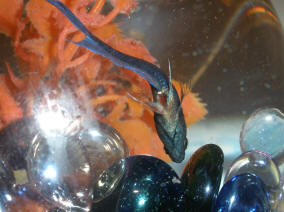
I first noticed the fine red line sprouting from underneath her 3
days ago.
Since then, the red lines are protruding a little further each
day and today she is having trouble keeping her tail from
floating upward. Since I got her two months ago she has had
trouble eating. I tried feeding her the
Hikari pellets but they seemed too big for her. I then tried
crushed up blood worms and she ate only those for about a month.
I was then able to transition her to Tetra Betta flake food and
that is what she has been on for about the past month, however
when she eats it is common for her to chew and spit it back up.
She has an appetite but has seem to have trouble keeping food
down from the beginning. I'm not sure her eating has anything
to do with the open area beneath her but I thought I would give
you all of the information I could think of.
Thank you for your time in evaluating her.
Michelle
<Michelle, to be honest this looks like an ulcer, i.e., an
open wound. In this case, the anus appears to have broken open,
and the red threads might be parasitic worms but could just as
easily be muscle fibres or something else. Difficult to say
without seeing the fish. In any case, euthanasia is the only
logical option here: I simply don't think this type of damage
will heal on a fish this small, though you could see a second
opinion from a vet.
http://www.wetwebmedia.com/euthanasia.htm
Do review the requirements of these fish: I mention this because
inexperienced aquarists often keep Bettas in tanks completely
unsuitable to their needs, and the result is invariably death by
some long drawn out
process such as this. So to recap: a Betta needs at least 5
gallons of water, preferably 8-10 if you want to make life easy
for both you and the fish. The tank needs a heater and a
biological filter, and that filter
needs to be maintained properly such that the bacteria are kept
healthy from week to week. You can't keep a Betta in a tank
without a heater (regardless of your room temperature, unless you
live in tropical Southeast Asia of course!) and you can't
keep a Betta without a filter. Use plain gravel for the
substrate, not glass marbles. Glass marbles stress fish because
fish aren't use to light bouncing up from below; plain gravel
makes a nice dark substrate and the fish will respond with better
colours and more settled behaviour. Water chemistry isn't
critical, but avoid very hard water; pH 6-7.5, 5-10 degrees dH is
ideal. There's no need to add salt to the water, but you
should always use dechlorinator. Kept this way, Bettas are
relatively easy pets. Kept any other way, and folks do end up
with the types of problems you're dealing with here. Cheers,
Neale.>
|
 |
My Betta is Listless and White
Another Sick Betta: Lots of Reading Needed. Betta Sys\Environment:
5/5/2009
<Hi Lynda>
This is my first Betta and I've had Jonah for one week.
He's in a 1 gallon plastic tank with gravel and a plastic
plant.
<Not the best environment for a Betta, despite what the stores tell
you.
Please read here:
http://www.wetwebmedia.com/FWSubWebindex/betsysfaqs.htm
>
I had been feeding him the flakes and he seemed fine;
<Another sore spot, They do need a varied diet. Please read
here:
http://www.wetwebmedia.com/FWSubWebindex/betfdgfaqs.htm
>
however, he was never very active and hung out near the gravel.
After six days the water became cloudy and I changed the entire
tank.
<Ammonia poisoning most likely, Read about nutrient cycling
here:
http://www.wetwebmedia.com/FWSubWebIndex/fwestcycling.htm
>
<Also, did you dechlorinate the new water before adding it to the
tank?>
The following morning Jonah appeared listless, staying on the bottom
and not moving.
He's also looks as though he's covered in white stuff.
<hmm.... Probably mucus from environmental causes: Read here:
http://www.wetwebmedia.com/FWSubWebindex/bettadiseases.htm
>
I went to the pet shop and they gave me something for the PH level and
a liquid for relieving stress.
<Likely useless>
I also heated the water by putting the tank on a heating pad and added
a 7 watt light on top.
<Good>
He still hasn't moved and hasn't eaten.
What can I do to make him better? Is it hopeless?
<Please read the above linked pages. There is a lot of information
posted on properly caring for Bettas.>
Thank you.
<My pleasure>
Lynda
<MikeV>
Re: Another Sick Betta: Lots of Reading Needed. Betta Sys\Environment:
5/6/2009
<Hi Lynda>
Thank you. I've spent time reading the pages you sent and now I
don't even know where to begin to try to save Jonah. He is still on
the bottom and not moving, and he doesn't look so white. His fins
don't look so great. They look thin and much shorter.
<Buy yourself a test kit for ammonia>
I did change some of the water - Brita filtered, (It sat for more than
a day.), added aquarium salt, and conditioner.
<Aquarium salt is pretty much useless.>
I think I'll need to get different housing. And here I thought
having a Betta was going to be easy and no trouble.
<It is still a living creature and does need proper care.>
How long should it take for him to get better?
<Impossible to say at this point.>
Is there any medication to help him? Is there anything else I can
do.
<No medication, do get a test kit and check his water. Do keep up
with regular water changes.>
I feel so bad because I ruined his life. He might have been better off
in the pet shop.
<Don't beat yourself up too hard. many Bettas die in transit or
in the pet shop. Plus, the perpetuation of the "myth of the Betta
in the cup." Keep reading and learning>
Thanks. I appreciate your sending me all that information.
<My pleasure>
<MikeV>
Sick male Betta fish 4/21/09
I have a sick male Betta fish. I just noticed today that his dorsal fin
(the one on top) is very short and has red sores around it. I think
this could possibly be fin rot, but I'm not sure. I did a complete
water change
and started using Bettafix. I'm not sure if the Bettafix will help
or just irritate his sores. I'm also not sure if it might be a
female Betta. Could you please help me? Thanks.
Sincerely,
Lisa
<Hello Lisa. I do need more information that this, specifically a
description of your aquarium (tank size, heater, filter) and water
quality statistics (at minimum, nitrite level). Almost all the
"sick Betta" messages we get come from people who are keeping
them in unheated tanks, or tanks without filters, or tanks that are too
small for Bettas. Contrary to what the sales drone might have
suggested, Bettas are actually fish.
Forgive me if you already know this, but some people who buy them
assume they're like some kind of pot plant or pet rock, and that
they don't need any of the other things fish need. In fact they are
fish like any other, and they need space, filtration, and heat. At
minimum, this means a 5 gallon tank, an internal filter of some kind,
and a heater that keeps the water steadily at between 25-30 C (77-86
F). Bettas cannot be kept in bowls. They will not live long without a
filter. And an angle-poise lamp or your home heating will not keep them
warm enough (unless of course you live in their native Southeast
Asia!). I'm almost certain your Betta has Finrot, and that's
almost always an environmental issue, caused by the aquarist keeping a
fish in poor conditions. Review and improve living conditions, treat
with a reliable Finrot medications such as Maracyn or eSHa 2000 (not
Melafix/Bettafix/Pimafix), and I'd fully expect your fish to get
better. In
the meantime, read here:
http://www.wetwebmedia.com/FWSubWebindex/bettasysart.htm
Cheers, Neale.>
Lethargic Betta 4/11/2009
Hi crew,
<Hello and Happy Easter,>
We have a Betta, Sin Mee, that until about 2 days ago was active and
had a good appetite. He would come to the surface at the side of the
tank where I was to be fed, and would attack the toothpick to get at
the blood worms or would aggressively take the pellet. However, about 2
days ago that all changed.
<Two things spring to mind. Firstly, how old is this Betta? Their
lifespan in captivity is often around 2-3 years, but that does rather
assume good conditions. In any case, as they age, their appetite
decreases, but
provided they eat every other day or so, this isn't a big deal. The
other issue is water quality. Because some people make the mistake of
keeping them in jars, cubes and other such boxes of water, Bettas are
frequently exposed to chronically poor water conditions. Just to recap:
Bettas need at least 5 gallons to do well (I don't care what the
sales drone said about a jar being fine) and that aquarium must be
filtered and heated, just like any other aquarium.>
He won't even eat the blood worms if they are right in front of
him, and he leaves the pellets. He often stays on the bottom or hidden
under the little plastic ledge that supports the cover to his tank. He
also hides under the plants.
<Need more data than this: what is, at minimum, the temperature and
the nitrite concentration? What sort of filter are you using? What is
the water chemistry? Though I hope you already know this, you should be
using dechlorinated tap water, and not mineral water, distilled water,
or anything from a domestic water softener.>
He now seems frightened if a finger is placed near him outside the tank
and becomes quite agitated. This is quite the opposite to his previous
behaviour.
<Does sound vaguely environmental; when water quality drops, fish
become nervous because they can't "escape" from the
ammonia or pH change that's "hurting" them.>
The tank is approximately a 20 cm cube.
<8 litres or 2 and a bit gallons; far too small for a Betta. How are
you heating and filtering this?>
We have had him for about 5 months and this is the first sign of this
sort of behaviour. We change the water regularly, replacing about 50%
each time.
<How often? Do understand that when Betta breeders keep their Bettas
in jam jars, they do so in HEATED rooms so the water is at the correct
25 C/77 F, and that the water is changed AT LEAST DAILY. This approach
makes no economic or practical sense at all in the home, which is why
you MUST have a heater and a filter.>
We rinse the pebbles in the bottom of the tank about every second water
change.
<What do you think that's doing? Why do you think that would
help? I'm not being sarcastic here, but trying to use the Socratic
teaching method to get you to think about what you're doing
scientifically.>
The pH is correct,
<Meaning...?>
and we have just obtained a heater as the temperature is starting to
fall with summer ending here in Australia.
<Good.>
We feed him about 3 or 4 pellets in the morning, or a similar number of
blood worm clumps on a toothpick. We give him a couple of pellets or
blood worm clumps in the late afternoon. About once a week we skip one
day of feeding.
There are no visible signs of anything wrong, such as no spots etc
Please help us as we are concerned for his health, and we don't
want to lose him.
Regards,
Ian
<The bottom line is I would fully expect this Betta to do well if
transferred to a heated, filtered aquarium. Where it is now, I doubt it
will last much longer. Your move. Do please read here:
http://www.wetwebmedia.com/FWSubWebindex/bettasysart.htm
Cheers, Neale.>
Betta Sorority with Ich: FW disease, reading
4/6/2009
Hi there!
<Hi Anitra>
I looked around the site and couldn't find anything specific to
what I was looking for since I have some parameters that leave me
looking for options besides the standard...
<Fire away.>
I have a 10 gallon heavily planted tank with a sorority of Bettas who
have come down with Ich.. I also have about 7 ghost shrimp in there as
well.
What is the best treatment option- since I have shrimp that are almost,
if not, impossible to catch and remove. Also, if you recommend aquarium
salt, what is the best dosage for curing, and how do I measure salinity
accurately during this?
<All answered on this page and the linked pages at the top:
http://www.wetwebmedia.com/fwsubwebindex/fwich.htm
Though with a planted tank, treatment is best done in a separate
tank >
Plants include Elodea, Anubias and various large leaf swords, along
with a plant that I can never remember the name to.
Temperature is currently at 80F and held stable. I can see the fish are
not comfortable- I have a feeling the Ich came in with my new batch of
ghost shrimp. I now see the reasoning behind quarantining- I just never
realized that ghost shrimp can be carriers, even if they can't be
hosts.
<Cysts can be transmitted by any wet object, thus the value of
quarantine.>
Any help is appreciated! Thank You!
<My Pleasure>
Anitra
<Mike>
Re: Fin Rot still... Betta hlth.
4/4/09
Ok, got it. No more meds for the guppies. But the Betta? He's a
beautiful half moon Betta, and his tail is splitting and ragged.
<Due to?>
True enough the Furanace hasn't worked and neither did the Maracyn
or Maracyn II. And maybe
the salt will help him, but I'm nervous to let it go. He's in
there by himself, so something has to be wrong in there. But as
you've pointed out, I'm at a loss as to what it is. I'm
doing my best by these guys and it's
really quite stressful that they're not healthy. What's the
aquaria equivalent of a "black thumb"?
Laura
<I would not treat this Betta. B>
Sick Betta Fish 3/30/09
My Betta fish is three years old possibly older he's always been
very big. For the past few weeks a lump has been growing on the
side of his body above the anal fin toward the back close to the tail
fin if that makes sense. it's starting to grow in the same place on
the other side of his body. it's a silverish white-green color. Now
he is also sitting vertically in his tank breathing hard. He swims to
the top of the tank for air then sinks back to the bottom. He has some
brown stuff hanging between the two ventral fins, but I think that is
just poop. I don't know what to do. I clean his tank once a week,
and he's been eating the same food for three years. Please
help!?!
Thank you, br /> Jessie
<Hello Jessie. Three years is a very great age for Bettas, and my
assumption would be in this case that he's simply getting old and
"bits" of him aren't working as well as they did once.
Since the lump here is growing close to the tail fin, and by that I
assume further back the pelvic fins, it isn't going to be
constipation. For obvious reasons, constipation occurs in the abdomen
where the guts are, between the head and the pelvic fins. The
part of the body between the pelvic fins and the tail is all
muscle. Any lumps that develop there are likely to be cysts
(which are harmless) or tumours (which are not). There isn't much
you can do about either. Stringy faeces on the other hand can be (and
usually are) caused by constipation. Constipation is dealt with by
abstaining from dried foods (including freeze-dried foods) completely,
and instead concentrating on cooked (or tinned) peas, live daphnia, and
live brine shrimp. All these foods contain a lot of indigestible matter
that helps clear out the alimentary canal. In fact, Bettas generally
are very prone to constipation because of the limited diet and minimal
physical exercise most specimens get compared to their wild ancestors.
So doing this every few weeks for a week at a time is a good idea
anyway. Cheers, Neale.>
Fat Betta? 03/24/09
Hi,
My question is about our male Betta who we have had for about a year.
He has become so fat that he seems to have trouble swimming.
<Not uncommon. For obvious reasons, Bettas in small tanks get little
exercise, so are prone to obesity just like people who stay indoors,
get regular meals, and don't do any exercise.>
I have cut him back to one pellet a day!
<Feel free to feed every other day until he starts losing weight. If
he's fat, he doesn't need food. Fish don't need to burn up
calories constantly to keep warm (like we do) so most species can go
without food for very long periods.>
And still he is bulging, I think the reason is that tiny ants have been
getting in the tank and he is eating them.
<Sounds possible. Stop feeding altogether and see what
happens.>
I am trying to solve the problem by skimming the water to remove what I
can but am worried about him overeating and me having no control. I
have fed him fruit flies but are ants good for him?
<Yes, provided they've not been contaminated with bug spray or
whatever.>
I plan to do a water change and general cleaning since I am worried
about the water quality now. He is in a 2.5 gallon tank with carbon
filter and BioWheel. He also never makes bubble nests except when we
first got him.
Is this normal?
<Yes.>
He normally knows that when we turn on the light its chow time and
lately he has been ignoring the signal.
<May simply be getting old. The lifespan of wild Bettas is about a
year, two at the most, and the captive bred ones are six months old
before you buy them (before then, their fins are too small to be
attractive). So at 18 months, yours is definitely well into middle age.
Cut back his food, because he doesn't need so much. As ever, review
water quality though, just
in case.>
We keep the light off because it heats the water too much. His water
temps are normally around 80-82. Thank you for any advice you may have
to offer.
<Hope this helps, Neale.>
Re: Fat Betta? 3/30/09
Thank you Neale for your response.
<Liz,>
I have not been feeding the fish at all for a week and he is still
big.
<As I said, if the bulge is on the muscular part of its body,
it's unlikely to be constipation.>
He is lopsided with the bigger bulge being on his right side. I have
not found any more ants in the tank either so I don't think he has
been eating anything. He generally is sitting around on the bottom and
is not himself.
<Old...>
I have put out a trap for the ants and moved the fish food in case that
was attracting them. We have 2 dogs and a child so no spray is used
inside the house. I believe they are ghost ants.
<I doubt these have been a factor either way, to be honest.>
When I cleaned the tank the pH was very low (around 6) and the ammonia
was slightly elevated. I changed one gallon of water out of the 2.5
gal. tank which brought the pH to about a 7 range on my color chart. I
scrubbed everything, changed the filter and rinsed the gravel too.
<Do take care not to over-clean the filter; the ammonia is likely
nothing to do with any algae you see on the rocks and such, but either
overfeeding or lack of filtration. In particular, over time water moves
more slowly through a filter as it gets clogged. There's a
crossover point where the flow of water drops below the minimum needed
to "clean" the ammonia
produced by the fish. Though this varies, the old rule of cleaning the
filter by rinsing the media every 4-6 weeks in a bucket of aquarium
water is a good idea.>
I don't know what else to do or not do. I was told at the store
where we got him and buy our water from that we can use Zephyr Hills
water for the Betta, they never told me that before?
<There's no need to use mineral or distilled water in aquaria.
Indeed, distilled water would be very bad, and water from a domestic
water softener almost as bad. Plain vanilla drinking water from the
kitchen tap (unsoftened, if you have a water softener) is ideal. Treat
for copper and chlorine just as with any other aquarium.>
Anyway we have such awful tap water here that I never use that in the
tank.
<How "awful"? Water from a domestic softener for example
would be far worse, being low in carbonates but high in sodium.>
I was going to give him one pellet last night but he wouldn't stay
up to the surface. He seems to wobble and swim like he is too heavy to
stay up. I have to leave at the end of this week for a week long
trip and am worried about what will happen to him in the care of my
husband.
<Suspect he's simply getting towards the end of his life. These
fish are little more than annuals in the wild, and given they are 6
months old before they appear in the shops, if you've kept your for
3 years, that's a MAJOR achievement. But no-one lives forever --
which is as it should be (segue to the 'Circle of Life'). So
enjoy what time you have with this old guy, and try not to be too
unhappy. When the time comes, you may decide euthanasia makes sense,
rather than letting him waste away or suffocate (if he can't swim
to the surface). We have an article on that here at WWM. It's an
overlooked aspect of caring for fish, the important bit about knowing
how to ease their passing, when the time comes.>
Thank you for your time and any advice you have to offer.
Liz
<Cheers, Neale.>
Re: Fat Betta? 3/30/09
Hi again,
<Hello,>
No the bulge is not in the body but just belly area like under the
gills.
<Ah...>
You didn't mention constipation to me before but if that is our
problem what do I do?
<My apologies; there were two bloated Betta messages today, and I
must have confused your fish with the other.>
This fish was purchased by me last March.
<Right, your fish is still comparatively young. The other fish was 3
years old.>
I know they don't live a long time but sure was hoping to get
results similar to my neighbors who have had Blue Bettas for 3+
years.
<Quite.>
I changed the filter cartridge but know to not scrub the BioWheel.
<Good.>
The other parts of the system had white deposits on them so I scrubbed
off the deposits as much as I could.
<The white stuff is lime; it's harmless, and gets left behind
from hard water after evaporation.>
The bulging of the belly is so acute that I see white between the
separate spaces of the scales.
<If this is the abdomen looking swollen, then yes, constipation may
be an issue. Much said about this on WWM, but in brief, stop feeding
dried foods (pellets, flakes, freeze-dried) and instead use cooked
peas, live daphnia, and live brine shrimps. Starving the fish a bit
will help, but you do need these fibre-rich foods to help. Epsom salt
at 1 to 3 teaspoons per 5 gallons can help, though in conjunction with
the fibre-rich foods, not instead.>
Liz
<Cheers, Neale.>
Bloated Beta (Another sick Betta splendens in an
unheated bowl and fed pellets...) 2/22/09 Hi
there, I've done lots of Google searches and read up on Beta
diseases but I can't seem to find an answer as to what I can do
for my fish. <Try searching with "Betta" not
"Beta". These are Bettas, not Betas, the name sounding
like the word "better".> I have 3 fish all in separate
bowls. <Bettas are fish. They need aquaria. If all you have is a
bowl, get some cut flowers. Seriously. The rate of mortality of
Bettas in bowls would sicken you. Any aquarium shop telling you
they are fine in an unheated bowl doesn't deserve your
custom.> I do not use aquarium salt (I never knew anything about
that), and the water in these bowls though not heated is kept
reasonably warm by the position they are in to catch the sun.
<Nope. Reasonably warm won't do, unless you live in the
tropics. If the tank isn't at least 25 C (77 F) all day long,
it's too cold. These are tropical fish, and like any fish need
a HEATED, FILTERED aquarium. If you aren't keeping your fish
that way, it WILL get sick.> Some months ago now my female beta
starting to get really fat. I was unsure if maybe I was feeding her
too much (I only give them 3-4 pellets twice a day, and sometimes
only once a day), so I reduced the amount I fed her. I tried to
vary the diet with freeze dried blood worms but they didn't
like them. <Avoid pellets. Use them as a treat, once or twice a
week. They are a notorious cause of constipation, likely the issue
here. Use (wet) frozen foods or live foods. Don't use freeze
dried foods at all (again, they cause constipation). If I fed you
dried or processed food all the time, you'd swell up like a
ball too! Fish are no different.> Now my female beta looks like
she has dropsy, she has this big massive ball just under her gills
(looks like a big puss ball that you want to pop with a pin), and
yet she's still alive. <Very sick; likely a combination of
constipation and systemic bacterial infection. Proper diet,
filtration and heating would fix/prevent this.> She's not
very active anymore, lies on the rocks all the time, and is off her
food. Is she going to die or is she just going to be sick all the
time? <Probably doomed.> Is it time to send her to her watery
grave? <Euthanasia doesn't involved watery anything.
Flushing dead fish into the sewerage system is one way to introduce
diseases into wild fish populations. Do see here for correct
methods of euthanasia: http://www.wetwebmedia.com/euthanasia.htm
> Now one of my male betas is starting to develop this same
disease. He's an old fish and he has had fin rot as he has not
top tail fin at all. <Not in the least surprised.> What is
causing my fish to get like this? <Not what, who! It's the
way you are keeping them.> What can I do to prevent it, and how
can I cure it in the meantime? <Keep them properly. Some great
articles here: http://www.wetwebmedia.com/ca/volume_5/volume_5_3/betta.htm
http://www.wetwebmedia.com/FWSubWebIndex/betta_splendens.htm
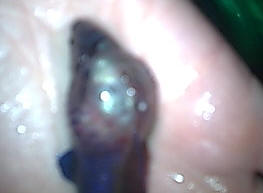
> Whilst this is not a very clear picture, this is what my
female looks like. That big ball you see is her stomach. It's
all grey and yuck. <Indeed.> Normally if I scooped her out of
the tank , like any normal fish she'd flip and flop about, but
she doesn't. She just lays there, I felt bad about having her
out of the tank to take a picture so I made it as hasty as I could.
<Dying...> Any suggestions? Can I get your BETA first aid kit
at any pet shop selling the fish in Australia? <My what? The
stuff you need is a 5-gallon (18-litre) tank, a heater, and an
air-powered sponge or box filter.> Many Thanks
Julie-Anne
<Happy to help. Neale.> |
 |
| Re: Bloated Beta (Another sick Betta splendens in an
unheated bowl and fed pellets...) 2/25/09
Thanks for your feedback. My only concern is that I thought I
couldn't have all three fish together because they fight and
kill each other. How do you put them all in a big tank and keep
them all alive without them killing each other? Many Thanks Jules
<Hello Jules. While female Betta splendens can be kept in
groups, males cannot. They will fight constantly. One male per
aquarium. Cheers, Neale> |
I have a question about my Betta.
Beh./sys./fdg./hlth. 02/08/09 Hi,
<Ave,> About a week and a half ago I bought my first Betta. He is
in a 2 gal tank with an under gravel filter, and a small heater. When I
first got my Betta, I noticed he was extremely sluggish, and that he
would not eat his food. I looked it up on line and decided to buy a
heater ( thinking that the temperature might be a problem). I have had
the heater in for 4 days now (the temperature is kept at
79°F), but he still rarely ever eats. <Ah, if kept
"cold" (i.e., below 25 C/77 F) for more than a few days, the
damage may already be done...> I also bought frozen blood worms,
thinking that the problem may be he just didn't like pellets.
However, this didn't help either. In the past couple of days I have
noticed that his face seems to be losing color. He is a bright red
crown tail Betta with very bright violet dots on his body and streaks
throughout his tail, however over the past few days his face is
increasingly becoming white. When I first bought him I noticed a few
dark spots on his body but thought nothing of. I have tried everything
I could think of, and do not know what else to do. The water was
treated with Top fin Beta Water Conditioner, and the aerator was ran
for about 2 hours before he was introduced to the tank. I am extremely
concerned about him. Earlier today I decided to put a mirror up to the
tank to see if he would even react to his reflection; he didn't. He
just laid at the bottom of his tank, nose down, like he usually does. I
rarely see him swim. Please help me, I don't know what the problem
is. Thank you, Mercedez (Texas) P.S. He is the only fish in the tank. I
was also wondering if it would be a good idea to get a snail to help
with the left over food. <There shouldn't be any leftover food.
Mercedez, it's almost certain there is an environmental issue here.
Very small tanks -- in the case of Bettas, anything less than 5 gallons
-- are difficult to maintain. While you sometimes here of them kept in
pots and jars, what you don't appreciate is that the water in these
containers is changed at least daily. Moreover, the room they're
kept in is a super-warm hot-house specially designed for keeping
tropical fish, so that chilling isn't a problem. Do a water test:
test for ammonia and/or nitrite, and then get back to me. Without that
piece of information, I can't say anything specific, though the
odds are that the fish is exposed to high levels of ammonia. Certainly
don't add any food! Read on WWM about cycling aquaria and
maintaining good water quality. I cannot stress this point strongly
enough: Bettas aren't novelties, they're animals, and like any
animal have a very specific list of requirements. Among them is heat,
clean water (i.e., zero ammonia and zero nitrite), and enough space
that pH remains stable between water changes. Always remember to use
dechlorinator, and never use water from a domestic water softener.
Cheers, Neale.>
Bubbles! On Betta... air 2/7/09 I had just
cleaned out my fish tank my Betta lives in and added the water
conditioner (since I use tap water) and now bubbles line the sides of
my tank! could it be because of the filter? I also noticed that my
Betta (Thor) has some bubbles on his fins and body that don't seem
to want to leave, perhaps I'm seeing it wrong and maybe its
'velvet'?? I've already lost 2 fish (Chaucer and Ophelia)
and I don't want t lose him! I have a 1 gallon tank and am also
wondering if I need a heater? <Yes you do... Bettas are tropical
animals...> in a tank that small, how much should I be
changing the water/cleaning the tank? K <Mmm, what's that famous
tag-line from Doug Adams "Hitchhiker" franchise?
"Don't panic!"... Very likely these are "just
bubbles" from the water change... I'd take ten (hours) off
here... and see what this fish looks like in the AM. Going forward,
it's best to mix up, store next weeks/times water change water in
advance, to allow for dissolved gas diffusion. Cheers, Bob
Fenner>
|
Betta Eye Problem, & Otocinclus sel.
f' 02/06/09 I bought my Betta about a
year ago. He is housed in a 10 gallon planted tank that he shares
with 4 Otos. I keep the temp at 78. The tank has medium lighting
(2 x 13 watt spiral CFLs) that is set for 10 hours a day. I use a
sponge filter and do weekly water changes of 20%. For food he
gets Betta pellets with occasional freeze dried blood worms and
brine shrimp mixed in (all Hikari products). He occasionally
munches on Oto algae wafers but spits most of it out. The
problem: My Betta has one white spot on each eye. The spots have
been there about a week, unchanged. The spots are opaque and on
the lower half of the eye. His eyes are not cloudy and the spots
are defined, not cottony, and it looks like they are on of the
lens of his eye. He does not show any sign of distress. He's
eating normal, normal behavior, normal eyesight it seems. The
water parameters are all good, ammonia 0, nitrites 0, nitrates 5.
Last PWC 20% on Sunday. When viewed under a magnifying glass, I
can see no swelling, redness, or movement of a parasite. Do fish
get cataracts? Could this be early signs of blindness? I have
attached a picture in the hope that it will help you diagnose the
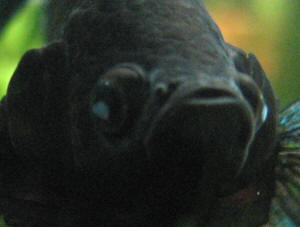
problem. Thank you for taking the time to read my email. Heidi
<Hello Heidi. Firstly, well done on keeping your Betta in a
heated, filtered aquarium of reasonable size! If only everyone
did that, there'd be a darn sight fewer sick Bettas in the
world. Now, do fish get cataracts? If we simply mean, can the
clear parts of the eye get damaged or turn opaque, then the
answer is yes. There are two main reasons. The first is physical
damage. If a fish bumps into something, or repeatedly jumps out
and hits the hood, is handled in a rough net, or is molested by
some other fish in the aquarium, the front of the eye can get
damaged, and the net result is the equivalent of scarring. Dead
white tissue forms a lump at the front, obscuring vision. The
second reason is infection, where the damage is caused by
bacteria or a parasite (e.g., Eye Fluke). More often than not,
this follows on from chronically poor water conditions, with
bacteria getting into the fish and causing harm because the
fish's immune system has been weakened. Now, I don't
think that's the issue here because your tank sounds very
good. Otocinclus are much more sensitive to water quality than
air-breathing Bettas, so if the Otocinclus are fine, the Betta
should be too. (As a side note, I'd not recommend keeping
Otocinclus in tanks 10 gallons or smaller precisely because they
are so sensitive to water quality.) There are some less common
reasons eyes become cloudy. One is malnutrition, specifically a
lack of Vitamin A. Again, I don't think that's the issue,
since the diet you're offering sounds excellent. Another
possibility is chlorine, which will cause this symptom among
others if not removed from the water. Assuming you're using a
dechlorinator, then this isn't likely. This leaves two
possibilities we can't do anything about: genetics and
senility. Bettas *are* inbred and genetically quite weak, and
there are lots of problems that they get that aren't obvious
when young but become more serious as they age. As for senility,
wild Bettas are basically annual fish. Since the fancy Bettas
sold in shops are about six months of age, your fish may well be
a year-and-a-half old already, if not more, if it was sitting in
the aquarium shop for a while. So it could be just plain old.
Sure, Bettas can live in aquaria for 2, 3 or more years, but
anything over a year from purchase and your fish is well past its
prime. Can anything be done? Not really; just as in humans,
damage to the eye doesn't usually heal without surgical or
pharmaceutical intervention, and that's not really viable
here. Since fish don't rely on their eyes to anything like
the degree humans do, if its vision is impaired, it will manage
just fine using its other senses, particularly its "built-in
radar" system, its lateral line. The one thing I would keep
alert for is how the Otocinclus behave. I have (repeatedly) seen
these fish attack injured fish, going for open wounds and grazing
on the blood. They may even cause these wounds directly.
Personally, I do not consider Otocinclus community fish, and
particularly warn against moving them with anything slow, e.g.,
Angels, Gouramis, or indeed Bettas. Cheers, Neale.>
Re: Betta Eye Problem 02/06/09 Neale,
Thank you so much for your prompt reply! It seems likely from
your description that either genetics or senility is to blame. As
I said, he does not seem to be bothered by the condition, but I
will certainly keep a close eye on him. I appreciate your advice
about the Otos. I was told by a trusted Betta website that Otos
would be ok with Bettas. To date, I have not seen them attack my
Betta whether he's been sick or healthy. They generally stay
away from him, as he likes to chase them away from his territory.
However, I will be much more alert to their behavior towards him
since I trust your experience in the matter. If I see that they
are giving him a hard time in any way, then I will find them a
new home. Thanks again, Heidi <Hello Heidi, I'm glad your
Otocinclus are behaving themselves. Some do, but some don't,
hence my warning. Good luck, Neale.>
|
 |
Sick female Betta 2/4/09 Hello, My name
is Leila, and thank you in advance for answering my question and for
making this wonderful site available. I know I'm supposed to do
research and read other people's questions before I write, and
I've never bothered you guys before, but the truth is I read on
your website on a daily basis and all of a sudden I have this problem
and can't find any relevant info, and I don't have any further
time to devote to it today and I need an answer. I have a female Betta
named Bruce, so named because I bought her in a cup and assumed she was
male... she is stunningly colored and has slightly longer fins than the
average female. I have had her for eight months or so; she was in a one
gallon tank for a long time, and I was finally able to upgrade to a
three gallon with a filter, and she seemed to love it. She is very
friendly, following my boyfriend around whenever he's near the
tank, and she has never even displayed signs of aggression. The tank
isn't heated, but the house stays really warm and she is in the
room where the heater is located. She seemed to be doing really well in
the new tank; her fins were a little ragged before due to poor water
quality, and they are almost completely healed now. Her color has
improved drastically. In fact, she looks like a completely different
fish. She's even grown, and she's become much more active.
She's spent a lot of time building a bubble nest (I know she's
not supposed to, but that is exactly what she's been doing) and I
saw she was ready to lay eggs... we thought of getting a male to breed
her with, but decided against it. Anyway, there are no other fish in
the tank; we've never had her with other fish. The only thing in
there is a live plant. We feed her a combination of flakes, which she
goes nuts for, and pellets. On to the problem: This morning I found her
laying on the gravel. I didn't think anything of it; she rests on
the gravel or in the plant at night and comes out when I turn on her
light. Well I just noticed awhile ago that she is still on the gravel.
She even floated tail up for a second and then went back to resting on
the ground. Her color still looks beautiful, but she looks as though
she is laboring to breathe. I thought at first this could be a water
quality problem but now I'm leaning towards some other explanation
because there's a part two to the problem: there is something in
the tank next to her...it looks like pink, slightly grayish clumps of
matter of some kind. It looks like gum. Or brains. I don't know
what it could be. I noticed a piece of it floating a few days ago, and
thought at first it was a worm but when I looked, it didn't appear
to be anything that was ever alive. I thought it was plant root or
something. Could she have a parasite? Or is this something to do with
her eggs? She still looks plump and healthy, with vibrant colors. My
boyfriend is on the phone with PetSmart, they said something about
impacted eggs, and that I may have to scoop her up and bring her to the
surface so she can breathe. Anything you folks can tell me will be
helpful. Thank you! Leila <Hello Leila. First things first, on
behalf of your fish, thanks for upgrading to a 3-gallon tank with a
filter. But the lack of heat may be an issue. Our idea of
"warm" isn't the same as that of a tropical fish. Bettas
need to be kept at 25 degrees C (77 degrees F) or slightly higher. It
is very doubtful your home is that warm, unless you live in the tropics
of course! You can use a thermometer to take the temperature of the
tank. Sticky LCD ones cost about a dollar and can be stuck on the side
of the tank and will immediately tell you the temperature. If it gets
colder than 25 C (77 F) then it almost certain the sickness is to do
with the lack of heat. The "stuff" on your fish's fins is
likely fungus or bacteria, and these are problems that often happen
when fish get too cold. For what it's worth, putting a heater in a
3-gallon tank is difficult, which is why I'd recommend nothing
smaller than a 8-10 gallon tank if at all possible. If you put a heater
in a tank that is too small for it, you run the risk of boiling the
fish, so shop very carefully. Here in England at least, the packaging
on heaters tell you the size of the tanks they're suitable for. I
actually think your fish is a male, as females don't build bubble
nests. Not all males have long fins; in fact wild male Bettas have
short fins much like the females, just with more colour. Anyway, to
recap, you [a] need a heater, and [b] will need to treat for Finrot and
Fungus. Bettas cannot be kept in unheated tanks or bowls at home.
Breeders keep them in fish rooms that are heated to 25 C or more, and
then the fish are fine because the water in the bowls gets to that
temperature. But there's no way your house is that hot, hence the
need for a heater. Cheers, Neale.>
my betas... Dis. -- 01/22/09 don't know
that you can help me with this but i have two male betas, in separate
tanks of course, I've had one for about 3-4 years the other about
2-3 years, both seem to just lay on the bottom of their tanks, one
looks rather fat in his upper area, the other i believe may have Ick
and I've been treating him but no response, can you help me save my
babies? <Hi Dawn. These fish are probably just getting old. Assuming
you're providing all the basics in terms of aquarium size,
filtration, heating and diet, it's unlikely they're
"ill" as such. Whitespot/Ick tends to move from newly
purchased fish onto existing fish. The parasites can't "lie in
wait" at the bottom of the tank for more than about a day, so once
you've killed Ick in a single aquarium, that's all you'll
see of it, unless it is reintroduced from somewhere else. If your fish
has Ick, then I wonder if you've used a net or bucket for
maintaining these Bettas that's also been used with a community
tank into which you've added some new fish? In any case, Betta
splendens is essentially an annual fish in the wild, and a lifespan of
three years is remarkable in captivity, and would tend to imply
you're doing all the right things. So unless you're sure
they're actually ill, I'd perhaps just accept they're
getting old, and will exhibit a variety of geriatric symptoms including
loss of colour and condition, loss of appetite, lethargy and so on.
There isn't much you can do save enjoy your fish while they're
still here. By the way, the name is "Betta", pronounced
"Better", from the native name for these fish. Cheers,
Neale.>
|
Betta Fin Fungus? 1/5/09 Dear Crew,
<Ines> I have read many of the threads on your website and
have found them extremely helpful, however I would still like
specific feedback regarding my Betta's fins. I have had my
Betta for 6 months, and have done my best to keep the water
quality good, though struggle at times to keep the ammonia levels
down (very frustrating, and I would like some feedback on this).
He has a tank with a carbon filter, is the only fish in the tank,
has a heater to keep the temperature stable, and I fed him twice
a day with both bloodworms and good Betta food (Aquarian brand).
About three weeks ago I noticed something white on his head that
surprised me (which is what lead me to your site). I checked his
water, and the ammonia levels were high (around 1.0mg/L)
<Yikes!> which alarmed me so I did a 50% water change and
sucked up all the gunk at the bottom of the tank. I did not give
medication since I didn't know what the white thing was I
thought it best to wait. <Ahh, you are wise here> I also
was going on vacation and the care of the fish would go to my
husband. The other thing I noticed is that the ph was very low;
my kit only measures 6.0 and up, and it was either at a 6.0 or
below. <How often are you changing water here? With water that
has some alkalinity... Should be every week> I realized that I
had not been measuring the ph consistently, taking for granted
that it would remain the same as when I got the fish since I
always get it from my tap and condition it with Stress Zyme--when
I first got him the ph was at a 7.4. Since I was going on
vacation, I felt I didn't want to start toying with the ph
and wait until I returned. <Also good> When I went on
vacation, sadly my husband was very careless. When I returned a
week later, the water was full of uneaten, toxic food. I
didn't want to check the levels because I could already tell
they were toxic and I just did a 50% water change (the same
procedure as before, this was done yesterday). The white thing on
his head was gone and I thought all was well. Today, however, I
notice this white stuff on his right fin and it appears to be
eating away at it. His appetite is normal, thankfully, but I am
alarmed at how quickly this stuff appeared (not there in the
morning), and I don't want his fin to disappear. I can see
that he is not using the infected fin as much as his good one.
I'm assuming it's fin rot, but it's white and I
thought fin rot is usually blackish. <Typically whitish...
fungal... like mushrooms... decomposers> I want to know what
is the best way to proceed. <Improve water quality>
Currently the ammonia level is at .25mg/L, which I will take care
of after I write this email. Nitrate is at 0, Ph is still at or
bellow 6 (I know I have to raise it, but I would like your
feedback on this as well). <Please read here: http://wetwebmedia.com/FWSubWebIndex/fwhardness.htm
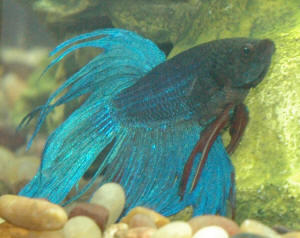
and the linked files above> In include a picture of the
infected fin, with also a white dot just above the left eye of
the fish that I also find suspicious. Thank you, I.G. <I
strongly suspect the root cause of the "disease" issues
here is environmental... with possibly some factor for "old
age" thrown in... I would review the area for Betta Systems:
http://wetwebmedia.com/FWSubWebIndex/bettasysart.htm
and the linked files above... and get on with a program of
consistent water changing... Not change all the filter media at
any given time, to preserve bio-filtration... Bob Fenner>
|
 Mmm, looks good to me. Mmm, looks good to me. |
|
Re: Betta Fin Fungus? 1/5/09 Oh, I forgot
to add that he's in a 3 Gal tank and the filter is a carbon
filter and bio wheel. <Mmm, strange that you should be
suffering ammonia anomalies with such a set-up... I would cut
back your feeding to once per day... And very little then... as
much as this fish will consume in a minute or so> I also
consistently add aquarium salt to his water <Ahh! I would skip
this... it might well be a factor in disrupting nitrification
here> and condition the water with Stress Coat at every water
change along with the Stress Zyme. <These are good products,
but may render a false positive for ammonia tests... Do
"experiment" here with them... a drop in some small
amount of water... test for ammonia... It should read as 0.0...
if not...> Thanks, IG <Bob Fenner>
Re: Betta Fin Fungus? Thank you very much for
your feedback. I do want to clarify that I do a 25% water change
every week regardless but maybe it should be more often? <Mmm,
no, not IMO... once a week is about right... I might be more
thorough though... perhaps half the water out, in order to
thoroughly vacuum the gravel... and... I would add some simple
floating plants here to aid in biofiltration> Should I reduce
feedings to once s day? <Yes> I will follow up on the links
you gave. Everything on this site is excellent and I'm
learning a lot, wish I had known about it before. I am currently
treating the fin rot with Maracyn. Is this a ok? <Mmm, yes...
though, your Betta (from your excellent pic) does look fine
health-wise> Will it harm my biofiltration though it claims it
won't? <Erythromycin generally does not... though it can
influence water quality in indirect ways... BobF>
Re: Betta Fin Fungus? Oops just replied to
the first email before getting the second. I will cut back on the
feedings for sure then to once a day. Should I use different
products than the stress coat/zyme? <No... these are fine...
However, I would pre-mix and store a good deal (maybe a gallon or
two) of new water for the week intervening... warm it with a bit
of new before using...> I will also see whether I'm
getting false positives for ammonia and not use aquarium salt. I
am confused about the salt being a problem since I thought it is
a preventative measure for maintaining a disease-free fish.
<Is a too-common "urban myth"> Would you help me
understand this? <Please search WWM... here: http://wetwebmedia.com/WWMAdminSubWebIndex/question_page.htm
with the string of words: "Salt Betta System" read the
cached views... Bob Fenner>
|
Re: Betta Fin Fungus? 1/7/08
Dear WWM Crew (Bob), <Hello again Ines> Thank you for
all the information and guidance. I wanted to give you an
update on the health of my fish. After two days of Maracyn
treatment, the fin rot on his right pectoral fin is gone.
He was listless two days ago when I last wrote and started
giving the Maracyn. His energy level is normal
now--he's a very curious and vivacious fish--and
he's using both his pectoral fins normally. <Ah,
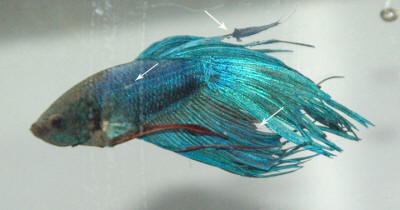
good> However, clumps of fin rot suddenly appeared
yesterday on his dorsal and anal fins. I also noticed a
faint white streak on his left side. All of these are
signaled in the picture I'm sending. I know the rot is
obvious but because it's new and these white
streaks/dots have come and gone over the past few weeks and
I don't know what to make of them. <Mmm, these sorts
of markings, indications of decomposition, are almost
always a result of water quality issues> They don't
seem like fungus because they seem to go away on their own
(granted, I'm not an expert). Could it be that my Betta
creates them by brushing against the sides of the cave in
his tank? <Mmm, doubtful> He is not darting around or
rubbing frantically. As for the new fin rot would the
Maracyn have treated the rot on the pectoral fin but not
the ones on his other fins? <No> I'm continuing
the course of the Maracyn, but I was wondering if I should
switch to Maracyn-Two or if these could be used
simultaneously. <These two Mardel products can be used
simultaneously. I used to help answer their 1 800 calls
years back> I checked the water chemistry, temperature
around 82, nitrite 0, ammonia .25 (again! I'm so
frustrated!) <This is likely the root cause of all
trouble here> so I added some Ammo-lock. <Mmm, not
really a solution... The cause/effect of the ammonia must
need be addressed. Please read here:
http://wetwebmedia.com/FWSubWebIndex/fwammfaqs.htm and the
linked files above, till you understand> It's
possible this is false reading, as you said, but what if it
isn't? <Is "burning" the fish if not> I
figured I shouldn't do a water change while he's
receiving meds. Oh, and I have decreased feedings to once a
day, small amounts since I last wrote. <Good> Thank
you for your patience and feedback! I want my fish to
recover from all of this. <Again, per your original
email... which I've just re-read, am very surprised to
find that you have ammonia present here with a BioWheel and
carbon use... BobF>
|
|
|
|
|
Betta Success
Doing what it takes to keep Bettas healthy long-term
by Robert (Bob) Fenner
|
|
|

