|
FAQs on Betta Diseases: Environmental 1 (the most common cause)
Related Articles:
Betta Diseases,
Betta Systems,
Anabantoids/Gouramis & Relatives,
Betta splendens/Siamese Fighting Fish,
Improved (Better?) Products for Bettas!,
Related FAQs:
Environmental 2,
Environmental 3,
Environmental 4,
Environmental 5, &
Betta Disease 1,
Betta Disease 2,
Betta Disease 3,
Betta Disease 4,
Betta Disease 5,
Betta Disease 6,
Betta Disease 7, Betta Disease 8, Betta Disease 9, Betta Disease 10, Betta Disease 11, Betta Disease 12, Betta Disease 13, Betta Disease 14, Betta Disease 15, Betta Disease 16,
Betta D
Disease 17,
Betta Disease 18 ,
Betta Disease 19,
Betta Disease 20,
Betta Disease 21
Betta Health 22,
Betta Health 23,
Betta Health 24,
Betta Health 25,
Betta Health 26,
Betta Health 28,
Betta Health 29,
Betta Health 30,
Betta Health 31,
Betta Disease Causes/Etiologies:
Determining/Diagnosing,
Environmental (By far the largest cat.),
Nutritional, Viral/Cancer, Infectious (Bacterial, Fungal) , Parasitic: Ich/White Spot, Velvet; Senescence/Old Age, Cures/Curatives/Treatments,
FAQs on Betta Medicines
Betta Medicines period, Antibiotics/Antibacterials, Anti-Protozoals (Metronidazole,
eSHa...), Copper, Formalin, Malachite Green, Anthelminthics, Organophosphates, Salts, All
Other Betta Med.s,
|
Bettas are tropical fish...
need consistently warm water (a heater) that
isn't too dirty (filtered) in a sufficiently
stable (few gallons) system, with suitable water
(medium hardness, pH.. not usually "bottled").
Without these yours won't live very long or
well.
|
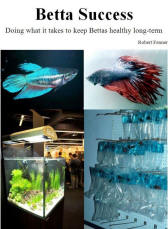 |
Betta Success
Doing what it takes to keep Bettas healthy long-term
by Robert (Bob) Fenner
|
Emergency, Please help... env./sys. heat/er
4/9/10
Hello
I have a very sick Betta on my hands and I don't
know what to do.
<Oh dear!>
He lives in a 5 gallon tank alone with a filter.
<No heater? Almost certainly the problem here. Contrary to popular
myth, unless you're keeping your Betta in a room where the ambient
air temperature is a stead 25 C/77 F or higher, Bettas cannot be kept
at room temperature.>
I feed him BettaMin flakes and blood worms.
<Good.>
About 2 weeks ago he had Ich (or what looked like Ich) so I added
aquarium salt and kept his water warm and it seemed to go away.
<OK.>
He was fine, but I noticed he was twitching more than a fish should.
Then I found a fungus in his tank which seemed to grow literally over
night, and moved him into his temporary 1 gallon tank until I could
clean the 5 gal. I noticed his belly was swollen and thought it might
be constipation so I fasted him for a day and it went away that
fast!
<Low temperatures slow down bodily processes, including resistance
to disease and digestion of food.>
But the twitching got worse. I shone a flashlight on him and checked
for gold sparkles (the indication of a fungal infection) I saw there
were some sparkles so I got Pimafix antifungal fish remedy and have
been giving it according to directions for 2 days.
<Tea-tree oil medications are fairly lightweight medications and not
at all reliable.>
The twitching is at its worst!!! He can't control where he goes, he
bolts like he's chasing something but I don't think its
intentional. It looks very laborious for him to even swim to the
surface. he likes to lay on the bottom and squeeze under things like
plant bottoms and his gravel. I'm not sure why.
<Environmental conditions.>
I was just watching him and he came and settled near me then all of a
sudden his gills opened and air bubbles came out and he dropped to the
bottom of his tank and laid there. Then he gets up and has a twitchy
fit then stops swimming... then fit... then rest.
<Oh dear.>
I really don't think the twitching is intentional. When he was in
his 5 gallon tank he had such a bad fit that he jumped out of the tank,
skipped across the water and landed back in the tank. I don't know
what to do. I've looked everywhere and there is nothing on this
sort of Betta turrets. I've done everything I can think of and
nothing seems to help.
<Install a heater. Hopefully it isn't too late.>
I'm not sure if he will make it till morning. He's still young!
My other Betta lived for 3 years and he lived in a tiny vase...
<You got lucky. In terms of cold, hard science, Bettas need a
heated, filtered aquarium. It's kind of like stories of people who
live to be a hundred despite brushing their teeth with vodka and
smoking 100 Marlboro a day. Yep, those folks are out there, but doing
that yourself surely wouldn't guarantee long life and happiness.
Same with Bettas. There are a few people who keep them in jam jars and
feed them nothing but breadcrumbs and they do just fine. But the vast
majority of Betta problems come down to people keeping them in
unheated, unfiltered jars and bowls. Install a heater, check water
quality is adequate (0 ammonia, 0 nitrite), and make sure water
chemistry is appropriate (slightly soft to moderately hard, around pH 7
is ideal). Make sure the tap water you use is properly
dechlorinated, if necessary treated for chloramine and copper.
Don't use deionised water or water from a domestic water
softener.>
Please help!
Thank you so much!
-JJ
<Cheers, Neale.>
Re: Emergency, Please help 4/9/10
Thank you so much for your prompt response!
<Happy to help.>
I just went to check the temperature. My heater is VERY unreliable...
it never gets more than 80 degrees but only if I make it that warm, it
generally stays
between 71 and 75 because my apartment is ridiculously cold.
<Get a better heater. The low-end brands are often unreliable, so
it's well to keep the receipt. If the thing isn't working
properly, take it right back and get a new one. Mid and high-end brands
such as Fluval, Hydor and Eheim are well worth investing in. Heaters
are among those items we take for granted, and if made well, last for
many years, 10 years or more. But a flaky one can cause all sorts of
problems, especially in a small tank. A stuck heater in its
"on" mode can boil your fish, especially in tanks as small as
5 gallons that will warm up very quickly.>
When he is sick I gradually increase the temperature to 80 degrees to
help him get better. Could this be harming him?
<No; the optimal temperature range for Betta splendens is between 25
and 30 degrees C (77 and 86 degrees F).>
I try to do it over the course of 12 hours... I know abrupt changes can
stress them, is that too abrupt?
<Potentially.>
I'm not sure why my previous Betta did so well... I was an unruly
high schooler and didn't take care of the poor thing except
changing his water and feeding him... he was a wonder fish! Probably
brushed his teeth with vodka... :)
<Indeed! Like any animal, Bettas are genetically varied, and so what
doesn't seem to harm one specimen can stress or kill another. So
aiming for the optimal conditions in terms of heating, filtration and
aquarium size will zero out the variance, and ensure your Betta does
well.>
I did a 25% water change on the 1 gallon tank just a few hours ago, its
been 3 days. I use some Betta brand de-chlorinator always, but we do
have VERY hard water.
<Hard water does Bettas no harm. If you want, and it's
economical to do so, mix hard tap water 50/50 with deionised water. But
it isn't necessary.>
I didn't think about that harming him. I have a Britta water
purifier... would water from that be better or worse?...
<Simply a waste of money.>
I'm not sure if that's what you mean by domestic water
softener...
<Some people have domestic water softeners connected to their
household water supply. This is to remove hardness and so prevent
kettles and other appliances from being damaged by lime scale build-up.
Without exception, if you have such a unit, don't use the
domestically softened water but instead use the unsoftened water
(usually a drinking water tap in the kitchen). The problem is that
people think domestic water softeners make soft water, but they
don't; all they do is replace lime scale-forming minerals with
minerals that don't, typically sea salt.>
When I was changing the water (very carefully to not stress him) I
noticed that he expanded his gills a lot. And usually his fits were
preceded by an expansion of his gills and a rush up to the surface for
air... then fit.
<Could be a reaction to dramatic pH changes, or to chlorine in the
water.>
He keeps going to the bottom and opening his gills (unintentionally?
maybe maybe not) and letting the air go and he thuds to the bottom.
Should I be concerned that this is just because of the temperature or
should I look into gill parasites, as he had Ich 2 weeks ago...
<More likely to be environmental. "Gill parasites" is a
fairly vague concept you come across a lot on tropical fish forums but
it's actually pretty rare. Most fish with damaged gills are damaged
that way because of environmental stress of one sort or
another.>
Should I continue the fungal treatment? He doesn't seem to have the
gold shine anymore, and I know you said the medication is pretty...
iffy.
<Always best to finish the course of medication as prescribed on the
box. If nothing else, it gives you peace of mind that you've
treated one possible problem completely, so you can tick it off the
list of possible problems. Pimafix is "iffy" only because it
isn't a reliable cure for Finrot or Fungus, but it is a reasonable
preventative, and in itself not toxic.>
Could it hurt him to continue?
<Unlikely.>
I just want to make sure its gone. I'm going first thing tomorrow
to get a better heater... but if I keep it at say 78 degrees and he is
still having twitchy fits and these weird gill behaviors, what do you
suppose I should do for him?
<Before anything else, test the ammonia and/or nitrite levels in the
tank.
Let's be sure the filter is doing its job. Nine times out of ten,
fish are sick because the filter isn't working properly. If you
don't have an ammonia or nitrite test kit, have the pet store test
the water. Any non-zero amounts of either can cause fish to
"flick" their gills and generally look sick.>
Again, thank you so much for your quick response. Its put my mind at
ease... at least temporarily.
Thanks!
-JJ
<Cheers, Neale.>
Re: Emergency, Please help... Betta, heater...
4/10/10
Thanks again for the great response.
<Happy to help.>
I was preparing his 5 gallon tank so I could put the new reliable
heater in and it could stabilize him. I ran into a HUGE problem...
maybe I'm just not meant to have a fish?
<Unlikely.>
After I took out some water and put new water back in, the filter
stopped working. It was just buzzing but not pumping water.
<Most likely clogged. Small filters quickly become clogged, and
rinsing the media is often a weekly chore. Often ignored, but just as
important, is to check that the slots in the filter casing aren't
blocked, and that the impeller (the whirling pump thingy) is clean as
well. Instructions on how to open and clean your filter should come
with your filter, but can often be found online via the
manufacturer's web site. Often the impeller sits in a little recess
and you need to flip up a trapdoor to get at the impeller and clean out
any muck in there. Obviously, unplug the filter while servicing
it.>
I left it on thinking it might start working after it warmed up. I left
it running and came home to find the loudest buzzing noise filling the
whole apartment. I unplugged the darn thing, which still has yet to
start filtering the water, and looked at it. There's no visible
malfunction...
<Hmm... when filters are buzzing, or for that matter any electric
appliance, leaving them plugged in is not a wise move. Buzzing comes
from two likely sources: a jammed motor or an electrical short circuit,
neither of which gets better by itself!>
I still have Klaus in the 1 gallon tank at 80 degrees... should I put
him in the 5 gallon without the filter?
<Short term, yes, you can get away without a filter but you'll
need to be doing 50% water changes daily until you buy a replacement
filter or figure out why the present filter isn't working.>
I don't want to keep him in that small tank but the 5 gallon, even
after the 50% water change, is in need of filtering.
<Indeed.>
Thanks so much... this is the only site I found that has been able to
help me with this.
-JJ
<I cannot stress too strongly the importance of buying good quality
hardware rather than the cheapest. If money is tight, air-powered
filters are inexpensive and reliable, if noisy and in need of (no more
than annual)
replacement of the rubber diaphragm in the air pump. An air pump
driving a simple box filter or sponge filter will work well in a small
tank and keep a Betta happy. Because air pumps are interchangeable, if
one dies you can always replacement it with another one without having
to lose your filter and filter media. Motorized filters have more to go
wrong, so buying a reasonably good quality unit is sensible. At their
best, units like the Eheim Aquaball will operate for ten years or more
without anything other than periodic cleaning. Cheers, Neale.>
Re: Emergency, Please help... Betta hlth.
4/12/10
Thank you for all the great help.
I'm not sure what happened... The day after I received your reply,
he stopped twitching. But he was really lethargic.
I checked the ph in his water. Everything except the, I think it was,
Nitrate was all in the "good" level. But he had stopped
twitching. I just got the 5 gallon fitted with an appropriate heater
and everything is working, so I put him back in it, but I noticed he is
missing a scale and has brown lumps all over his face. Is this from
running into his plant or glass when he had a fit? He hit his plant
really hard a few times when I was watching...
Is this all from the same thing or are a bunch of different things
happening to him? I'm almost done with the fungal treatment...
chemicals in his water are at the "normal" or
"good" levels... the tank is at 79 degrees... Am I missing
something?
Thanks so much... I wish he'd just get better :S
-JJ
<Don't tell me you think the levels are "good" or
"normal". Your opinions and mine might be very different.
Send me instead the pH, hardness, ammonia and nitrite (with an
"I") levels. Nitrate (with an "a") is generally
unimportant in freshwater fishkeeping so long as it isn't insanely
high.
The brown blotches aren't likely to be physical wounds but sound
more like ammonia burns. I cannot stress too strongly that the chances
are very good that environmental shortcomings are causing the problems,
and without
ensuring good conditions, medication is worthless. For a recap, for a
Betta you're after the following: 0 ammonia, 0 nitrite, less than
50 mg/l nitrate; pH 6.5-7.5; generally hardness "soft" to
"medium hard", i.e., 5-15 degrees dH. All new tap water
should be treated for chlorine, chloramine and ammonia. Cheers,
Neale.>
Re: Emergency, Please help... Betta hlth., test strips...
4/12/10
Oh no, the "good" and "normal" aren't my
opinions. That's what the meter said...
I bought those little strips and that's all the info they give...
there's some numbers at the top but it doesn't say what they
mean per chemical.
<Can you send me a photo of the carton/label so I can see these
numbers?
Really, these values are meaningless. A "good" pH for Discus
would be a "lethal" pH for Mollies. A "safe" level
of nitrate for Goldfish would be a "deadly" level of nitrate
for Tanganyikan cichlids.>
You just compare the coloring on the strips to the various shades
given, and it tells you if something is too low, good, too high, or
dangerous. Not the most sophisticated, but really its all I can afford
at this point.
I checked and the ammonia levels were normal... according to the
strip.
<One thing that concerns me is that some folks believe
"low" levels of ammonia are safe. They are not. The only safe
ammonia level is zero. Even 0.25 mg/l can cause problems.>
And I do treat the water every time I change it or add some... Its a
water treatment specifically for Betta's for chlorine and all those
other chemicals, and I put aquarium salt in it too.
<Salt is largely pointless in freshwater fishkeeping, though it can
have some occasional purposes. Do read:
http://www.wetwebmedia.com/FWSubWebIndex/SaltUseFWArtNeale.htm
>
Maybe the strips are wrong. Ill check it again, but if it is ammonia,
what should I do?
<If you have non-zero levels of ammonia, that means the tank is
either overstocked or under filtered, or the fish is being overfed.
Don't feed the fish, and review the tank. Make sure the filter is
adequate to the task and correctly maintained (e.g., you aren't
washing away the bacteria by rinsing media under a hot tap).>
Is the water treatment the only thing?
<Water conditioner can be critical, yes. Most brands remove
chlorine, but not all remove chloramine and ammonia from tap water,
both of which can occur in some water supplies.>
Because I do that with every change...
Thanks for your help
-JJ
<Cheers, Neale.>
|
Betta sick and new tank syndrome -corrected spelling,
sys. f' - 03/28/10
Dear WWM, 3 weeks ago, I bought a Betta from a "dollar
store" who told me all this junk about Bettas needing no
care, and I am hoping he doesn't die while I learn how to
care for him.
<Let's hope!>
I admit to doing many wrong things (small bowl, changing water
constantly, no heater/filter etc) initially and your website has
been great.
<Good to hear.>
Currently, I have him in a 3.5G tank (cycling a 5 gallon for him
to use eventually), with a carbon filter and heater at 76
degrees, gravel, several plants, tsp Aquarium salt, wonder shell,
and conditioned, bottled spring water (plan to slowly change to
conditioned tap).
<The "wonder shell" is a waste of money, and yes,
switching to tap water with water conditioner is a good idea.
Aquarium salt is far less useful than many suppose, but while
water quality is poor, it can be helpful. But there's no need
to use it all the time. Do read here:
http://www.wetwebmedia.com/FWSubWebIndex/SaltUseFWArtNeale.htm
>
Last week, I went away for 3 days, and my roommate accidently
overfed him.
<Yikes! Now, just for next time, you can leave a fish without
food for 7 days without the least concern. Indeed, most healthy
fish will last two weeks without food and not bat an eyelid. If
you must leave some food out, measure out the food ahead of time
and HIDE THE REST OF THE FOOD! Have you ever seen those little
medicine boxes people have labeled with the days of the week? Has
a compartment for each day? These are really good for this sort
of thing. Stick the right amount of food in each compartment. Put
HALF as much as you normally feed the fish, just to be on the
safe side, and allow 2-3 days between each meal. So if you're
gone for two weeks, fill just 4 or 5 compartments. Why? In case
your babysitter is a total idiot and decides to throw everything
in at once. With minimal food in the boxes, the risk to your fish
is reduced dramatically. But as I say, unless you're gone a
real long time, it's best to leave your fish hungry.>
Came back to listless fish with high ammonia; treated immediately
with Amquel . Did complete water change and am working hard to
get environment right. Currently in 3.5 g tank -ammonia-0,
nitrates 0.5ppm,
<Not good, but not lethal.>
nitrates 5 or 10ppm (hard to match the color on the card) , PH:
7.8, changing 20% water every day. Feeding him 1 Hikari pellet
and 1 dried blood worm every other day. He is currently active,
curious, nosy and eating, but weaker than before. Have 2
questions:
<Fire away.>
1. I enclose a picture of these reddish brown marks on his face
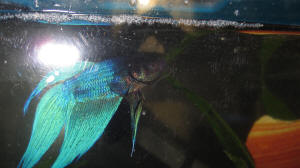
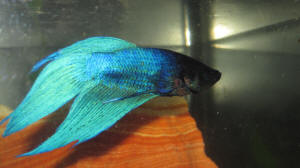
and gills, and gill damage. There is what looks like dark purple
coming from his gill area. Is that probably ammonium burn/damage,
or some kind of infection ?
How should I treat that ? I did a Methylene blue dip yesterday,
but am cautious about treatment when I don't know what it is.
I have Furan, fishcycline, fungus eliminator, Methylene blue,
fishcillin.
<He looks fine. I wouldn't treat him at all. Observe, and
maybe carry on using the salt as you're doing. But I
don't see any sign of Finrot or Fungus.>
2. I currently have him in the 3.5 gallon tank, while waiting to
cycle the 5 gallon (with sponge filter) using fishless cycling
(using fish food). The 3.5 gallon tank is still cycling also
(pretty much from last week due to be doing a couple of complete
water changes where I ignorantly scrubbed everything down, and my
doses with Furan etc). Which option would you recommend- keeping
him in 3.5G tank (easier to change water daily) until 5G tank
completely cycled, or move him to the 5G tank now, or doesn't
it really matter.
<Can you not move the filter from the 3.5 gallon tank to the 5
gallon one?
If you can, just do that, and off you go! If needs be, take the
media out of the mature filter and stick in the new filter. If
you want both tanks running, perhaps to stick some Cherry Shrimps
in the 3.5 gallon one, then divide the mature biological media
50/50.>
3. I'm concerned about the 0.5 nitrites in the 3.5G tank.
What would you recommend me do ? e.g. treat with Amquel again,
keep doing 20% daily water changes.
<Do a 50% water change and then don't feed at all for a
couple of days. If the nitrite drops to zero then, you should be
fine, and can return to normal maintenance (including feeding and
weekly water changes). Check you
aren't overfeeding, and check the filter is mature (this
takes some 4-6 weeks). Make sure you aren't over-cleaning the
biological filter media: these should be, at most, rinsed in
aquarium water or under a luke-warm tap, never hot water.
Don't waste filter space with Zeolite or carbon; it's
biological media, like sponges and ceramic noodles, you
need.>
4. When ready to transfer to the 5G tank, what media would you
think useful to transfer with him e.g. gravel, etc. I do plan to
transfer the plants. Is there anyway to speed up the process ? I
haven't been able to get bio Spira
from the LFS; do those bacteria starting kits they want to sell
work ?
<No, the bottles of bacteria are basically useless. The best
approach is to move the mature biological media (inside the
filter, typically sponges or ceramic noodles) from the mature
filter on the 3.5 gallon tank and install these media in the new
filter on the 5 gallon tank. You may even move the whole filter
across. Gravel contains only a little bacteria, so while yes, it
helps, it isn't an instant fix. Plants similar.>
4. Anything else about his care you would recommend ? I'm
quite attached to him and hope to make him as comfortable as
possible.
<I think you're doing the best you can. Keep reading WWM,
and if you have any questions, write back!>
Thanks,
Natalie
<Cheers, Neale.>
|
  |
|
Betta sick and new tank syndrome -corrected spelling
4/12/10
Dear WWM,
<Hello,>
So, I've finally gotten both nitrates AND ammonia to 0 levels
in my 3G tank, and my Betta, sushi, is happy and thriving. Still
have to change 15% water every other day though.
<If this was a 5 or 8 gallon tank, water changes once a week
would be fine.
This is precisely why small tanks are a waste of money; creating
the good conditions a Betta needs in a "jam jar" the
size of the tank you have is a lot of work. Buying a slightly
bigger tank may be more expensive, but as you'll eventually
see, it's a much easier way to keep your fish.>
I've still trying to fishless cycle my planted, 5G tank for
him, using the fish food method, as it has been difficult to get
access to pure ammonia.
Put powdered fish food every other day, watching the ammonia go
up steadily...then plateau at 0.25. Nitrites 0.25.
<OK.>
What I have now is lots and lots and lots of what looks like
little tiny snails (size of a speck), sediment (I think fish
food) floating around the tank, and little white worms in the
water, in this new, empty tank I'm trying to cycle. Is that
ok ?
<Yes. These are likely nematodes, and mean you're probably
adding a bit too much food. They're harmless, but once you
have the fish installed, go easy with the food for the first few
weeks, and with luck the nematodes will die back a bit.>
What should I do ?
<Nothing much.>
Thanks so much for your advice,
Natalie
<Cheers, Neale.>
|
Unable to determine what has my fish down... Betta
hlth./env. 2/22/10
I feel obligated to start off by telling you I am a college
student.
<Uh-oh...>
Four months ago (and several years into my schooling,) tired of being
petless, I decided to get the only thing allowed on campus.
<Now the reason I said "uh-oh" is because we get a *lot*
of messages from students with sick fish, and almost always, the
problem is that the fish was given poor quality housing and care. I
know it is incredibly tempting to keep a pet in a dorm room, but it is
actually very, VERY difficult to do well, especially on limited
funds.>
I know because of my limited funds and space I do some things that
aren't "by the book," but I do the best I can for my
half-moon Betta.
<Sometimes the "best you can" isn't enough. The
problem is that science is not kindly or flexible. If a Betta needs a
minimum water temperature of 25 C/77 F, then that's non-negotiable.
A Betta can't live without a heater because you can't afford
one. In other words, it's the difference between a requirement and
a recommendation.>
I did my homework before deciding to get him though. I settled on a
Betta because they are hardy and I figured he would be the best shot at
surviving college life.
<What homework did you do? Who told you Bettas are hardy? Or they
could live in 1 gallon of water without a heater or filter? If you
turned in a term paper with that level of research, you'd fail!
Bettas *are not* hardy, they *cannot* live without heat and they
*cannot* be kept in unfiltered tanks unless you're doing 100% water
changes daily. There's a huge difference between how breeders
maintain them (in specially heated fish rooms kept at 25 C/77 F) and
how aquarists keep them (in tanks in normal rooms).>
He lives in a 1 gallon tank with a live plant on my desk.
<Too small.>
(Originally my dresser, but the opening and shutting of drawers was too
stressful, so I moved him to his current location months ago.) The tank
originally had a filter, but freaked him out.
<Clearly the wrong type of filter, but almost any filter would cause
too much turbulence in one lousy gallon.>
Once I removed it he quit biting his tail and that seemed to solve that
problem. However, without a filter, I have had to do weekly 100% water
changes.
<Daily!>
I recently read that is never a good idea.
<What are you reading? Wikipedia? Seriously, I'm a college
professor some of the time, and if a student handed in these sorts of
observations in their essay, I'd be very concerned.>
I could buy a turkey baster and try and suck water out and replace what
I have taken to be more effective perhaps. The current drill is: scoop
out a little of the water using the container he came in.
<No, no, no...>
Pulling out the plant so it will make catching him a quick process and
least stressful as possible.
<Bet the plant loves that. What sort of plant is this? Likely dying
anyway, if it's kept in cold water and constantly uprooted and not
supplied with anything other than ambient room lighting. Shops will
often sell what are truly house plants to unsuspecting aquarists, and
these may linger for weeks, but eventually die.>
I use a net to catch him and put him in the small container, just for
the water change. As probably any fish, he doesn't like this, but
once I have him in the net he freezes. My Betta is truly his own
character!
<That's called terror, not personality.>
I then take the tank, with a colander, and plant to the bathroom where
I place the colander in the sink. It rests on the outer edges so the
bottom doesn't touch the sink. I pour out the water & the
colander catches the decorative pebbles. I rinse the tank out and scrub
it well. I don't use soap because I'm not sure if that will
have negative effects on him once I return him to his environment. I
then move to the pebbles and using warm water move my fingers through
it thoroughly washing the rocks & dislodging all of the old bits of
food. I move to the plant and wash off the leaves and roots. If any
edges look brown I cut them off with a pair of scissors.
I then return the rocks to the aquarium and put the plant back in
place. I fill the tank up, trying to get it as close to room
temperature as possible. If I don't do a good job at guestimating I
wait for it to get there on it's own before returning my beta to
his home. I add water conditioner to the fresh water. I scoop him out
of the container with the net and return him to the tank. I pour the
old water down the sink and let the container air dry. Maybe I should
wash it out and dry it? I usually am able to Google all of my questions
& find the answer.
<Here's where you're going wrong. Any bozo can publish any
old thing on the Internet. Google doesn't put alongside its search
results anything about the *quality* of the site. There are lots of
idiots out there who will tell you Bettas can be maintained in empty
baked bean cans and need only be fed once a month. They are of course
wrong, but that doesn't mean Google filters them out of its search
engine. You have to be intelligent. One of the things that drives me
nuts about my students is this phobia about books. I have a skit where
I explain to them where you find them, how they work, and how to search
them. Some students get cold and start shivering in libraries and
bookstores. It's quite strange really. Anyway, my point is that the
Internet is a good source of information only if you're
critical.
That's something as a college student you'll learn the hard
way, but for now, let me just tell you that you need to buy a book on
tropical fish, or borrow one from a public library, and read the thing.
Cover to cover.
Amazon.com sells used books for literally pennies, and we suggest and
link to some here:
http://www.wetwebmedia.com/fwsubwebindex/bookswwmsugg.htm
You're doing everything wrong, and that's why this fish is
sick. Something like "A Practical Guide to Setting Up Your
Tropical Freshwater Aquarium" would be very, very useful. Used
price, one cent.>
However, his condition now seems to be so specific to my lifestyle
& his symptoms that I have been unable to successfully diagnose
what is wrong with him.
<Hmm...>
It's been a little over a week and my Betta has been lethargic.
<Too cold. Tropical fish are from the tropics, which means they need
tropical temperatures. In most cases, that's 25 C/77 F, but for
Bettas, they actually prefer things a little warmer, 28 C/82 F being
ideal. When kept too cold they gradually lose "condition",
and eventually their digestive and immune systems pack up, and they
have problems with maintaining weight and fending off disease.
Eventually they die. So, just to recap, if you don't have a heater,
you can't keep a Betta; simple as that.>
He usually is more active and loves to swim around the open space of
his tank and nestle in his plant. He dances when I play fast paced
music and watches tv with me. I usually know I've made conditions
great when he builds a bubble nest & know when I need to help the
little guy out when he bites his tail. Well, his tail is at full
beauty, but he's been lying at the bottom of the tank, sometimes on
his side, more than ever.
<He is dying... you are killing him.>
I don't think it's because he's tired & just can't
shut his eyes any more.
<What?>
I thought it was because he was cold out, but it's warmed up
recently and he still is not himself. (The room is heated, but it is an
older building and is somewhat affected by the weather. The 45 degree
weather outside makes the indoor condition closer to 68 degrees than
his balmy 72.)
<To a Betta, this is still freezing cold. Please do read about the
needs of animals before you buy them. If you aren't prepared to
give an animal what it needs, then don't keep it. There are all
sorts of electronic pets out there you might find easier to
keep.>
He has a bulged belly so it might be constipation. I feed him 2-5
pellets of Aqua Culture's Betta Pellet Food to him every day. I
settled on this number because of such discrepancy on the internet.
<Again with the Internet... please try a book, or at least a site
like this written by people who write books.>
I went with a median because I was worried about over-feeding. Although
today he wouldn't eat. He also had a small white patch near his
gills, but this does not seem to be dominant. I added Betta Revive when
I was worried about it & it has since seemed to go away.
<Futile. Like giving aspirin to a person with hypothermia.>
He still is lying around though. I added Epsom salt today & while
he hasn't perked up--or pooped to my knowledge--he has relocated.
He is now resting at the top of the plant.
<Why Epsom salt? See, you're randomly doing stuff without
thinking about why.>
I don't test his water.
<Likely too depressing.>
I don't have a heater.
<Essential.>
Should I test his water? Should I put him on a fast? At the end of
which try to get him to eat a properly prepared pea? Do you have any
idea what could be making my little guy feel bad?
Best,
--Gatsby Owner
<Gatsby needs to be looked after, not owned, and you're not
looking after him. Do read here:
http://www.wetwebmedia.com/FWSubWebIndex/bettasysart.htm
Essentially, the basic reliable set-up would be a 5 gallon tank with an
air-powered sponge or box filter, plus a heater maintaining temperature
at 28 C/82 F. Without these three things, this Betta will die, and is
dying already. Feel free to ignore me, but the Betta WILL be dead in a
week or two. Your move. Cheers, Neale.>
Re: Unable to determine what has my fish down
Well thanks for the "help", as rude as it was.
<I don't really think I was rude. I was honest. There's a
difference. It seems to me a lot of people want to be told things they
want to hear. If they're told the truth, they get upset.>
I will look into getting a bigger tank & a heater, but you still
didn't address my concern.
<Which was? The fish is dying because it's in a small, unheated
tank.>
(By the way, good to know I'm supposed to be polite &
you're not held to the same standards.)
<Oh, I'm plenty polite. I'm volunteering to help you, and
spending what, a good 30 minutes of my day answering your two e-mails.
I think that shows quite a bit of niceness. If I'd said "buzz
off, you're a rubbish fishkeeper" that would be rude. I
didn't. I said "X, Y and Z is wrong, go fix it".>
I realize you might be jaded by *lots* of college students coming to
you, but maybe you should think that those are the Betta care givers
that might not actually get everything right, but CARE enough to seek
out someone who does. It's like a teenage parent.
<It is?>
Would you, being older and knowing more, turn them away just because
upon caring for the child they didn't get it all right.
<Far from it. But I wouldn't candy-coat stuff they need to hear.
There's always a risk in being too nice that people don't get
an impression of the seriousness and gravity of the situation. I think
you fully understand now why the fish is sick, and what you've done
wrong. So in that respect, my job here is done. I'm not your camp
counselor; I'm telling you why your pet animal is suffering, and
what you need to do to get things fixed. If you want people with
limited insight but better manners, then by all means hang out
someplace else. But I'm telling you the truth, I'm helping you
promptly, and I'm giving you detailed, specific advice. If me
telling you about reality hurts your feelings, then get over it.
Seriously, if I'm the worst person you meet in your life, then
you'll have had a charmed existence. I'm honest, expert, and
helpful, all at the same time. And I'm not costing you one single
brass farthing!>
I'm sorry my researching expectations aren't up to your
expectations.
<My expectations don't come into it. I couldn't care less.
But it's about your relationship with animals. I do care about
that. I passionately believe people should keep their animals well,
otherwise I wouldn't be hear volunteering an hour a day helping
people.>
I go to Betta specific websites, so clearly these people care!
<These two things aren't related. But in any event, just being a
member of a forum doesn't make a person an expert. I'm hopeless
at lots of things. I can't even drive a car. But I do know about
keeping fish, and I am here telling you what you have to do.>
But the information is so conflicting it's hard.
<Hence you should buy a book. A book is edited and written by
someone who is a genuine expert.>
If you don't have any compassion & are just going to feed me
more negative comments & not work with me to cure Gatsby then
don't respond.
<If I lacked compassion, I wouldn't be spending my time
*volunteering* and I certainly wouldn't be writing back to you
promptly, despite having a whole list of things I really should be
doing.>
If you have to respond, but don't have anything nice to say do an
ellipses or something.
<"Nice" is a silly thing to concentrate on. How about
"accurate", "honest", "relevant", or
"expert".>
I'm trying here, and even though I have a full schedule as a
student, and limited funds, I could go out today & buy Gatsby a new
tank & heater.
<Good.>
(Where I would put a 5 gallon tank is another issue.)
<Not my problem. My job here is to tell you what you need to keep a
Betta alive across its entire lifespan. If you can't satisfy those
requirements, then don't keep a Betta. It's really as simple as
that. I wish I could wave a magic wand and make everything
"nice" for you, but life doesn't work that way.>
Now instead of being so quick to judge, please help my ailing fish.
<I already have done so. What can I say?>
I am his advocate. You may be right that it's too cold & too
small,
<Not "may be". "Is" too small and too
cold.>
but I don't think that is his only symptom.
<Likely not.>
He may die from whatever has him down before from being in cold
water.
<Nope. Keeping the fish cold is why this fish got ill; kept warm,
his immune system would be fending off whatever the issues are.>
He has a bulging stomach still, although slightly less than yesterday
(perhaps the Epsom salt is helping his constipation.)
<Perhaps.>
Should I put him on a fast & at the end of 2-4 days try to feed him
a cooked pea, with peeled outer shell?
<Might be worth doing, but it's rearranging deck chairs on the
Titanic, really.>
(Many sites have recommended that to pass a blockage.) Even if you hate
me & think I'm a negligent care giver....be nice for a
Betta's sake.
<Didn't say I hate you. Indeed, I'm rather pleased
you've sought help rather than just flushed the thing, as seems all
too often to be the reaction of a lot of Betta owners. If I didn't
care, I wouldn't be writing.
But you must distinguish between being nice and being competent; two
totally different things.>
-Gatsby Care Giver
<Cheers, Neale.>
My Betta's playing dead: Betta Environment\Disease
2/20/2010
Hello there, lovelies.
<Hi Jessie.>
I've had several Betta fish over the years, and always really
enjoyed keeping
them. They've always seemed to me as being very easy to care for
overall, and I've never had any problems with them. It's been
about two years since the last I'd had, and while I was out
shopping with my family about five days ago, I elected to get a new
one.
<OK>
I bought a standard male Betta, colored blue-turquoise and black with a
little bit of red thrown in there, and named him Norway.
I got him a small-ish tank, around a gallon and half.
<They really do better in larger quarters>
I bought some black tank-rocks for his gravel, a small bag of varied
sea-shells for decoration,
and the tank came with some standard plastic plants. I washed
everything with hot water, put room-temperature water in the tank,
added some Ammonia Chloramine Eliminator (that also removes chlorine),
and got him in it. I also got a halogen desk lamp (the sort that bends
and can be adjusted), to put directly over the top of his tank to help
keep the water warm, and just so I could see him better in general.
There is no filter system in the tank, but I've changed out all or
very nearly all of the water every day to make sure it's kept clean
for him
<Good for you to change the water every day, but they do need some
sort of filtration system to keep the water moving and have good
aeration.>
Right off the bat he wouldn't eat the Betta pellets I gave him, but
he seemed normal otherwise.
<Hunger strikes in new fish are common, but they should come around
in a day or so.>
On the first day I figured he had already been fed,
<Sadly, probably not, particularly if it came in one of those little
plastic cups.>
and on the second I thought that maybe he was just a little bit odd and
was possibly having trouble adjusting to the tank, and wouldn't eat
for that reason. I tried to give him some tropical fish flakes, in case
he was just a picky eater, but he wouldn't take that either.
<May want to try some bloodworms - you can buy them frozen, They
usually can't resist them assuming the fish is healthy.>
Since I was worried about him, after that I would check on him
periodically throughout the day. After day three he started getting
more lethargic, not swimming around as much, staying put in one place
or very long periods of time. By this morning he would hardly move
about at all, and would sit in a corner of the tank with his mouth to
the surface of the water.
<Indicating some sort of environmental problem - ammonia, nitrite
poisoning or chilling.. What is the temperature of the tank?>
Several hours ago I went to go in and check on him, and he absolutely
wasn't moving at all. I tapped the tank (as normally any contact
with the tank would startle him), and even gently probed at his fin
with the eraser of a pencil to try and illicit a response from him, all
to no avail, and concluded him to have died. I was upset, of course,
but as he hadn't been eating, I'd suspected that he may not
make it.
<...>
Luckily, I got distracted; My mother had surgery yesterday, and so
myself and the rest of my family have been babying her quite a bit. By
the time I'd gotten all my other things taken care of, around three
hours had passed, and my younger brother and I went to flush the fish.
I haven't gotten around to getting a fish net yet, and so I used a
cup to scoop Norway out of the tank.
When he got into the cup, though, I thought I'd seen him move, and
was startled, but I thought I was making a mistake until me younger
brother confirmed for me that he thought he may have seen it too. At
this point I had a small episode, of sorts; I'm a fairly
high-strung person, and I've a lot of anxiety problems, so the
thought that I'd very nearly flushed my possibly-still-alive fish
down the toilet sent me into a panic attack.
Once I got myself settled down, my brother and I sat to watch for any
more signs of life from Norway, and eventually, he did just the oddest
thing; He began swimming around in the cup, near the surface,
completely upside-down!
<Again, pointing to environmental - ammonia or nitrite
poisoning.>
I was elated; Of course, I was very, very glad that my new pet
hadn't died.
But then, naturally, I was very concerned for the bizarre behavior.
I've never had a fish act like this before, and I've not done
anything differently with Norway's care than I have any of my other
fish. So, we got online and did some searches before I even tried to
put Norway back in his tank, for fear that there was something in the
tank that may have been causing this behavior. We found your website,
and read through very many of the FAQ's, and checked out some
others as well. I came to the conclusion that it was probably a
temperature issue; I cleaned out the tank, put warmer water in it, and
placed it on top of a heating pad so as to keep the temperature better
regulated. I then switched Norway, as well as the water that was still
in the cup, into a plastic sandwich bag, and placed the bag into the
tank of water to allow easier and slower adjustment to the temperature
change. After some amount of time, I transferred him back into the
tank. He hasn't shown any change since then, and it's been
approximately an hour and a half.
<It may take a while, it may be too late already.>
Firstly, I'd like to thank you; Your website was extremely helpful
to me, as I'm sure it's been very helpful to many, many
others.
<Thank you.>
I'm hoping that Nor will pull through for me; I'm trying not to
get my hopes too high, lest I be disappointed, but I'm crossing my
fingers. Is there anything else I can do to help his chances? I'm
not really sure what to do with this one, as all the other Bettas
I've had have been extraordinarily low maintenance and have never
had any problems like this. If he IS to recover, what sort of time span
should I be anticipating for him to be back up to health? Should I
expect any permanent behavioral changes in him from trauma?
<You need to get a few things - go to the pet store and buy a
ammonia and nitrite test kit a pH test kit would be useful as well.
Also get a small thermometer and a small air pump with an airstone to
provide some sort of water movement.>
<Do have a read on the following pages:
http://www.wetwebmedia.com/FWSubWebindex/betta_splendens.htm>
Thank you very much for your time.
<My pleasure.>
<MikeV>
Re: My Betta's playing dead: Betta Environment\Disease
2/23/2010
<Hi Jessie>
Again, thank you very much. From your help, I'll know much better
how to handle a situation like this if it ever arises again.
<Ok.>
Unfortunately, poor Norway didn't make it through the night, and
there really wasn't a chance of him faking it this time. I'm
hoping to get another fish soon, once I've made sure that I have
everything I could possibly need to handle any strange situations again
(I actually already have a larger tank, around 8 gallons, sitting in my
garage; I'm notorious for acquiring new small pets when I can, such
as fish and small rodents, so I always keep tanks and cages if/when the
pet dies. I've always had my Bettas in tanks larger than five
gallons before, mostly because I needed something heavy, as my cats
tend to try and knock tanks over, and I'd always thought it was a
little silly for one fish to have quite that much space. I'm glad
that you've told me otherwise, so I can have happier fish in the
future). =]
<Best of luck to you.>
<MikeV>
Betta hlth. 2/13/10
Dear Crew,
I believe I spoke to you earlier, but this is a different subject. This
morning, I found my Betta with scales or skin of some sort peeling off.
What does this mean??
Sincerely,
Dante
<It means he has Finrot, almost certainly caused by poor water
quality or some other environmental shortcoming. Bettas need at least a
5 gallon tank, with neutral, soft to moderately hard water, and zero
levels of ammonia and
nitrite. Temperature should be on the high side, around 28 C/82 F. Warm
air above the tank is essential, so use a hood. Bettas cannot survive
in unheated tanks, unfiltered tanks, or tanks without enough water
volume or filled only with deionised or softened water. In short, most
folks kill their Bettas through neglect of one sort or another, so
review these requirements, and cross check them against what you
provide. Cheers, Neale.>
Re Betta hlth. 2/13/10
How is can I treat him. I have a medication but is for ten gallon
aquariums. I do not want to overdose him or underdose him.
<If you have a 5 gallon tank, add half the dose it says you need for
10 gallons. Simple, no?>
Bottom line, I'm not sure if I will give him his medication dose at
exact.
This is a Jungle medication and dissolves.
<Which medication? One for Finrot? "General tonic" and
"anti parasite" medications will be useless.>
I only have a 5 gallon aquarium for him, he has everything he
needs.
<Heat? Filtration? I stress these things because too many people
keep their Bettas in unheated, unfiltered tanks.>
Sincerely,
Dante
<Cheers, Neale.>
No, no. I have it filtered and heated.
<So what's the temperature? What are the ammonia and nitrite
readings?
These are the things that cause Bettas to get sick.>
All the medication says is Jungle Fungus clear.
<Doesn't treat Finrot.>
It is for fin rot, dropsy, etc.
<No it isn't.>
Sincerely,
Dante
<Cheers, Neale.>
Re: Re: Re: re: (no subject)
I also am changing the heater, is 50 watt too much for a five gallon
aquarium?? This is an AquaClear Submersible Aquarium Heater Adjustable
Temperature Control.
sincerely, Dante
<50 W is acceptable for a 5 gallon tank, though a 25 W heater is
usually recommended. Cheers, Neale.>
My Betta Skye... hlth., env., reading 2/7/10
<Hello.>
I had my Betta Skye for 10 months. He always seemed happy, making
bubble nest, and flaring up to the mirror. Just today I found he
wasn't eating. He couldn't come up for food or air. He is stuck
on his side only. All his weight is on his bloated side. His tank was
cold, so I put him in a larger, warmer tank.
<When? Damage done does not reverse itself in minutes, just as the
negative effects did not take minutes to manifest, but likely days or
weeks.>
I tried feeding him, by bringing the food to him, but he still
won't eat. I put a pump in his tank, because he couldn't come
up for air.
<Did you cycle this system prior to adding the fish?>
The only closest symptoms I matched was depression or bacterial
infection. If you have any ideas please help.
<Please provide Ammonia, Nitrite, and Nitrate levels for the current
system. Did you cycle it? Also, what temperature is this tank now? Does
you fish have any external symptoms, other than behavior? How long has
he
been in this new system? As I said earlier, the positive effects of
warm water or clean water take time to affect your fish; if he was sick
yesterday, placing him in the new system will help him get better, but
won't fix him overnight. What are you feeding him? Feeding dry
foods only can cause constipation and bloat. You could add some Epsom
Salt to his tank (1 teaspoon per five gallons is the general rule of
thumb). However, we've got to first determine that this new tank is
a place where your fish can heal; i.e., everything is as it should be,
and that starts with water quality, temperature, and diet. Please read
here:
http://www.wetwebmedia.com/FWsubwebindex/BetDisEnvF.htm
I'd like to help, but you haven't given me much information on
this new system, and so it's difficult to determine whether or not
this new system will help the fish, or hurt him more. If he'll eat,
feeding peas can help with digestion. The Epsom Salt will help ease
digestion and also decrease swelling. He may have a bacterial
infection, but he's not going to get better if you don't first
fix environment. He also may just be bloated from improper diet and
improper environment. Please read and write back with some more
information on the new system.
--Melinda>
beta fish issues 1/14/10
Hi there,
<Hi.>
Our beta
<Betta, to rhyme with "better". Not
"beater".>
is housed in a 2.5 gallon acrylic aquarium with a small filter &
heater set up.
<Great.>
His name is Brubeck & we have owned him a little over a year. He
has been eating bloodworms as the staple of his diet, but has lost his
appetite.
<Variety is the key! Bloodworms are fine in their way, but
nutritionally imbalanced. However good carrots might be, you
couldn't live off them, and nor can your Betta live off just
bloodworms. A good plan is to cycle through wet-frozen bloodworms,
cooked peas, live brine shrimp, and a good quality flake food.>
He developed the Popeye condition about 3 weeks ago, which we treated
within a couple of days using Maracyn-Oxy. The condition cleared up
after about one week, but his appetite continued to be diminished.
<Oh.>
After a routine water change (about 1/3 to 1/4 treated water every
couple of weeks) and using a gravel vac, I tested the water and found
the nitrite level was dangerously high.
<Yikes!>
I am not sure if the medication killed some beneficial bacteria and put
his little tank out of balance, but I have not had this problem
before.
<While aquarium-safe medications don't normally kill off filter
bacteria, it does sometimes happen.>
I waited 48 hours and retested, but nitrites were still high.
<Right. Stop feeding, and do 50% water changes daily. Do this for
2-3 weeks, and your Betta should get through the re-cycling process
fine. If you happen to have another aquarium, add some live media from
that tank's filter to the filter in this tank. Alternatively, add a
handful of gravel from a mature aquarium. Either way, you'll
dramatically speed up the cycling process.>
I used another dose of the Amquel tonight and am very worried about our
fish.
<Do understand water conditioner will have ZERO impact on ammonia
and nitrite produced by the fish. These products are STRICTLY for
conditioning tap water. Nothing else.>
I have established fresh water tanks with tetras in them &
considered transferring Brubeck to one of those as an emergency
measure...
<Good idea. If you have a breeding trap or net, pop him in there, if
you're worried he might get nipped (things like Neons, Serpae
Tetras, Tiger Barbs, etc are notorious for nipping Bettas).>
but do not know what to do next.
<Do this just as if you were taking him home from the pet store. Put
Betta in bucket with water from his 2.5 gallon aquarium, just enough to
cover him. Add a cup of water from the tetra aquarium every 5 minutes
or so. Once the bucket is filled, net him out, and pop him in the tank.
The whole process should take about 30-60 minutes.>
I am going to try some frozen brine shrimp food tomorrow, but he
won't eat the beta pellets & has not eaten any bloodworms for
days now.
<Do not feed if nitrite is not zero! Just makes things
worse.>
Any advice on how to proceed would be greatly appreciated. Thanks in
advance! Shannon
<Cheers, Neale.>
|
Help with Crown Tail: Fin Rot? 1/5/10
Hello, & firstly, thanks to your crew for their enormous
contribution.
<Welcome>
I've had a lovely indigo Crown Tail since Sep't 2009 (see
attached bef pics). Over the course of the past month or so,
he's gotten to point illustrated in the aft pics 1 to 4. The
white coating on his tail is just a reflection; he has no visible
cotton fungus, Ick, velvet, dropsy.
<Just split fins...>
His fins are just severely clamped, limp & frayed. Everything
else about him is the same; his appetite, waste removal &
general activity are normal.
He's in a 2 gallon tank, gravel, a little prop, fed
freeze-dried brine
shrimp, TetraMin Tropical Medley Flakes & TetraMin Trop
Granules, w/ 100% water changes (leaving a little old water)
every 5 days or so, w/removal of waste in between. I use Start
Right w/Allantoin on stale tap water.
<Umm, where is the heater?>
I ran out of resources to test the nitrates, nitrites, ammonia in
his tank some time ago (will get a good kit asap), but I've
been following the same cleaning routine as before when the
levels of the above were good.
Could it be fin rot or ammonia burns or water stress? I live in
the Caribbean so I usually don't use a heater. However,
I've noticed the weather turning a bit cold in the night
recently (just chilly, not req heating for humans),
<... need consistently warm water... a heater, unless you live
in the tropics>
which led to his water temp dropping by a couple of degrees on
some nights (it's usu warm, like 29 to 30). So I put in a
heater today....
<Ah, good>
but it's a Jebo (some unreliable Chinese brand, I'm now
told), so I'll get it replaced tom.
<Even better>
Can you offer any advice?
<Do all the time>
Right now I'm just using a couple drops Methylene blue to
prevent secondary infection (if it is fin rot), but I'm
reluctant to medicate him. I think I contributed to my previous
already-ill-from-the-store-Bettas' deaths partially by adding
too much Jungle Fungus Eliminator (am wiser on dosage now) so
I'm just treating him to warm, clean water & the m.
blue.
On a side note, the store had him in a glass container roughly
the size of a medium mayo jar. Most of the space was occupied by
a hard-looking plastic plant w/dozens of leaves, & I'm
shocked his fins were in such good condition.
Any suggestions? Do his fins stand a chance or regrowing?
<Yes and yes>
Many thanks.
S. Ali
<The heater. Read here:
http://wetwebmedia.com/FWSubWebIndex/bettasysart.htm
and here:
http://wetwebmedia.com/FWSubWebIndex/BetDisEnvF.htm
Bob Fenner>
|
 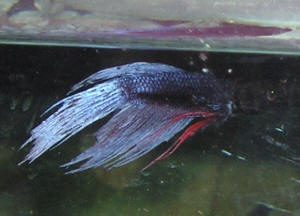 |
My poor Mastah. 12/1/09
Hi Bob,
I've never had problems with my Betta fish
(Mastah) until recently... He has been in three tanks over the past
year, he was in a 2 1/2 gallon tank to start with soft plants and no
heater and he seemed to be fine, he just swam a ton.
<These are tropical fish; a heater is mandatory, not an optional
extra (unless you happen to live in the tropics, of course!). The great
myth is that a centrally heated home is warm enough. It most certainly
is not!
These animals need temperatures around 28-30 C (82-86 F) and
nobody's house is kept that warm all day long. Lack of heat
doesn't kill a Betta instantly; what it does is weaken the immune
system and slow down the
digestive system, so over time the Betta eventually succumbs to some
type of infection or nutritional failing.>
Then I was reading that sometimes you can put them with some neon
tetras and snails for both cleaning and for company,
<Would not do this. Neon Tetras are confirmed fin-nippers, and since
Neons need at least 10 gallons, and have to be kept in groups of 6 or
more, keeping them in a 2.5 gallon tank simply isn't viable. As for
snails, the small varieties like Nerites are fine, but Apple snails are
a very poor choice. Apple snails need a resting phase for part of the
year, and in constantly heated tropical aquaria almost always die
prematurely. When that happens, they rot quickly, decimating water
quality. In a miniscule aquarium like yours, a dead snail could pollute
the tank within hours, killing everything else inside.>
so I put him into a 5 gallon tank with 3 snails and 5 neon tetras... he
wouldn't do anything but "pace" back and forth in his
tank and seemed really stressed out so I put him back into his 2 1/2
gallon tank, he wasn't swimming much at first then he went back to
himself after I added a small tank heater and the soft plants again (I
could never get the Betta live plants to grow, for some reason),
<Plants need light. Tanks designed for the Betta market are usually
rubbish, no other word for it. The problem is that most people buying
Bettas haven't the least clue about how to keep fish, which is why
most Bettas die within weeks of purchase. It's easy for Chinese
factories to crank out garbage "aquaria" containing a gallon
or two of water, slap a sticker saying "Betta Aquarium" on
the front, and sell the thing for a few dollars. I have YET to see a
Betta aquarium that comes close to being a proper, viable, good value
aquarium. Plants need at least a watt of light
per gallon, and realistically double that. This assumes a light
designed for growing plants. Most Betta tanks either don't have a
light at all, or some crummy flashlight bulb built into a bit of
plastic. Without exception, Betta keepers would do better buying a
basic glass aquarium in the 8-10 gallon size, and then a heater, an
air-powered box or sponge filter, and finally a traditional hood with
at least one fluorescent light running the length of the hood.>
I only change his water every week or so, he never seemed to mind he
actually would swim more when his water was a little dirty.
<Unfortunately for you, Bettas can't count the bacteria in the
water, or measure the amount of ammonia and nitrite. So trusting your
fish is a bit like asking children whether they'd prefer chocolate
or vegetables for dinner. In other words, meaningless.>
I noticed about a month ago that he would sit on his plants (now a
rougher/plastic kind than the soft ones) or just sit at the bottom of
his tank and struggle to swim to the top so I got some bacterial
medication for him because the person at the pet store I bought him
from said it sounded like a bacterial infection due to his lack of
swimming and sudden decrease in strength...
<Be under no illusions here: fish exposed to chronically poor
conditions exhibit precisely these symptoms. Bacteria may or may not be
involved, but even if they are involved, it is specifically because the
Betta's immune system was compromised. As I have said above, Bettas
are usually killed through neglect, not because a disease crept in
through the window while you were sleeping.>
now just over the weekend he started losing color, he was this gorgeous
blue with red tints, now he is turning a light blue/gray and light
red... and still not up to his strength.
<Finrot; again, classic symptom of neglect.>
I have done multiple water changes and he only goes between two tanks
and this does not seem to affect him, while I wait for one to go to
normal tank conditions with his conditioner and the proper heat he is
in the other
one.... Please help it kills me to see him like this...
<Here's the thing. Bettas are lovely fish, and their
well-meaning owners become very attached to them. But animals
couldn't care less about love, intentions, or even being given a
name. What they care about is being given
the right conditions and diet. If you fail in these regards, the fish
will get sick, no matter how much you "love" your animal
friend. Transfer this fish to a suitably large aquarium with filtration
and heating, such that the parameters are these: 0 ammonia, 0 nitrite,
temperature around 28 C, medium hardness, and a pH around 7 to 7.5. An
8-10 gallon tank is ideal, and the minimum you should use is 5 gallons,
but I can't think of any logical reason why you'd want to use a
tank that small. An 8-10 gallon tank will cost about the same, take up
about the same amount of space, but will be orders of magnitude easier
to maintain.>
Thank you,
Lizzi.
<Cheers, Neale.>
My Betta Ares is very very sick =( 11/30/09
Hi,
<Hello Amanda>
I really hope you guys can help me with this. I have tried PetSmart,
doing my own research and allexperts.com. I will continue to use my
other sources, but thought it wouldn't hurt to try you guys in the
meantime since you are obviously experts as shown from your past
answers.
<Ok>
My Betta Ares has been sick for about 10 days now. I originally had him
in a 1.5 gallon filtered tank with two African dwarf frogs.
<This system is thermostatically heated?>
He was perfectly healthy for the first month that I had him, and then
he developed swim bladder.
<Mmm, no. Has such a structure... Do you mean it developed an issue
with its hydrostatic organ?>
After I noticed he had symptoms of fin and tail rot as well, I took the
advice of some sites that recommended isolating him.
<? For what reason/s?>
I bought a 1 gallon glass jar (as I cannot afford to put him in luxury
right now =( )
<The reason I'd leave this fish in its filtered, heated
system>
and put some rocks and a small cave and a plant in there. His fin rot
has not gotten any worse but has not gotten any better in the past 10
days. He has also not eaten in 10 days. I have tried EVERYTHING to get
him to eat. I have tried blood worms, his regular food (the frog
pellets that he loved in his healthy days), the Betta bits that I could
never get him to eat anyways, Betta flakes and even a cooked and peeled
pea bits which was recommended to clear his system. He just will not
eat. I tried moving my finger in the water to "get his hunting
instincts going" as well. His new home I know is not the best for
him since it is not heated
<And therefore unsuitable>
but I have been doing the best I can to keep my heater on for room temp
and keeping a light by his tank during the day.
<Won't work>
His symptoms include: very lethargic, tail rot, his swim bladder is
minimal now and he can swim much easier with less turning to the side,
stays in one spot for hours at a time and then moves to another spot
and does the same thing. It is always at the top for easier breathing.
And now, there appears to be gold dusting at the top of his head and
his lower body and face has started to turn silver and blue. And again,
he has not eaten in well over a week (at least not as far as I can see
since I count the food and check if the same amount is still there). I
started treating his fin rot with the Bettafix, which I later read is
really only tea tree oil and will do nothing but coat his insides and
make it harder to breathe.
So I cleaned his tank (jar) completely and then put him back in after
putting his temp cup in the conditioned water tub to adjust him to the
temperature. I then went to PetSmart and looked at medicines,
<At least a good part of the issue/cause here is environmental...
Medicine/s won't fix this>
I was not sure if the new symptoms was fungus or plain severe case of
fin and tail rot-mostly tail, so I bought something that claimed to
cure both (API fungus cure).
<... won't work>
I have done 2 doses (1 every 48 hours two times which it states
completes 1 dose) and he is still just the same, as sick as ever. I am
new at this whole thing, and feel horrible that he has gotten so sick
(3 diseases all at once?!) but it seems that the gold dusting has
turned out to be velvet?
I wanted to ask: 1. If the fungus cure would do anything for him if it
is in fact velvet? -does it sound like velvet? He has the gold color on
his face, but I have seen no scratching against the cave or plant. Or
what else would you recommend me buying? 2. I have a 7 gallon tank that
is empty (was waiting for a time when I had more money to buy more
fish) but I would have to buy both a heater and a filter for it, which
I cannot afford. Would the heater be more necessary than the
filter?
<Yes>
I can only afford one of the two. I read that I should keep the water
level low for him to help him with breathing. So if I just buy the
heater and keep the water level lower would that be sufficient as long
as I do 2 50% water changes a week or more if the medicine requires
it?
<I'd leave out the medicine>
3. Do you have any recommendations for getting him to eat?
<Warm water... the low to mid eighties F.>
I do not want to add another illness to his full list =( I read that
they can go a while without eating, but I am positive that this has got
to be far too long with no food. 4. How often should I change the
water?
<All this information is archived on WWM...>
I know how stressful it can be for him, but I also did not want the
bacteria to stay in there. I hope this is enough information for you,
please let me know if you need any more as I am becoming desperate (and
broke) to help him become more comfortable and healthy =(
Thank you so much for your time and expertise in this,
Amanda
<Please read here:
http://wetwebmedia.com/FWSubWebIndex/BetDisEnvF.htm
and the linked files above till you understand. Don't write. Read.
Bob Fenner>
Re: my Betta Ares is very very sick =( 11/29/09
The 1.5 gallon I originally had him in was not thermostatically
heated... I am not sure if I even know what that means.
<Ah hon... These are aquarium heaters... w/ thermostats... To set
like ones used for space heating in homes, offices. Some are entirely
submersible, others you have to keep the top part above water. They
"run" off
electricity>
Do you mean heated with an actual heater?
<Yes...>
If so, no it is not. The light at the top does keep it heated because
it is a smaller tank. So all in all, would the original tank be better
for him?
<The larger volume would be better>
Or should I partially fill up the new 7 gallon and put him in there
with a new heater?
<Yes>
And you recommend to stop the medicine and wait to see if the better
tank conditions improve his health? And use nothing for the tail rot
and possible velvet gold coloring?
<Correct on both counts>
Thank you so much!
<... You should read as you were directed... Please do. BobF>
Beta fish is sluggish since water change... No reading;
Neale's seemingly infinite patience 11/18/09
Hi.
<Good evening!>
We cleaned out the gravel and filter in my daughter's beta fish
tank about 2 weeks ago.
<It's actually Betta, to rhyme with "better", not
"beater".>
It is a one-gallon tank and we have had the fish for about 11
months.
<Far too small. A one-gallon tank IS NOT viable for a Betta, no
matter what the sales clerk suggested. Do please read here:
http://www.wetwebmedia.com/FWSubWebIndex/bettasysart.htm
Assuming your daughter is still a minor, my attitude here is that you
buy pet animals for yourself, and simply allow children to share. Kids
simply don't understand the expense and responsibilities involved,
so it's silly
to call a pet animal "their" pet animal.>
After the water was changed, the fish has stayed at the surface near
the spot we feed him. He does not swim around and my daughter claims he
has some reddish streaks on him.
<Red streaks on the body and/or fins are caused by Finrot, and this
in turn implies the immune system has been suppressed by poor
environmental conditions. Typically, that's because the pet owner
has decided not to bother with a heater or a filter, both of which are
essential. Nature being nature, bacteria don't give a hoot about
your budget and how much desk space you have for an aquarium, and if
you're going to stick a fish in an unheated, unfiltered aquarium,
the bacteria are going to make that fish sick. Simple as that. If you
can afford a heated, filtered aquarium, or can't be bothered to buy
a heated, filtered aquarium -- then keep something else. Plastic
dinosaurs, potted cacti, etc. Not fish. I don't mean to sound mean,
but these things are non-negotiable, like death and taxes.>
Could it be because we changed the entire water instead of just half as
we usually do? We let the water stand in a bowl for 24 hours before the
change.
<Unfortunately, letting water stand for 24 hours does not mean it
gets sprinkled with fairy dust. You water into which dechlorinator has
been added. Water chemistry should be appropriate to a Betta, i.e.,
slightly
soft to moderately hard, and around neutral in pH. Can't be
bothered to do that? Don't keep fish.>
Also, we do not have a heater, although the fish did not mind that last
winter.
<He minds now. There's really no excuse here. These are tropical
fish, and like all tropical fish, need tropical conditions. That's
why they're called tropical fish and not, say, coldwater fish. So:
you need a heated, filtered aquarium. I'd say 5 gallons is the
minimum. In any case, you'll need to treat for Finrot (e.g., with
Maracyn, Paraguard or eSHa 2000) and upgrade the living conditions
accordingly. If you peruse some of the Betta healthcare messages we get
here, you'll see lots of people with sick Bettas doing things the
way you're doing them... so you aren't the first people to make
these kinds of mistakes. But what you do next matters, because this
fish won't recover if you don't upgrade its home and treat the
fish promptly. Happy, healthy Bettas can live 4 years. Hope this helps.
Cheers, Neale.>
Help: Betta dying 9/27/09
Hi, I am desperately trying to save our poor fish.
<Oh dear.>
I noticed only a few days ago that he was darting around the tank
sometimes.
<Nervousness in fish is very often a first sign that environmental
conditions have declined sharply. Let's review. For a Betta, you
want 0 ammonia and 0 nitrite. These are non-negotiable. You want a
steady pH. Any value between 6 and 8 is fine, but it shouldn't vary
much from week to week. Don't use water from a domestic water
softener, but plain, unsoftened tap water, with conditioner. Check your
water conditioner has something to remove ammonia, copper and
chloramine if you suspect these are possible issues in your area (best
assume they are, and choose a water conditioner accordingly). The
temperature should be somewhat high by fish standards, ideally 27 C/81
F or a degree or two higher.>
Then two days ago, he started darting and missing his food
completely.
<Does sound environmental. Do a 50% water change, and see if the
fish settles down. If it does, that's a good sign water quality was
the issue, and you need to focus on aquarium size, filtration, and
possible
overfeeding.>
He currently lives in a 5 gallon tank with filter and heater.
<Do you maintain the filter properly? Remember, it takes up to 6
weeks for a filter to mature, and once that happens, you need to treat
the live media like a newborn baby! Seriously! Wash the sponge (or
whatever) in a bucket of aquarium water, and don't ever let it dry
out. Change no more than half the media in a filter in any one
month.>
I feed him Betta pellets, but he hasn't eaten in two days.
<Pellets aren't acceptable every single day. While I don't
think this is the issue here, do mix his diet to include squished
cooked peas (tinned peas are good) and something with fibre, such as
live (or wet frozen, not
freeze dried) brine shrimp and/or daphnia. Dried foods, including
freeze-dried foods, commonly cause constipation.>
When he seemed to be acting strange, I took a good look a his tank. I
noticed black "hair like" algae or fungus (not sure) on some
plants. So, I removed the plants and did a 50% water change and added
conditioner. But,
he quickly went downhill yesterday. He is struggling to breathe. I did
not see anything on his skin to indicate disease. But, then as his
breathing grew heavier and more rapid, I noticed he was turning white
under his gills.
<Likely mucous, a sign of water quality issues, or perhaps
poisoning. Paint fumes, bug sprays, even heavy tobacco fumes can poison
fish, especially air-breathing species like Bettas.>
It grew worse quickly and he was laying on the bottom of the tank. He
would lay still for a while and than dart to the top of the water
frantically trying to get air. I have a plant with some roots at the
top of the tank.
He is laying in the roots, close to the surface. But, he is hardly
moving.
I feel so bad bc this happened so quickly and I didn't see anything
noticeable. Then today, it looked as if he may have fin rot. I noticed
his fins were looking ragged and a noticed a pinhole. So, I ran to
PetSmart and bought tetracycline. I added it to the tank. I have no
idea what to do.
<Strongly suspect environmental and/or poisoning.>
I did try and transfer him to freshwater, but he looked worse than when
he was in his tank. So, I put him back in his tank. It probably
stressed him out, but some advice I got was to put him in clean water
in case there is something in the tank. I am really upset bc I just
don't know if there is something we did or missed. He is really
suffering right now and is barely moving. It is breaking my heart. I
feel so bad that he has been in this state for two days. At this point,
his body is losing some color, but the only noticeable thing is the
white near his gills and white under his chin.
It doesn't look like he was salted as some have suggested. It looks
like his scales turned white. I purchased him about a year and a half
ago. He has done so well up until now. Oh, and there is a snail in the
tank that is doing well. I am at a loss. Any suggestions? Your quick
response is greatly appreciated! Danielle
<Do review conditions in the tank.>
PS. I also forgot to add that I had PetSmart test the water this
afternoon and they said that everything appeared normal.
<I don't believe this to be the case given the symptoms.
"Normal" is a vague term, and what I mean specifically here
is that Bettas need 0 ammonia, 0 nitrite, a pH between 6 and 8, and a
hardness level between 5 and 20 degrees dH.>
PPS. I just checked on him and he is laying in the roots, close to the
surface just struggling to breathe. But, his body is still very blue,
It is the area under his gills and chin that are white. He honestly
doesn't look that sick, in regards to color. Do you think he could
have food caught or a blockage? I do not see any swelling.
<Look at the environment. Good luck, Neale.>
Re: Help: Betta dying 9/27/09
Thank you for your response. I really appreciate it.
<Happy to help.>
I just checked on him this morning and after a day laying in the same
position on his side at the top of the tank on some roots, he is on the
bottom of the tank- living. I can't believe he has made it 3 days
like this. I added tetracycline yesterday and wonder if that has helped
him at all.
<May do. Unlikely to see a sudden turnaround using an antibiotic,
though.>
I am not sure what you mean about the filter. So, let me say this... I
noticed last week there was a black gooey substance on the edge of the
filter. I took i off (probably from the carbon pack) and changed
the
filter.
<Carbon largely useless in a tank like this. First understand what
carbon does: it removes dissolved organic chemicals (including
medications, which is why you MUST remove carbon before using any
medication). Carbon has no role in the "nitrogen cycle",
i.e., the conversion of the ammonia into harmless nitrate. This is why
a filter has [a] biological media, [b] mechanical media, and [c]
chemical media. For a Betta, biological media is the most important,
which is why a plain air-powered sponge filter is fine.
Small internal canister or box filters may be fine, if the water
current isn't too strong, but again, the media used should be
things like sponges and ceramic noodles. Carbon is largely redundant
because the stocking level is so low and you'll be doing 25-50%
water changes every week. No real value to carbon.>
I have not ever washed the filter. I thought I just change the filter
and put in a new carbon pack.
<No.>
What do you mean by "media"? You said I need to treat the
live media like a newborn baby and wash the sponge??? If you have a
picture or can explain this in greater detail, it would be MUCH
appreciated.
<Hope have done so above.>
I do notice a lot of debris right now on the bottom of the tank bc the
medicine package said to remove the filter, so as to allow for the fish
to get all the antibiotics. I am so confused.
<No, the instructions said to remove the CARBON from the filter. The
mechanical media (i.e., the media that catches silt) and the biological
media (typically sponges and/or ceramic noodles) must, repeat MUST, be
left in the filter. There's no point medicating the fish if
you're removing the biological media, because the ammonia will go
up and poison your fish!>
I obviously thought the filter was just like a filter we use in our air
conditioner unit, where you change it when it gets dirty.
<No. It's more like Mother Nature. Waste comes out the
animal's backside, it hits the ground, bacteria process it, and
it's rendered harmless.>
Am I wrong?
<Yes.>
I didn't think they lasted that long.
<...>
I was going to do a 50% water change today and add in more
tetracycline.
But, should I keep him in his own tank or should he be isolated. I only
have a snail in the tank with him. I felt that i made him worse when I
removed him yesterday for a bit.
How do I know about he nitrite levels, etc in the water? Petsmart only
had a dipstick and he colors showed normal. How on earth do I test to
find out the exact levels in his water???
<First answer this question: is the water you use plain,
non-softened water from the tap, treated with water conditioner? If the
answer is yes, then good. If the answer is no, then [a] don't use
water from a domestic water softener and [b] use a good all-around
water conditioner. Next up, you should have two test kits, one is a pH
test kit and the other is a nitrite test kit. You want the pH to be
stable from week to week, and the nitrite should be zero. Now, you can
use the dip strips, and I use them myself.
They aren't frightfully accurate, but all you're interested in
is that nitrite and ammonia are zero. If they're not zero, by
however much, that's bad. Liquid tests are perhaps more accurate,
but they're a bit more fiddly.>
Also, we live in a largely organic/green home. So, the poisoning seems
a stretch. I don't use anything with harsh fumes. I can only look
to maybe overfeeding or water quality. I use distilled water bc we live
on well
water
<No! Do not use distilled water in an aquarium! Distilled water, by
definition, contains no minerals whatsoever. Among other things, this
means pH will drop rapidly over the days. You absolutely must use at
least some tap water, with water conditioner, to ensure adequate
dissolved minerals in the water. Even well water will be fine. A mix of
50% tap (well) water and 50% distilled water would also be
ideal.>
and I didn't know what type of water conditioner they use in our
well. I know there is some type of water conditioner added to our well.
So, I have been using bottled, distilled water and adding top fin water
conditioner. I was told a once weekly water change.
<25% weekly is fine. Remove 25% of the water from your aquarium, and
then replace with a 50% mix of tap water and distilled water. Add water
conditioner. Should work fine.>
The rocks at the bottom of the tank look like they have some algae from
those plants I removed. But, I am afraid to clean them bc I don't
want to stress him out. Can you please advise as to what I should today
with him, now that he has made it through yet another night? Leave him
in his tank?
50% water change? add tetracycline? Put the filter back in?? That was
my plan... If you help me save his fish, I will be so grateful.
<Hope this helps, Neale.>
Re: Help: Betta dying 9/27/09
One more question...
if he makes it and actually starts eating again, I have a question
regarding the cooked peas. Do I remove the skin of the peas and just
give him the soft center?
<Yes. Remove the skins, squish, and feed. Make take a while for him
to catch on, but they usually do. Cheers, Neale.>
Re: Help: Betta dying 9/27/09
Thanks so much!
<You're welcome.>
I can't believe it, he is on the bottom of the tank, but moving
today. I tell you, he laid lifeless yesterday and I thought there is no
way he will make it through the night. But, I did notice that he now
appears to be rubbing his face against the rocks on the bottom of the
tank.
<As I said before, a water change will often improve the health of
seemingly sick fish. If that happens, it's a very good sign the
problem is with water quality and/or water chemistry.>
Will the tetracycline help bc I think this is a sign of bacteria?
<"Sign of bacteria" covers a lot of ground! Most bacteria
do nothing much either way for fish help, while others are helpful,
turning poisonous chemicals like ammonia into something safe. Only a
few cause harm.
Identifying when such pathogenic (disease-causing) bacteria are at
fault isn't easy or obvious, though Finrot and Mouth Fungus (which
despite it's name is a bacterial infection) are usually easy to
spot.>
I have a couple more questions...
I just did a 50% water change. The rocks are still noticeably dirty
(probably since having the filter out and after taking out the
plants.
<Dirty rocks may simply be covered with algae, which looks like
brown scum, or blue-black fur, or blue, red or green slime. In itself,
this isn't a problem. However, certain types of algae do best under
certain types of conditions. Diatoms (brown scum) often do well where
water quality is variable. Blue-green algae (which can be other
colours, but has a distinct musty smell) often appears when tanks have
too little water movement and too many nutrients in the water (i.e.,
nitrate and phosphate, and this in turn signifies overstocking or not
enough water changes).>
I am seeing debris floating around.
<May mean inadequate filtration, overfeeding, or not enough water
changes.>
I put the filter back in, but not the carbon pack.
<Good.>
I will try to go to Petsmart today to find an air powered sponge
filter.
<This is ideal for Bettas. But do bear in mind, if you replace the
existing filter with another filter, the tank will begin cycling. This
is bad. Offer very little food, maybe one small meal every 2 or 3 days,
and do 25% water changes, without fail, every 1-2 days for at least the
first 3 weeks. If you can add the new filter without removing the old
one, that would help.
Leave them together for 2-3 weeks, and then remove the old filter. The
new filter will quickly get its own colony of bacteria that way. Or
else, an air-powered box filter could be used. I like these. Stuff some
old media from the present filter in there, and top up the box with
some plain filter wool and/or ceramic noodles. This will be instantly
cycled if done that way, and you should be good to go.>
In the meantime, without stressing him more, what would you suggest as
the best way to clean the rocks of
debris?
<Remove and clean ornaments and big rocks every few weeks if needed.
Leave gravel in place though, and merely stir with a stick (a pencil is
fine) and siphon out the silt.>
Thanks so much!
<Cheers, Neale.>
Re: Help: Betta dying 9/27/09
OOps... so sorry, I forgot to add my last question:
How do I know how to measure out the correct dosage for a 5 gallon tank
of the tetracycline? It comes in a package for a 10 gallon tank.
<Use half the package.>
I put about half yesterday, but I am worried about the inaccuracy.
<Good enough for government work. Wouldn't lose sleep.>
Thanks
Danielle
<Cheers, Neale.>
Re: Help: Betta dying 9/29/2009
I am in awe! My little fish is now swimming again.
<Cool!>
It is unbelievable! Thanks for all of your help!
<Happy to help.>
We are not out of the woods yet because he still has not eaten.
<Will, in time. Don't bother feeding for a day or two: For one
thing, keeps the water cleaner, but it also helps stimulate his
appetite. Wild fish certainly don't eat as much food as we give our
pet fish, so we can afford to "starve" them a little now and
again.>
I tried pellets and peas tonight. He did not eat either.
<Depends on how hungry they are. Do offer very small, bite-size
morsels, perhaps using forceps. Daphnia and brine shrimp have the same
laxative effect and are more readily taken by some Bettas.
Spirulina-based flake is another good food for them, if they'll eat
it.>
It has been about 6 days without him eating. I am worried, but today
was the first day I finally noticed improvement. Any suggestions for
getting him to eat?
<Try getting a bag of live brine shrimp or daphnia. Pour into a jar,
and keep on the window sill. Use a net to take out small portions and
try and see if your Betta will take them. Live foods often stimulate
appetite when
others do not.>
Also, how long can he go without food?
<Two or three weeks, easily. Cheers, Neale.>
New tank syndrome and fin rot in Betta... No reading,
mis-using WWM 9/11/09
Hi , I bought my Betta about 4 weeks ago. He is in a 2.5 gal tank. The
tank came with a filter but was too strong for my Betta. I changed to a
sponge filter and had the filter for about 2 weeks.
<Good move>
I started to notice a strong ammonia smell coming from the tank and
noticed that my betas tailfin
was starting to look shredded and transparent near the tips.
<You could smell ammonia?! Any present is toxic, damaging>
I was having my water tested weekly at Petsmart where I purchased my
fish.
The ammonia was borderline
<See above... read on WWM...>
but I knew that the tank was still cycling.
<Needs to be done w/o aquatic life present>
One week later, my betas fins were getting worse. I decided to take out
my sponge filter from advice from a petstore and replace it with a
whisper filter. they told me that would improve my water conditions,
along with doing partial water changes. Now I fear that I made a big
mistake by removing my sponge filter. I know that it was probably
cycling but I didn't want to lose my fish to poor water quality. I
have done small water changes over the past two days and added some
aquarium salt. Just yesterday I took out my carbon from my filter and
started treating my fish with Bettafix (more advice from the
petstore.)
<This material's as useful as Pinesol... Not suggested... Had
you followed directions, searched WWM before writing...>>
My Betta still is acting fine but I fear that the fin rot with
eventually kill him. I have gotten so many mixed reviews that I
don't know which way to go.
<... Read what we have here... WWM is a growing reservoir of
QUALIFIED factual input>
I have also bought a heater to keep my temp. from fluctuating. I have
not installed it yet. The heater that I
bought keeps the tank at a constant 78 degrees. My tank is currently at
72 degrees.
<Too low>
Will this stress him more when his temp suddenly climbs to 78
degrees?
<No; less>
Should I continue treating him with the Bettafix or will doing a
partial water changes with aquarium salt cure the Finrot?
<Likely the latter>
I'm afraid that not using a carbon filter for a week while treating
him with Bettafix will make the water quality even worse.
<I agree>
I have read mixed reviews about this product. Also, will I have to
cycle the tank again after treating with
the Bettafix?
<Is possible>
I understand the cycling process, but I don't know how to avoid
losing fish to disease and ammonia poisoning until the tank cycles.
<A matter of having system/s cycled ahead of livestocking
mostly>
Will daily partial water changes keep the fish healthy while the tank
cycles?
<Not likely>
If so how often and how much water do I replace.
<... this is all covered over and over...>
I condition the water and add aquarium salt to each water change. I
also just bought a five gallon tank
with a BioWheel and carbon filter.
<Ahh! Much better>
It has been set up for a week and I just added a Betta to that tank
today.
<... w/o it having cycled? No!>
I don't want to make the same mistake with him.
<You already have>
Can you tell me how to get through the cycling process with this fish
without running into the same problem.
<Read on WWM re...>
I am hoping that I can fix the Finrot with my other fish before it gets
too far advanced. Please help!!
<Help yourself... tens of thousands of folks use our site
daily>
I am very attached to my little buddy and do not want to lose him. I
also do not want to put my other Betta that I bought today through the
same misery.
Thanks, Stacy
<Bob Fenner>
Blue Beta Male 9/7/09
Hi.
<Hello,>
I got a blue male beta yesterday. He is about 2 inches long. I put him
in his aquarium (2 litres) that has some small pebbles and a the
rounded bigger decorative pebbles.
<Sorry, is this a joke? Two litres? TWO LITRES? I have a teapot that
holds more than this! Seriously, 2-litres isn't viable, and
whatever the guy at the pet store said, you can't keep a Betta in
this. How is it heated? How is it filtered?>
I have added the water cleanser in and feed it twice a day with the
TOPFISH Betta pellettes.
<No such thing as "water cleanser", except ones that use
air and/or electricity, i.e., filters. Any "potion" added to
the water is simply taking advantage of your ignorance. It won't
work. Yes, you add water
conditioner to each new batch of water to get rid of chlorine,
chloramine, ammonia and copper in the tap water supply. But such
products do not keep the water clean once in the fish tank.>
My Betta, bluebolt, is eating fine and pooping a lot.
<So far.>
But I cannot figure out why he usually goes to the corner (sometime the
top and other times the bottom) of the fish bowl and hangs out there.
He doesn't move much and had his fins (near the gills) stuck to his
body.
<Stress.>
when he swims it moves fine though. His tail and fins don't seem as
open as I have read online it should be.
<Stress.>
I don't see his gills moving when he swims or rests except for when
he comes to the surface to breath. That time his gills open fully. Is
that normal?
<No.>
He usually only moves around when i tap his bowl or come and sit by
it.
<Don't tap the bowl. It stresses the fish. Would be like coming
up to you and hitting you with a plank of wood, just to get a reaction.
Sure, works, but it isn't nice.>
I am really worried because he is my first fish and I want to keep him
healthy and give him a long life (3 yrs at least).
<You have much work to do. A Betta needs a 5 gallon (19 litre) or
bigger tank, a heater that keeps the temperature around 82 F (28 C),
and an air-powered filter such as a sponge or box filter filled with
ceramic
noodles. Don't have those things? Don't want to buy them? Your
Betta will be dead in a month, tops.>
Is it possible that he is a slightly lazy Betta?
<Not the issue here.>
Thanks
Priyanka
<Happy to help, Neale.>
Blue Beta Male... reading 9/7/09
Hi.
<Priyanka>
I got a blue male beta
<Is this a test fish? A Betta...>
yesterday. He is about 2 inches long. I put him in his aquarium(2
litres)
<... too small... heater, filter?>
that has some small pebbles and a the rounded bigger decorative
pebbles. I have added the water cleanser in and feed it twice a day
with the TOPFISH Betta pellettes. My Betta, bluebolt, is eating fine
and
pooping a lot. But I cannot figure out why he usually goes to the
corner (sometime the top and other times the bottom) of the fish bowl
and hangs out there.
<Improper env.>
He doesn't move much and had his fins(near the gills) stuck to his
body. when he swims it moves fine though. His tail and fins don't
seem as open as I have read online it should be. I don't see his
gills moving when he swims or rests except for when he comes to the
surface to breath. That time his gills open fully. Is that normal?
<...>
He usually only moves around when i tap his bowl or come and sit by it.
I am really worried because he
is my first fish and I want to keep him healthy and give him a long
life(3 yrs at least). Is it possible that he is a slightly lazy
Betta?
Thanks
Priyanka
<Read here: http://wetwebmedia.com/FWSubWebIndex/bettasysart.htm
and the linked files above. Bob Fenner>
Re: Blue Beta Male 9/7/09
Hi
<Hello again, Priyanka,>
I am going to the pet shop today and getting a bigger aquarium, heater
and filter.
<Very good.>
Thanks for telling me. I was not sure about what all to get as I this
is my first Betta.
<We all start somewhere! Get a 5 gallon (19 litre) or bigger tank, a
heater (25-50 watt should be fine if your house is heated), and a small
filter, ideally something called a "sponge filter" with an
air pump that you can connect to it. A small electric internal filter
could be used instead, but get a small one, with a flow rate you can
adjust: strong electric pumps can suck up Bettas, damaging their
fins!>
You really helped...
<Glad to hear it.>
Thank you :)
Priyanka
<You are most welcome. Enjoy you pet Betta, and I hope you have many
happy years together! Cheers, Neale.>
Siamese Fighting Fish - Fin Problem 08/02/09
Hi Guys
<Hello,>
Can you please help me with this - I'm not sure if it's a
problem or not??
<Well, let's see...>
Our Fighting Fish, 'Tosh' appears fine and happy, he's
eating and swimming around ok, but has developed a small patch on the
top edge of his tail fin, that appears cloudy/not quite furry but like
sheeny and almost like its sticking his fin together.?
<Could be Finrot, could be Fungus, though I'd veer towards the
first.
Typically occurs when Bettas are kept in inadequate conditions: small,
unheated tanks for example. Do review aquarium size, filtration,
heating.>
I don't know if that makes any sense but the only other way I can
describe it is like when you get glue on your finger??!?
<When fish are irritated by something in the water -- such as
ammonia or opportunistic bacteria -- they increase mucous production.
This can appear like off-white patches on the skin though it's less
commonly the case on fins since they don't produce much mucous. On
infected fins, the trailing edges often become white because the
membrane is dying, and eventually you get the classic
"frayed" appearance of Finrot, with the membrane dying back
but leaving the bones (the fin rays) for a while.>
It appears to be spreading but not affecting him in any other way.
<This is often the case with early stage Finrot; but once the blood
stream becomes infected, you're dealing with septicaemia, and that
kills fish very quickly. So, you do need to treat, e.g., with Maracyn,
Paraguard, eSHa 2000, etc. But at the same time you need to figure out
what caused the problem. With Bettas, a small tank -- something under 5
gallons -- is probably the commonest reason for bad water quality, and
of course the filter needs to be adequate to the task and properly
maintained. Bettas don't like strong water currents, but the filter
should still have a decent flow and a goodly quantity of biological
media. Carbon, zeolite, etc., are largely irrelevant. Media should be
cleaned in buckets of aquarium water around once a month.>
The reason I'm worried is that we had another Fighting Fish before,
who we noticed got the same thing, but he was hiding behind the heater
at the back of the tank, not eating and was generally poorly. Sadly he
died.
<I see.>
Our tank is a community tank, with live and plastic plants, undergravel
filtration, plenty of hiding places, with Tetra, Guppy's, some
Panda Cory's, George our Plec and Tosh, it's clean, at 75
degrees F and I've
checked all the ammonia, pH, nitrite and nitrate levels - all are
ok!!
<Curious, but what are the tetras? Bettas mix badly with tetras, and
the other common reason for Finrot is physical damage. The obviously
nippy tetras are Black Widows (also called Black Skirt and Petticoat
Tetras, Gymnocorymbus ternetzi) and the various tetras sold as Serpae
Tetras. But other tetras that have been reported as nipping Bettas
include Neons, Colombian Tetras, Red-eye Tetras, and Bleeding Heart
Tetras.>
Do you have any suggestions or are we doing anything wrong?? We are
still fairly new to the fish keeping thing!
Looking forward to hearing from you
Caz & Chris x
<Cheers, Neale.>
Possibly Sick Betta and Algae Issues... just poor
env. 11/4/07 Hello! <Hi there> What follows is an unusual
story. I have tried searching the web and have not been able to find
another case such as mine... <That is unusual!> For the past 10
months I have had a male Crowntail Betta. About three months ago, I
noticed that there was a little bit of algae growing on the top of my
tank. At this point, I should mention that I have a one gallon tank
with an airstone, and a 5W bulb as a heater. <Uhh, no good... what
happens when the light is off?> Seeing the algae, I started leaving
the tank light on for less time every day, and for a little while the
algae cleared up. But, at the beginning of September, the algae came
back full force. It coats the gravel, the sides of the tank, and the
airstone tube. I started performing 25% water changes every three days
and draining and cleaning the whole tank about once every ten days, as
the algae accumulates so quickly and obscures the sides of the tank so
I can't see my fish. The light stays on only for about 2 hours each
day now, and it still does not curb the algae growth. <Mmm, other
ways to counter algae... depriving it of nutrients (from the get-go and
from filtration) adding competing photosynthetic life (plant
material...)...> This is making the temperature of the water cooler
(about 70 F) <Too low...> which I know is not the best condition
for Bettas. Also, when I do water changes for about the last three
weeks, my Betta has started freaking out - swimming rapidly around the
tank at odd angles, then lying listlessly at the bottom for about two
days afterward. He does this whenever I add or remove any water - it
can be as little as 1/4 cup of water that makes him do this.
<Yes> I should also say that I use tap water, first boiled to
remove chlorine and contaminants then treated with Betta plus bowl
conditioner, and left to sit for about 5 days to condition. This is a
never-ending process, and I am scared to do any more complete water
changes and cleaning, as this all seems to be affecting him in a
negative way, so right now the algae is very thickly coating the tank.
I am sick of the algae, and want my Betta to be happy - is this the
time to resort to using a chemical algae fixer? If so, could you
possibly recommend some brands that would be available in Canada?
<Not recommended... toxic and not really a fix> Some days my
Betta seems really happy, and is active, and then on others he is
listless and pale. He always seems to eat well, even if before and
after he just lays on the bottom of the tank. So, I know this email is
long, and I hope you can help me out. If you need any more information,
just let me know. Thanks, Liah <Thank you for writing... so well and
thoroughly. What your Betta really needs is a heated, filtered
environment. Please read here:
http://wetwebmedia.com/FWSubWebIndex/bettasysart.htm and the linked
files above. Bob Fenner>
You killed your Bettas. 4/3/07 i <I - next time,
please use proper capitalization, not "net speak"> had a
male and female Betta. We put them in a big bowl together... <A
single Betta doesn't belong in a non-filtered, non-heated bowl, let
alone two. A single Betta should be kept in a minimum 3 gal. filtered
tank, with a submersible heater to keep the temperature steady at
around 80-82 degrees F. Your setup is simply a recipe for disaster.
And, of course, keep in mind temperaments: males can be very aggressive
towards females and can literally stalk her to death. Professional
Betta breeders recommend keeping the sexes separate, and introducing
the female when it's time to breed, then immediately removing her.
You, my friend, need to read up on proper Betta care; check here for
starters: http://www.wetwebmedia.com/FWSubWebIndex/bettasysart.htm >
...when we change the water. <Now I'm confused. Do they live
together or separately? In any case, bowls are a no-no. Best idea is to
setup 2 minimum 3-gal. filtered, heated tanks, one for each fish...>
They don't attack each other at all...we did that for like 3 weeks.
<Ideally, you should be changing no more than about 50% of the water
in your 3 gal. Betta tank per week; changing 100% of the water at a
time can shock and kill your fish. I imagine you're doing complete
water changes because the water is quite filthy...yet another reason
not to house any live fish in non-filtered bowls. Also, keep in mind
that it's best to feed your fish sparingly - only 2-3 Betta pellets
once per day, alternative with bloodworms or mysis shrimp on
occasion...> Well, the other night after we put them each in their
own bowls they both spazzed out and were rushing up to the top then
slamming themselves down into the rocks. <Sounds like environmental
shock - did you test the water for ammonia, nitrites, nitrates, pH?
What was the temperature of that water? It sounds as though the 100%
water changes caught up with your fish and caused their demise...>
About 20 min.s later they both died. I was just curious as to why they
would do that or what would cause that... <Pollutants in the water,
too drastic a change in pH, temperature, etc. Read here on how to
properly treat tapwater for aquarium use: http://www.wetwebmedia.com/FWSubWebIndex/taptrtmnt.htm , and
how to "cycle" a tank: http://www.wetwebmedia.com/FWSubWebIndex/fwestcycling.htm
> Tiffany <Forgive my somewhat terse reply, but I must say I get
a bit irritated with telling folks that they need to do their homework,
research BEFORE attempting to care for any live animals. In a nutshell,
you killed your pets. Have you read up on proper Betta aquarium
conditions? Now that you are "fishless" is the time to do so
- here's some of my favorite Betta sites: http://www.bcbetta.com/Acclimatizing.html http://www.siamsbestbettas.com/ http://www.healthybetta.com/ Please take the time to do the
necessary reading and if you choose to try again, please be sure that
you have an appropriate-sized cycled tank prior to purchasing a new
Betta. Regards, Jorie>
Betta, Curling Fins, Disease? No -
07/04/2006 Greetings WWM Crew! <Hello, again!> The more time
I spend on your site, the more I'm impressed. <And probably less
impressed with this response time.... please accept my apology.... I
fear that your email came to us in a format that few (read: me) in the
Crew can respond to, and I've been a bit tardy these last few
days....> Thank you for this incredible service to the fish fanatic
community! :-) <Thank you very, very much for these kind words....
this means a great deal to me, and all on the Crew. Thank you.> My
5-year-old daughter chose a male Betta for her birthday last October.
His name is Marigold. He is housed in a Betta bowl (which I now
understand is not best and will consider moving him) <Please do,
thank you. If you'd like a recommendation, I like using
Marineland's Eclipse 3 systems for Bettas. If the filter is too
strong for them (never had that problem with mine), you can put a
filter sponge over the intake.> for which she does partial water
changes every 7-10 days (although it never appears that it needs it).
<Be testing - small bowls like this never truly cycle; should be
changed in its entirety every couple of days unless the space is a
gallon or more. If it is in fact less than a gallon, should be upgraded
quite soon.> She uses dechlorinated water (tap water set to air out
24 hours in advance) and adds a pinch of aquarium salt. <If your
local water treatment includes chloramine, this is inadequate - you
will need something to neutralize chloramine. Most places in the US now
add this to our tapwater, sadly.> She faithfully feeds him pellets
every day. (Another change we'll make now that I know they prefer a
varied diet.) <And rather than feeding on a daily basis, consider
feeding every other day or so - it's easier to kill a Betta by
overfeeding him than underfeeding him.> I've noticed that
recently his fins are curling on the ends. I searched your site reading
all of the Betta articles and couldn't find any occurrence of this.
<Is very common, and not a problem. Many Bettas get interesting fin
formations, either curling or extensions to the rays of the fins, or
other neat things.> It doesn't sound like one of the common
Betta diseases you explain in detail on the site. Is it something about
which to be concerned? <Nope. Sounds good to me.> Thank you for
your time. <Glad to be of service.> Sophie's Mom <I do
hope Sophie and Marigold have a wonderful time together! Ask Sophie to
say hi to him for me. -Sabrina> My Male Betta (Jovi)
7/3/06 Hi, I have had my Betta for about 4 or 5 months. I have had
no trouble with him until now. He's always been a lively fish, very
aggressive and definitely seems to have his own little personality.
<Oh yes> Well over this past week he's been swimming with his
body leaning more to the right side. More recently he hasn't been
swimming around as much - and seems to have more trouble doing it (puts
more effort into it). <Good observations> He usually swims around
watching me and is excited about his food. Now he barely eats. Now
today, I noticed that his right eye is extremely swollen and seems to
have a red outline underneath. I'm very worried about him. I hope
you have some insight for me. Thanks, Meghan <Mmm, hard to discern
actual cause/s here... But I would be focusing on your Betta's
environment, measuring water quality, perhaps adding to its diet...
Please do peruse WWM on Betta Systems: http://www.wetwebmedia.com/FWSubWebIndex/bettasysart.htm and
Health: http://www.wetwebmedia.com/FWSubWebIndex/bettadiseases.htm
and the linked FAQs files above these articles in the hope of this
activity stirring your awareness. Bob Fenner>
New Betta With Ammonia Problems 1/18/06 Dear Sirs: I did
search for this, and found something quite close, but it didn't
address my exact concern, so please bear with me. My Concerns: the tail
"threads" the water getting cloudy so quickly. Here are the
facts: New Male Betta, just purchased 50 hours ago. First 24 hours were
spent in smaller bowl, with tap water & drops of tap water
conditioner. Now in a round 1 gallon plastic tank, tap water
conditioner drops, fake plant (I would describe the feel of the fake
plant as perhaps feeling soft pine needles), plastic beads, little
divers helmet. All came with tank) Just put him in this last night.
Mid-day today. water seems to be slightly cloudy. (not heavily, but
perhaps as if I'd put a teaspoon of skim milk into the bowl) I am
in Australia, very hot, so air-conditioner has been on quite a bit
during day, off at night. I have taken a cooked small prawn, held it a
bit above or just on the water a couple times today and he'd do a
little jump and take a very small bite out of it. I did notice when my
husband was getting the new bowl ready, he had both his (cleaned) hands
in the water trying to adjust the beads and such. Water did set for
about 2-3 hours after being treated before putting fish in. He is
acting just fine, but for a lack of a better way to say it. looks like
he's starting to lose "threads" of his tail. Just today.
Not getting quite as excited about seeing himself in the mirror as he
used to. I tried to keep this as concise for you as possible. Thank you
in advance. Juli < As your new little Betta excretes waste it and
uneaten food quickly turns to ammonia which is toxic to fish. This is
the cloudy water you are experiencing. It "burns" the
fish's gills and fins. This may explain the threads you are seeing.
Do a 50% water change to dilute the ammonia. Feed only once a day and
only enough food so that all of it is gone in two minutes once each
day. Remove any uneaten food after two minutes. This will reduce the
ammonia but not eliminate it. You can continue to dilute it with daily
water changes. You can add Bio-Spira from Marineland that will put the
bacteria in the tank and begin to start to break the ammonia down. The
will transform the ammonia to nitrites and then to nitrates. The
nitrates are less toxic but still need to be removed with water
changes. There are many chemical resins that will remove ammonia. You
might want to look into these and make a little "tea bag"
filled with these resins top control the ammonia until you can get
around to doing a water change. An ammonia test kit will let you know
when the resin needs to be replaced and when a water change is needed.
Over time you may get the bacteria to developed naturally. Go to
Marineland.com and check out Dr Tim's Library. Go to the article
titled "The First Thirty Days" for a better understanding
about what is happening in your bowl.-Chuck>
Not the full Monty... Betta env. dis. - 02/25/06 Hello,
<Howdy> I am desperate for some help. I bought my Betta (Monty)
from an aquarium about a year ago. He has always been very happy and
healthy. I love him to death, I always say he seems to wag his tail
when he sees me, it is so precious. I am terrified that he is not going
to make it. About 3 weeks ago, I first noticed that he was changing
colors. He was (for a year) a deep burgundy and bright turquoise w/ a
couple of clear spots on his fins. Well, I read the color change was
normal, and the clear spots on his fins were from past damage. The
color change started at the base of his dorsal fin, then moved
throughout his body, covering almost everything but his head, and has
covered half of his belly fin. He is all white now w/ the exception of
his head and about 80% of his fins. Very shortly after that, I noticed
his fins were vanishing. I couldn't see any fraying or holes, the
just seemed to disappear. Right before that started, I had moved him to
a gallon tank. I added a mini filter and it made him unable to swim. It
was a very light filter, made for 1 gallon tanks, but the pressure was
too much, so I took it out right away. I use a Betta water conditioner
and change his water weekly. After the fin problem started, the happy
"wagging" stopped. He hung out in the corner at the top of
the tank and didn't do much. I checked with a Betta expert, who
told me he was a marble and the color change was normal. I also started
using AquariSol and aquarium salt. By, that time, his fins had gotten
worse. They began splitting and clumping, to the point where they
looked almost non-existent. I also noticed the black edge around the
fin that they say happens when a Betta has fin rot. I figured he
definitely had it and started treating him with fungus eliminator and
tetracycline every 3 days w/ a full tank change. He is on his third
dose and his personality is back to normal, the fins aren't clumped
as much, but they are not growing back. They are still splitting and I
noticed today that a long piece of his fin fell out, that he ate before
I could get it out of there. His temperature stays between 78 and 82
degrees. He eats pellets, and once a week I give him freeze dried
bloodworms. He eats all of his food, so I know there is no waste
collecting in his tank. I seem to be doing everything right, I am just
not sure. There are no other symptoms, and no other behavioral changes.
So, I guess I need to know, if I am doing everything right and if his
personality getting back to normal but not his fins, means he is
getting better. Is he normal? <Maybe> Is there another problem?
<Perhaps> Does he have to have filtration? <Yes> Are the
meds right? <... possibly, but I would not have done this> Is all
I have been told true? Will his split fins ever grow back together?
<Could, yes> I have read everything and searched everywhere, but
nothing covers EVERYTHING that is happening to him and changing with
him. He seems to be good one day and bad the next. his fins look more
clumped as I sit here typing this. Because his personality seems to be
good again, would I be foolish in thinking he is getting better? <?
Not likely> I ordered a ph test kit, which I will use when it gets
here, but even with the use of water conditioner, could it be the
water? <... is resultant from environmental insult... an intractable
infection? No> Our city does not have the best water. I also read it
is not good to use bottled water. If our water is bad, can I slowly
acclimate him to bottled water? <I would not> I don't know, I
am so confused. I am leaving on vacation for 9 days and really
don't want to leave him. It will break my heart if anything happens
to him while I am away. Can someone please help us? I really don't
want to lose my baby yet. He still seems to have a lot of life left in
him. I am lost, ANYTHING you could tell me would be greatly
appreciated. Thank you for your time. Pam Kisling <Bob Fenner>
Monty II - 02/25/06 Hello, I sent an e-mail earlier asking for
advice on my sick Betta Monty. I need to add something that I just
noticed. On the top of his body, right after where his head meets his
body, at the beginning of the rise of his dorsal fin, there is a tiny
patch that looks meaty. It looks like he has lost some of his scales. I
wanted to include this with my previous e-mail, as it may be pertinent.
Thank you again. Pam Kisling <Is just more evidence of env.
originated problem/s... Please read here: http://wetwebmedia.com/FWSubWebIndex/bettasysart.htm and the
linked files above. Bob Fenner>
Change Water Problem and the Effect of Aerosols on Fish
(6/5/05) Happy weekend everyone! <Thanks, same to you. Steve
Allen answering today.) I just have a simple yet strange question that
I cannot find an answer to. I make my change water a week ahead of time
in a 20 gallon plastic garbage can which I purchased just for that use
brand new. I add the salt then water then water conditioner. Then I put
in a heater and a large bubble stone and let it sit with a loose
fitting cover. The last two times I decided to check the change water
for no particular reason and there was a significant amount of ammonia
in the water. <yikes!> I rinse the can out with hot water before
and after every use. <I'd use room temp water rather than
hot> I'd be a little concerned that the hot might cause the
release of some chemicals form the plastic. I've noticed plastic
odors when I use hot water in plastic containers.> Any suggestions
as to why this is happening, because it really is frustrating to dump
the water out and start over again... and costly too. Maybe a week is
too long to let the water sit? Thank you, Heather. <Two
possibilities come to mind. The first is that there is ammonia in your
tap water. Test it. The second is ammonia in the salt. This happened to
me once. Another possibility is that there's something wrong with
your test kit. You may want to verify the results with your LFS. If
there is no ammonia in you tap water (you should aerate for 24 hours
before adding the salt), and there is after you add the salt, then the
salt is the culprit.> P.S. A reader (Christene) asked a question
regarding the deaths of multiple Bettas in her mothers bathroom. I had
the same problem and found that when I quit spraying my hair and
stopped using spray deodorant the fish lived. The spray particles where
contaminating the water. Just a suggestion worth trying. ...And also
for the lady in Loves Park Illinois with the ich problem.... I live in
Brookfield Illinois if you want me to try to help. I've gotten
through ich successfully before. <Thanks. Excellent observation on
the aerosols. Using any aerosol chemical product in the same room
(especially a small one like a bathroom) can be dangerous to fish in
the room. If you'd like to be helpful to others in this hobby, you
should consider joining our chat forum--lots of folks seeking input
there.>
Betta with Pinched Tail I've had my male Betta Mortimer
for about 4 months. In the last 2 weeks I've noticed that his tail
looks as though someone pinched it together. Even when he swims around,
the tail seems to be stuck together into a point. Any ideas on how I
can restore Morty's tail to it's original flowing glory?
<Clamped fins/tail are definitely a sign that something is wrong.
Have you tested his water for ammonia, nitrite and nitrate? I'd
suggest increasing the number of water changes. Also, not to jump
ahead, but it seems as though you don't have a heater (nor could
you, in a 1.5 gal. bowl.) I might suggest upgrading his digs to a 3
gal. tank (minimum), with a 25watt heater. That way, you could keep his
water temp. constant at around 80 degrees - the optimum Betta water
temp.> Morty is less active (he used to be very peppy and busy all
the time) and eats sporadically. <Bettas do sometimes get
bored...perhaps re-arrange his tank, if at all possible?? He's in a
1.5 gal container with one small plastic plant and some gravel. I do
partial water changes once each week and total water changes once every
3 weeks with distilled bottled water and a few drops of Aqua Safe
thrown in for good measure (I pour the gravel into a small plastic tub
and rinse it with distilled water several times since I don't have
a filter system). I transfer Morty to a separate bowl of distilled
water while I do this (I scoop him out gently with a cup so that he
stays in water the whole time). I often feed him 3 Betta Gold pellets
twice each day, but decrease the number as needed if I notice he's
not eating a lot. <Everything sounds great with the exception of
using bottled water. There are essential elements missing from bottled
water that fish need...I'd suggest gradually replacing the bottled
water with tap water (using a dechlorinator first, of course)...maybe
he's suffering from a lack some mineral trace element?> After
pouring over the FAQs, I'll try getting a heater and giving him
bloodworm treats. <You could actually just replace on of his daily
"dry food" meals with frozen, thawed bloodworms...Bettas love
these, and they are very good nutritionally. Hikari makes a great
frozen bloodworm product. Also, if it's possible, see about getting
him a little bit larger tank with a filtration system and heater...the
Eclipse 3 is a perfect choice, in my opinion. Good luck, Jorie> Sara
Molyneux
Re: Betta with Pinched Tail Hi, I just wanted to thank the
WetWebMedia crew for their help. It turns out that the root of
Morty's ailment was indeed water temperature that was too cold! I
was able to get Morty into a warmer environment over the weekend and
have seen 100% improvement. His tail is back to normal, he's eating
well, and back to his zippy self again. Also he really seems to like
the Hikari bloodworm treats as recommended. What a relief! Best regards
Sara L. Molyneux <Hi Sara, I'm so glad to hear Morty's doing
well again! Just be sure to keep the temperature as constant as
possible, as drastic fluctuations are even worse for the Betta than
cooler, steady temperatures. Best of luck, and glad to hear the good
news! Jorie>
Sick Betta (chilled) Hi Crew, <Julia> I found your site
today and I'm really impressed! Hope you'll help me with my
problem. <Will try> I currently have two Bettas living in 2
separate tanks. Couple of months ago one of my Bettas got some symptoms
that reminded fish tuberculosis. So that sick Betta died in the
beginning of December. I bleached the tank and got another Betta late
December. Recently my new Betta started getting the same symptoms as
the one that died. He almost doesn't swim, sits always in the
corner of the tank, at the bottom or at the top with his fins clamped.
He stopped eating. He doesn't pay any attention to the food. At
times he'd go to the bottom and swim there for a bit, looking for
food there or a place to hide. His belly looks a bit big as if he's
constipated. One more thing, there is a thin membrane on top of his
water, it usually appears on the third day after I change his water.
<Likely a film, scum from food... perhaps from aerosol... like
cooking oil, in the house... Bettas are aerial respirators (notice them
coming to the surface periodically?), but I would keep this film
"wicked" away... with a clean paper towel...> There are no
other symptoms that I noticed, but they awfully remind me of my other
Betta that died. I asked for some advice in the pet store and the girl
told me that he is just mad because his water is too clean so he tries
to make it dirty. Do you think she is right? <Mmm, no> If she is
why then my other fish doesn't do that. What do you think it might
be? Is it fish tuberculosis? <Doubtful this is Mycobacterial... but
very likely environmental... you don't mention, oh I see this
below... you have no heater... and this is a tropical fish. Please read
here: http://www.wetwebmedia.com/FWSubWebIndex/betta_splendens.htm
and the Related FAQs (see above)> And what would you advise to use
in order to help him, I don't want to lose him. He lives in 2
litres Betta bowl, there is no heating and I change his water once a
week or once in two weeks. The other fish feels fine. Thanks in
advance, Julia <Translate your caring into action and all will be
fine. Bob Fenner>
Re: sick Betta Hi Bob, <Julia> Thank you for your
advice. I raised the temperature and now he started opening his fins
and swimming from time to time, but still spends most of his time just
sitting in the corner. <"These things take time"> One
more question: I mentioned that he stopped eating, but today when I
tried to give him a flake he paid attention to it, came close to it,
and tried to eat it, but it looked like his mouth was too small for it.
<Bettas by and large don't eat flake foods... and if do, these
will not sustain them.> (I chose a really tiny one, because I
noticed that is a problem when he eats, looks like he just can't
open his mouth wide enough). Finally he swallowed it but was chewing it
for so long and then he started opening his mouth, it looked like he
was yawning. What can it be and what should I do in order to help him
get the food to his mouth? I even got smaller bites for him, but still
too big apparently. Thank you, Julia <Read: http://www.wetwebmedia.com/FWSubWebIndex/betfdgfaqs.htm Bob
Fenner>
Betta in Recovery Date: Wed, 2 Feb 2005 Hello,
<Hi there> I dip fish at a retail store. <I'll bet you do
much more than this> Last week I sold a Betta that was, by all
appearances, healthy. Three days ago the customer brought the Betta
back to me screaming that I sold her a sick fish. The Betta was still
alive but looking very very ill. Later I found out the customer told my
co-worker she had been using distilled water in his tank. <Arggghh,
too clean... bereft of needed mineral content> I brought the poor
sick boy home to take proper care of him. He is eating, though not
much. For the most part he is just lying on the gravel, periodically
coming up for air. Right now I'm trying to keep him comfortable.
He's warm and not near other fish. His fins seem to be growing
back. I put a bit of Melafix in his tank along with a touch of aquarium
salt. My question is...Is there anything else I can do to help him
recover? Thank You, KAYE <Not much Kaye... Keep the fish fed, warm
as you're doing and there is very good chance of full recovery. Bob
Fenner>
Dory the striped Betta... (1/23/03) Hi there,
<Hi! Ananda here today> I've owned my Betta fish for about 3
months now. I just recently changed her from a small bowl into a bigger
aquarium so I could keep the temperature consistent and make her
happier. <Good idea.> I also just bought test strips to test her
nitrite, nitrate, ph, and all that stuff. The only thing I've
noticed is the PH is higher than some people recommend, but also people
say that it's OK as long as its consistent...so I don't know
what to think! <We had Betta in water with a pH of 7.6 for 3
years... as long as you don't change the pH by more than 0.2 in one
day, and keep it as steady as possible, your Betta can get used to
higher pHs. Just keep the pH below 7.8 -- much higher than that, and
they do start to suffer.> Anyway, my main problem is that my fish
has a white stripe from head to tail on both sides of her body, and I
don't know what it's from. I thought maybe she was just
adjusting, but it's been about 3 days now in her new tank, and the
stripe hasn't gone away. <Sounds like a stress stripe. You might
need to do a water change -- check your tank pH, ammonia, nitrites,
nitrates, etc and see what they are. Did you cycle the larger tank
first? If not, you may want to move her back into her bowl and continue
water changes etc. in there while the new tank cycles.> Is she
constipated? I've noticed some poop in her tank, so I think
she's OK, but I'm not sure. <Doesn't sound like
constipation.> What should I do? I don't want her to be
hurting....Thanks <Keep her water quality good and the pH constant
and under 7.8. If the pH of your tap water is higher than that,
you'll need to do something to decrease it (slowly!). Please do
post on the WWM discussion boards at http://wetwebfotos.com/talk , too --
we have several Betta fans on the boards. --Ananda>
Dory the Betta addendum Hi there, I asked a
question about 2 days ago about my Betta, Dory, and haven't
received any response yet? I see on the website that you've updated
till the 23rd, and I've been checking daily~ did I miss it, or did
you guys not receive the email? Worried Betta owner!!!! <Sorry about
that. The person who initially had your question has had computer
problems. --Ananda>
Dory the Betta II: getting the pH down (1/24/04)
Hi there Ananda, <Hi!> It's Dory's owner again! Firstly,
what does cycle the tank mean?! <When you start a tank, fish wastes
are and become ammonia...bacteria grow and turn the ammonia into
nitrites...more bacteria grow and turn the nitrites into
nitrates...which you remove via water changes. All new tanks go through
the cycle of ammonia/nitrites/nitrates. Ammonia and nitrites are very
harmful to fish, and nitrates can be harmful in high
concentrations.> I'm guessing I didn't do that since I
don't know what it means! <Well, it's not something you do,
but rather something the tank does -- though you can start the tank
cycling without using fish. Do a search on the WWM main site and chat
forums about "fishless cycling" for more info.> Secondly,
I think my PH is higher than 7.8, I'll double check again, but how
do I begin to decrease that PH? Does water filtration help? I do own a
Brita filter and I could add filtered water to her bowl slowly if
that'd help~ <The Brita filter won't help much, and is
unlikely to change the pH.> I don't know. Please let me know how
to bring the PH down. <You could use peat in a filter bag, or an
"acid buffer" or "discus buffer" -- which depends
on the size of your tank and what kind of filtration setup you
have.> Thanks for the responses, I appreciate it. <You're
quite welcome. --Ananda>
Betta swollen on one side Good Morning I was pleased to find
your web site as I have a problem with my Betta I purchased Thai last
summer. "Thai" lives alone in a 2 gal tank (actually it only
takes about 1 1/2 gal of water). He has two artificial plants. I turn
the light on about 1 1/2 hours in the am and the PM. I feed him some
BettaMin Tropical flakes and Hikari multi vitamin enriched blood worms
in the am and blood worms only at night. I change the water about every
month - using bottled spring water. Recently he seems to be spending
more time at the bottom of the tank and has developed a lump on his
right side. It extends from the back of his fin to the "end of his
torso (?) before the long part of the tail. It is quite large,
considering his small size. It looks sort of white behind his scales
but I think that is just the separation of his skin due to the
swelling. The other side seems normal, but might be just a wee bit
large. Hard for me to be sure.. I changed the water when I noticed his
spending less time swimming but that that did not change his behavior -
I have no idea what this is or what to do. He is still eating and
continues to be very happy when I talk to him - but clearly something
is wrong. I have read some of the other questions and answers but all
are slightly different. Never the less, it sounds less likely to be
constipation - than a tumor. But I am willing to try anything. Does he
maybe need a heated or filtered tank? His tank is in the kitchen. I
keep the heat around 69=70 during the day, but turn it down at night. I
really don't see how that would cause this sort of problem, but
going forward want to do whatever I can for him. We would appreciate
any assistance you can send our way. Thank you very much. Dear Joan,
Allow me to confuse you even further :) The reason you read different
responses is because it could be anything. Plus, there is more than one
way to skin a cat. So, first, let's address the water
changes....once a month is NOT nearly often enough. Try once a week,
even twice is not too much! Your Betta is swimming in his own liquid
waste. Not good! Once a month is asking for problems. And tap water is
fine, as long as you dechlorinate it. Also, make sure, when doing water
changes, that your water change water is the SAME temp as the tank! I
can honestly tell you that 90% of fish disease could be avoided simply
by doing proper water changes. Now, temperature. I know that Bettas can
live at Room Temp. However, they will fare MUCH better in winter if you
use a heater. It would cost you very little to set up a 2.5 or a 5
gallon tank with a small heater in it. Set the temperature for 78F. You
can add a small filter, if you like, but it's not necessary. A
filter means you can go longer periods between water changes. If you
really want to know how often to change the water, buy yourself some
ammonia, nitrite, and nitrate test kits, and use them regularly :D On
the down side, I am not sure if your Betta is going to survive. Clean
up his water, and maybe he will pull through. You may add a bit of
Melafix, if you can find it at your Local Fish Store. And add some
Epsom salts, to help with any "constipation". One last
thing...keep in mind Bettas are pretty short-lived, usually only
lasting two to three years. -Gwen
Swollen Betta Dear Gwen, Oh Thank You so much for responding!
>>You are welcome :)<< I got my Betta at Wal-Mart (felt so
sorry for them in these horrible little containers) 'Anyway, then I
"consulted" with a Pet Store - they are the ones that said
clean the water once a month - even once told me not to feed him more
than once a day OR LESS - so the tank didn't get so dirty. I
thought that was pretty absurd. >>Actually, I agree with this
info. Most people tend to way overfeed their fish, resulting in
deterioration of water quality and dietary problems like fatty liver
disease. Feed your Betta once a day, or every other day.<< I will
begin by changing the water today and then 1-2 times a week. I did know
about the water being room temperature and I have been very careful
about that. Also, I will look into getting a heated tank -
>>Excellent.<< because even if Thai does not make it, I
will "rescue" another Betta. I sure wish I had found your
site when I bought him. I actually did surf the web for some basic info
- but what I really needed to know - came from you. So thank you once
again for all your information - I do have two questions 1 - How do you
dechlorinate water (I actually have a big water filtration system which
I am told removes most of the chlorine - but I don't know how to
check it. >>You can buy dechlorinator at your local fish store.
It is not expensive.<< And finally, one you may not be able to
answer - but could the fact that the water was not cleaned often enough
produce a tumor? >>Correct. Water that is not changed often
enough becomes more and more toxic over time. This can have detrimental
effects on fish health, everything from fin rot to internal infections,
to outright death. Regular partial water changes, done at the right
temperature, can minimize health problems, and give your fish a much
better chance at living a nice long life. -Gwen<< > Good
Morning > I was pleased to find your web site as I have a problem
with my Betta I purchased Thai last summer. "Thai" lives
alone in a 2 gal tank (actually it only takes about 1 1/2 gal of
water). He has two artificial plants. I turn the light on about 1 1/2
hours in the am and the PM. I feed him some BettaMin Tropical flakes
and Hikari multi vitamin enriched blood worms in the am and blood worms
only at night. I change the water about every month - using bottled
spring water. > Recently he seems to be spending more time at the
bottom of the tank and has developed a lump on his right side. It
extends from the back of his fin to the "end of his torso (?)
before the long part of the tail. It is quite large, considering his
small size. It looks sort of white behind his scales but I think that
is just the separation of his skin due to the swelling. The other side
seems normal, but might be just a wee bit large. Hard for me to be
sure.. I changed the water when I noticed his spending less time
swimming but that that did not change his behavior - I have no idea
what this is or what to do. He is still eating and continues to be very
happy when I talk to him - but clearly something is wrong. > I have
read some of the other questions and answers but all are slightly
different. Never the less, it sounds less likely to be constipation -
than a tumor. But I am willing to try anything. Does he maybe need a
heated or filtered tank? His tank is in the kitchen. I keep the heat
around 69=70 during the day, but turn it down at night. I really
don't see how that would cause this sort of problem, but going
forward want to do whatever I can for him. We would appreciate any
assistance you can send our way. > Thank you very much. >>
Dear Joan, Allow me to confuse you even further :) The reason you read
different responses is because it could be anything. Plus, there is
more than one way to skin a cat. So, first, let's address the water
changes....once a month is NOT nearly often enough. Try once a week,
even twice is not too much! Your Betta is swimming in his own liquid
waste. Not good! Once a month is asking for problems. And tap water is
fine, as long as you dechlorinate it. Also, make sure, when doing water
changes, that your water change water is the SAME temp as the tank! I
can honestly tell you that 90% of fish disease could be avoided simply
by doing proper water changes. Now, temperature. I know that Bettas can
live at Room Temp. However, they will fare MUCH better in winter if you
use a heater. It would cost you very little to set up a 2.5 or a 5
gallon tank with a small heater in it. Set the temperature for 78F. You
can add a small filter, if you like, but it's not necessary. A
filter means you can go longer periods between water changes. If you
really want to know how often to change the water, buy yourself some
ammonia, nitrite, and nitrate test kits, and use them regularly :D On
the down side, I am not sure if your Betta is going to survive. Clean
up his water, and maybe he will pull through. You may add a bit of
Melafix, if you can find it at your Local Fish Store. And add some
Epsom salts, to help with any "constipation". One last
thing...keep in mind Bettas are pretty short-lived, usually only
lasting two to three years. -Gwen<<
Betta Problems? - 02/10/2004 Hi, my name is Megan. <Hi,
Megan - Sabrina here, tonight!> Last night I bought a Betta fish
from a pet store. I have had another Betta fish for about 1 year and 4
months now and have had no problems with it. <These are excellent
fish.> However, this new one seems to be sick. I bought it a 1/2
gallon tank. I used Betta Plus Bowl Conditioner in the water and have
feed him Wardley Bette Food (pellets). When I bought him he was a deep
blue and black color. Today, he is turning pink and on his stomach
underneath his front fins/gills it is silver. <Sounds like he's
stressed - do please check your water parameters (ammonia, nitrite,
nitrate, pH); this new tank is probably cycling now, and ammonia and
nitrite may be rising dangerously. It would be a good idea to do a
water change of 50% or greater; be sure to match the temperature of the
new water to the water that he's in now.> There is a black type
thing coming out of his gills and underneath his mouth (I don't
know what this is called, it looks like a sharks mouth) when he
breaths. <This is part of his gill structure.... nothing to worry
about.> I have tried to get a picture of this, but it is difficult.
I am sending the picture that best shows him. <I'm afraid the
picture did not make it through....> Also, it seems as if it is
difficult for him to eat the pellets. He puts them in his mouth and
just spits them back out. Should I switch his food? <Heh, it sounds
like he's being a picky eater.... give him a few days with this
food, if he persists in not eating it, you might try freeze-dried
bloodworms, or even frozen bloodworms or brine shrimp, just to get
something in his tummy. If he is hungry enough, he should eat the
pellets.> One more thing, when I fed him tonight, he ate one pellet
and then a few minutes later he seemed to throw some of the food back
up. Please help me. Thank you very much!! <So far, the only step I
can recommend is to test his water, and do a water change or two to
keep ammonia and nitrite down.... please do continue keeping touch on
the forums, as well, and we'll be sure to help you figure out your
new Betta pal. Wishing you well, -Sabrina>
Betta sitting Hi, I have been Betta sitting for a friend of
mine. I have had fish and been a hobbyist for close to 30 years (not
claiming to know everything here, that's why I love your site so
much!). I am, however, more of a saltwater fanatic, but will be setting
up a tropical tank, since sitting the Bettas. Gotta say, I have fallen
in love with them. <All to easy to do so! A neat, simple fish, fun
and easy to care for.> I am very worried about one of them though.
It is sulking, has not eaten in the 3 days since being here, while the
other one is doing fantastic! Now when they were dropped off they were
in tiny little plastic containers and the water was so disgusting I
could not even see the poor little guys. <Ugh!!> After hollering
at my friend about this, <Holler for me, too!> I changed their
water and have moved them into their own larger Betta display tanks. I
used Novaqua for the water change and for the move to the new tank set
up and I did acclimate them to their new homes, slowly. <Good
job.> Have I done something wrong with the one? Why is he sulking?
<Likely not anything you did/didn't do. Bettas are virtually
indestructible; he'd probably been sitting in a cup of fish waste
for just too long to live through.> I have them nowhere near each
other so they won't stress out seeing each other (I think that is
cruel) Why is the one doing better than the other? <The other may
simply be weaker, older, or for whatever reason, more sensitive to his
previous horrible water conditions.> I cleaned the tanks both the
same, the rocks both the same, I did everything the same. Any info
would be of great help. <My best info for you (well, your friend)
would involve a baseball bat, so I'll just keep that to myself. But
as for all you've done, excellent job - and in light of your second
email, you've done all you could do, I think. -Sabrina> Thanks
so much! Magic Betta sitting - part two. Hi, <Hello,
again.> Sad news. The Betta I was worried about died. I just
don't get it. I know I did everything right. Correct acclimation,
correct water temp, dechlorinator, whole nine yards, plants extra, all
cleaned properly. Did both the lil guys the exact same. <Sounds
good.> Upon closer look after he passed I noticed a whitish coating
on him, but did not see it a few hours ago. I am thinking a bacterial
infection perhaps? <Could be.... maybe fungus, velvet, excess skin
slime from the uncountable irritation of his foul conditions
before....> Weakened immune system from the disgusting water
conditions he had been kept in prior to me getting him? <Undoubtedly
at least a serious contributing factor> Stress? <Another
contributor, I'm sure> But then there is the coating, and I have
seen that before and it really looked bacterial to me. Ugh! <Ugh,
indeed. Well, perhaps he at least was a little more comfy than
before.> Thank y'all for listening and Thank you for THE best
website there could possibly be on the net. Magic <And thank you for
the kind words. -Sabrina>
Betta sitting 3 Hi again, Sabrina, Thank you so much for your
input. <Hello again, and you're quite welcome, as always.> I
tried my best to talk my friend in to letting me keep the surviving
Betta, but he said for me to go and get my own. I told him that if I
see that lil guy in even the slightest dirty water or any shape he
should not be in (in other words, not being paid attention to, any kind
of disease, poor coloring, poor nutrition, etc..) that I was taking him
back and that is it! My friend agreed to that. He knows I will do it
too. He did not like your comment about the baseball bat, LOL and a BIG
RIGHT ON TO YOU!, but knows I will take one to him. :) :) <LOL!
Well, I did mean it jokingly, so let him know I meant him no harm ;)
And I'm glad he's going to have you looming over him to keep an
eye on his fish.> I will teach him how to take care of his lil guy
(MY lil guy) <Hopefully, that's all he needs - is to learn how
properly to care for a fish. Once he knows, maybe he'll do better
for 'em.> Even if it takes beating him silly and getting on his
nerves and taking his fish away from him. <Disclaimer: I do not
condone the use of baseball bats for teaching lessons, etc.> I
don't believe people should own any kind of animal if they
don't look for the info to take care of them prior to owning them
or right directly after getting them. (And I prefer the first over the
latter) <Indeed.... But researching after a purchase is researching
too late - but hey, better late than never.> As soon as I got the
lil guys to sit, after getting them correctly set up so they could see
what day light looked like and I could see them, I was on your site
reading away for hours. Grabbing every little piece of info so I could
care for them properly. I will be printing up the info for him and I
will sit there while he reads it IN FRONT of me and make sure he
understands it. <Wonderful. Uh.... but don't scare him away from
caring for his fish, okay? Just help him learn wherever necessary.>
Just so I am sure here (lots of info floating through my head and it
gets jumbled) how often on the water change and what percent?
<I'd do 50% every week in something of a gallon-ish size,
perhaps twice a week if it's a lot smaller. Or if it's one of
those little bitty Betta bowls (UGH!), daily.> Do you recommend
Novaqua over Stress coat? <I use/recommend both.> Can you use too
much of either? <Yes. Try to use them as directed.> He just has
the display tank right now, but might buy a 1 gallon bowl(?) with a
filter on it. I have not seen it so I have no clue what he is talking
about. They are sold at Wal-Mart, specifically made for Bettas. <Do
beware of this if it's an undergravel filter - if your friend
slacks on water changing, nitrates can get dangerously high in the
little bowl very fast. UGFs require a bit more maintenance than I
usually like to recommend for a beginner's use. However -
there's a small 2-gallon tank (and other larger ones, as well) that
is available at chain-type stores (and Wal-Mart) made by Regent
(Marineland) that has a small wet-dry filter. These are also available
from Eclipse (still Marineland). This would be a super simple tank for
your friend to use.> I am patiently waiting for one of the LFS out
in my area to get in some Split tails and some Crown tails, now that I
am hooked. I have quite a few tanks just itching to be set up. :) I
knew there was a fish out there calling my name! <Sounds
exciting!!> I hope you won't mind me writing again, most likely
with more news or questions, especially once I get my tanks set up, and
snitch MY lil guy back from my friend. *grin* <Of course we
don't mind. Please do feel free to.> Thanks so very much! Magic
<Any time. -Sabrina>
Betta Losing Color Hi Mr. Fenner, <Ananda here
tonight...> My husband and I are worried about our Betta fish, Max.
Max is about a year old (at least when we bought him from Wal-Mart a
year ago, the person there said that he was a baby at the time) and he
has not been acting like his "normal" self. He is hanging
around the top of his vase listlessly. He doesn't swim around like
he once did, and the color on his once deep maroon body has faded to a
silvery white. <All the time?> We thought perhaps it was
bacterial and gave him a quarter Maracyn tablet for five days, but this
didn't seem to help. <Maracyn does not work against all bacteria
that can affect fish....> We noticed the problem began when we moved
him from his large glass vase into a 1.5 gallon aquarium with filter.
He seemed happy at first but a couple months down the road this odd
behavior and color change began. We don't know if it's
associated with the move to the new tank but expect it's probably
not since he's back in his vase and still listless and colorless.
<I would keep him in the bigger quarters. How often are you doing
water changes? What are your ammonia, nitrites, nitrates, and pH? What
temperature is the tank kept at? Hard to know what's wrong without
a bit more info.> Also, I read an FAQ area on your site that
suggested treating the water when someone complained of a listless
Betta and color change, but we do treat Max's water with Aqua Safe
(3-4 drops in the vase) and he does eat Betta food. <You might also
try a change of diet. I've noticed our Betta gets bored of the same
old, same old food after a while.> I would be grateful for any help
you can give us. <Some water quality info and a photo would help us
help you....> Thank you in advance, Laura Bullock <Wish I could
help more -- if you can get a photo, that would be great.
--Ananda>
Pale Betta (11/01/03) Hi Ananda, Thank you so much for your
reply. I'll answer your questions as best as I know how.
<Okay.> Yes, Max floats around near the top of the vase all the
time unless we turn the vase a bit; then, sometimes he swims but only
for a few seconds. We have moved him to the big vase again (This was
over a month ago.) but he is acting the same. We change his water about
once a week. I do not know the ammonia, nitrites, nitrates and pH, but
I will buy a test kit and find out. The tank does not have a heater so
the water is lukewarm from the tap when we change it and then is room
temperature water for the rest of the duration until we clean the vase.
<Do try to keep the water you use for water changes the same
temperature as the water he's in. That will be less stressful for
him.> We will try new food as well. Any recommendations? <Hikari
makes good stuff ("Betta Bio-gold"), plus a treat of
bloodworms now and then (frozen bloodworms, thawed, give just a couple
at a time). Marineland has a new one out called "BIO-blend";
I haven't used that one, but most of the rest of the stuff in that
line is good.> I must say we were ignorant of the need to keep the
water at a certain temperature. Our house maintains a temperature of
between 68-78 degrees and we thought Max was fine in his vase.
<That's an awfully big temperature swing for a fish. They're
from tropical areas where their water temperature doesn't vary more
than a degree or two over a day.> Is there an optimum water
temperature for Bettas and also, do we need a heater for his vase?
<Bettas do prefer warmer water -- we keep our Betta tank at 80
degrees. Hmmm. I'm beginning to wonder if Max is saying he
doesn't like the cold....> One hears that all Bettas need is a
clean vase, some pretty stones on the bottom, and food. The store
personnel as well as some literature we have read about Bettas are very
misleading, especially to the general public like us who don't know
a lot about fish. <Yup. Generally, they want to sell you more
Bettas.> I've attached a couple photos of Max. I must say it is
difficult to take a photo of a fish! I hope these help. <Hmmm...they
help rule out some possibilities, at least.> Thank you again for the
information, and I look forward to hearing from you further. <I
chatted with Sabrina, and we really can't make a definite diagnosis
on Max. It could be a number of things, not all of which are treatable.
On the other hand, it may be that a change of food, a heater, and
better water quality may help. Do get those test kits. You might also
want to check and make sure the AquaSafe neutralizes chloramine as well
as chlorine.> Laura P.S. I've copied this email to my husband at
work so he can see what you've suggested and what I've written.
He may have a little more insight. <I haven't seen anything
further, so I'll fire this off now. Let me know what those water
parameters are when you get those test kits! --Ananda>
Max is Just Getting Maxed Out.. Thank you so much! I will
email you with the test kit results. <Cool! Got some more info from
a Betta breeder I know... she says that some Bettas are born
pale-colored, develop color later, and then lose the color when they
get older. If you're doing 100% water changes every week, she
suggested you switch to 50% water changes twice a week. If you
can't find the Hikari pellets, or if he won't eat them, she
suggested Aqua-culture Betta Micro Pellet food. She suggested feeding
him 50% frozen bloodworms and 50% Betta pellets. She says "If he
is taking his food in, then spitting it out, taking it in, spitting it
out, etc, then that's a sign that he's saying 'I can't
eat hard foods easily any more'." She also suggested Hikari
frozen brine shrimp (it's enriched with vitamins & stuff) as
something Max might go nuts over. --Ananda>
Pale Betta (11/02/03) Dear Ananda, Sad news to report here-
Max went on to his next life this afternoon. <Bummer. I was afraid
his color change might be a sign of old age....> This morning, I
bought a 2 gallon aquarium with filter and a small heater that heated
the water temperature gradually to 75 degrees and would've heated
it to approximately 80 had Max lived. <And now you have a great tank
when you're ready to get a new fish.> Before putting Max in, I
treated the water with Aqua Safe as I've done in the past and made
sure the water temperature was just about the same as his vase water
temperature. I bought the Hikari pellets and we also had the
bloodworms, which we tried to feed Max, but he just wouldn't eat.
He seemed paler and paler as I checked on him and monitored the
aquarium's temperature every half hour or so. Last check I found
him on the bottom of the tank floating vertically. Hopefully he'll
have better luck in his next incarnation. We will miss him.
<Understandable.> Thank you anyway for your suggestions and
attentiveness. I truly appreciate your effort. Laura <You're
quite welcome -- thank you for taking the time and energy to do the
best you could for your fish. --Ananda>