|
FAQs on Betta Diseases: Diagnosis 1
Related Articles:
Betta Diseases,
Betta Systems, Anabantoids/Gouramis &
Relatives,
Betta splendens/Siamese Fighting Fish,
Improved (Better?) Products for Bettas!,
Related FAQs: Disease Diagnosing 2,
Disease Diagnosing 3,
Disease Diagnosing 4,
Disease
Diagnosing 5,Betta Disease 1, Betta Disease 2, Betta Disease 3, Betta Disease 4, Betta Disease 5,
Betta Disease 6,
Betta Disease 7, Betta Disease 8, Betta Disease 9, Betta Disease 10, Betta Disease 11, Betta Disease 12, Betta Disease 13, Betta Disease 14, Betta Disease 15, Betta Disease 16,
Betta Disease 17,
Betta Disease 18 ,
Betta Disease 19,
Betta Disease 20,
Betta Disease 21
Betta Health 22, Betta Health 23, Betta Health 24,
Betta Health 25,
Betta Health 26,
Betta Health 28,
Betta Health 29,
Betta Health 30,
Betta Health 31,
Betta Disease
Causes/Etiologies: Determining/Diagnosing, Environmental (By far the largest cat.),
Nutritional, Viral/Cancer, Infectious (Bacterial, Fungal) , Parasitic: Ich/White Spot, Velvet; Senescence/Old Age, Cures/Curatives/Treatments,
FAQs on Betta Medicines:
Betta Medicines period,
Antibiotics/Antibacterials, Anti-Protozoals (Metronidazole, eSHa...),
Copper, Formalin, Malachite Green, Anthelminthics, Organophosphates, Salts,
All Other Betta Med.s,
|
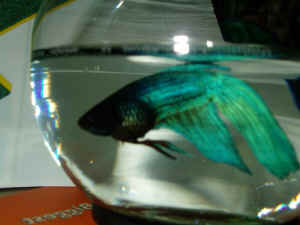
Oooh, I don't feel so
good...
|
 |
Betta Success
Doing what it takes to keep Bettas healthy long-term
by Robert (Bob) Fenner
|
|
Strange white spots/cotton mouth? on my Platys and Betta; plus
broken link
> I tried looking at the article mentioned on
>
http://www.wetwebmedia.com/before/index.htm
> 'The vast majority of times fish get sick, the disease involved is
> whitespot, velvet, finrot, fungus, or the shimmies. Use this article to
> establish which disease is causing your problems, and then select the
> appropriate treatment.'
> Unfortuantely when I click on 'this article' I get a 404, same with
> 'select' so hopefully this email wont be too out of place.
> <Thank you for this. Will take a look/see>
> A quick history, I'm new to aquarium keeping, and had thought things were
> pretty settled out when I went out and purchased some additional fish and
> plants for my 50G/200L tank. The day after putting the plants in (rinsed
> in RO water, but guess not good enough) I found all of my shrimp upside
> down on the bottom of the tank, some floundering around.
> <? What from the plants themselves would cause this?>
> I panic'd and added too much Tetra Aqua Safe (Water/metal treatment) which
> allowed a few of the shrimp to recover, but then caused havoc with the
> fish. I did man water changes over a week and also upgraded the HOB filter
> that came with the tank to an Eheim Ecco pro canister. After a week of
> trouble things appeared to be as good as ever with happy fish swimming
> around. During the challenging time I lost one of the new platys and one
> of the new guppies I had bought for the tank.
> <Mmm; how long has this tank been set up? Best to let all run a week or
> more before introducing any life... then allow the system to become
> established in terms of cycling.... before stocking more>
> A week passes and yesterday I look at my tank and find my betta with a
> funny gray/white chin/mottled blue face instead of the black it has been.
> The other new platy I bought a few weeks ago has a funny white fuzzy stuff
> on his mouth, and now I'm anxious it might be Columnaris that will wipe out
> my tank.
> <May be... but...>
> I've isolated the platy and betta to another smaller tank but now in
> looking closer at my other fish I am seeing little white spots that almost
> look like paint on some, and I *think* maybe holes or skin damage on the
> other platys. Unfortunately Im too new to this to really know if what Im
> looking is normal fish anatomy or something going horribly awry.
> <Just stress... from the system being new, water quality issues>
> Here's a 2 second video of the platy with the funny mouth
> https://www.youtube.com/watch?v=pfQ56mRgdzY (I couldnt get a photo
> unfortunately)
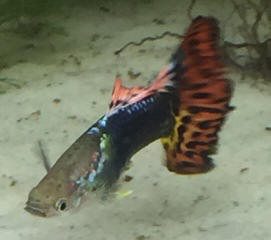
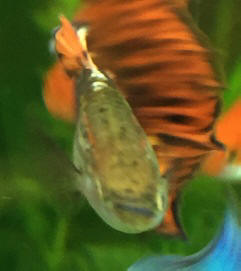
> Here's a few photos of the platy, betta and guppies. Would love if you
> could tell me if I'm hallucinating or if everything is ok? I keep reading
> about a specific antibiotic Kanamycin but have no idea how I can get it
> here in the UK ?
> <Am going to ask Neale; who lives in Britain... for better input here>
> Anyway, thank you very much for any insight you can provide!
> -Crh
> <I encourage patience, and no medicine introduction at this juncture. Your
> fish's troubles are not likely pathogenic, but environmental. Treating may
> well make matters worse. Perhaps a good general freshwater book to read for
> now.
> Bob Fenner>
Re: Strange white spots/cotton mouth? on my Platys and Betta
<<Bob’s covered the basics, but some thoughts. Excess mucous production and/or
poor mechanical filtration (i.e., removal of silt rather than ammonia) can cause
fish to appear speckled out cloudy even though they’re not sick. Replacing the
mechanical filter media, checking for an irritant (such as copper or
incorrect/sudden changes in pH), and the use of flocculants (sometimes called
filter aids) can help. A series of large water changes is usually helpful where
there are large quantities of silt, together with stirring/cleaning the
substrate. Second though is the use of salt to stress freshwater parasites.
While not an option for the Betta, you can easily up the salinity to one-quarter
seawater and cause livebearers such as Platies and Guppies no harm at all. This
will severely stress most ectoparasites (velvet, ick, even Costia) and to some
degree can even help with bacterial infections (particularly where these are
opportunistic). Mouth Fungus (the bacterial infection Columnaris) is always a
possibility, though it is relatively easy to treat as per Finrot if caught
early. Antibiotics such as Kanamycin cannot be legally obtained in the UK (or
indeed most Western countries outside the US, and even in the US the
free-for-all on antibiotics isn’t likely to persist for much longer; do see the
issues with antibiotic resistance). However, you can obtain them from vets,
typically for around £10-15, which is about 2-3 times the cost of generic
aquarium treatments here. With that said, a product called eSHa 2000 is
generally excellent against bacterial infections, much better than the other
antibacterials I’ve used here (the Interpet one for example I’ve never had any
success with). eSHa 2000 costs about £4-5 a pot and is very economical to use.
It, and eSHa EXIT for external parasites, are the only two medications on sale
in the UK that I use or recommend. Cheers, Neale.>>
Re: Strange white spots/cotton mouth? on my Platys and Betta
<<The Platy in the video looks like he’s damaged his mouth, got some dead skin
there, but isn’t otherwise in trouble. If he can feed okay and is swimming
about, I’d not worry overmuch. I’d look out for opportunistic infections, such
as fungal infections, but good water quality (hard, alkaline chemistry too)
should be all he needs. Low-end brackish conditions tend to minimise fungal
infections, so if he’s in an all-livebearer tank, 3-6 gram/litre salinity could
help. eSHa products widely sold; your local Maidenhead Aquatics for example
should stock and be open Sunday. Cheers, Neale>>
Re: Strange white spots/cotton mouth? on my Platys and Betta
From the plants I believe it was pesticides used to keep snails/etc.. off them.
<Strange>
The tank has been setup for 6 weeks ish, ammonia is 0, nitrite is 0, nitrate is
about 5-10.
Changing roughly 25% water once or twice a week and using (now) seachem prime to
condition.
Could you see anything from the photo's or video that looked odd? Thanks!
<Not really; no. BobF>
-Crh
|
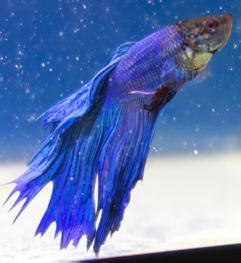
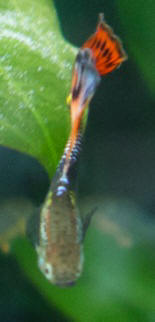
More than full size |
|
Healthy happy Betta dead within 24 hours - is it the end of
my fishkeeping affair :-((
9/11/14
Dear WWM team,
<Irena,>
I've never believed that one is incapable of keeping fish, but despite
my love for all things fish, it might, sadly, be true. You are pretty
much my last hope before I stop this hobby for good, as the fish pet
shops are of no help.
<Oh dear.>
Today my Betta fish which was happily swimming and eating yesterday is
dead. He was living in a smaller Betta-tank for around 4 weeks.
Initially
I did water changes of 80% weekly and then (after reading more about
Bettas and considering a small size tank) was doing 100% change every 4
days.<Good. Please can I stress the point that the secret to Bettas is
living space. Forget about the "living in jam jars" thing. Massively
labour intensive approach. Instead get a tank around 5-10 gallons (20-40
litres) in size. Everything will become much, much easier if you do
this.
Installing heaters, choosing the right filter, and providing enough
volume of water to buffer against temporary problems or changes.>
I was feeding it 1 to 2 Betta pellets once a day with a fasting day once
a week.
<Possibly not enough. Does depend upon filtration and tank size. In
tanks without filters, even the smallest amount of food can cause water
quality problems; in a 5-gallon tank with an adequate air-powered
filter, overfeeding isn't that much of a risk after the first 4-6
weeks.>
The tank was sitting on the heating mat giving the temperature around
15oC (59oC).
<Much too cold. These fish come from Thailand. Hot, hot, hot! Something
around 25 C/77 F is about right.>
Any further increase in the temperature was not recommended by the pet
shop who sold me this fish.
<Useless advice.>
I always used Prime water conditioner, no bettafix etc.
<Good.>
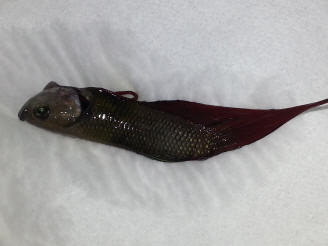
Photo of the poor deceased fish is attached.
<Indeed.>
There was no ammonia / nitrate in the water. Nevertheless, when I noted
him a bit lethargic and not eating this morning, I did another 100%
water change. He stayed closed to the surface, but after a while started
darting back and forth, clearly in distress, often falling on the bottom
of the tank. By 6 pm today he was dead.
<Yes.>
There was no visible discoloration. On average I saw him changing colour
a bit between day and night. I also noted horizontal lines on his body,
more visible when he was pale in the morning.
<Colour changes at night are normal, but can also be associated with
stress.>
As he was kept in our rather darkish kitchen / living area, I was using
an electric lamp during the day, maybe this is the reason of his change
of colour between day and night. I do not recall using any lotions or
soaps around him. Also do not recall dipping fingers in the water. In
fact
yesterday was his fasting day. Does it all sound odd?
<No.>
Is there such thing as bad luck in fish keeping?
<No. Like pretty much any skill, there's a set of things you need to do
first to succeed. Reading helps. Getting a big enough tank, some source
of heat, and proper filtration are the "holy trinity" of fishkeeping.
Get them right, and the rest is child's play.>
Maybe I need to take any fish bowls form the kitchen area and try other
area in the house??
<I would spend some time reading first.>
My previous (and very first Betta) lived for about a year in an unheated
same tank with partial water changes. He slowly got discoloured and
eventually passed away from what I though could be old age.
<Or luck that he survived so long... perhaps warmer weather (summer)
meant his water was warmer than 15 degrees C?>
Below is my disastrous fish keeping history - as much as I love the
hobby, I can't help feeling as a fish murderer. Maybe it is time to
stop.
* First 3 gold fish bought in 2001. Lived in a plastic bowl for 2 years.
No filter, weekly partial changes. Had no problems for 2 years. Then
they started slowly dying out. Once had constipation which was
successfully treated and lived with me another year. The other two
eventually passed away.
* Got another 2 gold fish in the same bowl, who were OK for the next 3
years, and then passed away. I believe it was dropsy.
<Bowl-induced goldfish death. Bowls are to Goldfish what guillotines are
to French aristocrats.>
* Thought that I need to do fish keeping properly and got 140 l aquarium
in
2007. First batch of gold fish from a local pet shop did not survive - I
did not understand the need for cycled tank.
* Cycled the tank and tried to keep 2 fishes in 140 l, using prime
conditioner. Got all proper water testing kits, a large Fluval filter,
substrate, plants. Fish lived for around 3 years, but slowly died out.
* 2010-2012 no fish
* 2012 - recommissioned the tank. Bought an Eheim large outside filter.
Cycled for 3 weeks. Introduced 3 gold fishes. Water OK, tested daily.
Fish died. Introduced a single fish. Ammonia 0, Nitrite 0, Nitrate low.
frequent water changes. Fish died. Decommissioned the large tank.
* 2013 - tried to give fish keeping another go - Betta this time. No
luck!
Any help and advice are greatly appreciated.
Kind regards,
Irena.
<Might direct you first to Bob Fenner's "pocket money priced" book of
Betta keeping, here:
http://www.amazon.com/Betta-Success-long-term-Successful-Aquariums/dp/1494867818/ref=la_B001K810CI_1_2/186-9319682-7061545?s=books&ie=UTF8&qid=1410370856&sr=1-2
Easy read.
Do also look at his briefer summary here:
http://www.wetwebmedia.com/fwsubwebindex/betta_splendens.htm
Then your humble correspondent has a few words to say about goldfish and
stocking tropical fish tanks:
http://www.wetwebmedia.com/FWSubWebIndex/goldfish101art.htm
http://www.wetwebmedia.com/ca/volume_5/volume_5_3/stocking.htm
http://www.wetwebmedia.com/FWSubWebIndex/fwlivestk.htm
Find out what your local water chemistry is. Hard or soft. Then choose
hardy fish that enjoy those conditions. In hard water that could be
Platies for example. In soft water many of the tetras (though I'd avoid
Neons to be honest). Some fish will do well in both, Danios and Bronze
Corydoras for example. Pick and mix hardy species, adding a few at a
time, with at least a couple weeks between each batch. Hmm... more I
could say, but this should help. No, don't give up; but yes, do read,
reflect, ask questions. Cheers, Neale.>
|
Re: Healthy happy Betta dead within 24 hours - is it
the end of my fishkeeping affair :-(( 09/11/14
Neal,
<Irena,>
Thank you so much!!!! I will do the reading again and try again.
<Wise.>
I am in Western Australia. Will check the hardness of water (ours is pretty
soft I believe). Our pH is usually high - around 7.8. Could
that be the problem? I used filtered water before, it seems to lower pH -
maybe should revert to that?
<Possibly. If it works for you. Do check water chemistry if you use filtered
water or mix it with tap water. Basically, for a mixed community of fish you
want around 10 degrees dKH, pH 7-7.5.>
Will keep persevering!
<Good luck!>
Thank you again,
Irena
<Cheers, Neale.>
|
Normal Coloring or a sign of sickness?
(Bettas) 4/8/14
decide to come straight back with a few questions! I recently came into
possession of two male Bettas. Thanatos, or just Natos is a lovely black
dragonscale crowntail with gorgeous red fins. His dorsal fin however,
does not look like his others, whereas his ventral, anal, and caudal
fins are red with black tips and silver streaks on the rays his dorsal
is entirely silver with a bit of black on the rays. While it looks like
normal coloration, it was something I did not notice when I bought him.
But the thing I am actually worried about is this fine "dust" that I
worry may be velvet.
<Mmm; not likely this Dinoflagellate... simply on the basis that it
would have killed the fish. See WWM re Velvet and FW fishes>
Under a flashlight he has this fine dust kinda light brown in color only
behind his head along his spine to his dorsal fin. He is active, eats
well and when shown a mirror, flashes aggressively much
like my steel blue bicolor, Mako.
I have not treated for velvet yet because I recently added API First
Layer Pure Laterite substrate so that I could add in some Amazon
Compactas. Both tanks are clouded due to adding it and I hope that the
laterite dust is the "dust" that I'm seeing on Natos. The box says that
the cloud will clear but it has been around 18 hours since adding the
substrate. If it is velvet, I have a 1.5 gallon tank on hand to treat
him in.
Mako is another story. I believe him to be a giant crowntail as when
placed next to Thanatos, he dwarfs my poor little tough guy. However,
his coloring makes me worry. Mako was a Wal-Mart rescue submersed in
icky brown water.
Though he is inquisitive and lively, there are so many diseases in
Bettas that I worry for the slightest thing though I try not to jump the
gun. When I bought Mako, I had him housed in a 1.5 hexagonal tank with
several fake plants, a bubbler set to very low(so that I would not
damage his fins) and a small filter. I performed 20-40% changes when his
water clouded, rinsing excess food and debris from the gravel (until I
can get a gravel vac) and then slowly acclimated him back to the water
by bagging him (I know this can be stressful to him, but I'd prefer that
evil over a shock related death) and floating him in the water for an
hour, the slowly adding new water (about 10-15%) every thirty minutes
until the water is mostly the tank water, then released him.
He was rather pale when I got him, so much so I couldn't tell if the
poor boy was supposed to be steel, black, white, or copper! After
getting him in his tank he began to brighten up and I was able to
identify his as a steel blue. He is very iridescent, and even his red
fins pale out to a metallic pink due to a silver wash color that makes
him very flashy to watch.
However, recently when I bagged him to add the Laterite substrate
without harming him, I saw that the very ends of his fins were clear.
Should I be worried or is that a sign of fin regrowth?
<Not a worry; either genetics or new growth likely>
His fins were tattered (beyond crowntail appearance) so I was curious if
the clear fins was a good sign. He also has two large golden metallic
spots on his gill covers that I wonder if it is disease or his normal
scales.
Both Bettas are currently set up in cycled tanks, Mako's being a 5.5 gal
and Thanatos' being a 5 gal. They both have Amazon compactas to rest on.
Mako has a sunken ship and a small forest of silken plants to hide
himself in while Thanatos has a rock outcropping with silk plants
surrounding it to hide in though they never use them. They're too busy
trying to meet me at the front or attack their reflection... Both tanks
received a layer of the API First Layer mentioned above. Mako has a
small heater holding his tank at a beautiful 80-82 degrees while
Thanatos is in a warmer part of the house that stays about 80-85 degrees
year round therefore I did not see a reason for a heater. Thanatos has
an Aqueon Quietflow that came with his Bow Front aquarium. Mako has a
Top Fin 5.5 gallon with the power filter that came with it, which I need
to replace. It is far too powerful for Mako and buffets him about like a
ragdoll. To keep water moving I reinstalled his bubbler, but I'd like to
find a less powerful filter that won't harm Mako or his delicate fins.
Do you have any suggestions?
<Just the usual reading>
I still have the air powered filter from my 1.5 gal should I try to
reinstall it just as a means of filtration until I can find a less
powerful filter? Are there any Betta specific filters?
<Not that I know of; but any low volume one/s will do>
Both tanks operate at a often stable 0 nitrite and ammonia level that
only minorly raises before I deign to clean. I have hard water that
hovers around a pH of 7.5-7.6. My house operates on a 40-year
old-country well. So I worry less about the chlorine, but treat the
water anyway to err on the side of caution. Never know what nasties end
up in the water.
<If you drink it... I wouldn't be concerned>
I want to be sure I am doing this right. I want my pretty boys do have
long happy lives of comfort.
Thanks for your time guys!
sincerely,
Brittney
<Keep reading! Bob Fenner>
Betta Inquiry; hlth. 6/22/13
Hello,
<Ang>
I recently received a male Crowntail Betta (it was purchased from a chain
pet store on 6th of June, 2013) from a family member because
they could not get the fish to eat.
<... unusual... Is this fish in a heated (tropical), filtered setting?>
After dabbling with a variety of foods, I finally figured out that
he would eat freeze-dried bloodworms.
<A poor choice... Please search, read on WWM re this and
suitable environments for Betta splendens>
He has been his happy Betta self, although today (while his behavior has
remained the same) I noticed that he appeared to be hiccupping
of sorts and I was wondering if that was cause for concern.
<Is. Bob Fenner>
Thanks,
Angela Simmons
Re: Betta Inquiry 6/23/13
Hello Bob,
<Angela>
The fish is in a tropical environment suitable for Bettas that is properly
heated and filtered.
<Ah good>
He refuses live food, although today I did manage to tempt him with
frozen brine shrimp and frozen bloodworms.
<... I'd skip the sewer fly larvae... Again, just search WWM re
rationale... And here re Betta nutrition:
http://www.wetwebmedia.com/FWSubWebIndex/betfdgfaqs.htm
I have had (and still have) numerous Bettas yet this one appears to be a
picky eater. While the ‘hiccupping’ has stopped, I am still wondering
what caused it.
<Could be... parasite/s, something stuck in the buccal cavity, an aspect
of water quality; many other possibilities. B>
Thanks,
Angela Simmons
One white spot in Betta 2/15/13
Hi, I have had my Betta for 6 months. He has always been in a Fluval
edge 12 gallon with 3 media filtration system, & heater with temp
consistently at 78 degrees. He is by himself. I feed him high quality
pellets once a day to prevent from over feeding & to maintain ammonia
levels at minimum low.
In the beginning when my tank was still new & I just got him his color
faded & developed fin rot. I immediately got fungal medicine and after
3-4 weeks of monitoring I was able to get rid if it. I even bought a
Malaysian driftwood to lower the ph in the water. It was over 7.8 at the
time.
For the past 5months I have been doing 30- 40% water change very 7-10
days, I add salt
<I wouldn't. Please search WWM re. Not necessary; may be detrimental>
(but not the full amount each time always half less because of frequent
change), & water conditioner. I change the sponge in media every 1mnth
to 1.5mnth, & change his carbon/zeo crystals every 2-3wks. he has been
growing, & his tail is almost back to his fullest. He has gotten so
beautiful vivid red & he is getting some neon blue tint in his tail &
body.
Very active & very interactive. He goes straight to top of tank waiting
for his 7am feeding time.
But for the past couple of wks I noticed he had a white spot on the side
of his body. I didn't think anything of it, but I wanted to monitor it.
This mrng it appeared slightly larger. No bumps, no other spots, no
discoloration, no velvet texture, & no change in behaviour.
<Not to worry re this one spot. Not likely parasitic; disease-related>
I have a water test kit, & all levels were exactly where they are
suppose to be.
What could the white spot be from? am I not putting enough salt?
<Perhaps a physical injury, accumulation of body mucus at the spot.
Again, I'd leave salts out.>
Sorry for the long description, but I wanted you to know everything
first.
Best,
Roya
<Cheers, Bob Fenner>
re: One white spot in Betta 2/15/13
Hi thank you for your quick response!
You said to not add salt, do you mean to not add salt at every water
change?
<Correct>
I thought I should add salt, but since I'm doing regular changes I should
add half of what I'm suppose to ( 2tsp per 2.5 gallons).
How much should I add at every 30-40% water change for a 12 gallon tank?
<.... search WWM re... >
You mentioned it could be mucus build up? How could he get that?
<Fishes produce it... see WWM re this also>
so this will go away on it's own?
So its not a fungus, parasite, or disease?
Roya
<Keep reading. B>
|
Sick Bettas, Roundworms?
12/5/12
Hi! I'm hoping you all can help me. I have 7 female Bettas in a 26
gallon bowfront. It's heavily planted and has a gravel substrate. It all
started one day when I noticed that one of my Bettas had a paler
spot between it's mouth and gill. It wasn't a slime patch, it looked
like it had just lost it's color.
<"Does just happen" at times, but can be indicative of other troubles>
I wasn't sure what it was, so I just kept an eye on it.
<Good>
A couple of days later, I saw a scale fall of where the pale
spot was. The next day, something was growing out of it. The
best word I can use is fronds, almost like an anemone, but much thinner.
I went to my local fish store, and talked to the owner, and he said it
sounded like Columnaris.
<Mmm, maybe Camallanus... roundworms. See WWM w/ the Nematode genus name
in the search tool>
He told me to use Maracyn, and that it would clear up. So I moved her to
my hospital tank and dosed her. On the first day of treatment the fronds
went away, but where they were was a sore. I thought she was getting
better, but on the last day of treatment, the fronds came back. I did
some reading on the internet, and saw that a lot of people had luck with
Furan 2,
<This won't treat/rid worms either>
so i did a 100% water change, and a couple of days later started the
Furan. It didn't seem to do anything at all. About this same time, I
noticed that 2 of the other Bettas had Finrot.
<Likely from exposure to the other med.s... a slippery slope...>
I went back to the fish store and was told this time to try Maracyn Plus.
I moved the first Betta back into the main tank since i would have to
treat them all. While I was moving her, the fronds came off, but they
left almost a hole where they had been. I did the course of Maracyn
Plus, and it seemed to help the Finrot. After the fronds fell off, it
seemed to heal, without the paleness, and she has been doing a lot
better. But now one of the other Bettas has the same thing, but it has
4-5 of them, one was big, the other ones were pretty small. I decided to
move that one to the hospital tank, since the other problems had cleared
up. And again, while trying to catch her, the fronds of the big patch
came off, leaving a giant wound. I got really upset and went back to the
fish store for the third time, talked to the owner yet again, and this
time he said maybe it was a fungus. He sold me some API Liquid Fungus
Cure,
<... of no use>
which also hasn't seemed to help at all. I'm pretty sure I'm going to
have to euthanize the Betta, she won't eat and the wound doesn't seem to
be healing. Do you have any idea what the problem could be? I trusted
the fish store owner, but nothing he said seems to be right. About my
tank, ammonia and nitrites were at 0, nitrates were about 30ppm. PH was
a 7.6, and the temp stays about 75/79. It's been an established tank for
about a year, and I've never had any problems before this. If you can
give me any idea how to keep this from happening again I would be very
grateful. Thanks!
<Do take a read here:
http://www.wetwebmedia.com/FWSubWebIndex/nematodesfwf.htm
Does your situation look like these examples? I'd be treating w/ an
Anthelminthic... Like Prazi/quantel... in foods if the fish are eating.
Bob Fenner>
Re: Sick Bettas 12/5/12
Thank you for the quick response. I took a look at the link, but that's
not quite what it looked like. I know this is going to sound stupid, but
if you look at the attachment I sent, it looked like this, but it was
all gray/white.
<Descriptive of mycelia... a true fungus... These are actually rare in
aquariums. Most what folks call fungal are bacteria>
The fish that had them the worst passed away last night, but I would
like to know if this was something I could keep from happening again.
Again, thanks for your help
<Good maintenance and nutrition are the best avenues to keep such
infectious disease at bay. BobF>
|
 |
New Betta Question 6/13/12
Hi! I'm a new Betta mom (as in three days new). My beautiful little (and
I do mean little, he's the smallest Betta I've ever seen) Zen is
swimming all over his 10 gal. tank, he especially enjoys surfing with
his filter current and playing NASCAR around his heater. I have only one
small problem with him that has me a little paranoid and have exhausted
every search engine I can find to try and get an answer; his ventral
fins seem to stay quite close to his body (except when he is turning or
when he is flaring and even then they have me nervous because they seem
to cross over each other). I don't know what to do! Am I worrying over
nothing or is he seriously sick?
<Worrying will not change the future; assuredly. Perhaps these pelvics
haven't "developed" as yet... or they may be somewhat different than
general for Betta splendens. At any case, as you state, the fish is
apparently healthy and happy...>
Is it clamped fins (which I'm not sure because it's only his ventral
fins that he keeps close, all of the others flow out brilliantly,
besides his dorsal which has a slight curl over like it's too long for
him and seems quite smallish in width)?
<Don't be concerned... this is natural>
Oh, I wish my camera was working so I could attach a picture! Thank you so
much for your time and help, Erin!
<Welcome. Bob Fenner>
Siamese fighter. Hlth., fdg. rdg. 6/4/12
Hi, about two or three months ago I bought a red crown tail Siamese
fighter which I noticed back then I noticed had some light spots on its
head they're not cottony and they're not pure white. They're a
pinkish colour and I see now he still has them. He's got them about each
eye and other two on each side of his head. Should I be worried?
<Mmm, no; likely "natural coloring">
The temperature is about 27 degrees Celsius and the eater is fairly clean.
He eats normally , I give him the Tetra Betta food is that okay?
<Yes; though I'd augment this w/ meaty, small size foods... See WWM re:
http://www.wetwebmedia.com/FWSubWebIndex/betfdgfaqs.htm
Bob Fenner>
Sick crown tail Betta... why not search, read ahead of writing us w/ no
info.? 4/7/12
This morning I started noticing my male Betta was being lethargic. A
few minutes ago I saw he was at the surface not moving much and another
few minutes later I saw a white patch starting to form on his head and
cover his eyes and now he's blind. Anything in particular that can
cause this?
<Many>
A specific disease maybe? He was a tiny bit lethargic yesterday and the
day before but I thought he was just resting. Can I save him?
<... system, water quality, foods/feeding...? Where's the useful
data? Read here: http://www.wetwebmedia.com/FWSubWebIndex/bettadiseases.htm
and the linked files above. Bob
Fenner>
|
Could you provide a diagnosis.
2/9/12
> Hi,
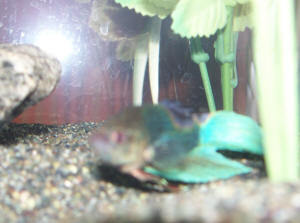
> Here is what my Betta looked like the day before he died. I
really do my best to take care of my fish. I had a
Betta for 4.5 years
<Wow! Most Bettas live 2-3 years... yours was very
long-lived>
prior to this one. The status of my aquarium is this: 10
gallon, cycling, and now has 2 cory's in it. My Betta was in
it, but it died two days ago.
> Is my tank infected?
<Not direly so; doubtful. The photos reveal some sort of
decomposition, mostly in the latter, upper body area...>
can you see what was wrong with the Betta? is my tank
> infected with something? are my cory's safe?
<Likely so>
> Thanks again,
> Kaite
<Welcome. Bob Fenner>
|
|
|
Re: Could you
provide a diagnosis.
2/9/12
Hi Bob,
<Katie>
Is there a possibility of diagnosis? Is there a name for what
happened to my fish that you know of?
<Senescense as hinted. There is no better definitive
possibility w/o sampling and microscopic examination; possible
staining, culture...>
Also can you please give me some advice on what I should do?
Anything? Nothing?
<I would do nothing... simply
"treating" blindly, using a biocide will do nothing good.
Read here: http://www.wetwebmedia.com/FWSubWebIndex/BetDisDiagF.htm
and the linked files above for much more.
B>
Thanks again,
Katie
Re: Could you provide a diagnosis. 2/10/12
Hi again,
Do you think his problem was fungal? Bacterial?
<Again, and hopefully for the near-last time; there's no way
to tell w/o...>
I really don't want this to happen again. I read on your
site that salt was not the answer, neither was the Melafix.
<Worthless>
You do recommend something (...2000) that is available in Europe. I
spent a lot of time searching your site. Its really hard to gather
info.
What do you think?
Katie
<The same as the two last email exchanges. See below/above.
B> |
|
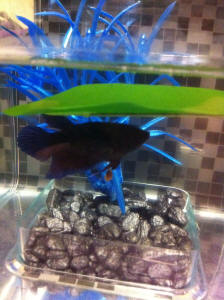
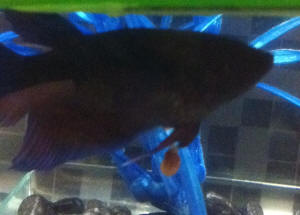
Betta with a Hernia? 2/4/12
My roommate's female Betta has a protrusion from her stomach.
It looks like a small kidney bean that is attached to her tummy.
Earlier this week she was acting like she was having seizers so
we tested her water and her nitrate and stress levels were high
so we changed her water and added aquarium salt to reduce the
hardness, and she seemed fine after that.
She has a normal appetite. Her diet is mostly Betta pellets with
freeze dried blood worms given occasionally for a treat. She
lives in a half gallon tank with a Betta hammock and a plastic
plant. Her water gets changed once a week and while her tank does
not have a heater we try to keep her water temperature in the mid
seventies or higher. She has been blowing bubbles more often then
normal as well.
<Mmm, I don't know what this might be; but definitely not
a kidney... these are retroperitoneal as in ourselves. If it were
me, mine, I'd leave this mass as is; not treat... likely it
will drop off of its own accord. Bob Fenner>
|
  |
Betta
in harder water 11/23/11
Hello:
I was thinking of putting a Betta into a 20 gallon long that I put a
tablespoon of marine salt in. The Betta that I had in there this
morning with fungus on the tail died after a water change. Since the
marine salt
went in there, the ph is a lot higher. I was wondering if I should
drain the water first and fill it with soft tap water or it is ok to
leave a healthy Betta in a tank with a little salt for a few days??
Thank you!!
<Hello Judy. It's unlikely your Betta died "because of a
water change" so you might want to establish the true causes here.
Surely the fungal infection reflects poor environmental conditions
and/or nippy tankmates. Review, and act accordingly. Since you have an
aquarium now, cycling shouldn't be a problem. Adding tiny pinches
of flake food each day or two should keep the filter bacteria happy
even if there isn't a Betta in the aquarium. Next up, remember
Bettas are basically incompatible with other tropical fish. Among
common community fish, the only obviously safe tankmates are
Bristlenose catfish and Corydoras catfish. Danios, tetras, barbs,
cichlids, etc. generally cause problems. Thirdly, there's no need
to use salt in a Betta aquarium. It has, historically, been used in
Betta bowls, where the salt slightly (but not completely) offsets the
poor nitrate/nitrite levels that exist in bowls. But in a proper heated
and filtered aquarium, there is absolutely no need for salt except in
those situations where it is used for a short period to combat
Whitespot or Velvet. Concentrations of 2 g/l will do no harm at all,
but honestly, you'd
do best to flush out most of the salt through a couple of largish water
changes across a couple days before you go buy the new Betta. Do please
read:
http://www.wetwebmedia.com/fwsubwebindex/BettaGldfshKpgArt.htm
http://www.wetwebmedia.com/fwsubwebindex/bettasysart.htm
http://www.wetwebmedia.com/fwsubwebindex/SaltUseFWArtNeale.htm
Cheers, Neale.>
Help
with my little Betta, Buddy
11/6/11
Hello experts of fish! I have just found your site and have been
diligently searching it for answers to what is going on with my Betta
(Buddy), but have only found bits and pieces in posts but nothing that
sounds quite right for his situation. I am hoping you might be able to
provide some guidance, please and thanks.
<Ok and welcome>
So, I've had my Betta for about a year and he initially started off
in a 1/2 gallon bowl, but then I began reading about Bettas and felt it
was cruel and set him up in a 3 gallon tank with a filter and a little
heater around February. I have always fed him 4-5 little Hikari Betta
bites per day with no problems and he always gobbled like a little
pig.
<I'd definitely expand on this diet. Please read here:
http://wetwebmedia.com/FWSubWebIndex/betfdgfaqs.htm>
I kept his water clean with a vacuum of about 1/3 his water per week
and keep a plastic jug of water treated with water conditioner.
<Good>
He then turned into the happiest little guy and seemed to love life; at
least, until a couple of weeks ago. I noticed that his fin seemed to be
a bit smaller, was looking a little tatty and less vibrant, and had a
slightly whitish edge.
After doing some research, I thought it could be fin rot so I
transferred him to a smaller bowl so that I could do more frequent
water changes and monitor him a bit better (in hindsight, perhaps a bad
idea but I was thinking it was like a little "hospital"
bowl). I stated giving him small doses of aquarium salt according to
the package and checked all his bowl water parameters (except that my
strips do not test for ammonia, which seems problematic). He didn't
seem to be getting better and then he became progressively worse. At
first, he seemed to be having a hard time breathing and his fins were
gaping at an alarming rate. He also was quickly swimming to the surface
to the point that I thought he may propel out, at which point I covered
his bowl a bit to prevent that (but obviously left room for air to
circulate).
<Something is wrong here... water quality wise... or perhaps your
Betta has "eaten a bug" of some sort that has found its way
into the system>
At this point, he has a very hard time swimming to the top and once he
does swim to the top for air or food, he immediately sinks back down,
and pretty rapidly. His breathing is labored and his gills seem to
slowly open and close. His bowl water is between 78 and 80 degrees and
I am trying to do water changes every other day or so with a turkey
baster while trying not to disrupt him. I have a little silk plant and
a leaf hammock near the surface, where he often sits so that he can
reach the top of the water to breathe more easily. I noticed that there
did not seem to be "poo" in the water and I was afraid of
swim bladder,
<... there really is no such thing>
so I fed him some pea bits for a few days, which he readily ate, but
still no poo. He was trying to eat and would swim to the top when he
saw me for more than several days, but all of these actions have become
more difficult in the last couple of days. For the past 2 days he was
really trying to swim up and eat, but he did not appear to be able to
stay at the surface for long and would fall back down, therefore
missing most of the food. I called two fish stores I frequent to ask
for advice, as I did not want to dose him with anything without knowing
what may be wrong with him in order to avoid stress.
<Ahh, very good>
They wanted me to bring him in but I really was afraid of stressing him
out so I have been checking the internet ad nauseam to see if I can
find an explanation of all of his symptoms, which I have not.
Additionally, under his head and now more around his head as well has
been turning whitish/silverish, which seems concerning. He was always a
vibrant blue/purple and now he is a very dull color. Honestly, and I
know this is terrible, but I go to bed every night thinking he will
pass, but things have been getting progressively worse for the past 2
weeks and it seems like he is fighting, which makes me feel even more
terrible because I have not been able to improve his life. I am afraid
that he is really suffering and I really want to put a stop to it if it
is necessary, although that makes me cringe. I know that I have to do
what is best for him. Any advice on next steps would be appreciated.
Thanks so much!
Amber
<In such circumstances (not knowing what the actual root cause/s
might be), my reaction is to default to wholesale change of the
environment... Keep the filter media wet, but either dump all else, or
bleach, rinse, treat for chlorine... and start again. Some might advise
you to add a modicum of Epsom Salt as well. Please do relate your
further observations, experiences here. Bob
Fenner>
Really calm Betta or he is
sick? 10/1/11
Hello:
I managed to give away all my female Platies due to not wanting them in
with the males and keeping the large tank on the counter. At the store
where I dropped them off, I found an actual rare black crowntail Betta
and bought it. I never see these around and I was thinking of getting
one for a long time. I have an old five gallon and he is now in warm
soft water with a hiding place. The Betta moves really slow and is now
hiding in a plant, really still, like he is meditating :) Could the
Betta be sick?? Freaked out by a five gallon after being in a small
cup?? or just really laid back?? Crowntails tend to be feisty, but this
guy is the most Zen Betta I've met. Thank you!!!
Judy
<Hello Judy. Bettas aren't very active anyway, and a day or two
after purchase, they may well be spooked. So give it time. Subdued
lighting and gentle filtration (as opposed to bright light and
turbulent water) will both help him feel at home. So long as he's
feeding and breathing normally, I wouldn't worry too much just yet.
After a couple days, bring a mirror close to the tank and see if he
reacts. He should get interested. Don't tease him with the mirror,
but as a way of checking a male Betta is healthy, it's as good a
way as any. Cheers, Neale.>
My poor Betta... reading 5/26/2010
Hello there. I am really hoping you can assist me in figuring out what
is wrong with Bear (my Betta). He is almost a year old and has been
very very lethargic lately. His color has not changed too much
considering the fact that he is a white Betta already. About a week ago
he stopped eating his Beta Color Bright flakes
<Insufficient nutritionally>
so I went and got him so fresher freeze dried blood worms. He still
won't touch them. I do a 1/4 water change every week and have
Stress Coat to take out the chlorine and other bad chemicals that are
in the water. He now just sits on top of his cave or lays near the
surface of the water. I was wondering if he's sick or possibly just
an old man on his way out.
Thank you very much,
Sophie
<... is this system filtered, heated? Read here:
http://wetwebmedia.com/FWSubWebIndex/bettasysart.htm
and here: http://wetwebmedia.com/FWSubWebIndex/bettadiseases.htm
and the linked files above... do you now know what the issue/s are
here?
Bob Fenner>
Mac...my blue Betta fish... hlth.
9/27/09
Hello,
<Hi,>
I hope I'm able to explain this correctly and not confuse you as
far as what's wrong with my Betta but I just happen to notice
he's got a bump on the lower part of his mouth.
<Most likely physical damage. Check the tank is big enough (at least
5 gallons/19 litres) and that the water current isn't so strong the
fish is buffeted about. Do check the water quality is good, otherwise
secondary infections are likely. Also check the water is warm enough
for the same reasons: not less than 25 C/77 F.>
I've had other betas before with problems but I've never seen
this one before. It sort of looks like a pimple and if you see him from
a side angle it's sticking out. I feed him the pellets (little
round ones) because he seems to love those instead of the flakes
because he has a hard time getting the flakes and I can tell he
get's frustrated because he can't grab them.
<Hmm... do try offering more of a variety, ideally some green foods
(cooked peas, squished) and live/wet-frozen daphnia and/or brine
shrimp.
Constipation is very common when people feed Bettas just flake, pellets
or freeze-dried foods.>
As far as the little bump to be more specific it looks like a little
pellet got stuck on his lower jaw stretching the skin out. Do you have
any idea what it could be?
<Without a photo, it's difficult to say. Physical damage is the
most common explanation for small, odd deformities that appear from
nowhere. But vitamin deficiencies can cause fish equivalents of goiter,
and exposure to chronically bad water quality or extreme water
chemistry can cause other developmental problems. Bettas are
"jumpers" and in small tanks can throw themselves at the hood
or tank walls, causing damage. Overly strong filters can damage their
fins and loosen scales. So there's a bunch of things to review.
Food is unlikely to cause damage from the inside of the mouth, though.
I mention the environment repeatedly here because too many people keep
Bettas in unheated, unfiltered tanks that are too small for them.
Regardless of what the salespeople sometimes suggest, these are
tropical fish that need a tank 5 gallons or larger with a filter
(preferably air-powered) and heater (central heating or an angle-poise
lamp won't do).
Almost all the myriad Sick Betta queries we get are from people who
don't consider these particular issues.>
I would appreciate your help with this and if you could give me some
advice on to how to treat it.
Thanks,
Miguel
<Cheers, Neale.>
Betta Illness: Unclear Origins 8/6/07 Dear
Crew, <Hi Alison, Jorie here today.> I've sent in once before
about my Bettas and you were very, very helpful. <Glad to hear this
- we certainly try our best here!> I'm hoping you can help me
with my most recent problem, as I've searched the archives and I
couldn't find anything to the specific incident I had. <I will
try!> Here goes: I have a two year old albino female Betta (with
little pink eyes), and she's always been my pride and joy.
<Ahhh, I'm jealous - these are beautiful fish! Quite expensive
'round these parts, too, which is why I don't have my
own:-)> I had her in a smaller bowl for the past month in order to
condition her for her first breeding so she had ready access to food.
When I keep my Bettas in the conditioning bowls, I usually do a 75%
water change every one or two days and remove any feces or left over
food with a dropper. <It certainly sounds like you know what you are
doing, but I'm a bit concerned about changing so much water at
once. Hopefully the new water is "matched" as closely to the
old water as possible (in terms of pH, temperature, etc.)? Otherwise,
you run the risk of shocking the little girl's system. When I tried
to keep a female Betta in a 1 gallon filtered/heated tank, that was the
problem I ran into; in trying to keep the waste product under
control...there's not much water to play with in such a situation.
Also, I have found that the fancier stains of Bettas (i.e., more
genetically manipulated) can result in the fish being even more
sensitive to adverse conditions...something to keep in mind.> The
problem is, I went out of town for a day, and when I got back, her bowl
was unusually dirty (not a big deal, someone in the house had given her
a treat (confirmed) and there was extra waste output). <It happens.
Whenever I go out of town, I make little Ziploc baggies of food for
each of my tanks, and emphasize that this is the only thing I want the
fish to be fed in my absence.> I went to change her water, and she
jumped into the dirty water bucket... <Wow - an active girl!> The
water contained pieces of cucumber and tetracycline from the other
fish's water. I netted her out and she jumped approximately 7
inches to the floor, where I picked her up and put her in her clean
bowl. Immediately, I noticed her swimming erratically. <She may have
injured herself, but hopefully it's just a result of shock, which
will remedy itself given proper care.> The characteristic swim
bladder problem of twirling came to mind. <It is possible the swim
bladder was injured in the fall...> However, I also noticed she was
able to maintain a chosen depth in the water, but was unable to stay
upright. Then I read the Wet Web Media article on swim bladders and the
part about their "ears", fluid-filled chambers that let them
know they are upright. That seemed more feasible, as she had it happen
literally within 10 seconds. <I'm not sure I exactly understand
what you mean here.> I am unclear why this happened or what I can do
to remedy it. I know she jumped out because I was home late and not
careful with her when doing my animal husbandry chores. <I think
this was just a fluke, honestly, and not something you should blame
yourself for...> What I am unsure of is what it resulted from
(shock, bacteria, etc.), and what on earth I can realistically do.
She's still eating voraciously, but having a heck of a hard time
doing it. She spins like a torpedo trying to get a bloodworm and
although she doesn't look miserable, I can't imagine spinning
forever to be an ideal sort of life. :( <Well, first things first.
It sounds like she lives alone, so this is good - no one to pick on
her, eat her food, otherwise stress her out. A Betta's swim bladder
is quite sensitive, so I'm betting she did in fact injure hers in
the fall/jump. It's good that she's able to swim up and down,
so that she can easily make it to the top to take in air. If that
weren't the case, I would recommend lowering the water level in the
tank, and giving her some decorations to be able to "perch"
on. The latter may actually be of use in your girl's situation; if
she's constantly spinning, give her a couple of spots where she can
"rest" in the tank, and just sit/lie. The good news is swim
bladder injuries/disorders are not usually painful and are rarely fatal
to the fish, and a fish so affected can live out the remainder of her
live in comfort. The bad news is there really isn't a way to
"treat" the injury, per se. The best you can do is keep the
water clean, keep her comfortable, make sure she continues to eat, and
allow her to rest (not that different that treating an ill child, is
it?!)> The fish whose water had been treated was a goldfish with a
great deal of finnage which had been damaged while struggling with
improper tank decorations. He has no parasites or diseases I am aware
of, nor does the female Betta in question. <That's good - no
pathogens, diseases transmitted to your girl, then.> Most treatments
I find usually only specify what to do for constipation or bacterial
infection of the swim bladder. <Yes.> I am most hopeful for a
suggestion. <Unfortunately, this is a case where only time where
tell. Keep her clean, warm and comfortable and hope that the injury
repairs itself internally. If not, make the necessary accommodations in
her tank (see suggestion re: places to sit/perch above) and she'll
likely live out her life comfortably. Do be careful about choosing
whether to breed this fish; if her swim bladder is truly injured, the
stress of breeding may well do her in. Unfortunately, she may be better
suited as a true "pet", in a larger heated/filtered tank (3-5
gallons is ideal).> Thank you for your time. <You're welcome;
sorry I don't have a "magic cure". Hopefully time and
rest will be of use here. Best wishes, Jorie> Alison
Sick Betta... toxic system 11/12/06 Ok here I
go. I had 3 tuxedo guppies, 5 neon tetras and a male Betta. The beta
had white patches on him, was lethargic, had clamped fins and was
losing color so I treated the tank with fungus cure. After that he
patches were gone but even after some time the beta still was just
coming up for air and food so I did a 70% water change. I even cleaned
the gravel and plants (by boiling not with soap). After that the beta
was much better. His fins were opening slightly, he was swimming and
his color was coming back. After a few days one of the guppies died
with a bent spine. <All of a sudden? All of them?> I then recheck
all the water (ph, ammonia, nitrates...) and everything seemed to be in
a normal range. I also noticed that one of the other guppies had red
strings coming out of him and a bloody tail fin. I was so sad that even
though I noticed this, it didn't quite register. The next day the
other guppy died of what looked like internal bleeding since his
abdomen looked to be filled with blood. I looked around and found out
that this was due to worms so I treated the tank with an internal
parasite killer. <Active ingredient/s?> After a bit I noticed
that one of the tetra's was missing a tail. I tried to quarantine
him (like I had all the other sick fish) but he got so lethargic,
wasn't eating and was only trying to jump out of the water, <...
bad signs> I figured it was best for him to stay with his school. He
died soon after. After I finished the full treatment for the parasite,
the guppy still has worms but the medication said not to use more then
3 treatments which I had already used. This is when I noticed the beta.
He is staying near the top of the water, lying sideways most of the
time. He is not eating, and I have tried freeze dried bloodworms which
he used to love, flakes, and pellets. He also has scratches on his body
which is paper thin almost everywhere except his stomach which is much
rounder than usual. He also has a strange yellow sac hanging on to him
near his fin. One of his eyes is clouded over and the other has one
white speck on it that moves around pretty fast. If I were to treat
each symptom separately I would have to use: antibacterial, fungicide,
anti-parasite which would probably be overmedicating and I still
wouldn't cover everything. I was hopping that the symptoms might
match up with something that I could cure, and I have no camera so I
can't send a picture. Basically, what should I do? <Well...
something is definitely out of whack here... some type of poisoning...
Do you have a geode? Sea shell from the seashore? There is a source of
toxicity that you need to find, address... and soon. Bob
Fenner>
Betta diagnosis/prognosis 3/4/06 My little
Roswell has experienced quite a series of unfortunate events lately.
Although I have been successfully keeping another Betta fish, I fear I
have made things worse for the new guy (he's about 6-12 months
old). If at all possible, I would appreciate your advice as to
what's fundamentally ailing him and if he might recover. (I
apologize in advance for what will invariable be a long email...).
<No worries, take your time> Roswell lives in a nice 3 gallon
bowl with a soft plastic plant, a moss ball and one other small live
plant. He has a junior heater that doesn't keep the water
temperature steady per se, but keeps him at a more comfortable
temperature between 75-80 depending on the time of day. I change 30-50%
of his water every week with aged, treated water of the same
temperature and I clean out his entire bowl every month. <Would be
better to have a filter...> We don't have a PH or chloramine
problem in the city's water and I never let any of his uneaten
frozen blood worms stay in his bowl. And I definitely don't
overfeed...once a day, 2 mouthfuls of blood worms that he would grab
off my finger. <Needs more than this one food item...> 4 months
ago, he lost the small purple splotches on his body and tail, which
left him pink. After staring at him like a simpleton for weeks and
weeks I could never see anything wrong with him other than his fins
looked a bit unhealthy. So we treated him with Jungle Fungus cure.
<... toxic> It never really worked, even after an extended
treatment, so we stopped that and just observed him. His health seemed
to deteriorate about 2 months ago. We thought that perhaps he had a
parasite because his gills were getting a bit red and he seemed
irritated, though he didn't show any classic signs of parasites. I
put in 5 drops of Costapur and then another 2 drops 48 hours later and
I saw what was, I know in retrospect, probably a dead anchor worm
floating on the surface (at the time I thought it might have been just
an old piece of food because I was amazed that something of that size
could have gone unnoticed...perhaps it was in his gills). At this time,
his breathing had become more laboured and his gill plates (cheeks?)
became more reddened, so worrying that the medication was too strong, I
quickly gave him a fresh bowl. This didn't really help his
breathing. In fact, he started to "yawn" or "cough"
a lot and he was having problems keeping the air he inhaled from the
surface. He would gulp great bubbles and they would immediately escape
through his gills or mouth. His vision also deteriorated and he was
incapable of seeing my finger and jumping up for food. Because he was
having problems breathing, I got an aerating stone (...which led to the
escapade of swallowing bubbles and having to pass gas...). I tried
tetracycline for his inflamed gills but that didn't really help.
While changing his water (to make matters worse) the bottom of his
hospital bowl fell out. <!?> I had the bowl about a foot over a
plastic basin that I syphon water into and he fell with the water and
the bottom into the basin. Nothing fell on top of him, and because he
seemed to be just swimming about, I crossed my fingers that he would be
okay. Nothing changed (or got better) until, about 3 weeks ago, I
noticed a red mark near his anus and the very next day, there was a
huge anchor worm attached to him. <Yowch!> I bought Jungle
Parasite Clear which quickly killed the worm. The box recommended that
I treat once a week for 3 weeks, but when it was time for the 3rd
treatment, he just didn't look healthy enough to treat. His gill
plates were red, he was gasping a lot and had developed an equilibrium
problem. His scales looked like they were protruding a tiny bit, though
he wasn't bloated at all. I thought it might be the beginnings of
dropsy because of all the trauma so I did a couple Epsom baths and got
a wide spectrum antibiotic called Kanaplex that said it could help
treat dropsy (and gill disease), which I put in yesterday. <A good
move this last> Right now he's still lying on his side and
panting. I read a drop of hydrogen peroxide can help with the gills and
to oxygenate the water, but it doesn't seem to help in a
significant way. <Is only temporary> Perhaps instead of dropsy
(his scales look better) he has a swim bladder disorder. Could the fall
have brought that on, even if he didn't start displaying symptoms
of SBD until a week and a half afterwards? <More likely the
cumulative stress of treatments, the parasite...> Can a parasite
infection cause SBD? <Yes, to a degree> I think his vision is
improving and his appetite has always been okay, even if it's
difficult for him to scoop up the worms, he manages to eat a few almost
every day. He's in a small bowl right now for comfort sake and
I'll certainly continue using Kanaplex in case there is an internal
bacteria infection, but I'm not feeling very hopeful. I'm
shocked that he's still alive... I hope this isn't his new
normal. I would assume it was just SBD if he didn't still have red
cheeks and was panting a lot. Your best guess about what caused what
would be great. I can't imagine there's much more I can do, but
if you have any suggestions I would be happy to try them. And...I
hesitate to ask... at what point would euthanasia be recommended? Fish
and fish keepers around the world thank-you for your fantastic site!
Merci! <Mmm, welcome. I do encourage you to fit this fish's
bowl/system with a small filter of some sort (inside power, air-driven
sponge...) to facilitate biofiltration... Not to change out the water
entirely... And to read: http://wetwebmedia.com/FWSubWebIndex/bettasysart.htm
and the linked files at top. Bob Fenner>
Betta's keep dying, frustrated!!! 7/27/05 Hi Bob and
crew, <John> My partner was recently in our local pet store and
bought one of those Betta bowls you guys don��t recommend
(discovered later). The bowl was not filtered or heated and
Frankie the Fish grew white stuff (like a fungus) all over him and died
shortly after. <Try living in the refrigerator...> She then got a
filter for her bowl, aquarium salt and bought another fish, which was
named Frankie again, and the same thing happened, which really upset
our four-year-old son, as it was his pet. <Was this system
heated?> I started searching on the net after the second fish died,
and came across many sites, but your one seemed the most helpful, so
stayed up and read it all night. I then went out and
purchased a bigger tank 20 Litres, don��t know what that is
in gallons. <A liter/re is a little more than a quart, four quarts
to a gallon> I also bought a heater and a new filter to clean the
tank. <Yay! Now you're getting close...> We set
the new tank up, added aquarium salt and made sure the temperature
stayed on 26 degrees Celsius, which is 80 degrees F. After a
week, we went out and purchased our 3rd Frankie, as well as a Ph kit
for testing the water. We tested the water first, and all
seemed fine. We then added Frankie, and after swimming
around for a little while, he then would just stay at the bottom of the
tank, only coming up for air. He would lie on his side
sometimes below the heater, or on the opposite corner to the
heater. Frankie refused to eat anything, and would sometimes
swim around but mostly he would just lie on the bottom of the tank,
only coming up for air. Sadly to report, 3 days later, our
third Frankie is dead, which is sad for the fish, and also for our
son. It is rather frustrating now, after reading up on
everything for weeks and then doing everything right (as far as we
understood), for the same thing to happen. The third
one did not grow any white stuff on it, so at least the temperature
seemed to solve that. Are there any suggestions you could
give us at all? <Mmm, was this tank cycled? The principal cause of
captive aquatic life loss is actually accumulation of their metabolic
waste/s, or bottle-necking of chemical reactions therewith. Please read
here: http://wetwebmedia.com/FWSubWebIndex/fwestcycling.htm>
We also added some Bettafix to the water, when it was lying on the
bottom all the time. <Not necessary> Any suggestion
would be most welcome, as my partner does not want to get another one,
but our son loved his little Frankie and would always come to the tank
to see how Frankie was. Thanks for any help you can provide, John
<Please leave the water as is... perhaps add a bit of
"old" water from the store to it ahead of Frankie IV...
You're close to understanding, providing the basics. Bob
Fenner>
Re: Betta's keep dying, frustrated!!! 7/29/05 Hi Bob,
<John> I had already emptied the tank, but had not read up on the
cycled part of your website. I have read all of that now and
bought all of the kits to test the water. The guy at the pet
store said I did not need the nitrite kit, <Wrong> but I bought
it anyway. I filled the tank again tonight, and added
aquarium salt, added some Methylene blue as this has been recommended
on different sites. Got a new filter again, as Frankie III
did not seem to like the old one, when I turned it off, he swam
more. I will try to get some of the stores water for the
tank as well. The tank is sitting on 26 degrees
Celsius. Hopefully everything goes well this
time. Thank you for your advise again and prompt reply, it
is greatly appreciated. Hopefully everything will go well
this time. Thanks Bob, again. John <I wish you and Frankie well. Bob
Fenner>
Re: Betta's keep dying, frustrated!!! 8/11/05 Hi again
Bob, thanks for the advise so far, it is greatly appreciated.
<Welcome> I bought Frankie the IV and the V at a different Pet
store. So far both are living well, which is a great turn
around from what happened before. So thank you very much for
your advise. <Persistence pays! Congrats.> One lives in a 20
litre tank with 4 Cory's, 1 bronze, 2 panda's and an
albino. There is also 4 algae eaters in this
tank. <Do keep your eyes on these last... happens that
Betta's are often "rode on" by CAEs> In the other tank
at home, a 50 litre, it has with Frankie, two bronze Cory catfish, and
two algae eaters, but my problem is, when I test with the ammonia test
kit, it goes into the higher readings. I got rid of all of
the live weed that we had planted in the tank as the local person at
the petstore suggested this might be the problem. This
morning I did a full water change to bring the ammonia level down, and
it has for the moment. I'm feeding the fish, live black
worm, Betta pellet's, and also frozen blackworms and also brine
shrimp, of course different food for different days. I bought a product
to bring ammonia down, but it didn't seem to work. <Look for
BioSpira... Ammonia toxicity is the number one killer of captive
aquatic life... Please read here: http://www.wetwebmedia.com/FWSubWebIndex/fwammfaqs.htm
and the linked files above> Sorry to disturb you again,
but am I doing anything wrong? I can't understand why
the ammonia got so high! When I did the complete water
change today, I noticed a few live worms under the
gravel. Does this have anything to do with it? <Do peruse
the linked files... you want to discover why this system is not cycled,
cycling and solve it pronto... in the meanwhile, keep testing, feeding
sparingly, doing small water changes...> Thanks for all of your help
so far..... Frankie is going really well, and I just love this fish,
seems to have a mind, so much better then goldfish. Thanks mate, John
<Bob Fenner>
Re: Betta's stopped dying, not frustrated!!! 8/13/05 Hi
Bob, <John> Ammonia levels are down to zero, thanks for the
advice. I went to the local aquarium shop and got a bag of
their dirty filter water and added it to the tank. Despite
the water being dirty for a day or so, ammonia is down to zero now. So
now everything looks like it is going well. I did add a bag
of their water originally as suggest in your link, before buying any
fish. So all is going well now and the fish seem healthy and
happy. Thanks for all the help. John <Ah, congratulations on your
success. Bob Fenner>
Betta's frayed fins... from? 7/12/05 Hi again,
<Hello> I changed my Betta's [Haru] water today, and after I
put him back in, I noticed that his dorsal looked sort of
frayed. Does fin rot usually start there? <At the tips of
fins usually, yes... but, what is the cause?> Or could it just look
like that because, his tail fin and dorsal have always been pretty
transparent [he's a white Betta] Or, could I have accidentally torn
it during transfer with the net? <Too likely the latter (I would use
my hand, not a net), or just the change, new water> I'm not
sure. I have always put aquarium salt and AquaSafe in his week-old
water, and change it religiously every Monday. Or, maybe
I'm just freaking out for no reason... <Best to be patient
here> Anyway, a little help would be nice, even if it's just to
say "you're paranoid." Concerned, Crystal Howlett <I
would not panic... often fish treatments/cures... are worse than actual
diseases. Bob Fenner>
Question about Betta fins Hello, <Hi there> I have a
question about my Betta's fins. They look shredded. When I brought
him home with me in a different tank, they healed, but when I brought
him back and into his bigger tank, his fins get shredded again. His
behavior is very normal and he is very active. I change the water
frequently and add aquarium salt to his water as well. I've changed
the decorations from a coral decoration to two plastic plants and his
fins are still shredded. He does like to fight with I'm guessing
his reflection. Do you know what it could be? Thanks. LST <I
don't know... you've covered about all the usual suspects...
the decor (coral) affecting water quality, adding the salt... I take it
that the fish is in a tropical (heated), filtered setting? Please see
here: http://www.wetwebmedia.com/FWSubWebIndex/bettasysart.htm
It may be that your water quality is "that bad" either out of
the tap... or is it just not cycled? Perhaps you have a Betta with
genetic make-up that tends toward shredded fins... If it were me, my
situation and I were curious, I'd try putting another individual in
its setting... and see if the same thing happens to it... and then
investigate your water quality more thoroughly... perhaps through
analysis by a lab, college... There is "something" amiss
here... like a geode, new copper plumbing... that is mal-affecting your
fighter. Bob Fenner>
Re: Question about Betta fins I had a Betta in there before
in the exact same settings and he didn't have the fin trouble.
Actually, for the first Betta I didn't have the salt. LST
<Thank you for this... well, am back to my "guess" that
this is some inherent trait (the tatty fins gene?) of this particular
Betta. Bob Fenner>
Sickly Betta with a white spot Hello. <Hi...this is
Jorie> I just discovered your website today and wish I had known
about it a lot earlier. <'Tis a great website...I'm very
grateful to have found it a few years back myself!> I
have one male Betta in a (probably) ½ gallon "Betta
keeper." It doesn't have a filtration system or
anything like that. Luigi was really healthy and active till
recently, but all of a sudden he's just lying at the bottom of the
tank. He's breathing pretty heavily and has a
decent-size white spot behind his gill (I don't think it's
fuzzy or anything - almost looks more like a gouge, but he's by
himself). I'm feeling like this is probably all my fault
because I haven't been watching him that
closely. I've had him for about 3 months. He
was a really good eater (Wardley Circle of Care), but now he's not
even interested. He does come up to the top to breathe every
once in a while. <How often do you do water changes on this little
tank? This is very important, especially since there isn't a
filtration system. With a tank that size, I'd do maybe 2
75% changes per week. Also, be very careful not to overfeed
your Betta...they only need about 4-5 pellets per feeding (whatever
they can consume in about 2-3 minutes). If there is excess
food lying around the tank, that will just contribute to poor water
quality. When you are doing water changes, be sure to match the
temperature and pH as closely as possible of the old to new water.
Additionally, I assume you are using tap water - be sure to use a
dechlorinator to remove chlorine from the water...there are many brands
available at most pet stores. Follow the directions on the
bottle for dosage. Also, might I suggest you
"upgrade" his food to the Hikari brand pellets...Wardley is
pretty much on the low-end of the scale. A small container
of Hikari pellets won't cost you too much more, and it will be
greatly appreciated by your friend. I think that with proper
maintenance (i.e., more frequent water changes) your Betta will be just
fine...sounds like a completely fixable situation!> I've learned
a lot from reading over your site today, but I'm wondering if
there's any chance to save Luigi now. <Water changes, water
changes, water changes. Is he still swimming and eating? If
so, it's definitely not a lost cause.> I keep him at
work with me - the pet store said he would be really low-maintenance.
<Sadly, my friend, you've learned the hard way that some fish
stores can be less than reliable. Not that the Betta is
"high maintenance", per se, but it does have specific
requirements. The one additional thing I'd suggest is to
get a small floating thermometer to keep an eye on the tank's
temperature...ideally, it should be at between 80 and 82 degrees for
the Betta, but more importantly, be sure to keep the temp. as constant
as possible. You won't find a heater for a tank that
small that won't fry the fish, so I certainly wouldn't suggest
that, but I would suggest avoiding putting the tank in direct sunlight,
etc.> I can't afford an expensive set-up, but is there anything
I can do to help him? I haven't been working much this
morning because I'm feeling so bad for him. <Since Xmas is just
around the corner, perhaps you could put a 3 gal. Eclipse tank on your
list for your friend. I've got two Bettas each in their
own 3 gal tanks, and it's a Betta heaven, I tell you! The reason I
suggest the Eclipse is that it comes with a 3 stage filtration
unit. I don't remember the exact cost, but I do not
believe I spent more than $35 for the entire set up (and maybe even
less than that). You would then be able to fit a 5 watt
heater in the tank to ensure constant temperature, and you'd be
able to do less water changes (the more water in a tank, the more
stable the environment). As for your Betta's present
situation, just keep doing water changes religiously, as I'm
guessing poor water condition is the culprit here. Hope I helped you
and your fishy friend...good luck, and let me know if you have more
questions! Jorie> Meghan
Is my Betta sick or not sick? Hi, my husband and
I have been pulling our hair out over our little Betta, Zen. He has
something and we cannot figure it out to save ours or his life. It
started about 6-7 weeks ago when the edges of his caudal fin began to
fade. Nothing other than the fading. It began to consume more of the
caudal fin and the edges of the dorsal and anal fin begin to fade, as
well. His behavior remained normal. Very active and alert with a very
healthy appetite. We went over a week on his scheduled water change
which we have never done and the surface of the water was a little
scummy. He is in a ten gallon tank with 2 O'Cats and a Tetra
Whisper filter 10i. There is a 6-8 inch ceramic air stone. The
temperatures outside started dropping around late November and we could
not maintain a consistent temp anymore so we added a heater, it's a
110 watt Guardian. <Good... much of the observed trouble could be
directly related to cool and fluctuating temperature> There were
some temp fluctuations while trying to adjust the heater. For about a
week and a half the temps fluctuated around 5 degrees between morning
and night. We were worried sick but kept trying until we got it set.
The temp has been stable at 77.5 - 78.5 degrees for over a month now.
So, we went over a week on the water change and noticed the scum
starting to develop on top and had fluctuating temps. We did a water
change immediately. It was right in this time period of a few days that
we noticed the fading. We thought it might be fin and tail rot so we
started him on some Kanamycin. That was from Dec 28-Jan 01.We removed
the carbon from the filter and gave a 5 day treatment. No change. In
fact, it was fading just a bit more. I called someone with much, much
more knowledge than I and she said I should do one more treatment but a
25% water change should be done every other day. So we did another 5
day treatment with no filter and water changes from Jan 03 - Jan 07.
Again, no change. Now his fins were not just faded but there were some
small pieces missing from his caudal fin and his dorsal and anal fins
had started to look "matted" on a small part of the edge. In
frustration, we went to the local fish specialty store and talked to
them. They suggested it might be his water. We were using distilled and
tap at an 80% / 20% ratio. They said that with distilled water the fins
can sometimes fade. So we did a 50% water change on Jan 09 and added
Ozarka natural spring water. All the way up to this point our water
quality was very good. <Is your tap/source water "that"
bad? I would mix about half of this with one or the other of these
bought waters> Tested by ourselves and the fish store employees. So
we changed the water and left everything alone for about a week. After
that week his fins were still faded and matted looking on some edges.
By this point the small portions of fin he had lost were back. However,
with the fading and the matted look we thought we should try one more
Kanamycin treatment. We did this treatment from Jan 14 - Jan 18 with no
carbon and we did not do 25% changes every other day. Jan 18 we were
out for the evening and came in about 1am. Zen was not looking well at
all. I dropped a couple of pellets in the water to see if he would eat
and he looked right at them and swam right on by. Not like him at all.
My husband and I watched him for a very short time and we saw him go to
the bottom of the tank and fold himself in half and try to burrow into
the sand with his head. I freaked out. I knew he was in serious trouble
and I was sure he would die. My husband and I flew into action and did
a 50% water change as fast as we could. I suspected the ammonia had
reached toxic levels so we tested the old tank water and sure enough it
tested at .015 ppm. <Yes... and I hope you understand the
"why" here... the antibiotic killed off your nitrifying
bacteria... and will do very little good for your Betta period> The
pH was 7.0 and the temp was 77 degrees. As soon as fresh water went in
the tank he began to look and act better. Within an hour he was eating
and active and excited to see us looking in at him as usual. We left
things alone for awhile and watched him but with no improvement in the
coloring or the matted look we decided to try something new. On Jan
22-Jan 26 we treated him with Maracyn and Maracide. Unfortunately, we
did not remove the carbon b/c we thought if it was 6 days or older it
could stay in and with the ammonia scare we wanted to leave it, if at
all possible. The only problem was we did not realize until after the
treatment that the carbon was only 3 days old at the start of
treatment. On Jan 26 the Toxic Ammonia was .006ppm / pH was 7.0 /
Nitrite was 0.1 and temp was 77.7 degrees. On Jan 28 we did a 50% water
change and added salt and Stress Coat. We, also, removed all
decorations except two artificial plants and a very small "ancient
ruins" figurine. Then on Jan 29 we removed the carbon and started
treating with Maracyn 2 and one dose of Copper Safe. Tonight we will be
giving him his fourth day treatment with the Maracyn 2 and we still
have not seen any improvement. With the exception of the ammonia
poisoning he has shown no other symptoms than what I have already
stated. He has remained active and alert. He has been eating very well
and we have not seen any sores, cottony white stuff, white spots,
diseased looking gills or lifted scales. Nothing we can find in any of
the disease books or online seem to apply to him. The Toxic Ammonia
tonight (Feb01) was .0015ppm / pH = 7.0 / Temp = 78.4 degrees. I hope I
have given you enough info. Do you have any suggestions for how to
treat him or what might be wrong?. <I do... first, I fully suspect
there was, is nothing "wrong" disease-wise with your fish...
the chilling incident will account for your well-described behavior,
fading changes... along with the mineral-deficient tank water... The
medications, though well-intended, have been responsible for much
anguish for you, and toxic to your fishes... Please do NOT add any
more. I would raise the temperature of your water here to the low
80's F... and actually keep it there... much better for your Betta
and catfish... and going forward, I would store and use a gallon or two
of tapwater to use in your weekly water changes. Have you read over our
archives on Betta splendens? http://www.wetwebmedia.com/FWSubWebIndex/betta_splendens.htm
and the linked files (in blue, above).> I sincerely appreciate your
time spent on this. Thank you and I hope you have a wonderful
day. Best Regards, Patricia and Daniel <Thank you for your
intelligent, complete input here... and your obvious caring behavior
toward/with the creatures in your care. Perhaps adding a bit (sprig) of
live "grass" would aid you also in assuring good water
quality... Bob Fenner>
Resting Betta 11/06/03 Hello Crew! You guys rock in so
many ways! <Hi, Pufferpunk here> I have a 12-gallon
tank with two mollies, two platys, and one male Crowntail Betta,
that I keep at 80 degrees. The Betta looks perfectly healthy and
eats well (I feed him Hikari Betta bio-gold plus freeze-dried
bloodworms, but he also eats the flakes I feed to the other fish)
but he's started taking "breaks" to rest on the plants in
my tank. He will stop for a minute and drape himself over a leaf and
just rest for a few minutes. Is there anything I should be watching
for? Is this a sign of some subtle ailment, not readily visible.
<Sounds like a nice tank. I'm sure your Betta is happy not being
kept in a tiny bowl! My Betta does the same thing. I wouldn't
worry, he's fine.> Thanks a lot for your time!
<You're welcome--Pufferpunk>
| Betta Colors Hello, I've had my beta
since September, and I never really noticed until a couple of weeks
ago, that his colours aren't as vibrant as before. His
beautiful tail was white at the tips and pure. Right now, they
have some streaks in them. He's eating normally (twice a day
with Hikari Betta bio-gold pellets) and makes his bubble nests (if
anything, makes them more than he used to). He pretty much
doesn't' act any different than when I first got him. I
change the water once ever 1.5 weeks and I put these fizz tables
(Bowl Buddies from Jungle that remove chlorine, heavy metals, etc
and makes tap water safe). When I change the water, I always let it
sit for almost a whole day for it to be room temp. and let these
tablets dissolve before putting my fish in. Is there something
wrong with him?? Thanks for your time. ~Ping >>Hello :) You
can try doing the water changes twice a week, and see if that perks
him up. It's hard to say how old he is, perhaps he is getting
on in years. Also, try feeding him some frozen bloodworms just
before you do your water change (so as not to pollute the water)
and see how he does. Perhaps a diet change is needed. -Gwen |
|
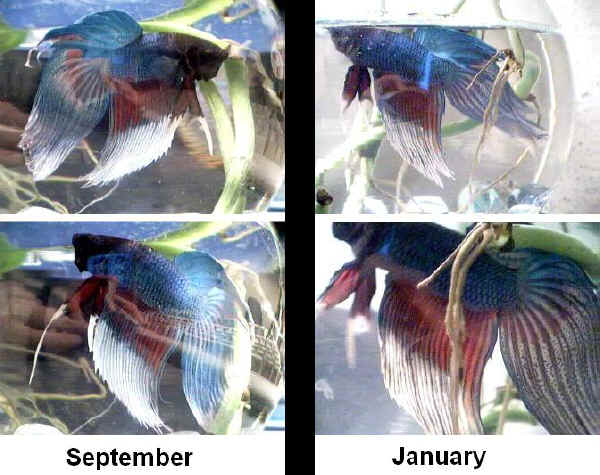
|
| Swollen.. um.. uh.. Hi. I have a question -
my Betta, Pecker, is swollen if you see the pic
attached. I don't know when or how just one day I
realized that he was hug like belly huge. He doesn't
have the fins sticking out as what other diseases as a pine
cone. I really don't know what to do. He's
energetic and eating like crazy. He's as energetic as
before. I have two other bettas around but I love all of
them. What can I do. Pecker seems to be so
okay and nice and totally not very sickly as I can see.
I believe it's constipation since there is maybe a feces that
is trailing a bit from his bottom. Aside from thawed
pea-insides, what else can I give Pecker? If I fast
Pecker, for how long do I do it? If I fast, that also
means that I don't feed him the peas? <Hi
Cheryl, from the picture I would have to guess either constipation,
or a tumor. If it is tumor there is really no way to fix
it, but they can still live a while. If the other side
is swollen as well I would say constipation, if one sided, possibly
a tumor. I would start by adding some Epsom salt to his
water. Mix up 1 gallon of water with your dechlorinator
and 1/2teaspoon of Epsom salt. Do partial water changes
every couple days with this water. Feed sparingly for a
few days, maybe an adult brine shrimp or so a day. Feed some brine
shrimp for a few days, they are not very nutritious, but good for
cleaning out the pipes. You can offer some bits of
thawed peas if he will take them. Some frozen bloodworms
will be good when you are done with the brine, the other bettas
will appreciate them too, basically you want to avoid dry food for
a while. Let us know how it goes, Gage> Cheryl |
|
|
|
|
Betta Success
Doing what it takes to keep Bettas healthy long-term
by Robert (Bob) Fenner
|
|
|

