|
FAQs on
Betta Diseases: Parasites of Many Kinds:
Protozoans, Worms, Crustaceans. See Also: Ich/White
Spot, Velvet,
Costia
Related Articles:
Betta Diseases, Betta Systems, Anabantoids/Gouramis &
Relatives, Betta splendens/Siamese
Fighting Fish, Improved
(Better?) Products for Bettas!,
Related FAQs: Betta Disease 1, Betta Disease 2, Betta Disease 3, Betta Disease 4, Betta Disease 5, Betta Disease 6, Betta Disease 7, Betta Disease 8, Betta Disease 9, Betta Disease 10, Betta Disease 11, Betta Disease 12, Betta Disease 13, Betta Disease 14, Betta Disease 15, Betta Disease 16, Betta Disease 17, Betta Disease 18 ,Betta Disease 19, Betta Disease 20, Betta Disease 21 Betta Health 22, Betta Health 23, Betta Health 24,
Betta Health 28,
Betta Health 29,
Betta Health 30,
Betta Health 31,
Betta Disease Causes/Etiologies: Determining/Diagnosing, Environmental (By far the largest cat.),
Nutritional, Viral/Cancer, Infectious (Bacterial, Fungal) , Parasitic: Ich/White Spot, Velvet; Senescence/Old Age, Cures/Curatives/Treatments,
FAQs on Betta Medicines:
Betta Medicines period,
Antibiotics/Antibacterials,
Anti-Protozoals (Metronidazole, eSHa...),
Copper,
Formalin,
Malachite Green,
Anthelminthics,
Organophosphates,
Salts,
All Other Betta Med.s,
|
Need to confirm diagnosis first. May take a
microscope... and body smear, other sampling.
<RMF would REALLY like to have a pictorial
atlas... for WWM like we have for Clownfish Diseases>
|
 |
New
Print and
eBook on Amazon
Betta Success
Doing what it takes to keep Bettas healthy long-term
by Robert (Bob) Fenner
|
|
Sick Betta (RMF, any better guesses?)<<None>>
4/21/18
Thank you for the opportunity to ask you about my sick Betta. I have a
female Betta that has developed a whitish film first on her
sides and now on the top of her head and gill plates. She has a
good appetite, puts
forward enthusiasm when she sees me, but otherwise is not herself,
depressed and not swimming around as usual, she is not flashing or
scratching, her fins are clamped most of the time. She is in an
established, filtered, heated bare bottom tank (I think it's a 3 gal)
with weekly water changes. There is an air bubbler and two live
plants in the tank. The film on her seems flat not real poufy or cottony
and as far as I can tell does not seem slimy, it's just a film that I
know is not normal.
She holds her anal fins close to her body. Your thoughts are greatly
appreciated! Sincerely, Tina
<Hello Tina. Assuming good water quality and adequate heat, and no
evidence of classic Whitespot (such as salt grain speckles and
persistent scratching), my mind is turning towards Costia, sometimes
called Slime Disease or Ichthyobodo. It's relatively easy to treat if
caught early, but can become more stubborn with time. It's a protozoan
parasite a bit like Whitespot that causes the skin to become cloudy with
mucous. Often the cloudiness surrounds the scales, almost like mortar
around bricks.
http://www.wetwebmedia.com/fwsubwebindex/CostiaF.htm
Many anti-Whitespot medications will work against Costia (I like eSHa
2000) but more often than not a second course is needed because Costia
does seem to be quite stubborn and difficult to shift. The classic
remedy was
formalin, but that's somewhat less widely used nowadays because it can
be toxic, to both fish and aquarist! Hope this helps, Neale.>
Re: sick Betta (RMF, any better guesses?) <<Nothing more>>
4/23/18
Thank you for your quick response. I have attached a few pictures, I hope they
aren't too big. If Betta does have Costia will Seachem "Para Guard" be
effective? Thank you again! Tina
<Paraguard should work, being marketed as useful against ectoparasites, but I've
not tried this particular approach, and Seachem are a little vague on specifics!
Since it doesn't contain either copper or formalin, the two best treatments for
Costia, it wouldn't be my first choice. But definitely worth a shot, especially
alongside elevated temperatures and/or salt water dips.
Costia struggles to survive at temperatures above 28 C/86 F, which Bettas can
easily handle. Dipping fish for short periods in seawater (35 gram sea
salt/litre aquarium water) can help to shift the mucous and kill some of
the parasites. Bettas aren't particularly tolerant of salt, so I'd use this with
the usual caution of removing the fish at the first sign of distress.
The longer the exposure to salt, the better -- so obviously this approach is
especially well suited to those fish that handle seawater well, such as Guppies
and Mollies. Nonetheless, anti-Whitespot medications of all sorts, used on their
own, should shift Costia, but as I've said before, it may require several
treatments because Costia is a stubborn little critter!
Cheers, Neale.>
|
_LI.jpg)
.jpg) |
Sick Betta (RMF, any better guesses?)<<None>>
4/21/18
Thank you for the opportunity to ask you about my sick Betta. I have a
female Betta that has developed a whitish film first on her
sides and now on the top of her head and gill plates. She has a
good appetite, puts
forward enthusiasm when she sees me, but otherwise is not herself,
depressed and not swimming around as usual, she is not flashing or
scratching, her fins are clamped most of the time. She is in an
established, filtered, heated bare bottom tank (I think it's a 3 gal)
with weekly water changes. There is an air bubbler and two live
plants in the tank. The film on her seems flat not real poufy or cottony
and as far as I can tell does not seem slimy, it's just a film that I
know is not normal.
She holds her anal fins close to her body. Your thoughts are greatly
appreciated! Sincerely, Tina
<Hello Tina. Assuming good water quality and adequate heat, and no
evidence of classic Whitespot (such as salt grain speckles and
persistent scratching), my mind is turning towards Costia, sometimes
called Slime Disease or Ichthyobodo. It's relatively easy to treat if
caught early, but can become more stubborn with time. It's a protozoan
parasite a bit like Whitespot that causes the skin to become cloudy with
mucous. Often the cloudiness surrounds the scales, almost like mortar
around bricks.
http://www.wetwebmedia.com/fwsubwebindex/CostiaF.htm
Many anti-Whitespot medications will work against Costia (I like eSHa
2000) but more often than not a second course is needed because Costia
does seem to be quite stubborn and difficult to shift. The classic
remedy was
formalin, but that's somewhat less widely used nowadays because it can
be toxic, to both fish and aquarist! Hope this helps, Neale.>
|
Identification of possible parasite
5/19/17
<Karan... we ask that folks send image files of a few hundred Kbytes; yours
is some 17 megs... >
Hi there
I have a very poorly Betta who has been battling a number of issues for a
few months. He has PopEye in one eye which has not responded to any
treatment - daily water changes, Indian almond leaves, Epsom salt baths,
Myxazin, meth blue baths (all treatments spaced out over a few months).
<Unilateral exophthalmia can be the "Dickens" to cure, depending on root
cause, how entrenched it has become>
He has lost a lot of colour and energy but still eating and I have
now spotted something attached to his side which I think is a
parasite but I'm not sure. Would you be able to help identify if it is a
parasite and what
type it is and what treatment you would advise?
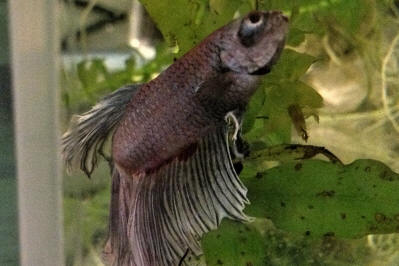
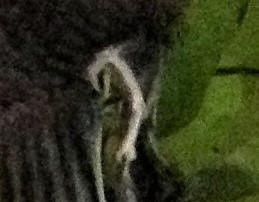
<Yes; I see what appears to be an "Anchorworm" (actually a crustacean
parasite) on the "chest area"; please see here re:
http://www.wetwebmedia.com/fwsubwebindex/anchorwrmfaqs.htm
He is in a filtered 12L hospital tank (half filled as not swimming to bottom
great - swim bladder?) temp 82 with ammonia and nitrite 0 and nitrate 40
(tap water 40 too at the moment) I use Prime to condition water.
Cheers!
Karan
<Please write back if your course of action is not clear here (after
reading); I would carefully tweeze this adult Lernaeid off, dab the wound
site w/ a proscribed topical antiseptic... and treat the system per the
above reading to eliminate unattached stages. Bob Fenner>
|
 |
|
Re: Identification of possible parasite
5/20/17
Thanks Bob. Apologies for size of pics! I attempted to remove the parasite but
it didn't go well and the head is still buried.
<Ahh!>
I now have one very stressed out fish and half an anchor worm!
<Well; a bit more chance for secondary infection... but the rest will decompose
in time>
I'll get some Waterlife Parazin and treat with that. Hoping that will sort the
worm and improve his overall health if he survives tonight.
Thank you :)
<Steady on Karan. Cheers, BobF>
|
|
Ill Betta with potential worm
5/12/16
<.... 14 megs... we ask that folks limit to a few hundred Kbytes....>
Hello! I have a 2 year old Betta that has been ill for around two months
now. I will try to condense this extensive journey as much as I can. When
healthy my Betta was in a planted ten gallon with 6 pygmy cories, one Nerite
snail, one blue and one yellow cherry shrimp.
<Good companions, bio-indicators>
Almost two months ago I noticed him excessively scratching against the
plants, tank walls, and driftwood. He would go so far as to dig himself
under the driftwood for a full body scratch. Soon he became extremely
bloated and very skinny, even though he was eating fine, and one eye began
to pop out and cloud. With the help of a forum I frequent, I decided to try
treating the tank with API General Cure and Epsom Salt because the
scratching pointed to parasites.
<Mmm; not necessarily, no. Some aspects of water quality, environment,
genetics will result in this behavior>
This proved to have no result besides killing the shrimp and one of the
cories.
<Oh yes>
I was not present for the entire treatment, so I didn't see the body of the
Cory, I was just unable to find him anywhere in the tank even if I removed
everything and pulled out the other cories. I assume he was eaten.
About a week after the first round of General Cure I decided to give it
another go, this time with the Betta in a half gallon hospital tank floating
in the main tank. Again, there was no results. I should note that there was
not any signs of parasites in his poop. They were perfectly clean.
At this point the symptoms looked much more like dropsy than anything. His
abdomen had swelled to an enormous size and he struggled to lift it off the
bottom of the tank. His one eye became fully clouded over to the point where
seems to be nearly blind on that side, and it was popping out horridly. I've
tried a variety of treatments since then. The first was
Epsom salt and Kanaplex, following the directions on the medication. That
proved useless, so I tried the baths as directed by
americanaquariumproducts.com. He got baths with Kanaplex, Furan 2, Epsom
salt, and Methylene Blue daily for half an hour. I briefly tried keeping the
Kanaplex in the hospital tank in addition to the baths, but it proved to
hard on him. These baths did help a tiny bit, but not enough. The website
said the medication could be safely double dosed for the bath, so that's
what I tried, twice daily. It provided the most results. His bloat went down
fairly well and he regained most swimming ability. Although he had
maintained a voracious appetite and good energy throughout, he was still
extremely skinny. Also, when viewed from above, the bloat was significantly
worse on one side than the other. Because he had been going through over a
month of treatment at this point and improvements had been made I decided to
give him a week break and see what happened.
His condition quickly reversed. The bloat returned full force, making his
stomach so heavy he would slowly sink to the bottom of the tank until it was
pressed up against the bottom. His eye popped out even further to the point
that I feared it would come out of his head. After his 5 day break, I
continued the baths with a slight adjustment. Instead of Methylene Blue I
used ParaGuard, which actually made his bloat even worse.
Today is when things got really weird. I've noticed a slight discoloration
under his right pectoral, but I assumed it was simply a result of the
extreme bloating on that side. He's always made it difficult to view or
photograph that side of his body for some reason. After his bath tonight I
was determined to get a good view of that side, and was very confused at
what I saw. It looks like a perfect spiral, much like a worm. It is a white
circle with a dark spiral in it. I cannot for the life of me figure out what
kind of organ displacement by the bloat could cause this impression on his
side. It looks like a worm curled up just under his skin.
<Might be... I would see/read on WWM re Anthelminthics>
The pictures I got are poor because of the angle of the spiral and the
bloat, but they're enough to get the general idea. Is this a worm?
I will post the pictures from oldest two newest and try to show the worst of
his symptoms the best I can.
Thank you for your potential help!-Sabrina
<Mmmm; what to you feed this fish? Have you read here?:
http://www.wetwebmedia.com/fwsubwebindex/BetDisViralF.htm
Do so. Bob Fenner>
|
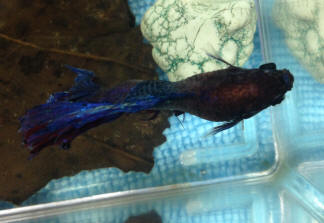
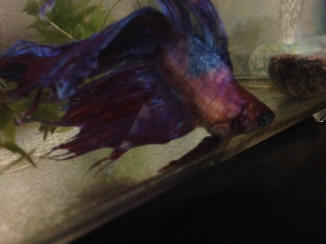 |
|
Re: Ill Betta with potential worm
5/13/16
I am so sorry it was so big! I could have swore I shrunk the picture
size way down.
<Heeee! Like my bank account?>
Would links to the pictures be better in the future?
<Ah yes; if need be huge, or a big video>
I have read both of those, but nothing seems to quite fit him.
<Mmm; on just reading your input from the one message, seeing the
images; my strong guess is that this is a tumorous growth... not
directly treatable. Search, read directly on WWM re this supposition>
I feed him Omega One Betta Buffet Pellets, New Life Spectrum pellets,
and Hikari frozen foods (bloodworms, daphnia, and Spirulina brine
shrimp). He's fed twice a day, 2-3 pellets each time or a roughly
equivalent amount in the frozen foods.
<I see>
I did get a better picture that shows the entire portion of the spiral
that can be seen without having to flip the Betta over. As the email
size is already so large (so sorry, once again!) I'm assuming a link
would be better?
Thanks,
-Sabrina
<Welcome. BobF>
Re: Ill Betta with potential worm 5/13/16
If I attach more than one picture again I'll shrink it down to the size
of my college student bank account. You may not be able to see the
picture much at all, but it'll be small!
<Heee!>
A tumor or cyst is what I have begun to think, but I can't figure out
why a tumor would produce a spiral pattern. I did entertain the idea of
trichinosis but it's unlikely.
<Perhaps another nematode>
If it is concluded that this is probably a tumor, would it be best to
euthanize him or let him live out the remainder of his life?
<Up to you... IF the fish doesn't appear to be suffering.... There are
spontaneous remissions.>
The mass/bloating/whatever this is does cause him some swimming
difficulty and occasionally make it difficult to get off the floor of
the aquarium.
Could he ever return to the main tank, or is he destined to float in it
in his pitiful half gallon for the rest of his life?
<I'd return the fish to the main tank>
Thank you again for your time,
-Sabrina
<W. B>
Re: Ill Betta with potential worm 5/14/16
Would you recommend attempting another method of deworming, just to be on the
safe side?
<Yes; worthwhile. I alluded to this earlier.... Prazi.... B>
Re: Ill Betta with potential worm 5/14/16
I'll be ordering PraziPro today then! I really hope this does the trick!
Thanks for all your help!
-Sabrina
<Certainly welcome. Bob Fenner>
|
|
Betta illness 1/4/15
I was hoping you could help me diagnose my Bettas. I just got a new Betta, who
had some gill iridescence. I was concerned so I put him in his three gallon tank
with aquarium salt and Kanaplex. But now the problem has spread
to two other Bettas. All are in separate tanks but I know I shared a bucket
between two tanks. Anyway, now I have three Bettas with this gill iridescence
which is white on two fishes and blue on another. One of them also has black
spots on his head and lately white spots. They look too big to be Ick but it's
possible I suppose.
<... Mmmm>
I have one Betta in a 10 gallon, 1 in a 5 gallon and 1 in a 3 gallon.
They receive weekly water changes, twice weekly for the 3 gallon. I monitor
the ammonia levels to ensure it is always at 0 and use Prime for water
conditioner.
I've attached a few photos and would appreciate any help you can provide.
<Can't discern w/ any certainty what this is from your pix or descriptions, but
this appears to be Protozoal (perhaps Costia/Ichthyobodo or Trichodina) to me. I
would treat just the one time w/ Metronidazole. Bob Fenner>
|
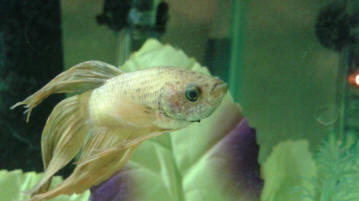
 |
|
Re: Betta illness 1/5/16
Thank you for your reply. I ordered the med and will give it a try.
<Mmm; please do a bit of reading re my guesses here... Some folks promote a mix
of formalin and malachite (and salt).... can be a bit harsh; more people kill
their livestock w/ treatments than actual pathogenic diseases.>
If the yellow fish has Ick, would I still see the white spots?
<Yes; Ich is quite apparent on all colors, types of Bettas>
He's a pale color so I wasn't sure if it would present in the same way.
Thanks again!
<Welcome. BobF>
|
|
Sick Betta, need advice (RMF, I'm going with Costia; you?)
<A good guess. RMF> 4/11/14
Hello!
I was given your email by Timbra Newbury. She has been helping me with
my Betta, Eugene and is out of ideas. She suggested that I email you
guys and tell you what has been going on and see if you have any ideas
or advice. I guess I'll start with the basics first...
I have Eugene in a 10 gallon tank with Mopani driftwood and fake plants
(until the summer when I have time to actually learn how to do real
plants). I started out with the Marineland 10 gallon setup. Back in
October or November I noticed 2 white spots on Eugene's side. I'm sad to
say that it took me until about early December to figure out what the
cause was. I finally realized the spots matched where Eugene was
sleeping against the heater. He was acting completely normal and I had
asked someone at one of the local fish stores about it and they told me
the pigment had probable just been burned and he would be fine. In the
middle of December, I was away for about a month and my roommate was
taking care of Eugene. When I got back in January, there were 2 small
lumps on the white spots (one lump per spot). He was still acting
normal, so I just figured he had been burned even more. So I bought some
plants to cover the heater and a Betta hammock for him to sleep on.
Neither of those worked, so I searched the internet for other solutions
and for what to do for heater burns. The only thing I could find was
that heaters should not burn a fish, even if they are sleeping against
it. I then figured the heater was malfunctioning somehow, so I bought a
Fluval. He no longer sleeps on the heater, so that's good.
Then a few of his scales turned black, so I decided I should show a
picture to my local fish store and see what they suggested. They
suggested I use Melafix, so I did. I think I had about 1 more treatment
of that and it still didn't look any better, so I posted a picture of
Eugene on a fish group on Facebook asking for suggestions, and that's
how Timbra got involved.
Timbra told me the Melafix was bad for Anabantoids, so I immediately
stopped using that and I gradually did a 100% water change that night.
Timbra suggested I use Furan 2, so I got some of that and did a full
course of treatment of it. The appearance of the infection did not
change, but he started to act like he was feeling a lot better (I hadn't
realized how different he was acting until he started to feel better).
Anyhow, Timbra said the appearance may not change right away since the
medicine was getting rid of the infection so that his body could begin
to heal. Fast forward 2 weeks and the white lumps were getting bigger
and it looked like one of his scales was falling off. This time Timbra
recommended that I use a combination of Furan 2 and Kanamycin. Last
night was the last does of the Furan 2 and tonight will be the last dose
of the Kanamycin, and the lumps have not changed and he's still getting
tossed around by the filter current. I know Bettas typically have
trouble with filter currents, but his favorite thing to do is swim
through the current (he's also a half-moon plakat, so he doesn't have
the long fins). He used to hover just in front of the current and build
up some speed and then shoot through the current and turn around and do
it again, he'd repeat this about 4 or 5 times until he got tired out.
Now, when he swims through the current he gets pushed forward by it and
he tries to avoid the strongest spot as much as possible.
His appetite has never decreased though, he's actually a giant piggy and
would eat an endless amount of bloodworms if I let him.
I'm going to send you another email after this with some pictures
attached to it. Unfortunately the pictures that I have are all on my
iPod touch and I'm not very tech savvy, so I can't figure out how to get
them on my laptop. I normally would have just sent an email from the
iPod, but this is a book and would have taken me forever to write on
that. So, I'm sorry for sending you 2 emails rather than 1. And thank
you for any advice you might have.
-Jen
<Hello Jennifer. My gut reaction here is the disease commonly called
Costia or Slime Disease, caused by ciliate parasites such as
Chilodonella and Ichthyobodo spp. Costia manifests itself as
accumulating patches of slime on the flanks, sometimes alongside obvious
inflammation, with secondary bacterial infections (effectively, Finrot)
setting into the wounds. It's a tough disease to treat. In some cases,
transferring fish to half-strength to full-strength saltwater for
extended periods (days, weeks) will do the trick on its own since the
parasites come in either seawater or freshwater strains and can't adapt
to the "wrong" salinity. But this is only an option with
seawater-tolerant things like Mollies and certain cichlids. Dipping in
seawater (effectively 35 gram salt dissolved in 1 litre of aquarium
water) still makes a useful dip though, for 2-20 minutes depending on
the tolerance of your fish. This helps to clear the slime and weaken the
parasites. Bettas have low tolerance, so shorter periods of time would
be used there. Longer periods work with salt-tolerant things like
puffers and livebearers. If you're doing dips though you'll need a
medication as well.
Very often, anti-Whitespot/Ick medications work well against Costia, but
you may need to use two or three "rounds" of treatment to finally beat
it, and if a bacterial infection has set in as well, a suitable
anti-Finrot antibacterial medication of your choice. If the disease is
really well entrenched, Whitespot medication might not work, in which
case you'll need to use Formalin, but this is very nasty stuff, both for
you and the fish, so is a last-ditch option. It's a good sign your fish
is still eating, and while Costia looks pretty nasty, it doesn't seem to
cause rapid decline in the health of the
fish, giving you sufficient time to fix things. A while
back I wrote a piece for FishChannel
that might offer some more insight into
Costia and its management; see here:
http://www.fishchannel.com/fish-health/freshwater-conditions/slime-disease.a
spx
Cheers, Neale.>
|
%20sic%20b.jpg) |
|
Re: Sick Betta, need advice (RMF, I'm going with Costia;
you?) 4/15/14
Hi Neale-
<Jennifer,>
Thank you so much for getting right back to me. I'm sorry it's taken me
so long to get back to you. My weekends are pretty crazy because I work
20 hours between Saturday and Sunday and have school work on top of
that. At any rate, I just want to make sure I completely understand
everything you've told me before I do any treatments just in case. I
tried to click
the link to the Fish Channel article, the site said it didn't exist. I
did however, find a list of all the articles you wrote for them and read
the one you wrote about slime disease (which is what I'm assuming the
link was supposed to take me to).
<Yes, when pasted across to the Daily FAQ page there was an error, which
I've now fixed.>
Now as for treatment products... I bought Rid-Ich Plus by Kordon for
Ich.
I'm a little worried about it though, as it has Formaldehyde in it and I
didn't see that until I got home. Will that be okay to use?
<Formaldehyde is safe to use if used precisely as directed. But some
fish, especially oddballs, catfish and loaches, react badly to it. Most
community fish (barbs, tetras, gouramis, etc.) are fine though. Just
observe the fish carefully, read the instructions before use, and if
necessary, remove sensitive fish to another aquarium.>
I also got some Instant Ocean sea salt rather than aquarium salt because
from what I gathered, the water needs the be of marine quality.
Although, I am not sure if there is a difference between aquarium salt
and sea salt, I just figured I should get what you use for saltwater
aquariums.
<Well, there is a big difference. Marine aquarium salt is a mix of
sodium chloride (what we call "table salt") and other chemicals that
harden the water, raise the pH, and provide important trace elements for
the corals.
Tonic or freshwater salt is simply sodium chloride, much like you'd put
on food, but without the iodine added. You can actually use non-iodised
cooking salts (such as kosher salt) to treat fish. In all probability
you can use marine salt without problems, but if your water was very
soft and acidic before, you may find the pH and hardness go up, and if
by a large
amount, that's a potential stress on your fish.>
The actual treatment portion is where I may have gotten a bit confused
and want to make 100% sure on. If I understand correctly, I am to do 2
minute (at most anyhow) salt dips, with 35 grams of salt per 1 liter of
water and 2-3 courses of Ich treatment.
<Yes; add the Ick treatment to the aquarium, but winkle out the sick
Betta, dip him into the salty water, and keep him there for a couple of
minutes before putting him back into his aquarium.>
I'm unsure of the antibiotics though since I just completed a course of
Furan 2 and Kanamycin. Should I still use erythromycin and how can I
tell if there is an infection?
<You really can't. But if you use a general purpose antibiotic and your
fish gets better, then probably the fish did have a bacterial infection
of some sort.>
You mentioned fin rot as a potential infection, but his fins do not look
like they have fin rot and I don't know what it would look like on other
parts of his body, or if they can get it anywhere else other than their
fins.
<Absolutely. Finrot is simply called that because it's an infection of
the fins. But the bacteria that cause it -- Aeromonas and Pseudomonas
spp for the most part -- can affect all parts of the body of your fish,
inside and out.>
Also, how many salt dips do I do?
<I'd do one first, then observe the fish for the next couple of days. If
all is good, you can dip again, leaving 2-3 days before each dip.
Unlikely you'd need to do more than 1-3 dips if the medicine is
helping.>
Should I expect an obvious sign of this clearing up, such as the white
patches and lumps going away?
<Yes; the dip should shift a lot of the cloudiness quickly. Thereafter
you should find over the successive days that the underlying oddness of
the skin clears up too.>
Or will it be more subtle? If it is subtle, what should I expect or keep
an eye out for? Thank you so much for all of your help, I truly
appreciate it.
Sorry for all of the questions as well, I am fairly new to all of this
and this is the first real health issue I have ever dealt with.
<Glad to hear it! Must be keeping your fish well.>
-Jen
<Cheers, Neale.>
Re: Sick Betta, need advice (RMF, I'm going with Costia;
you?) 4/15/14
Thank you so much. I will start the treatment right away.
<Most welcome, Neale.>
|
Update....Re: How long do you safely treat a Betta fish with
gill flukes with the amazing Quick Cure? 12/4/12
He's no longer at the bottom.... he's swimming around with
true interest and life today, and he's eaten a second time and more
eagerly. I'm doing a full water change with one drop dose again.
<Ok>
I read so much about what the medicines are and what they treat over the
last week, and I found at least 5 different opinions on how to use the
formalin alone,
<Yes...>
or recommendations for using it with malachite, and two versions on dosing
Quick Cure along with suggestions to wear gloves and goggles when using
any of the above mentioned! With that in mind, I guess I probably
shouldn't add an additional drop today.....but maybe I'll keep him in
the jug another couple days with daily full water change and one drop
medicine as the swelling in the gills appears to be receding.
(This is something I'd read would NOT happen.)
I've never had a Betta come down with flukes before. I feel
terrible he suffered, but at least there was a treatment and it wasn't
fatal. I'm amazed that so many sites recommend Prazi but don't
mention as Bob did that it needs to be in the food for freshwater.
It had no effect on my fish when used in his tank. And if your
fish isn't eating, as mine had totally completely stopped eating or
caring.... the Quick Cure (and it's formalin I guess) is worth it's
weight in gold! And it only cost 3.00!
Jill
<Cheers, BobF>
|
New Betta...Help! Not eating, env.,
Lernaea 5/3/11
Hi There-
<Shanda>
I am hoping you can help me with my new Half Moon Doubletail
Betta. I bought him from Petco 11 days ago and when I first got
him home he was very energetic but has never been willing to
eat.
<!? Is this system heated, filtered?>
I know that they can be picky eaters so I have tried a couple
different brands of food. I previously had a Betta for over two
years that finally died a few weeks ago. He loved the Hikari
pellets so that is what I have tried to feed the new fish. He
initially swam up ate it and then spit it out. I tried again the
next day and the same thing happened. I went and bought Betta Min
Tropical Medley and tried that. The fish swam up to it and then
swam away. I have been trying every day and the fish swims up
like it is hungry and then swims away. I tried crushing the
pellets thinking that maybe they were to big but he eats them and
then spits them out. I have noticed over the last 2 days that he
seems lethargic and he looks like he his starting to float on his
side. I have also noticed him with his nose to the top of the
water (straight up and down). I have been scooping out the
uneaten food so that his water doesn't get contaminated.
Today a friend of mine gave me dried blood worms to try and the
fish swam up and looked at them and swam away.
He is in the same tank that my old Betta loved. It is a gallon
bowl with rocks and a plant.
<...>
I used Aqua Safe for the tap water and added a drop of stress
coat to it. I got a thermometer and it said it is between 72 and
75 degrees. Not sure what else to do. Any suggestions?
<Read here: http://wetwebmedia.com/FWSubWebIndex/bettasysart.htm
Thanks so much for you time!
Shanda
<Welcome>
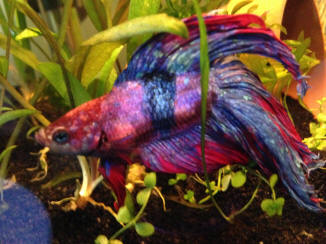
P.S. I have attached a picture. He also has these little white
things hanging from his bottom fins. Is that normal?
<Mmm, no; these are anchor "worms". Read here re:
http://wetwebmedia.com/FWSubWebIndex/anchorwrmfaqs.htm
Likely contributing to this fish's troubles, non-feeding. Bob
Fenner>
|
|
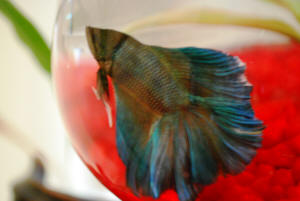 
|
|
Re: More re: New Betta...Help! Lernaea
5/3/2011
Thanks so much Bob!
There is so much information on here so I am hoping I am reading
correctly.
This is what I am thinking that I need to do....please let me
know if I am incorrect. =)
<Okay>
I need to take the fish out of water and carefully remove the
white anchors with tweezers (grabbing it right at the entrance
spot) and then dab the wound with Mercurical.
<Yes>
I am a little unclear about what to do about the tank since it is
a small tank. I am thinking I need to wash the bowl and throw out
the gravel, put new gravel in, treat the water with stress coat
to take out the chlorine and then add some aquarium salt???
<Mmm, no... I'd wait, see if any intermediate forms have
been released by the adults on your Betta. Perhaps they
haven't>
Also, should I throw the plant away or just wash it? I know the
parasite was on the fish when I bought it. I am hesitant to take
it back to the store because they probably won't even bother
to treat it. I am praying that I can fix him.
Again, thanks so much for your time. Your website is so
helpful!
Shanda
<Did you read re Betta husbandry, where I referred you? Your
fish needs warmer (steady, as in w/ a thermostatic heater) water
and a filter. BobF>
|
Unusual Betta problem
11/16/08 Hello. I'm having a problem with my Betta that
I've never encountered in my 4 years in the hobby (I know it
doesn't sound like much, but I've seen a lot working in the pet
industry). I've tried all sorts of searches online but I can't
seem to find anything like it. First, I'll give you some background
info. <Please> I have a 10 gallon tank that has been set up for
about 3 months. Up until recently, it housed only two male Bettas (with
a divider, don't worry!) and whatever Malaysian trumpet snails
managed to find their way in there. It has live plants (mainly java
fern, water sprite, and a couple species of Anubias) and a small
filter. The nitrates have never been above 20, the ammonia and nitrite
have steadily been zero for two months, pH is 7.4-7.6, KH is 3 degrees,
and GH is 4 degrees. The Bettas were quite content until I pulled some
stupid moves. First, I came into possession of a couple baby platies,
and was keeping them temporarily in a 2.5 gallon tank. I needed a
heater, and the only one I had was in the Betta tank, so I pulled it
out thinking the temperature wouldn't drop below 72. I was wrong...
it went from 76 to about 68 over a couple days. I was concerned at
first, but the Bettas seemed fine, no change in behavior, so I
didn't really worry about it at the time. <Mmm, such a stress
can/does show up later...> About a week after that, I decided to
move my 6 Danios from my 20 gallon tank to the 10 gallon tank, 3 on
each side of the divider. I kept an eye on the water chemistry, and
other than a 5 ppm raise in nitrates everything stayed the same. I
replaced the heater in the tank as well, and the temperature went back
up to 76. I knew my Danios were rather boisterous, and I tried to put
the most boisterous ones with the Betta that I thought was the tougher
of the two. Considering all the stressors I introduced, I'm not
surprised that one of my Bettas got sick. However, it's the illness
itself, not the cause, that has me befuddled. I first noticed that his
gills were hanging slightly open and he was breathing heavily. He would
come to the top to eat, but the rest of the time just lay on the
bottom. I assumed it was probably a bacterial infection of sorts
brought on by stress, and I set up my 2.5 gallon tank as a hospital
tank. I put a heater in it, got the temperature to 76, put 1/2
tablespoon of aquarium salt in it, and let it run overnight with an air
stone. I transferred him this morning. Tonight, I came home, added .5
ml of Melafix, <Mmm, not a fan> and attempted to feed him. He was
VERY interested in food, and practically attacked it... however, he
couldn't seem to even get it in his mouth, and that's the bit
that has me stumped. It's not like he takes it and spits it back
out, it's like he can't even open his mouth enough to get it
in. I tried a variety of foods, including flakes and daphnia, and he
barely got anything in his mouth. He would lunge after it and end up
just pushing it around. It's like Betta lockjaw! I've never
seen anything like it, and it's frustrating me. He seems like he
would have a great prognosis for recovery if it weren't for the
fact that he can't eat -- he's active and interested in food.
I'm just wondering what could be causing this? <Could be
pathogenic> My best guess is a bacterial infection, but nothing
looks red or swollen, he's just skinny, his gills don't close
completely, and he can't open his mouth. I even managed to peek
into his gills with a flashlight when he had them flared, and they
didn't appear swollen at all. In fact, they looked like all the
pictures of fish gills I've seen in the text books, healthy pink
but not inflamed red or anything. Any thoughts would be appreciated. I
don't want to have to euthanize him, but if the treatments
don't work I'm worried he faces slow starvation. Thanks, Tamla
<Given the symptoms you describe, the course of exposure to other
life, am guessing that this may be an instance of Flukes... Please read
here re: http://wetwebmedia.com/FWSubWebIndex/flukesfwf.htm
and further on the Net re monogenetic Trematodes. Bob
Fenner>
Internal parasites: white, stringy feces, Betta
10/16/06 Hello Wet Web Media crew, <Hello there - this is
Jorie> First off, let me just say I love the site, it is extremely
informative... <I've learned so much from this site!> ...but
I'm a tiny tiny bit stumped on this little' problem with my
female Betta. She has the "white, stringy feces"
sign of internal parasites... <Yes, you've likely correctly
identified what's going on.> I am currently using
"Parasite Clear - Tank Buddies" by Jungle Brand "With
Praziquantel!" as quoted on the box as it had been recommended to
me by a few sources. Unfortunately, to no result (as far as
I can tell - of course, one never knows if maybe the resultant white
stringy feces may be the dead worms leaving the body, as they seem to
be passing much quicker than other cases of this I've had in the
past without any meds) <I've found that internal medicated food
is the best/only way to successfully treat internal
parasites. Jungle makes one called "Pepso", and
you can also find medicated flakes here: http://flguppiesplus.safeshopper.com/234/cat234.htm?380
> Ok, on to the informative stuff. I have a 29 gallon
acrylic planted tank containing 6 Otocinclus, 1 normally striped male
dwarf Gourami, and one "fire red" male dwarf Gourami (which
may be a morph of the honey dwarf Gourami, but no one seems to know for
sure) and previously 3 female Bettas as well as numerous Malaysian
trumpet snails and Ramshorn snails and the occasional pond snail (pond
snails, when discovered, find themselves on a magical
journey to the male Betta tank for algae control, as he refuses the
company of algae eating fish) My ammonia is 0, nitrites
currently are 0 (but are occasionally at .05)... <Nitrites need to
be a zero when live fish are in the picture...> PH 7.8, temp 84 when
the lights are on, 82 at night. <May want to drop the temp. a degree
or two...also, try to minimize that temp. swing from day to
night...> I am using a Whisper 30 hang over the back filter with no
carbon, but the bio-filter is in, and I use no aeration or CO2. <No
"aeration"? I'd suggest adding an air pump or two to get
some oxygen into the water...> So, anyway... My
"Ruby" female Betta has been having some white stringy feces
hanging out of her anus, so I moved her into a hospital tank (5gl)...
<Thank goodness - I was just about to ask if you isolated her!
I'm so glad you did...> ...and added aquarium salt to the water
(1 tsp/2gl) and used a dose of the Praziquantel med tabs described
above. <I'd suggest running carbon and doing water changes to
get the present medication out, then switching to the medicated
food...> I also medicated the main tank... ...<WHY? I
was so happy to hear to had used a QT tank...you do realize you likely
destroyed your nitrogen cycle, so keep a very close eye on ammonia,
nitrite and nitrates...I'd suggest testing daily until everything
has spiked and lowered...> before doing a 90(ish)% (I got as much
water out as possible, but it's almost impossible to get it ALL out
without removing everything and letting it air dry for 6 days) to try
to remove any possible eggs or whatever and scrubbed the driftwood,
rinsed the filter pad (though on reflection, I possibly should have
just changed it, and maybe scrubbed the filter itself?), <I'd
suggest changing the filter pad - if nothing else, you want to remove
any residual medication. Do keep a close eye on everyone
else...> ...put everything back - everyone seems fine, but I popped
in the meds as a precautionary measure just in case they happened to
have caught it anyway and I hate to lose fish... <It's never a
good idea to "preventatively" medicate. It's
much better to do more water changes. I do understand your
fear, though, as my 29 gal. recently was exposed to parasites, and I
just yesterday ended up breaking the whole thing down...all remaining
fish are in QT. Anyway, enough about me:-)> The sick fish
is eating well enough and is not showing horizontal "fright
lines" yet, though she is not as fat as the other females are
(though she is lowest on the totem pole, so that could be normal), but
she definitely still has the white stringy feces showing now and again
- though not constantly, and certainly not for days at a
time. My question is, is this Praziquantel stuff in fact the
correct medication for this particular parasite, and, could she
possibly be expelling dead worms, and be "on the mend" so to
speak? <Not likely - a sign of continued infestation. Try
the medicated food - that's probably just what she
needs. If she needs incentive to eat it, try soaking it in a
couple of drops of Kent's Garlic Xtreme. AND, if it
just so happens that I've been giving her the wrong meds, what
would you recommend I get, as I'm beginning to believe that I
should medicate my females whenever I get a new one for this particular
infestation, as I believe the supplier feeds his Bettas live black
worms or other live foods and gives them all horrible
parasites. (look like crap in the store, beautiful in my
tank.. sigh) <No, do not medicate unless you see active
signs of illness. DO quarantine all new fish, especially in
light of the info. about what these fish are fed. Maybe
consider keeping them in QT 2 mos. or so (longer than usual), just to
be safer.> Oh, yes, I do not feed my fish live foods.
<Glad to hear that. I don't either.> I
feed them Betta Bites (for the Bettas) and TetraMin Tropical Crisps for
the gouramis, so I'm assuming I'm not the one introducing these
parasites. <Likely you are not. Try alternating their
diets with frozen bloodworms and Mysis shrimp - they'll be
ecstatic! My Bettas go nuts for those treats, and since they aren't
live (I use the Hikari brand), there's no risk of
parasites. Fish do need some variety in their diet.>
Alright, I hope I've covered all the basic info you will need to
(hopefully) help me with this... (in my long, rambling
writing style - I hope I haven't bored you to tears
yet) And if you need any more info, please let me know and I
will be more than happy to tell you anything I can. <LOL! You write
just like I do - I can relate! No, I'm not bored at all - more
info. is better. Hopefully I've helped you!> Thank
you very much in advance, Alyssa <You are
welcome. Jorie>
Internal parasites: white, stringy feces PART
2 - 10/18/06 Thank you, Jorie, for replying. :)
<You're welcome.> Well, as an update: I did not
get the medicated foods, as they don't seem to carry them at my LFS
(oddly... I'm in Seattle... I'll check
around) <I've had trouble finding medicated foods locally as
well. Try http://www.drsfostersmith.com or
http://www.flguppiesplus.com > But, on the bright side of things,
Ol' Ruby seems to be fattening up just a little (I've been
over-feeding her just a little to see if she would or
not. I'm assuming that this would be a good way to check
for parasites, as she would likely not fatten up? I'm a
little afraid I'll give her dropsy, though...) <Probably not a
good idea to overfeed...just so long as you are feeding a small amount
of quality food (e.g., Hikari, Spectrum New Life pellets, frozen
bloodworms, Mysis shrimp, etc., as previously mentioned> Anyhow, and
the good news is, I haven't seen any white stringy poops in a few
days. <Great!> I did a good water change of the hospital tank to
remove anything in there, and she's kicking around like she's
bored to tears, checking out the plastic ornaments and the boys
(hospital tank is right next to the boys' divided
tank) But I'm thinking of keeping her in quarantine for
another week or two before I let her back in the main tank, and I'd
like to find the medicated foods... as of course, internal
parasites seem to be a problem from my suppliers. <I think
that's a great plan - can't hurt to "over"
quarantine. Keep up with the water changes, and I really
would try to find the med. food online.> Ok, that
settled my main question - Praziquantel, probably
good... but better as a food additive. <Yes...the
medicated foods I am most familiar with contain Metronidazole,
though...> Maybe it helped that I would dose the tank, and then feed
her? <I don't want to suggest the external meds
don't work, it's just usually that the medicated food is more
effective. But hey, if the symptoms are gone, that's all
that matters, right?! Keep an eye out, though, as discussed
above...> lol... and maybe that she would pick at
it. Anyway, the rest of my tank seems to be healthy, no one
seems to care that I drained the tank, re-did everything and put
everyone back sans one female Betta. <Perhaps they enjoyed the
distraction? I find my Bettas like it when I rearrange decor
occasionally...smart little fish - they do tend to get bored, as
you've noted above also...> A note about the
aeration: I have quite a few plants in there, and my fish
are labyrinth fishes, so an airstone would be a tad redundant, I think.
<I'd suggest a powerhead instead, for water circulation
sake. The plants would likely appreciate
it. You're right, though, in the sense that the
labyrinth fish do breath from the surface, but that doesn't mean
they appreciate water devoid of O2...> Just my
feelings... maybe I will get an airstone eventually. But for
now everyone seems to be doing excellently. Thank you very
much for the advice, as I build out my med kit:-) <Yes, good to have
medication on hand. Best of luck - sounds as though Ruby is
improving - glad to hear it! Jorie> Alyssa
Sick Beta... Betta - 11/13/06 The
active ingredients for the parasite killer was: sodium chloride,
Metronidazole, Praziquantel, its called jungle fish health internal
parasite guard. <A good product> The only things that were in the
tank was gravel and a live plant, but he has been in a separate tank
for a bit now with only some gravel so I don't know what kind of
poisoning it could be. <Mmm, many possibilities... household
cleaners, aerosols, a bug flying in...> The bad thing is that he has
another symptoms: slightly raised scales just around the swollen
abdomen. <Ascites... "bloat", dropsy> The question is
should I euthanize him or can I treat him? <Mmm, yes> I really
don't want to kill him because I know that they can get over
dropsy, but probably not if I can't figure out the problem and
treat it, and I do not want to make him suffer. Thanks for your quick
reply. Hope I can help him. <At this juncture, a broad spectrum
antibiotic... BettaMax would be my choice... You have read on WWM re
Betta Disease? Bob Fenner>
Bloated Betta - 08/26/06 Good
evening. I have a Wal-Mart special female Betta that I
purchased about 6 months ago. Originally I had her in a very
large (5 gal equivalent) bowl, and then moved her into a 46 gallon
community tank about a month ago. She seemed much happier in
the larger tank, and got along well with the other fish (few platys and
tetras). 3 days ago, I noticed that her abdomen was starting
to swell. I assumed she had over eaten, and just kept an eye
on her. This morning when I went to feed, she was floating
on her side at the top of the tank, and her abdomen appeared extremely
swollen. Today was also the first day she appeared to be in
distress. She has no missing scales, and the swelling is not
malformed. I removed her immediately and put her into a
small bowl with the same tank water and a little salt. I
tested the water in the tank, and it was normal (for my tank) at 78
degrees, and exactly 7.0 ph. All other fish appear healthy
and no new fish have been added. I left for work expecting
to return home to a dead fish, but she did not pass on during the
day. She is in very much the same condition, only now her
breathing appears labored (not gasping - but deeper in the water than
normal). She is still floating on either side, and will
flail to get air from the surface. She has not eaten since
last night, and I am at a loss. I noticed that between her
bottom fins, there is a small white soft-looking mass (possibly anus
area???) no bigger than a pen dot. Can I save
her? What is your opinion of the trouble? I feel
helpless right now. Please empower me to understand the
issue, so I can ensure if it is my fault, that it doesn't happen
again. I sincerely appreciate your time in advance, Amber < Sounds
like you Betta has an internal infection. This is usually caused by
stress, like too hot, too cold, wrong food, dirty water etc.. It can be
treated with Metronidazole and Nitrofuranace with a little
salt. Some aquarists have had some success with Clout. Early
treatment is the key to a complete recovery.-Chuck>
| Betta parasite?? 3/30/06 Hi, <Hello there>
Firstly let me apologize that the photo is not as clear as I would
have liked... unfortunately the male Betta in question is
apparently not a fan of being photographed. <I understand> I
have owned him for approximately 5 weeks, we purchased him as a
replacement for our previous male with intent to attempt to breed.
I noticed around 2 weeks after we got him home that he had a small
(approx. 1-2mm) white growth on the rear portion of his dorsal fin.
However it vanished after a couple of days. He usually resides in
alone in a 4 gallon tank with a small sponge filter, a couple of
Java ferns and a heater. As we intended to breed him with one of
our 2 females (currently sharing an identical home) we had set up
and cycled a 2 gallon spawning tank. Just before we
moved our male Betta into the spawning tank we noticed that he was
acting a little strangely... he seemed to spend rather a lot of
time swimming in small circles around the suction cups which hold
the heater in place. He would also suddenly swim very
quickly and erratically then stop. <Not totally atypical
behavior for this species, sex> I moved him into the intended
spawning tank (after acclimating him of course) to have a better
look, as this tank has a light, and have now noticed that this
small white growth has reappeared, only this time above his gill as
the photo shows. It is very small (again 1-2mm) and protrudes from
his skin rather than laying flat against it. It is rounded at the
end and seemed to shrink and turn slightly grey in response to the
10 minute salt bath we tried yesterday, but has now returned to its
full, white glory. I have scoured the web and your site for info on
parasites, which I assume it to be since it has moved from his fin,
and since it appears to be causing him some discomfort, but the
only similar things I can find are Ich - which it most certainly
isn't as there is only one, and Anchorworm, which aren't
normally white and resemble hairs (or so I gather). <Yes... the
"egg sacs" stick out like a bifurcated tail...> This
"thing" is quite thick (maybe between 0.5-1mm) and I am
at a loss as to what it might be, and how to rid my Betta of it. He
doesn't appear to be ill... no clamped fins, eating fine, still
flaring for the ladies, no listlessness or loss of colour, just the
occasional odd bout of swimming in circles. I do hope you can help,
as we (and I'm sure him too) are eager to begin breeding, but
obviously don't want to start if there are parasites around!
Thanks in advance. Kindest Regards, Lindsey <Well... this could
be "nothing" but a reaction site... in infected part of
the Neuromast system (the "head and lateral line")... or
might involve a protozoan like Octomita/Hexamita... or even a
"higher" invertebrate parasite... If it were me/mine I
would treat this animal with Flagyl/Metronidazole (for Protozoans),
and see if the one-shot application "does it". Bob
Fenner> |
|
|
|
Re: Betta parasite?? 4/3/06 Hi Bob,
<Lindsey> Thanks so much for your reply. Just thought I
would give you a progress report. As you also thought it likely
to be a parasite I decided to give my Betta a weak WS3 Malachite
Green bath for 20 min.s, as I had some of this in the house (the
only anti-parasite I keep around as I find it incredibly good for
savage Ich outbreaks) and it was proving difficult to find
Metronidazole. A day later the "parasite" was all but
gone, leaving just a grey dot. Today it has gone completely...
I'm keeping an eye on him for a week or so before we attempt
to breed him to ensure it hasn't just moved again! I'm
also continuing my search for Metronidazole in case it returns.
Thanks again for your help Lindsey <Great news! Thank you for
this update. Bob Fenner>
|
Cut Lip and maybe Chilodonella First I have to say
this site has been a godsend to my little guy and me. Background.
I've had Buttah the Betta a month. He lives in a 1 gallon tank with
two plants, some gravel and his best friend the thermometer. He loves
to swim around and around and around the bottom of it. The tank does
fluctuate about 2 degrees at night, but I keep it as constant an 80
degree environment as possible. I half cover his tank with a black
towel at night so he can get some sleep, but the light still heats him
(and he can see me. I treat the water with either Betta Plus or Betta
Basics bowl conditioner, as well as aquarium salt with each water
change. His pH is a constant 6.8 to 7. I do a 5% water change with
every meal, siphoning out the missed bits and his pottyposits. I
replace the water very slowly with pre-prepped water that I always keep
on hand. I do a 30 - 50% change every 3 days and a 100% every 7. 4 Days
ago I bought a snail for his tank, just cuz, and slowly introduced it.
He seemed to think it a cool enough companion, nudging and watching it,
but within 24 hours snail was dead. I removed it, (he missed it
immediately) siphoned off all the debris from the floor and did an 80%
water change, but I noticed that Buttah was acting very itchy all of a
sudden. I saw no overt indication of anything wrong other than his
sudden twitches and rushes, but I kept a close eye on him reading up on
parasites here. I am afraid he may have contracted Chilodonella?
<Where would this have vectored from?> His colour is fine, but he
has extended moments of lethargy, just lying on the gravel, most unlike
him, and exhibits strained breathing, not the regular underwater yawn
before a surface, but his gills pumping hard enough to make him rock
while at rest. He is a surface kinda guy, sleeping on a leaf near the
top of his tank. He loves to literally race around his tank in the same
pattern over and over, but he has never shown this kind of strained
breathing before. His appetite is still good. He prefers frozen
bloodworms, brine shrimp and daphnia over all flakes, pellets and
freeze dried. Actually, he won't even look at these. So I thaw and
warm the frozen food then drop it into his tank with tweezers at
feeding. At breakfast this morning he jumped at the tweezers and
clipped his bottom lip, HARD. I do not think he tore it, but it is
swollen and ever so slightly *pouty*. He did not seem phased at first,
but then he began rushing at the surface and gulping the air when he
took it, then he swam away frenzied. I am afraid surface breathing was
painful for him and he became lethargic and withdrawn all day even
resting on the gravel and clamping his fins for a while. I was not sure
if it was his lip or the above mentioned discomfort. I did a 100% water
change (He has a 1/2 gallon holding tank with a plant that I keep
prepped and warm for 100% changes and emergency, so he is content in
there while his 1 gallon settles over night.) He has perked up, but
sometimes he still looks like he is having trouble breathing and
occasionally he hiccups??? <This behavior is natural...> Very
Concerned. The way I feel about this little gut is the only difference
between him and a puppy is you can pet the puppy. He seems brighter,
but he still settles onto the bottom as if just too exhausted to play
or he races around suddenly like he is trying to shake something off.
His color is good, (though his face seems a little pale), his fins are
not clamped and he is 80% his usual hellion self, but he is still
twitching and itching, or so it seems. I am taking a water sample into
my LFS tomorrow and I will be picking up some Maracide and some Beta
Fix, as well as an ammonia kit. Can the Betta Fix and Maracide be used
together? Is there anything I can do for his lip?? It looks so
uncomfortable. Thank you in advance for whatever help you give, even if
is a hyperlink to the appropriate page. Kate <You show good
care and great compassion for your Betta friend... I doubt if it is
encountering Chilodonella or other parasitic disease... these come from
other fish, live foods... Very likely the hard breathing et al. stemmed
from the dead snail incident... these often are "doomed" to
not recover... and the wound from the tweezers should heal in time. I
would just continue with the good care you list and all should be fine.
One last note, warning to you to keep the water level down a few inches
to prevent Buttah from jumping out altogether. Bob Fenner>
Re: Cut Lip and maybe Chilodonella Update Hi Bob, (or crew member
if Bob is busy elsewhere.) *waves, big smile* I sent a quick thank you
reply to your swift response saying things were well with Buttah the
Betta, but I may have jumped the gun. He was wonderful when I left for
work this morning, swimming happily around his clean 1G tank, treated
with its 2 drops of Melafix and 1 of Maracide. He ate a decent, (not
overfed) meal and I headed off to work. When I came home I thought at
first he was just happy to see me, but then I realized that although he
*was* happy I was home he was/is also itching like crazy, bouncing off
his plants and thermometer then centering in his tank to stare at me
and just twitch and twitch. Not Buttah behaviour at all. Staring at me,
yes, twitching like a demented neurotic, no. As I mentioned in my first
e-mail, he looks almost as if he has the hiccups. His fins appear fine
and undamaged so far. When he is not swimming and twitching he rests on
his leaf, but when he decides to move about, t he cycle begins again.
Slam, twitch, bump, twitch. He seems to be favouring his left gill,
knocking it into the plants more than anything else, although his right
one gets a good knock on occasion too. I checked his gills when he was
flaring and they look fine but after all if I can see the parasite, I
think he'd be in real trouble. As you felt the snail that died
would not have transmitted Chilodonella, might he just be high-strung
(ya think?) and could it be Ick? If so, I can try to slowly get his
tank up to 82 - 85 degrees, as well as his replacement water, but as
Ick lives in all waters wouldn't upping his water changes be
counter productive by adding to his stress level? <I would skip
adding any more "Fix", but keep up the Maracide treatment,
raise temperature and mix in half a teaspoon of salt> And how long
does it usually take for this parasite to clear up? <IF it is a
parasite, a week or so> I read somewhere (perhaps even one of the
pages on this site) to treat until all behaviour and symptoms are gone
and then for another ten days just to be on the safe side. Poor guy, I
am sure he would just like his normal life back. I always siphon any
replacement waters back into his tank very slowly, as if it were a
normal, slow running stream in nature, so I intend to do a slow,
stress-less 20 - 30% replacement with treated water before I go to bed
this evening and I am willing to do so everyday if need be but if you
feel it is too much please advise. Oh, and btw, his lip is already
looking *much* better. Again my thanks in advance for any help
you may offer. <Stay the course here... all should work out.
Bob Fenner>
Re: Cut Lip and maybe Chilodonella Cut Lip and maybe Chilodonella
Reply: "I am afraid he may have contracted
Chilodonella?" <Where would this have vectored from?> I
had feared he might have contracted it from the snail. Thank you for
your reassurances, Mr. Fenner. <...One last note, warning to you to
keep the water level down a few inches to prevent Buttah from jumping
out altogether. Bob Fenner> LOL, thanks again. Yes, he is a feisty
wee lad. I always keep a good amount of space at the top of his tanks,
about an inch in his holding tank and 1.5 in his regular. Both of these
are lidded, the lids only ever up when I am feeding him or seated
beside the tank. I am treating his tank with Melafix (decided against
Beta Fix) for the week just in case he actually did tear that lip, but
he seems 100% back to his happy and healthy self. Thanks Again:
Kate <Ah, you're welcome my friend. Bob Fenner>
Re: Cut Lip and maybe Chilodonella Upset - Take...? Hey crew, sorry
to be such a pest. This is an update of the earlier update and I am
afraid my wee guy is really sick. How can he go from so happy and
healthy to so sick so fast!? <There are infectious diseases
(bacterial mainly) that can act quickly... though most complaints are
environmental in origin> I am sure it was that snail. His
banging into his thermometer has bruised his side, his fins are already
beginning to fray, his colour, though his fins are still iridescent, is
grey and his fins are clamped and all this since 6 PM PST. I am
fighting the tears as he is just so damned uncomfortable and I am
afraid he has something really aggressive and may lose him over night.
I mean, what the heck happened between my going to work this AM and
now? Could he be reacting to the Maracide and the MelaFix? <Yes...
particularly the latter> I am grasping at straws here. Help? I have
read all I can absorb without popping and do not want to over treat
him. I feel so blasted helpless. Kate <Not much more you can/could
do Kate. Bob Fenner>
Re: Buttah the Betta is dying Hey Crew, hope you
had not too crazy a day with people inundating you with questions.
Where would any of us be without all of you? <Where we are...
perhaps with a bit less knowledge, solace> I know it is what you are
here for but it has to be tough. I sent you 3 mails yesterday alone.
Sadly Buttah seems to be declining. Last night he turned the most god
awful shade of grey and just rested on his ventrals gasping. I have no
idea what brought this on other than perhaps a reaction to the drop of
Maracide (for what I now know was obviously some kind of evil parasite
and the 2 drops of Melafix for his cut lip in his clean, prepped, 1G
tank. As I mentioned, he *was* what I thought to be 100% when I left
for work yesterday morning. He was playful, bright, good appetite,
swimming about as he always does, just his usual content, happy self.
When I came home he was bashing himself into his plants and his
thermometer. He did eat some, (frozen blood worm and brine shrimp) but
things seemed to go downhill from there prompting me to do a 30% water
change with unmedicated water. (also as mentioned these are as
stressless as I can make them, pH and temp. matched and a slow siphon
replacement) He did perk up a tiny bit in the fresher water, but then
just took to sitting at the surface on his plant where he remained
without moving from 11 PM until 7 AM gasping every few minutes. I was
very pleased to see him alive when I when I woke up. I was even allowed
to stroke his back. This did not seem to startle him at all. He just
looked up at me, sighed, woke up and swam about, twitching and twisting
as if he would like to turn himself inside out. He returned to his
plant to just sit and breath. ALL his fins were clamped, and I have
noticed red marks at the base of his pectoral fins, (the right is
worst) red spots on his gill flap (again the right) and his iridescent
scales on his face (they surround his gills and his gill flap making a
beautiful point on his chin) seem brighter. When he does swim, or
frankly float, about he tends to flop to one side and he really is
contorted as if against some hidden pain. And he is seriously gaping
for air. No matter if on the surface or resting on the bottom. <I
would discontinue the Melafix use... this material is starting to make
me feel less than simply uneasy... TOO many cases of it seeming to be
responsible for troubles. Am sending these notes to Aquarium
Pharmaceuticals (Manufacturer)... the old owners are friends of mine
and appreciate input.> As stresslessly as I could I have returned
him to his 1/2 quarantine/holding tank. Like his 1G, this water is
steady 80, but it has not got any Melafix or Maracide in it. It has a
touch of extra Betta Basic Water Conditioner (1/8th tsp) and a hint
more salt. (1/16th tsp). It was prepped 48 hours before placing him in
it. In half an hour he had gone from sitting on the bottom or floating
on the top 85% of the time, he looking like he is battling a swim
bladder issue, to being brighter and more interactive. But he is still
gasping, tilting, very lethargic and his breathing is still strained.
He also periodically slides backwards, going vertical even coming to
rest on his tail. I know I read something about that here on the site
but I am typing this in a rush to get to work and do not have time to
go looking. If moving him to the smaller tank is any indication, God
willing, maybe there is hope for him. I am seriously beside myself
about this as he appeared perfectly fine yesterday morning aside from
mild itching and as I mentioned what seemed like hiccups. I am
convinced it was that wretched snail and I somehow introduced something
wicked into the larger tank. I am not going to feed him this morning as
I think that could be counter productive and I doubt he has an
appetite. I swear he prefers this smaller tank and, if he survives
whatever this is, I may just make it his permanent one. Bigger does not
seem to be better in Buttah's case. I have been reading up on
velvet, on Ich, on septicemia and am frankly more confused now than
helped. (okay, he just leapt out of his tank, I did not have the lid
down. I immediately scooped him back in and closed it but now he is
nose diving, falling over, floating on his back. God what am I to
do!?) I do hope one of you can find the time to get back to me on
this matter today although I am afraid he is dying before my eyes. I am
so thankful for this site. Sending this off with an aching heart,
sincerely, Kate <STOP using the Melafix. Bob Fenner>
Re: Buttah Didn't Make it Sadly Buttah died not five minutes
ago. No, wait, there is still some very minor gill activity and he is
still gasping. I am still at a loss as to what happened. I sent 2
follow up e-mails after this one but I hold little or no hope at this
time. Thanks all the same, my friend. =:( Kate <Very sorry to hear
of your and your Betta's plight. Bob F>
Rod-like fins on Betta Hi Robert, <Nelly... my
mother's name...> I have a sick Betta with rod-like fins and
tail. (As far, this is the best site I found). <Yikes... sounds very
much like "Anchor Worm"... a copepod parasite... please see
the pix here:
Yucky Anchor Worm> About ten months ago I got 3 male
Bettas: blue, turquoise and purple. The blue one (the most beautiful)
died soon after I got them. The fins and tail looked rod-like. When I
showed the sick fish to the man in the pet store from where the Betta
came, he told me that he never seen such a disease. However he
suggested trying BettaFix which I did with no results. <Mmm, no... a
sort of anti-microbial... not useful against metazoans... you want an
organophosphate (yes, like the insecticides)> Then after a few
months the purple Betta was in the same condition. I had Melafix by
that time and after only one treatment she was fine. Miraculously the
fins had opened again like a mantel. At that time I was not aware that
BettaFix and Melafix are the same thing (Melaleuca-or tea tree oil)
only in different concentration, so you need more drops from the weaker
solution. <Yes... both Aquarium Pharmaceutical's products>
Now the turquoise Betta is sick for about 2 weeks with the same
symptoms. None of the BettaFix has helped him. He eats does not
get better. He does not move very much around and his color is fading.
I do not think this is fin rot because the fins are there [and] he just
[can't] open them. I keep each Betta in one-gallon cylindrical
glass container, use Aquarium salt, Stress Coat Water Conditioner and
change the water frequently, so never gets polluted. The temperature is
in the high 70s Fahrenheit. There are not small heaters on the market
to be used for 1-gallon container, but I have underneath a heating pad
that provides the right temperature. <Good> The water test shows
ideal for pH, Chlorine, Ammonia, Nitrates and Nitrites. To reduce the
amount of the stress I also have a piece of cardboard between the glass
vases so they fight only when I remove the cardboard. I think that in
nature they fight, but only if there is an intruder (which can not be
all the time). <Good move> Is it possible to identify the
disease by looking at the photo in the attachment? <Mmm, the
attachment would not load through Hotmail... Argggghhhh... Would you
kindly try re-sending it to here, the WWM mail server?> I have
showed the picture with the sick Betta to people in several fish stores
around and nobody knows about it. What should I do to save this
courageous boy? <Treat with Dimilin, DTHP/Masoten/Dylox/Neguvon...
these active ingredients... IS sold for pet-fish use by several
names...> Thank you so much for you comprehensive site. Nelly
<Getting better by bits and pieces. Bob Fenner>
Constipated Betta? I emailed you all about a week ago and was
telling you what was wrong with our Betta here at work.
<Yes, I recall, Sandra. Hope all is well with you.> He
is going on five years old and for the last couple weeks, he hasn't
been himself. I have not seen him eat in over a week. And he has been
doing nothing but laying on the rocks on the bottom.
<I'm very sorry to hear that.> He shows no signs of any
diseases. Yesterday, we put a new lily in his vase because
the old one was dying <Ahh, this could very well have been what was
making him feel unwell before; have you tested ammonia, nitrite,
nitrate? I'd bet ammonia was elevated with decaying
plant material.> and today he has been more active except he has a
white string (I think feces) hanging out of his belly.
<Often a sign of internal parasites or constipation.> His belly
is a little swollen but it seems maybe he is trying to pass feces now.
Its really gross. It looks like a white blob hanging out from his
abdomen. He is just severely constipated? <A strong possibility,
yes.> I tried feeding him a pea but he wont eat anything. <Try
feeding him daphnia, perhaps, or other foods of high roughage content
(like the pea you tried), as it might help him pass the
blockage. Uh, also, just a thought - did you squeeze the
shell off the pea? If not, try that
again. Another thing to try is adding Epsom salts, at a rate
of one tablespoon to ten gallons (so about a teaspoon to three gallons,
go down from there, depending on the size of his
tank). Hopefully this will do the trick. Wishing
you well, -Sabrina.> Sandra Taylor
(Still) Constipated Betta? Hello again, <Hi Sandra,
Sabrina here again> Henry (our Betta) is still not doing good. His
belly seems to be swollen more. <Yikes, I'm sorry to hear
that.> Maybe he has internal parasites instead of
constipation. <It is possible, but there might be other
causes/solutions too, especially at his age (five years, right?) - most
importantly, are his scales sticking out, pinecone fashion?> What
should we treat him with? <*If* it's a parasitic
infection, "Discomed" manufactured by Aquatronics is a good
medicine to help out. It is administered via food, just
follow the directions on the box. But, I must say, it may
very well not be a parasitic infection; though that is a strong
possibility (if it's not simply constipation), there are a few
bacterial infections that may cause such a condition, as
well. Again, of some importance - are his scales sticking
out?> He still has white stuff coming out of his belly and it is
really swollen. I haven't put salt in his bowl yet. <Please do
add Epsom salts, this really, really may help.> Should we do that
for parasites? <In either case, it may help - certainly worth a
shot.> There is only almost a gallon of water in his bowl ,
that's all. Not sure how much salt to put in. <Well, general
rule of thumb is one tablespoon per ten gallons, so it comes to right
around one third of a teaspoon for one gallon. Mix it into a
small cup of water from his bowl, then pour it in.> Please Advise
Back <I do hope your little guy overcomes this! Please
keep in touch. -Sabrina>
(Still) Constipated Betta, II Hi Sabrina, <Hi, Sandra> No.
Henry's scales are not sticking out <Good> but he has clamped
fins. And he has a constant string of (poop?) hanging on him (hope its
not worms, it is white) and now he stays at the top of the bowl instead
of the bottom and he seems to be gasping for air. <Could still be
constipation, could be intestinal parasites, or possibly internal
bacterial infection.> I still haven't seen him eat. I will try
to add the salt today and hopefully it may help. If not, I will try the
medication you suggested. <If you try the Discomed, perhaps try it
with either live brine shrimp or frozen bloodworms, hopefully these
will be irresistible foods to your Betta....> I will keep in touch
and let you know how he is doing. <Yes, please. I'll
keep my fingers crossed!> Thanks for your advice!! Sandra
Taylor <Any time, Sandra. I do hope your old timer Betta
can recover. Wishing you well, -Sabrina>
(Still) Constipated Betta, III Hi Sabrina, <Hello again,
Sandra> I could not find the "Discomed" at my pet store, I
did find some stuff called "Myacin", it is supposed to treat
bacterial infections. It is an antibiotic called
Erythromycin. <Mm, I generally do not recommend
erythromycin except in cases where one can be relatively certain of
what bacteria you're dealing with, since erythromycin is only
effective against gram-positive bacteria. It may be helpful
in your case, it may not.> What I am wondering is if it is ok to use
it now since I already put the salt in??? <Should be just fine.>
Or do I need to do a water change and then put the "Myacin"
in? It is a capsule and you just put the powder in the water. One table
per 10 gallons of water, so should I only use about a pinch? <For
this or any other antibiotic to be effective, it really must be
administered in an accurate dose - I do recall one good, broad-spectrum
antibiotic called "BettaMax" that might be more useful to
you, especially with its directions for dosing Betta containers - it is
a blend of sulfa drugs and Nitrofurazone, I believe, and I know
I've seen it at large chain pet stores.> We only put a pinch of
salt in. I cant tell yet if it is helping him. <You used Epsom
salts, right? You can use a whole third of a teaspoon, and
it won't hurt if you go over that a bit. This will help
him by relieving pressure of fluid build-up, and help him pass any
blockage, if he's constipated. Really, no
disadvantages.> I really feel like he has an infection because his
area where he poops is all swollen. <It could still be any one of
those three possibilities - constipation, internal parasites, or
internal bacteria - though I am starting to think it is probably not
simply constipation. Ooh, another thing you can look for to
try - see if you can find "Pepso Food", made by Jungle Labs -
this is geared to be used as a precautionary measure against internal
parasites in newly acquired fish, but it also has some antibacterial
properties, might be worth a shot, in either
case. Here's a link to Jungle's info on Pepso Food,
so you can see what it looks like: http://www.junglelabs.com/pages/details.phtml?item=NJ169
. Of course, if you can find a good quality antibacterial or
antiparasitic food, that might be the best option all around. I'm
am sorry to keep bothering you but I really would like to save him.
<It is no bother to try to help you, don't worry about that -
I'd like you to be able to save your fish as well. Good
luck, and I do hope he recovers. -Sabrina> Thanks
again, Sandra Taylor
(Still) Constipated Betta, IV Sabrina, <Hello again!> Just
wanted to let you know that Henry died last night. <Oh, I'm so
sorry to hear that!> We are sad. But he was very old. <Indeed -
as I recall, he was with you for five years.... very old for a
Betta. Perhaps it was just "his time".> And
I'm glad he is not suffering anymore. <Of course.> But I
wanted to thank you for all your advice!!! <Any time,
Sandra. I'm sorry Henry didn't recover, but at his
age, it probably would have been a minor miracle if he
had. Rest assured that your Betta lived a very long, full
life. Wishing you well, -Sabrina.> Sandra
Taylor
Gyrodactylus? Re: Constipated Betta While we're at it,
I'd like to ask your opinion/advice.... <Okay> A girl in the
forums has been having problems with her Betta; you might recall our
ongoing WWM correspondence "Constipated Betta", now on its,
what, twelfth segment, I think. Anyhow, at this point, she has seen
what looks like a long-ish, dark, worm-looking thing inside the Betta,
either in its intestines or in the body cavity of the fish. The
fish's belly is very swollen. After starting treatment with
Levamisole, the fish may be improving, and has been pooing much better,
although feces is sometimes clear, sometimes brown. From what I've
read, this indicates Capillaria, perhaps? <Possibly. My best
guess considering the info. is some sort of nematode> I'm pretty
convinced, in any case, that there's some sort of internal worm or
wormlike parasite going on, here. To put a spin on things, though, she
took a fecal sample to a vet that agreed to look and see what she could
find; this is a first for the vet (can't imagine much fish poo goes
in to vets, these days, heh). The vet apparently decided the fish has
Gyrodactylus - but as far as I can find, these skin flukes would have
essentially nothing to do with such a bloated belly. <There
are monogenes found elsewhere, but my guess is still a roundworm... the
adults and eggs of same are very different... the Vet could give the
fish a vermifuge and dislodge the adult/s...> I guess I'm
getting confused, here; not sure if my texts are good on information at
this point. If you might take a look at the forum link, here it is:
http://wetwebfotos.com/talk/thread.jsp?forum=31&thread=15483&start=45&msRange=15
Really, only the fourth page is pertinent at this point, if you
don't want to read the whole thing ;) And even then, I think
I've summed it up pretty well, no real need to read it at all,
unless you like, and might want to throw in your .02 worth. Sorry to
bug yah.... -Sabrina <I would prescribe an Anthelminthic... and
possibly Epsom. Bob Fenner>
Lucifer the Betta, feeling like the devil Hi, my name is Sara
and my Bettas name is Lucifer. <sounds like a cute Betta... hehe>
Over the past couple of days he has started to twitch a lot, like he is
itchy. <He might have a gill parasite, which you won't be able
to see.> I can't see any red or white bumps on him but this
morning I woke up and his lower fin was shabby on the ends (it looks
torn). <Most likely he is rubbing himself on objects to try and
scrape the parasite free (which he will not be able to
do). If he is seems to be at the surface breathing a lot
then it might be Chilodonella. This is a dangerous parasite that
effects fish. The symptoms are excessive rubbing of skin, laboured
'breathing', loss of appetite, lethargy, clouded skin
and fish spending too much time lying dormant on the
aquarium floor. Chilodonella is a dangerous parasite
because it has a wide temperature range that it
can live in, and also because symptoms don't show
up until late in the disease when it may be to late to
save the fish. Parasite medications easily treat
Chilodonella - just remember to remove any activated
carbon from filter. There are other parasites that manifest
the same symptoms in fish, you can visit our freshwater Parasite
section on WetWebMedia. http://www.wetwebmedia.com/FWSubWebIndex/fwfshparasites.htm>
I got him from the pet shop two weeks ago. He is in a five pint vase
which I have treated with complete water conditioner and I have changed
half the water each week. <Water changes are a must for these fish
so they don't get a body fungus or other illness due to weakened
immune systems.> I feed him 1-2 freeze dried blood worms a day. The
other day my partner fed him 2 mosquitoes (freshly swatted) he seemed
to really like them. <Bettas are bug eaters in the
wild. They feast on mosquito larva and any other bugs they
find in their ecosystem.> The temperature here (Sydney Australia)
has been quite warm lately as we are in the middle of
summer. He is in a warm sunny place. I thought he might have fin rot
but I couldn't find anything that explained the twitching. <Many
times when the water gets warmer, the parasites and microfauna in the
water start to breed faster, and this increase in the normal amount of
bugs gets to much for the fishes immune system to handle. I
suggest you look at getting a larger tank for the fish, so you
don't have to constantly be changing water. Also, you
can medicate the fish with Maracide or CopperSafe, Use Maracyn-Two,
Maracyn, Tetracycline or TriSulfa to prevent secondary infections
from bacteria> I hope the information I have given you is helpful.
thank you for taking the time to help me. Sara. <Good
luck with the fish, hope he gets better. -Magnus>
Betta Problem My son purchased a Betta about 1
month ago. Seemed fine. Living in tap water using
drops. For about the past week or so - the fish seems to
stay on the bottom most of the time - but all of a sudden will start
dashing around, jerking - almost like it's having seizures - then
will settle back down to the bottom. I don't see
anything unusual on the fish itself like spots or anything. We
also have another Betta that we bought at the same time - it's in
the same living conditions as the other one and it is fine. Any
ideas what may be wrong? >>Sounds like it could be a parasite.
Does the water temp change a great deal? What is the temp in the early
morning? Do you do regular water changes, using water the same
temperature? The problem with Bettas in winter is generally fungus on
the fins due to the cold room temperatures. But fluctuation can bring
on Ich. You can try using Quick Cure or any other anti-parasitic
medication, and see how it goes. -Gwen
Black spots on Bettas Hi, <Hello, Pam! Sabrina
here, hoping I can help> I have been raising Bettas for about a year
now. I bought one that looked dirty, he had black spots on him or
"patches of black". Don't know what I was or wasn't
thinking when I purchased him. At any rate the black has spread to
other fish. Mainly the females. But, some are on my males too. <Can
you give us a few details about the black patches? Are they
small, large? Raised, or seems to be part of the
coloration? Also, could you give us some specs on your
tank(s) / setup(s), primarily pH, ammonia, nitrite, nitrate
readings? Are the Bettas acting normal? Fins
clamped, or anything else amiss?> I searched and searched for this
prob. all over Betta sites. I know I saw it a while back somewhere. But
can't find it now, naturally. <Well, there is one parasitic
illness that comes to mind, referred to as "black spot", but
this is a digenetic fluke (requires multiple hosts) that is usually
only seen in wild fish or in ponds, or in instances where wild snails
have been introduced into an aquarium. I'm more inclined
to think that this discoloration in your Bettas is related perhaps to
water quality issues, so do run some water tests (or, if necessary,
have your LFS check it for you), and do water changes if necessary.>
My two year old makes it very hard to get on here to search. <Quite
understandable!> So, please help me. What is it, and how do I fix
it? They seem fine, not scratching, eating well and are active. It just
makes them look "dirty". Please help me!! P.S. I
know you prob. cant send me a personal email about the whole deal, but,
if at all poss. Could you tell me when it will be posted and exactly
where? <This will be posted at http://www.wetwebmedia.com/daily_faqs.htm
probably tomorrow.> Thank you so much for any help you give me,
Pam
|
|
New
Print and
eBook on Amazon
Betta Success
Doing what it takes to keep Bettas healthy long-term
by Robert (Bob) Fenner
|
|
|

