|
|
| Home | Marine Aquariums |
Freshwater Aquariums |
Planted Aquariums |
Brackish Systems |
Ponds,
lakes & fountains |
Turtles & Amphibians |
Aquatic Business |
Aquatic Science |
Ask the WWM Crew a Question |
| Please visit our Sponsors | ||||
Re: I thought fish ate worms not vice-versa!
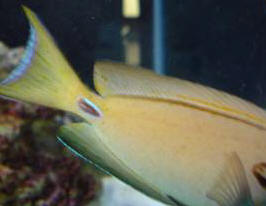
05/24/09 Yellow Tang Black Spot, 8/14/08 Hello, <Hi> Just a quick question about "Black Spot" disease. I have a fairly new Yellow Tang, and have noticed the small black spots on him (I would say around a dozen right now). I was surprised to read about black spot disease/Ich as I was unaware of this condition. <http://www.wetwebmedia.com/parasiti.htm> In the past, if a fish in my main display reef gets Ich, I do my best to treat with garlic. I do my best to keep the fish healthy by eating and I use plenty of garlic to resolve the problem. <No scientific data that suggests garlic is anything more than an appetite stimulant.> The thought is that Ich hates garlic causing them to abandon the fish, and as long as the fish is eating the garlic, the Ich has no host and eventually dies off. <Again, I would not rely on garlic.> It can be difficult for me to catch the infected fish, so depending on severity of the condition of the fish, I will however set a trap to catch the fish if necessary for treatment as a last resort. <All the more reason to QT all fish.> I have had good success in the past ridding Ich as long as fish are eating. My question is does black spot behave the same as garden variety Ich, or are they completely different? <Completely different, is a flatworm, Paravortex.> Will my process of feeding plenty of garlic help rid this parasite? <I do not believe it will rid any fish of any parasite, the science is just not there. But for Paravortex, a pH and temperature adjusted fresh water dip usually does the trick.> Thanks. -Chris <Welcome> <Chris> Parasitic Disease... Black Spot Hi, I am new to the board but not new to reef tanks or fish. I have a question about a chocolate tang that was purchased 2 or 3 months ago. It came from a LFS and looked healthy and happy. Clear eyes, fins and eating well but it was in copper. I have a 4 year old tank with tons of macro algae and I feed Nori daily. No more than a day after the tang was in my tank it had small black spot on its fins. My parameters are perfect other than my salinity was much higher than the LFS but I took time to acclimate the fish. I have used broad spectrum anti biotic (fresh water Maracyn) and the patches disappear leaving a lighter colored skin under it. I also used garlic soaked Nori with almost the same results. As soon as the treatment stops the fish has them again. It can turn its self from a all yellow to a black face in a matter on seconds so I do not know if its gills are supposed to be dark or if there is an infection causing this. There adult color is much darker and I believe its beginning to change now. The fish is calm eats well does not really ever scratch and comes out even when the net is inches from it. That is why I am leaning to treating in the tank. I do not see a reason to stress it further by trying to catch it and move it to another tank. My questions are has anyone had a similar problem? Should I just try and medicate longer with the Maracyn than I have before because I just followed there instructions and quit when I was told. I have heard tangs can develop spots to make them look less appealing for predators is this true? <Not in this case. Go to http://www.wetwebmedia.com/parasiti.htm and read/follow procedures for worms/black spot disease.> I also have two huge dusky Jawfish that could be grabbing the tang and cutting fins leading to infections. I am mentioning this because I have came home a few times and seen the fins ripped a little and I have seen the tang back up to them and swing its spike. <As long as it isn't too serious....minor pressure is alright, but do not let this escalate to stressful or dangerous conflict.> I am moving to a 180g within a few months so they would not see each other as much but I do not want to transfer the infection if that's what it is. Thanks, Adam <Treat as per parasites page at WWM. Use a QT now and in the future! NO main tank intros without QT!!!!! Good luck! Craig> Go Spot, Go! (Marine "Black Spot" Disease) Can a UV Sterilizer kill black ick? <It may potentially kill some free-swimming parasites, but you really need to treat the affected fishes with medication, such as copper sulphate, in a separate "hospital" tank, along with some freshwater dips> Can black ick kill my yellow tang if left untreated? <Sure, Parasitic diseases can eventually move into the gills and other vital tissues, and cause severe stress for the fish, weakening them. If it doesn't kill the fish, it could leave it open to secondary infections. Should I be concerned for my Jawfish or Bi-color Blenny?, they have shown no signs of it while the tang has. <Well, Tangs are particularly susceptible, but, this being a parasitic malady- it can affect everyone in the tank. I would go for the "fallow" tank route like we so often recommend at WWM. All fishes in this tank are potential victims, and you should take this stance when you are contemplating treatment options here> Can blenny and gobies have freshwater dips? Or is it to stressful? <These fishes can be freshwater dipped (I am a big blenny/goby fan, and I FW dip all of my new arrivals without problems). The dip procedure is certainly a potentially stressful one; that's part of its advantage as a prophylactic/supplemental treatment technique. It induces some osmotic shock, which the parasites can't handle nearly as well as the fish! If performed carefully, freshwater dips are a great technique to use> Thank you Sensitive fish guy. James DeHoff <Finally, some one besides Nadine calls me "sensitive"- Gotta love that! Good luck! Regards, Scott F> Danger of disease with too little practical knowledge, bunk advice I have a 55 gallon tank, which has been up and running again for a little while...(4 months?) Anyway, we have crushed coral on the bottom, and some coral and rocks for decoration/hiding/shelter. Our water has been checking out fine when we do a test at the store. (the only test kit we have is the PH one) <First Dave, take responsibility for knowing your water, get an ammonia/nitrite/nitrate/pH/alkalinity test kit(s) and learn to test your water. Your fish store may or may not be able to really help you.> Our fish are 1 yellow tang, 1 orange tailed blue damsel (don't know his official name, but he is not the yellow-tailed ones), 1 Clarkii clown fish, 1 juvenile Emperor angel and 1 cleaner wrasse. (Okay, I have only just begun to read about how this is a bad fish to get, but was trying to solve the tang's problems) Oh, and our filter is an Eheim canister style filter (says 2213 on it?) and we have a bubbler stone with little pump just for nice bubble look off to the side. Okay, here is the problem. Our yellow tang looked great when we first got him. (this was after cycling our tank with damsels and then returning all but the orange tailed guy) Then a few days later developed tiny tiny black dots all over. Checked it out and talked to our fish guy. He said it was the Hawaiian black spot parasite and he recommended a fresh water dip. I did that and they went away. Then of course they came back, I now am beginning to read and understand about the life cycle of the parasites. Because they kept coming back the fish store people had me treat the tank with Marine Aquaria NO ICH treatment for 2 weeks. <FIRE your LFS and do not buy this snake oil stuff anymore!!! PLEASE go to the disease pages of WetWebMedia.com and read about *why* you are getting this disease and how to get your system back in order. Also, please read about and obtain a quarantine tank large enough for all your fish. Read about quarantine and marine stocking at WWM too!> Well, all looked well so after the treatment cycle we bought the emperor angel. I mentioned to them that I thought I saw one or two new dots, and they agreed that a cleaner wrasse would help. <See my advice above and give me a double. Give them the broom, they are not only rip offs, but they sold you a fish that you now know doesn't have a good survival record AND is endangered.> Sure enough, that day the wrasse ate them off, and I thought we were out of the woods. Now here we are a week later, and the yellow tang has 4-5 tiny dots again. and the wrasse is not eating them. She is eating everything else we feed the fish (we primarily use the frozen formula two food, but to ensure the Emperor would eat, we got some brine shrimp) <Brine shrimp is fine to get fish eating, but do switch to Mysis shrimp and another form of nutritious food, brine shrimp is the Wonder Bread of fish foods, no, it's more like Twinkies. IOW, it has no nutritive value.> I did another fresh water dip on the tang, for 5-7 minutes. He looked fine in there the whole time, but is looking definitely stressed now. His breathing was quite rapid, and he was in his stress darker color mode. He is fortunately looking a bit better now, but not much. What also worries me is now our Emperor angel is lingering in the bubbles on occasion, and I am afraid he is getting something now. I just did a 15% or so water change today, and put the carbon back in the filter (was out during the treatment) But things just seem off. I am afraid we are going to wake up to all our fish dead. Oh yeah, the wrasse is not looking so good anymore. Having trouble staying straight in the water, and holding her mouth open a lot. (her name is Alice, by the way, from the Brady Bunch.) So there we have it. Spare me no details, although I already know some of the major mistakes we have made. (No quarantine tank being the biggest I think) Help save our fish! Becky <I would look up black spot disease on WetWebMedia.com and treat as per directed there, in a QT tank, this is common for Yellow Tangs. You may also have another parasite or water condition that you don't see or can't test for, (ick/velvet) and wastes (esp. ammonia/nitrite) and pH/salinity/temp. I would recommend a QT tank along with tests for water parameters as these may be problematic/causative with all fish listless. Also search on google search at WetWebMedia.com on ick/velvet treatment as this may be problem with new additions to black spot. I know you won't add any more fish without a proper quarantine, will you? It may take a month or two to get all straightened out. Make good use of the QT and disease pages of WWM! Best of luck! Craig> Freshwater Dips and Black Spot Disease - 08/26/06 Hello, <Hi there> I'm looking for help in treating black spot disease in my 90 gallon fish only quarantine tank. It has been running for 6 months now. I'm using a Marineland Emperor 400 for filtration and a couple of powerheads for circulation. The water parameters are at 0 ppm for ammonia and nitrites, 8.2 for Ph and around 10-15ppm for nitrates. The water temperature is kept around 80.5 degrees. For the past 8 weeks, I have kept a white-faced surgeonfish, a black percula clownfish, a lawnmower blenny, a royal Gramma, and a firefish in this tank. Over the last 2 weeks, I have lost a black percula clownfish and a Lubbock's wrasse. Up until the 24 hours before they died, both of them were active and eating well. However, since I purchased the fish, some of them have been breathing slightly heavier than normal, and when the 2 fish died, their breathing was rapid. <Mmm, not usually a symptom of Paravortex parasitization> I haven't been able to see any noticeable signs of disease on any of the fish other than the white-faced surgeonfish, who had visible tiny black spots on his body. For 8 weeks, the fish have been treated with (nonchelated?) copper from the Red Sea test kits. <Oh, is a symptom of copper stress> I've kept it at .15-.20ppm; the last few weeks I've kept it closer to .15ppm. The copper wasn't helping much with the black spots on the surgeonfish, <Mmm, nope... usually doesn't> and I started reading on your web site to do freshwater dips as a treatment. <These do> I decided last night to try dipping the white-faced surgeonfish and the lawnmower blenny since the surgeonfish had the spots and the blenny's breathing has been heavy. Well, I obviously made some fatal mistakes with the freshwater dip because the surgeonfish did not make it. Before I did the dip, I put about a 1/2 teaspoon of buffer to a couple gallons of water, added a powerhead, and waited 15 minutes. The water was about a degree warmer than my tank, and I'm not sure what the Ph was because it was not a color on the test kit chart. The kit I was using was old, and I'm thinking that the Ph of the water was too high since I added too much buffer. <Maybe. I encourage folks to use simply Baking Soda (Sodium bicarbonate) as its kOH) is so low as to make it virtually impossible to drive the pH too high> I mistakenly proceeded to do the dips anyway, and dipped the surgeonfish for three 5 minute dips over 40 or 45 minutes, with one final 10 minute dip. <Usually one immersion will "do it"> I only gave the blenny three five minute dips. The blenny was ok and active when I put him in the tank; however, the surgeonfish's eyes were cloudy, it's breathing was heavy, and it had some white scrape-like spots on its body. Could ammonia have built up in the bucket and caused this or was the ph too high? <Mmm, not likely> The fish were eating a few hours before I did the dip. I would appreciate your help. I don't want to kill any more of my fish. Thanks, Jenny <One dip, pH-adjusted, with Baking Soda... The cause of the loss of the original Cirrhilabrus and Clown... something else. Bob Fenner> Getting Tough On A Parasitic Disease... I have a yellow tang which continues to develop black ich despite repetitive fresh water dips. The black ich will reoccur 4-6 days after the fresh water dip. I have done three dips and prior to that I used Organicure for 10 days. My tank is a 125 gallon tank, one Sailfin tang, two clowns, two cleaner shrimp, snails and crabs. All are healthy except the yellow tang. The yellow tang is in the refugium. The tank has been set up to since 1/16/04. The yellow tang was purchased 2/16/04. Contracted black ich 4/5/04. Please offer suggestions. Is there a long term cure? <I'd consider...gulp- copper sulphate. Yes, copper can be problematic for tangs if not administered properly and monitored diligently, but it can be very successful. You need to observe the fish carefully and discontinue copper at the first sign of distress. Treatment should last no longer than the manufacturer's suggested duration, so read and follow the instructions very carefully. I generally do not recommend copper for tang treatment, but I have used it myself many times with much success in difficult-to-treat parasitic conditions such as this. Good luck! Regards, Scott F> <<Umm, the fish/host is being returned to the same/infested system... RMF>> - Blue Tang, Black Spots - Well? >Hi, >>Hi, I'm coming into a conversation already taking place, so forgive me if I go over stuff already covered (this is why we like to have previous exchanges included in the body - this is also likely why you ended up with me). >We have a new tank raised baby Hippo Tang with black ich. >>Righty-oh. Very easily eradicated. >Have read everything on freshwater dips - but haven't found the step by step for complete idiot's guide. Is this procedure appropriate? - - Add amount of reef buffer recommended for salt water to RO/DI water (do not add any salt) - Test that pH is the same as saltwater - Get temperature exactly the same - Add an airstone for 5 minutes prior to putting in Tang - Place baby Tang in the freshwater for 3 minutes - Move baby tang to fresh tank treated with ? (CopperSafe at xx strength???)? >>I don't know that you would really need to go with the copper, this parasite is so easily eradicated with simple hyposalinity. A salinity of 1.010 ought to do the trick. Also, I'd leave him in there much longer than 3 minutes, I'd give him more on the order of 10 or so. >Also, how many days should we wait before bathing the little fellow (to not add too much to his stress) - and then how often would you do the fwb? >>Bathing? I'm going to assume that you're using this terminology interchangeably with dipping, in which case length of dip as above (forgot to add that you would do well to add Methylene blue - enough to turn the water dark blue). I would keep the tang in the hypo for two weeks, using observation to decide at what point he seems to be clear. As I said, this is easily dealt with. Then, he should remain in quarantine for 30 days MINIMUM, starting from the point at which you decide that he's clear of all disease. After that 30 days is up, begin bringing the salinity up to the tank's levels, over two or three days is good. Dip in the freshwater as above, then he can be placed in the display. Oh! Garlic has not been shown at all to demonstrate any efficacy for treating Cryptocaryon irritans. >History - 1" tank raised baby Hippo Tang was put in quarantine Friday evening after a very traumatic shipping experience. Developed small black spots Saturday night and now hides in the rock about 95% of the time (we can only tell he has the spots by looking with flashlight). Has eaten a little off the live rock and nibbled a tiny bit of the Gracilaria we soaked in garlic extract - I think. Thanks, Patty PS: Sorry for constantly sending you questions! Your site is the best - the only one we trust completely! >>It's the first for me, so.. I'm not irritated at this point. ;) (We like our fish-minded friends, anyway.) Be sure to keep up water quality with water changes, this is KEY. ZERO ammonia and nitrites, nitrates under 30-40ppm is desired (obviously, the lower the better). Best of luck! Marina Reef-safe treatment for Black Spot I have a 55 gallon marine aquarium with about 60-70# of live rock seeded with feather dusters and baby sand sifter starfish, a few small anemones, an undergravel filter with 3" of substrate, and a few fish, including a yellow tang. My problem is that the tang has recently come down with black spot. I would normally net it and dip him in a fresh water bath to kill the black spot, but it quickly hides in the live rock. I don't want to pull out the rock to get to the tang because the fish have been through some stress lately due to the addition of 20# of live rock, along with the rearrangement of all the rock. My question is whether there is any kind of black spot treatment that is reef and invertebrate safe? <Mmm, one possibility comes to mind... the use of purposeful cleaner organisms... perhaps a Lysmata species shrimp, and/or a Gobiosoma goby... no chemicals exist that are safe AND effective.> I would like to treat the aquarium as a whole. One dealer recommends Kick Ich, and another recommends a Chem Marin product that lures the Paravortex off the tang, while increasing the tang's slime coat to prevent recurrence. <There is no such thing... am very familiar with the turbellarian in question, its history of study (my old college roommate/friend Mike Kent generated his higher degrees studying it)... Ask around further re these "products". IMO/E they are a sham and a HUGE source of livestock loss and hobbyists leaving our interest. Bob Fenner> Thank you. Re: Reef-safe treatment for Black Spot Assuming I am successful in netting the tang, what is the most safe, effective product to eliminate the parasites outside the aquarium? <Easy to eradicate. Please read here: http://www.wetwebmedia.com/YellowTang.htm and the linked FAQs (at top, in blue)... Bob Fenner> Managing black ich, Paravortex 9/13/07 Hello crew and thanks for all the great information. I wanted to get some advice on my course of action to address black ich on a yellow tang that has been in a 12g QT for about 1 week. I did not freshwater/pH adjust dip him before adding to the QT as he appeared to be too stressed at the time. <Okay> I have noticed a few black specs that are consistent with black ich. Since I can't let the current QT run fallow for 4 weeks as I have no other QT, I was planning to do the following: Freshwater/pH/Methylene blue dip for 5 minutes and place in a holding container with water from the display tank for a few hours Break down the QT, toss the media and bleach sanitize for 2 hours to destroy any remaining Turbellarian Worms Setup QT with media and saltwater from the main tank and reintroduce fish The questions are as follows: Based on the FAQs, 5 minutes should be enough time for the dip but is the dip that highly effective against the Turbellarian Worm <Mmm, yes, generally they fall right off> If the black ich persists, is chelated copper effective against Turbellarian Worm as the FAQs were unclear on this point I assume I have to restart the QT clock for 30 days? Thanks again <Mmm... I'd go the Praziquantel route myself if the pH adjusted FW dip doesn't do it. Please read here: http://www.wetwebmedia.com/fshwrmdisfaq2.htm and the linked files above. Bob Fenner>
|
|

|
Features: |
|
| Featured Sponsors: |