|
FAQs on Identification of Stinging-Celled
Animals 15
Related Articles: Cnidarians, Water
Flow, How Much is Enough,
Related FAQs: Cnidarian IDs 1, Cnidarian IDs 2, Cnidarian IDs 3,
Cnidarians ID
4, Cnidarians ID
5, Cnidarians ID 6, Cnidarian ID 7, Cnidarian ID 8, Cnidarian ID 9, Cnidarian ID 10,
Cnidarian ID
11, Cnidarian ID 12,
Cnidarian ID 13, Cnidarian ID 14, Cnidarian ID 16, Cnidarian ID 17, Cnidarian ID 18, Cnidarian ID 19, Cnidarian ID 20, Cnidarian ID 21, Cnidarian ID 22, Cnidarian ID 23, Cnidarian ID 24, Cnidarian ID 26, Cnidarian ID 27, Cnidarian ID 28,
Cnidarian ID 28,
Cnidarian
ID 29,
Cnidarian ID 30,
Cnidarian ID 31,
& Anemone ID 1,
Aiptasia ID 1, Stony Coral
ID 1, Mushroom Identification,
Soft Coral ID, Alcyoniid ID, Xeniid ID,
|
|
|
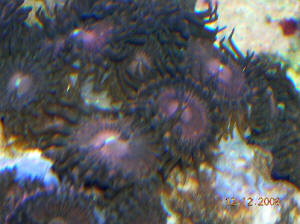
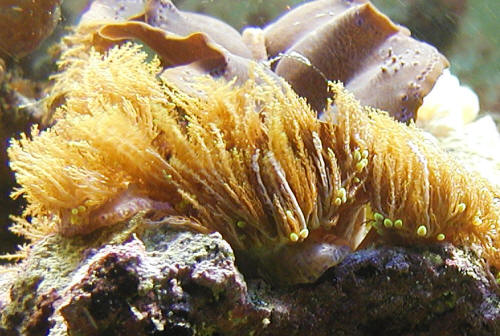
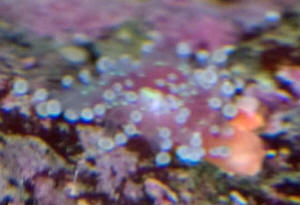
Can you help me id this?
Thalassianthus 12/16/08 Thanks for such an
informative site. Many of us really trust you experience.
<Thank you for your kind words.> Attached are two pictures
I took of something growing in my reef tank � I
was hoping you might tell me what it is - and what I should do
� if anything. They are beginning to populate
and are very difficult (impossible) to remove from the rock. Is
it some form of anemone? <Yes. I am sure this is a
Thalassianthus species or at least closely related. Do a WWM
search for this genus to find further posts. The picture nicely
shows small grape-like balls, these are nematospheres, quite
typical for this genus and only found in one anemone family. Can
become a pest. I have them in a fish/soft coral tank without any
problems and think they are beautiful. But in SPS tanks or tanks
with sensitive animals like clams they may be problematic,
especially when propagating like crazy.> If so, if I try to
remove them and do a partial job - will I create a pollution
problem? <As I wrote to another poster, I'd try: Careful
(!) injection of boiling water, muriatic acid or sodium hydroxide
solution as described at
http://www.wetwebmedia.com/ca/cav1i3/aiptasia_impressions/aiptaisia_impressions.htm
under �other chemicals�.
Don't kill too many at the same time and always filter with
carbon and also watch the pH when using pH changing substances.
You can also try to remove them with an old, but clean tooth
brush, just brush the foot for a few minutes and the animal may
eventually decide to loosen its grip. Then, they can be removed
with fingernails or an old knife or piece of plastic. This method
needs some practice, be aware that they are able to burn at least
the underside of your arms, possibly even your fingers. Carbon
should also be applied when going this route. Removing them in
one piece is more difficult, but might be worth it (you'll
avoid most of the pollution) and some fellow hobbyists with less
sensitive animals or fish tanks might actually be happy about
them.> One is actually growing on the shell of my clam!!
<Needs to go.> My tank: 125 gallons with about 130 pounds
of life rock taken directly from a friend's 400g tank. 30
gallon sump/refugium Skimmer. Change water every other week
(15g). 3 x 150 MH lights. 4 x 96 actinic lights. 8 moon lights.
Thank you for any help you can provide. Regards, -gene
<Hope this helps. Marco.>
|
 Nice! RMF. Nice! RMF.
Re: Can you help me id this?,
Thalassianthus II 12/17/08 Fantastic! Thank you so
much for the information. <You are welcome.> Actually,
I'm not as concerned as I was before. Since you have some in
your tank and with a careful eye on control -- they apparently
are not a serious problem. <Not in my specific tank, I put
them in there intentionally. But if you have sensitive stony
corals, they might become a problem or at least mean some
work.> Just an update -- my clam doesn't seem concerned at
all at this point -- but I'll follow your recommendations.
Thanks again. By the way -- since I had no idea what this was, I
really didn't know how to do my 'home work' before
asking for your help. �gene. <No problem.
There is not much information available in the usual aquarium
literature on this anemone family as far as I know. Cheers.
Marco.>
Re: Can you help me id this?,
Thalassianthus III 12/17/08 Marco <Glen.> --
one other thought -- I use Aiptasia-X (Red Sea) to control the
Aiptasia in my tank -- and it works well. Do you think it would
be effective on the Thalassianthus? <Yes. Works quite similar
to Calcium hydroxide.
http://www.wetwebmedia.com/ca/volume_1/cav1i3/aiptasia_impressions/aiptaisia_impressions.htm
.> Of course, I can try it without harm - just curious about
your thoughts. If I do try it (and it works) would you like me to
share that with you and your team? <Of course. It will help
others in the future. Thanks. Marco.>
|
|
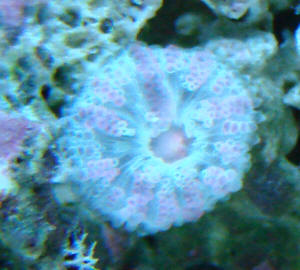
Hitch Hiking Disc ID 12/14/08 Hello WWM Crew,
I have about 10 of these discs on my live rock.. all appear to be
thriving. They move around until they find a spot they like. If
you touch them they pull right into a hole/ base and shrivel up.
They have a base like a mushroom/ anemone. I believe it may be a
variety of Epicystis sp. from other posts on your site. Here are
some pics.. <Hmm, could be Epicystis sp. (a little
bleached)...>
http://i277.photobucket.com/albums/kk60/nallender/DSC02003.jpg
http://i277.photobucket.com/albums/kk60/nallender/mysterydisc.jpg
<It's hard to tell from the photos, but they might also be
some type of Corallimorph (i.e. mushrooms, etc.).> Thanks for
all your help,
Nick
|
Re: Hitch Hiking Disc ID
12/16/08 Thanks for the response. I just wanted to
update you on my hitch hiker. I have posted on some forums and
searched the internet and I believe 100% that it is a mini carpet
anemone. Most stay under 1"-1.5" in diameter. A lot of
people have shown interest in these little guys! I might have to
look into mini carpet anemone propagation! <Cool... thanks for
the info/update! -Sara M.> <<Stichodactyla
tapetum... Interesting indeed. RMF>>
|
|
Zoanthid or pest anemone? 12/14/08pest
anemone? 12/14/08 I just want to thank you all for
your priceless service. I have enjoyed your site for years. I
just sent an incomplete email a moment ago, my apologies. I
forgot to mention that I browsed all of your Zoanthid ID pages,
and all 20-something of your anemone pages, and didn't see
anything quite like these. <I see> I have attached a pic of
some supposed Zoanthids that I was given by a local shop. They
also look a lot like some pest anemones I have seen. They had
come loose from a frag and covered the shop's frag tank wall.
I scraped off a dozen or so and superglued them to the rock in
the pic. <Okay> They spread on a translucent white base a
lot like some clove polyps do--- on runners that form a tangled
mat. <Ahh! A good clue> They are about 1/2" diameter
and the tentacles are only a single row around the disc. Would
you say they are an anemone or a Zoanthid type? <The
latter> I have never seen a pest anemone spread on runners
before, but that isn't saying much coming from me. Oh, and
they are being kept in a 10 gallon nano with a bull shark.
<Heeee! With the emphasis on bull!> Do you think the bull
shark would host a Condylactis anemone? Or should I try one of
those pretty pink sebae anemones? ;) <I think we might start a
Bob and Matt comedy routine!> Thanks!!! Matt <Do take a
read here: www.wetwebmedia.com/zoanthid.htm re the table
detailing the differences twixt Zoanthids and Actinarians... and
here: http://wetwebmedia.com/anemoniafaqs.htm for some pix of
Anemonia... are similar, but note the "number, arrangement
of tentacles"... and the mat appearance you mention. Oh, and
the usual cautionary remarks re Zoanthid keeping, handling... and
watch out for bites from the Carcharhinus leucas... Bob
Fenner>
|
|
| Question: Is this a hydroid?
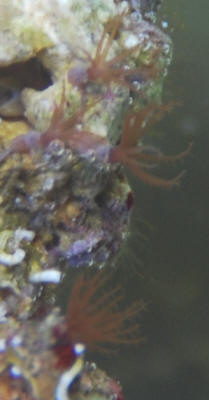
12/5/08 Hello, Wet Web Media Crew I would like to begin by
proclaiming my love for your site. I began to visit this site six
months before I set up my first saltwater tank and have visited it
almost daily since. I use your site to do research on sea creatures
that I have absolutely no intention of ever buying (or even seeing
in person, for that matter) just because you have such a wonderful
plethora of information. <Ahh, most welcome> Anyway, I have
recently found a mystery hitchhiker in my tank. I have searched
through all of the FAQs I could find on your site and have not yet
found a match as to what type of organism this might be. I am
concerned that it is a hydroid of some sort. If this is the case, I
want to get it out of my tank right away. However, if it is
something more innocuous, I would like to leave it be. <I would
leave be... is not a hydroid but some sort of Octocoral... an
Anthozoan... note the eight multiple tentacle pinnate polyps.
Please see here: http://wetwebmedia.com/cnidaria.htm and on the Net
in general re Octocoral identification...> I have attached a
photo to this message. The organism in question appears to
consistently have eight "tentacles," <Ah yes> and
all of the different polyps seem to sprout from a common vein that
runs along the piece of rock the organism is attached to. It also
is capable of retracting, if that makes a difference. <Does...
Please see here: http://www.wetwebmedia.com/polypidfaqs.htm What
you have is some sort of "Star Polyp"... a
Clavulariid> Thank you for all that you do, <Welcome, and
enjoy these. Bob Fenner> |
 |
|
Corallimorph? ID Hi Crew <Hi Karen, Mich
here tonight.> I was doing my usual cleaning/water change on
my reef tank last weekend and out rolled the critter pictured
here - <Cool!> it seems to have been hanging out in the
substrate. <Really, unusual place for it.> I stuck it in a
hole in the rock to keep an eye on it; <I'm sure it's
happier there!> in the upper part of the tank where there is
good flow. <It will appreciate that.> It looks like a
Corallimorph; <It is.> similar to Corynactis californica;
<Close, but I believe you have a Pseudocorynactis
caribbeorum.> but if so I am at a loss to explain how a
cool-water species got into my tank. <Pseudocorynactis
caribbeorum are warmer water species.> There is one main
polyp, which when fully extended is about 1.5 cm. There also
appear to be 3 small buds attached to the main polyp (one is
visible as the pink mass on the right of the main polyp).
<Wow! I see it. Great that you were able to capture that on
film. You may want to contact Brian Plankis the founder of
Project DIBS, as there was interest in breeding this species and
he would likely find your photo helpful. Please see his post
here: http://www.projectdibs.com/forums/showthread.php?t=1153
> There is a central mouth, and the tentacles are club-tipped
and clear. They retract to direct food to the mouth. <Yes, you
can see photos of this on the site above.> The whole polyp
closes into a pea-sized ball when it has something to
"swallow". I have not seen, however it extending the
tentacles and mouth on a stalk like mushrooms do. Finally -
although it does not seem photoactive, it does have a weak
fluorescence in the club-part of the tentacles, which I take to
be due to zooxanthellae? <Yes, often the tips are orange, thus
the common name Orange Ball Anemone. These are generally
nocturnal, and are capable of locomotion, and in my experience
tend to gravitate to lower light areas of the tank.> Any idea
what this is, and is it ok in a tropical environment? <Yes and
yes.> This tank is about 5 years old; with thriving soft coral
(mostly mushrooms and green star polyps). <Highly allelopathic
animals, best to keep this tank dedicated to these animals.> I
added some pacific live rock and Florida live sand about 10
months ago; which is how I imagine it was introduced. <Likely
from the Florida sand, as this is a Caribbean species.> Thanks
for your help <Welcome.>
Karen
<Mich>
|
 |
|
|

