|
FAQs on Identification of Stinging-Celled
Animals 13
Related Articles: Cnidarians, Water Flow, How Much
is Enough,
Related FAQs: Cnidarian IDs 1, Cnidarian IDs 2, Cnidarian IDs 3,
Cnidarians ID 4,
Cnidarians ID 5,
Cnidarians ID
6, Cnidarian ID 7, Cnidarian ID 8, Cnidarian ID 9, Cnidarian ID 10,
Cnidarian ID 11,
Cnidarian ID 12, Cnidarian ID
14, Cnidarian ID
15, Cnidarian ID
16, Cnidarian ID 17, Cnidarian ID 18, Cnidarian ID 19, Cnidarian ID 20, Cnidarian ID 21, Cnidarian ID 22, Cnidarian ID 23, Cnidarian ID 24, Cnidarian ID 26, Cnidarian ID 27, Cnidarian ID 28,
Cnidarian
ID 29,
Cnidarian ID 30,
Cnidarian ID 31,
& Anemone ID 1, Aiptasia
ID 1, Stony Coral ID
1, Mushroom Identification,
Soft Coral ID, Alcyoniid ID, Xeniid ID,
|
|
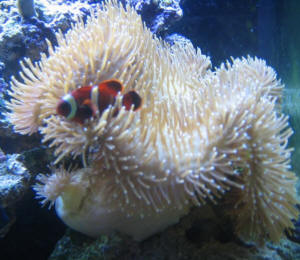
| Anemone? 07/20/2008 Dear WWM: <Kevin>
My tank is a 72 gallon saltwater FOWLR but has a couple isolated
corals. Single protein skimmer and several powerheads. Only four
fish at present (a waste, for sure). (Also seems to have a fair
amount of Cyano but that is a story for another day!) I have had
extremely little change to the tank over the last three years,
except for the introduction and subsequent death of a few small
fish. <Mmmm> This very slow-growing presumed anemone is about
2 inches across. I haven't been able to find a photo of a
similar specimen and I don't trust my LFS for this kind of
info. It looks like none of the aiptasia I eradicated a few years
ago, but I just wanted to be sure it is OK for my tank. Thank you
for your help! Kevin <Looks more like a Zoanthid or Corallimorph
to me: http://wetwebmedia.com/mushroomidfaqs.htm Bob
Fenner> |
|
|
| Re: Anemone? 07/20/2008 Thanks a lot.
I never would have figured it out. I'll research it to find out
how to care for it. Kevin <Ahh, good. BobF> |
|
Ghost shrimp/jewel anemone hlth/ID - 07/19/08 I
can't seem to find an answer for my questions.#1 I bought
some ghost shrimp from my LFS and I noticed they had some white
dots on their body, is this normal or some sort of disease?
<Mmm, likely more the latter... not communicable though. These
sorts of markings show up in specimens that have been kept in
poor conditions> #2 I have a large colony of jewel anemones
<There are a few species that go by this name... Is this a
Corynactis? Which do you have? and can't find any info on
them any where can you tell me or give me a link to some
information on them? Thanks for any help! <Bob Fenner>
Re: Ghost shrimp/jewel anemone 07/20/2008 Wow I
didn't think I would even get a reply yet alone a reply so
quick! So then it would be safe for my fuzzy dwarf lion to eat
said ghost shrimp his health is of great importance to me. #2 yes
my jewel anemones do resemble Corynactis and now I have their
scientific name I'm finding a lot on them. I saw tanks full
of them at Chicago's Shedd aquarium that's were I got the
jewel name from. thank you very much. I'm sure your words of
wisdom have prolonged the lives of many of our aquatic friends!!!
<<Yes, the ghost shrimp are fine for the lionfish. Really
glad you found the correct name for your anemone, all helps
towards providing a better environment for them. Thanks for the
follow-up, hope this helps. A Nixon>>
|
It looks and swims like a jellyfish, could that
be? 6/19/08 Hi Crew, First I want to apologize for
the quality of the picture. This thing is Tiny! Maybe I could send
a better one in a few weeks when I get my new camera. I have 2 of
these things swimming around in my molly tank. They seem happy, the
mollies leave them alone. I should mention my mollies are kept in a
full marine environment, with a salinity of 1.024-1.025.
They're (the mollies) are kept in their own tank and not with
my other marine fish and corals . The tank has been set up for over
a year, with just a smidge of live rock that I've moved over
from my marine tank. My daughter starts yelling about jellyfish in
the tank about a week ago. Though I've seen these things many
times a day, they swim like jellyfish, (flapping their dome tops up
and down), they look like jellyfish,( domed top and a couple
tentacles). That doesn't mean it's a jellyfish. Do you have
a clue? <The picture is far to blurry to say much of anything
sure. There are "pest" anemones that can "swim"
like jellyfish. This would be my guess. I'm sorry I don't
know the proper Latin name/classification for them. But I've
seen them many times, and they do look a lot like jellyfish when
they "swim."> I've tried to research them but I
don't know what I'm looking for. Some sort of egg that
hitched in on some rock I suppose. I'm not worried about if it
was indeed a jelly, maybe they would keep the fish population under
control in there. I do supply that tank with phytoplankton and keep
the parameters in check as I do with my main saltwater tank (except
for nitrates, the mollies don't care so I use tap water in that
tank only for water changes). <I wouldn't worry too much
about them unless they reach plague populations. I also would avoid
touching them. Depending on a person's sensitivity, they might
sting or cause a rash... as all hydroids/jellies and/or
anemones/stinging celled animals have the potential.> Thanks for
your help, Rochelle Lee
<De nada,
Sara M.> |
|
 Jelly... RMF. Jelly... RMF.
|
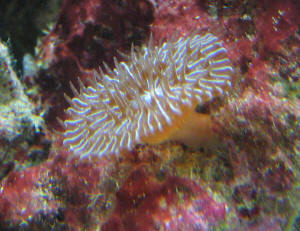
| Please identify this 6/1/08
HI, I was hoping you could identify something for me. It totally
defies anything that I've read about and I'm stumped.
Attached are two pictures one of the 'thing' open and one
of it closed. It came attached on a piece of rock about 6 months
ago. It only opens when the lights are out and has clear tentacles
with balls on the ends that are sometimes white, when the lights
come on it closes up and the outer "casing" is red, it
also closes up like this when agitated (usually by shrimp feet) or
when its gotten hold of food. It has stayed the same size since I
got it, probably from lack of food (since I feed when the lights
are on and its closed then). thanks! Sadie <Is a stony coral
(Scleractinian) of some sort... perhaps a single polyp species
Caryophylliid... Bob Fenner> |
 |
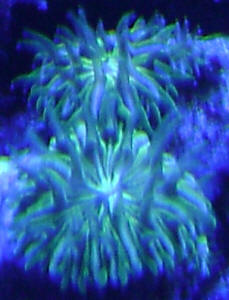
Please ID this Hi, all. I have searched endlessly on
your site and can find nothing resembling what I have on a piece of
rock in my soft coral tank. First off, This came on a piece of rock
that had some mushrooms on it about mid March. These two creatures
you see were hardly noticeable when i brought the Shrooms home. I
did see it, however and cut the rock to have this as a separate
specimen. <Good move> The larger of the two was about the
size of a small Zoa when I noticed it. The other was hardly able to
be seen. There are a total of 5 of these on the rock and they seem
to be localized on this small piece. They do not have a mat and are
not connected. <A good clue> The largest one that you see is
about the size of a penny, now and the other is catching up. They
remain open like you see them almost all the time and will catch
mysis to eat. I have seen no sweeper tentacles and they have not
physically moved themselves. I feel like I can rule out anemones.
There is no hard skeleton that I can see, either. <Mmm, I do>
Can you help? <Likely these recruits are Fungiids:
http://wetwebmedia.com/fungiidae.htm perhaps Cycloseris sp.>
Thank you
Jason
<Thank you for sharing, Bob Fenner> |
|
|
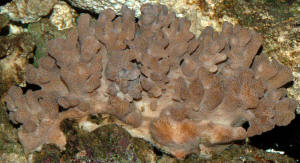
Coral ID 03/30/2008 Hi everybody, This is Sam
from India... <<Hello Sam, Andrew today>> Hope all are
doing great out there! Well, I recently got this soft coral
shipped, which was in the box for two nights, but has made it quite
well, was a bit wounded, but seems fine now. I know that it is a
leather coral, but I wanted to get a proper identification from the
experts. Can you ID this coral's genus, species would be even
better! As, then I will have better understanding of its needs.
Please see the attached picture, the coral had come three days ago,
when it came in it was totally shirked and dark in color, now it is
a little larger and turgid. Basically, I don't know how it
looks when the polyps are fully extended. So, knowing the species
will help compare images for indication on health! Also, looking at
the image what do you feel about its health and condition, how
large does it extend it polyps? Also, how much time does and
average soft coral take to molt? <<Ahh yes, a leather finger
coral by the name of Lobophyton. Looks in a nice condition, and
will look even better when it extends out>> Thanks in
advanced! Cheers, Sam
<<Thanks for the question. A Nixon>> |
|
|
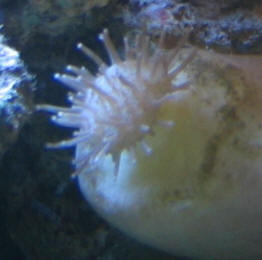
Hairy Mushroom [not] 03/25/08 Hello, I
purchased a large mushroom shown in the attached pictures some time
ago, it is in my Red Sea Max. I assume it is a hairy mushroom but
not exactly sure? <Oooo, no, not a Corallimorph. It is a leather
coral, looks like a Sarcophyton sp.> As you can see it is
budding (if this is the correct term) a new mushroom from its base
which seems to be doing really well. As I understand it, it will
move further out from the shade and grow full size. What I am not
sure of is if it will detach itself <likely> and how long
will it take? <It just depends on how fast it grows.> I was
also thinking of propagating this 'fledgling' and I am not
sure how long to leave it before I do this? <Leather corals are
very easy to frag. You can do this at any time you like if you
don't want to wait for it to detach on its own. Please see
here: http://www.wetwebmedia.com/softcorpropfaqs.htm> You can
also see that my Maroon Clown has 'moved in', it seems to
act as if it were an anemone, is this normal? <This is quite
common.> I do have a sand anemone (but it usually only opens up
at night) which the clown ignores. Any ideas? <Not really.
It's difficult to "force" these things. The only
"trick" I've heard of that might work for helping
anemones and clown fish "bond" is to put the two in a
small bucket together for a little while (but not long enough for
the water to spoil). I don't know if this works, but Rod
Buehler says it can sometimes. You might also read through some of
the info here on WWM, http://www.wetwebmedia.com/clwnfshanefaqs.htm
http://www.wetwebmedia.com/clnanemfaq2.htm ...and other pages.>
Thanking you in advance for any help you can give. Colin
<De nada,
Sara M.> |
|
|
|
|

