|
FAQs on Identification of Stinging-Celled
Animals 4
Related Articles: Cnidarians, Water Flow, How Much
is Enough,
Related FAQs: Cnidarian IDs 1, Cnidarian IDs 2, Cnidarian IDs 3,
Cnidarians ID
5, Cnidarians ID 6, Cnidarian ID 7, Cnidarian ID 8, Cnidarian ID 9, Cnidarian ID 10, Cnidarian ID 11, Cnidarian ID 12, Cnidarian ID 13, Cnidarian ID
14, Cnidarian ID
15, Cnidarian ID
16, Cnidarian ID 17, Cnidarian ID 18, Cnidarian ID 19, Cnidarian ID 20, Cnidarian ID 21, Cnidarian ID 22, Cnidarian ID 23, Cnidarian ID 24, Cnidarian ID 26, Cnidarian ID 27, Cnidarian ID 28,
Cnidarian
ID 29,
Cnidarian ID 30,
Cnidarian ID 31,
& Anemone ID 1, Aiptasia
ID 1, Stony Coral ID
1, Mushroom Identification,
Soft Coral ID, Alcyoniid ID, Xeniid ID,
|
|
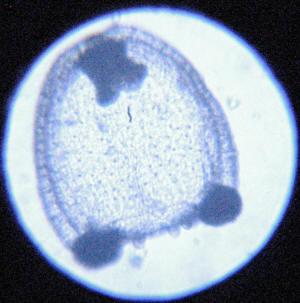
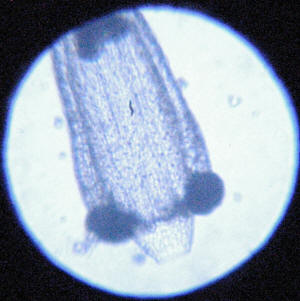
| Baby jellies... or some other creature?
1/4/06 Hi crew, <Chris>
Sheesh. I had to get creative to photograph these
critters. I snagged one with an eyedropper, placed it in a water
drop on a slide, and popped it into my $20 National Geographic
'scope. After removing the eyepiece shield, I was able to snap
a few photos of reasonable enough quality for ID purposes... I
hope. <Neat> These pics are slightly out of focus, but the
best I could get and still get the whole thing.
('scope/lens/user? limitations) I've seen some dozens of
these, over the past few days, in my 55G saltwater tank. I'm
seeing fewer lately, due to losses in my power heads and/or
filtration, I suppose. (Or predation?) <A combo. no doubt> I
didn't notice them today, until swishing around my LR with a
turkey baster... blowing off some food that had 'settled'.
(Perhaps these had 'settled' too... and I stirred them up?)
<Likely so> Anyhow, they look for all the world like
mini-jellyfish of some sort, though I couldn't imagine from
whence they came. My only recent addition is a 6" ball of
Caulerpa Racemosa from my QT. (Note that this QT also contains
assorted amphipods, worms, and other tiny marine life that has
accumulated over time) The Caulerpa had been in the QT for three
weeks. <Mmm, are some sort of medusoid life> Most are about
the size of this period. (Some are a bit larger) The photos show
the rest of my observation. At "rest", they're full
of water, their "valve" is closed, and you can see a few
small protrusions between the two dark spots at the valve end. To
move, they appear to expel water through the 'valve', and
they contract axially, while extending longitudinally. (Moving away
from the 'valve' end, of course) <Yes> Enough of my
rambling, I suppose. Please edit and ditch any irrelevant babbling
as you see fit. I won't mind. Do these look like anything
you've seen before? <Mmm, yes... juvenile
"jellies" of some sort (Scyphozoans, Hydrozoans) or
ctenophorans...> Feel free to whack me in the head with a book
of your choice, if these are something very common that I
should've found on a simple web search. (I looked, but perhaps
not hard enough) Tell me if you need more info, tank
specs/inhabitants, etc... Thanks in advance, Chris
<I wouldn't be overly concerned re these being in your
system... likely "strobilized" from the new algae... or
some other substrate. Will pass with time. Bob Fenner> |
|
|
Hydroids? Aiptasia? Majano? Help! - 12/05/05 I
have these little polyps spreading all over my live rock. They
don't look like Aiptasia as their tentacles have
"feathers". I think they may be some type of hydroid.
<<A possibility...but they may also be Majano anemones.>>
They sting everything and peppermint shrimp won't eat them (as of
yet). Joe's Juice isn't effective either (they shrivel up only
to open back up a day or two later). Can you please help me identify
them and tell me how to get rid of them. <<Have a peruse through
our FAQs starting here: http://www.wetwebmedia.com/anemoniafaqs.htm>>
They are not attached at the base and I've never seen one divide
yet they spread like wild fire. They sting Xenia (and kill it) and
everything else they come in contact with. You can see them in the pic
to the right of the Xenia. Sorry for the size of this picture but
it's hard to get a small one of them that you can actually see them
in. <<There was no picture with the email.>> Any
identification help and advice on how to get rid of them will be MUCH
appreciated. I'd like to find a predator for them. They don't
seem to need much (if any) light so they are hard to access (hide in
small dark crevices). <<These anemones can quickly multiply to
plague proportions. Do have a look in the FAQs, much info/help
there.>> Thanks
<<Regards, EricR>>
| Susan's Cnidarian Identification - Per
James via Marina 12/5/05 Thanks! I didn't want to
clog your inbox with them... I'm so interested to find out what
you think. -Susan <<Susan, I've had some other
crewmembers take a look at the photos, and this is what James has
to say: "Marina, Looked in your folder at the pic. If
I had to guess, I'd say it was a very small rock anemone.
Regards, James" So, there you have it, he's guessing
rock anemone (though that second shot, are its tentacles fully
extended there?). In any event, it looks like a pretty, and
honestly, unless it's causing you problems I'd just enjoy
it. Marina>> |
|
|
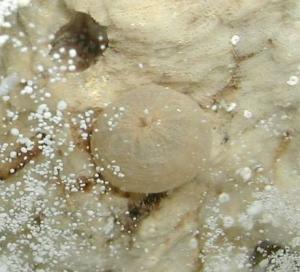
| Polypoid ID 9/28/05 Hello Crew, <Ed> Does
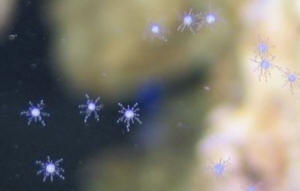
anybody know what these little bugs might be? <Mmm, some sort of
Cnidarian... a polyp-animal of some species> I have
done some research on your site and others. Doesn't
really look like any of the pictures of copepods or
amphipods. They are reproducing rapidly in my
tank. My tank is currently cycling, I just put the live
rock in two and a half weeks ago. Thank you, ED <Not
to worry... these too shall pass... Enjoy them while they're
there. Bob Fenner> |
|
|
| Quick ID Pleeeeease! Dear Crew,
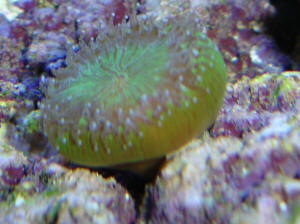
If you will, please ID this hitchhiker
anemone for me so that I may take proper care. He does eat any and
everything I feed him. If you can ID, how big might I expect him to
get? Will he be a good host anemone?
Thank you Mark <Mmm, actually... this looks more like a
single-polyped stony coral to me... can you make out a calcified
skeleton within this animal? At any length it is a Anthozoan, and
likely to some degree photosynthetic... I would enjoy it! Bob
Fenner> |
|
|
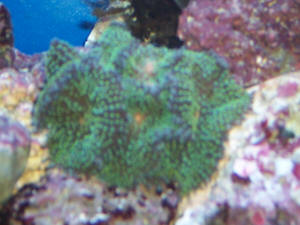
Invert id 9/5/05 Hey guys.. quick question.. I was
searching the coral i.d. <Not a coral...> and could not
find this coral I now have in my tank due to a friend of mine
moving, could you please tell me what it is?... <Please see
here: http://www.wetwebmedia.com/corallim.htm and the linked
files at top> thanks (pic attached) also I just finished
placing my xenias, flower pot feather duster and leather
(toadstool) around my tank... could you take a look at my pic
and tell me if they are placed ok? <Not shown... but there are
placement, Compatibility files on all these on WWM...>
the feather duster is kind of touching the pulsing xenia, and
suggestion from such a fine crew is Always appreciated!
Thanks
Paul
<Read my friend... read. Bob Fenner> |
|
|
Coral ID 9.2.05 Dear Bob and Company,
<Howdy> First off BIG fan of the site, keep up the great work.
<A tall order with a skeleton crew of volunteers on a ever-growing
website... more volunteers, anyone? <G>> Now to the
question. I can't identify this particular coral I have
received. It was given to me, so I can't complain but
I'm stumped. It is similar looking to a pipe organ
polyp, in that it has a long stems, but not of the eight tentacle
variety. It can fully retract into its rock, and this
particular piece has about 50-70 individual polyps. Each polyp center
is about an eighth of an inch in size, with a half inch to an inch-plus
stem length. Each polyp has 16-20 small tentacles about 5 mm
thick by one-sixteenth inch in length. The stems and polyps
are greenish-brown and the tentacles, and centers, on the polyps are
light green. This is under 2*65w actinic and 2*65w 50/50-10k compact
florescent bulbs. I hope this is descript enough,
<Without a close/clear picture... this is a pot-shot at best.
Furthermore, I'm concerned if you are buying corals and other
animals, but don't have a basic photo ID/husbandry book to refer
to. Do seek Fabricius and Alderslade for soft corals (2001) and
Borneman's "Aquarium Corals" for general coral
keeping> I don't have a camera or else I would include a
picture. If you know what it is and have any advice as to
placement, water movement, light requirements, feeding, etc. That would
be greatly appreciated. Rock On, Jonathan <you mention Tubipora as
comparable, and I wonder if you are mistaking that soft coral (organ
pipe) as a hard coral? If so, that would explain the lack of tubes,
despite being compared to a Tubiporidae (you state the tentacles are
fully retractile). If that's so... I'm then wondering if the
animal is stony? Do polyps retract into stony calices? I'll take a
random guess here and say that you have an encrusted patch of
Goniopora. Do use the google image tool to find examples. Else a
picture when you can, mate. Anthony>
| Hydroids to Flatworms Hi Guys, I have a cluster of
little brown pom-pom like things in my reef. Using the google
search on your site, I found out that they are "a fairly
common nuisance hydroid, Myrionema". My question was answered.
<Good> While I was on the Hydrozoans FAQ page I noticed a
posting titled "Stranded Hydroid! Yikes! 4/7/05". Your
staff answered the question and identified the animal as a hydroid.
I had similar things in my tank growing on a finger leather coral.
It turned out to be some kind of flatworm. It had the same
tentacles in the posted picture. The worm would release the
tentacle into the current and pull it back repeatedly. <Strange,
interesting... have not heard of, seen this offered re flatworm
behavior ever> The worms are very clear, so they almost
disappear when they are spread out over the surface of the coral
which makes it seem that the tentacle is coming from the coral
itself. <Good plan, eh?> I used Salifert Flatworm Exit in a
bag of tank water and dipped the coral in it. After approximately
45 minutes the flatworm came off by creating a current in the bag
with my finger. It was a clear, slightly cloudy flatworm. Even
sitting on the bottom of the bag, it released the tentacle and
pulled it back. The tentacle was a long single strand which had
smaller lines coming off one side. I actually got a few of them
using the dip. Each worm only had one strand - so if you see more
than one - chances are that there are several worms. Great Site.
<Thank you for this input. Will try to find the bit you
reference and couple it with yours here> Dave Here was the full
post from the FAQ: Stranded Hydroid! Yikes! 4/7/05 Hello WWM
Crew, <howdy> I have a quick question for you regarding a
finger leather and a strange set of tentacles coming from it.
<yikes! they are not from the leather, but instead are from a
stinging hydroid. They can be quite aggressive to other reef
creatures and even burn your skin painfully> I have attached a
picture of identical tentacles as what are coming from
my leather but am unsure of how to deal with this issue. <manual
removal> I have only had the leather for 3 weeks now and it has
never extended a single polyp. <Perhaps it's irritated from
the hydroid. More importantly... I fear you have added this coral
to your tank without a proper quarantine period. Yikes, if so...
it's a surefire way to introduce pests and predators to your
tank like this hydroid> Every evening these threads come out and
they are very intricate which is what led me to believe they were
not just mucous. I cannot see anything on the leather
itself by following the threads but there are 6 or 7
coming out. Any help you can give me would be greatly appreciated.
Regards, Scott B. <There are many types of hydroids in the
world. Some look like corals... some look like algae... others more
like jellyfish. Caution with all :) Anthony> |
|
|
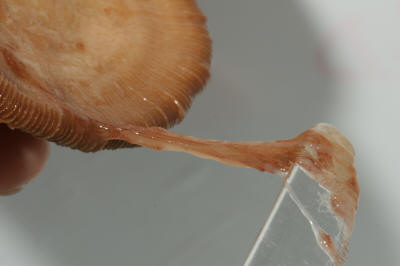
| Hydroids... hydrozoan: what's in a name? 6/21/05 Ah,
yes... understood. It really does look like a flatworm. Not so
though. Its a ctenophore... benthic sort of "hydroid" or
"jelly" (not the same, but kin). In the hobby... we have
been calling the thing that I think you are seeing (a unique
description... really sounds like it) "a hydroid" for
lack of a better understanding/term. Pics of one of my own attached
- its being scraped from the underside of a Fungiid. And... a link
to a quick mention of the lil buggers here: http://www.seaslugforum.net/display.cfm?id=12274 Anthony
:) |
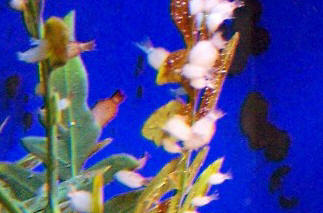
| What is this? 7/4/05 Hello Everyone, <Hi there>
Happy 4th! Can anyone identify what is growing all over
this plastic plant (pic attached)? They look like "pearl
onions" or small white sacks tied at the top, attached at
their base and the only place I have found them are on this single
plastic plant. They seem to have appeared overnight or
within the last day or so as my wife and I take a good look at our
tank every day to make sure the fish are doing well, any upside
down snails etc. and have not noticed this until
today. Are they O.K. or should they be
removed? Any help would be greatly appreciated.
<Leave them... look like some sort of polypoid life... Any
chance of a close-up pic?> 150 gal, 175 pounds live rock, 50 gal
sump/refugium, spg 1.024, ph 8.2, Nitrite 0, Nitrate 10, Ca 385
ppm, Alk 9 dKH <Bob Fenner> |
|
|
|
|

