|
FAQs on Identification of Stinging-Celled
Animals 8
Related Articles: Cnidarians, Water Flow, How Much
is Enough,
Related FAQs: Cnidarian IDs 1, Cnidarian IDs 2, Cnidarian IDs 3,
Cnidarians ID 4,
Cnidarians ID 5,
Cnidarians ID
6, Cnidarian ID 7, Cnidarian ID 9, Cnidarian ID 10, Cnidarian ID 11, Cnidarian ID 12, Cnidarian ID 13, Cnidarian ID
14, Cnidarian ID
15, Cnidarian ID
16, Cnidarian ID 17, Cnidarian ID 18, Cnidarian ID 19, Cnidarian ID 20, Cnidarian ID 21, Cnidarian ID 22, Cnidarian ID 23, Cnidarian ID 24, Cnidarian ID 26, Cnidarian ID 27, Cnidarian ID 28,
Cnidarian
ID 29,
Cnidarian ID 30,
Cnidarian ID 31,
& Anemone ID 1, Aiptasia
ID 1, Stony Coral ID
1, Mushroom Identification,
Soft Coral ID, Alcyoniid ID, Xeniid ID,
|

|
Sudden Appearance of a Bright-Pink, Flat Anemone!
UFO? 3/5/07 Hello again. <Hi there> Last night I
transferred some fishes into my 2 month old brand new tank, which has
live rock, crabs, shrimps, sea hare <Do investigate the biology of
this animal> and a leather coral. All are doing
well. This morning there was a bright-pink 'thing'
with a trunk of approximately 2 cm long with a flat round disc at the
end of approximately 2 cm diameter with stubby little frills around the
edges. The centre of it has green and white patches and what
looks like a little hole. <Does "read" like a polypoid
form of life> It wasn't sticking straight up, but bent
over. Presuming this to be an anemone I have trekked through
all your pages on anemones and I have found one picture that looks a
little like the anemone I discovered this morning except mine is
luminous pink. <Neat> Unfortunately I do not have a
digital camera so I cannot send you a picture with this
email. I want to know what the name of the anemone is on the
picture on the page entitled "FAQs on Anemone Compatibility
1." please? <At the top right? An Anemonia majano>
Also does the colour and shape of mine sound like it could
be the same as the one on your picture? (If the one in your picture has
a positive ID). A couple of hours later it had become
completely flush with the rock and difficult to see. <Have never
seen a bright pink Anemone period... unless it had been dyed> My
major concern is if it an anemone which could kill any of my fish,
crustaceans or corals I would rather take it out of my tank. Thanks
once again in advance. Angela. UK. Still raining <Likely is a
Zoanthid... from the tentacle description, its sudden appearance... Do
you have "reefing" friends who might come by and take a look,
perhaps a digital image to make/send? BobF>
Re: Sudden Appearance of a Bright-Pink, Flat
Anemone! -- 03/09/07 Hi Bob <Angela> When I said I will
not probably see it again for another two months I meant because I have
had my tank set up for two months and it has only just
appeared. It can only have come in on the live rock added
when my tank was installed. <Ahh!> I did have a tiny 3- 4 cm
across hitchhiker xenia which came in on a piece of macro algae; I
attached it to the rocks, but it has disappeared since this strange
pink creature appeared and disappeared. Is it more likely to
be the sea hare eating this? <Mmm, could be affecting them... maybe
by just kind of grazing over...> I was told that they do not bother
corals? <Generally not, no> Thanks a bunch Angela PS. Doing lots
of reading but always getting conflicting information. <Gots to sort
the wheat from the chaff... Keep an open (by slightly cynical) mind,
and you'll do fine. Bob Fenner>
Small Invasive Polyps...(Hydroids I Think) -
02/19/07 Hi Mr. Fenner, <<Hello Dominique...tis Eric here
this morning>> Hope you're doing fine. <<Doing
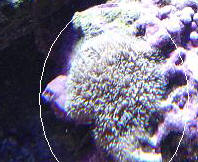
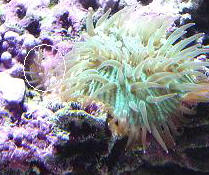
well, thank you>> I have some small unknown (to me) polyps
that are spreading on the LR. <<Yes, I see>> When they
reach Montipora they seem to burn the border (1 or 2 mm) of these
SPS. So far they didn't grow on the
SPS. I fear they may inhibit growth of my SPS or grow on
them as they spread in the tank. <<A valid concern>>
One picture is cropped to have a closer view but the other picture
is already a close shot since I used a macro lens. I
tried to brush them off the LR with a toothbrush with no
success. They seem to retract in the LR deep enough to
avoid the brush and possibly regrow quickly when damaged.
<<Is likely, yes>> Could you please ID those polyps
and/or give me hints as to how to get rid of them or how to deal
with the problem...? <<Well Dominique, though at first glance
these seem to resemble Aiptasia anemones what I think you actually
have here is a species of hydroid (though Anemonia Majano can't
be ruled out either). These can have very powerful
stings as you have witnessed...and can spread very quickly in some
instances to plague-like proportions. Trying to brush
them off the rock in the tank is usually futile as you already know
and may even cause their spread. There are nudibranchs
that might prey on the hydroids but these are very obligate feeders
and would require identifying the exact species of hydroid you
have...all this assuming you could even find/obtain the
nudibranch. Your best option here is to remove the
affected rocks and give them a freshwater soak (maybe add a small
amount of bleach) and then leave them in the sun to
dry. Obviously this will destroy any/all life on and in
the rock. You may find alternative strategies you can
try by looking through our FAQs on these critters. You
can begin by starting here, and following the associated links at
the top of the page: http://www.wetwebmedia.com/hydrozoanfaqs.htm>> Many
thanks!
Dominique
<<Good luck, EricR>> |
|
Re: Small Invasive Polyps...(Hydroids I Think) -
02/20/07 Thanks for the quick answer! <<Welcome>>
That is bad news though. <<Can be nasty little
devils>> I have several colonies/frags of M. digitata on
these LR. If you have any other suggestions please get
back to me. <<Can these colonies not be removed/placed on
new rock?>> Could using a syringe and lemon juice or
Joe's Juice to kill them bit by bit each day be a good
strategy? <<Not foolproof, but give it a try if you're
willing...you may be able to at least keep them at bay>>
Maybe use a tool that scratched the LR deep enough (unlike a
toothbrush). <<Perhaps...using a steel-wire brush, or maybe
even an old carpenters chisel to remove a layer of rock from
beneath the hydroids. You will need to do this outside
the tank in a bucket of seawater...rinsing the rock thoroughly
when done in a different bucket of clean seawater before placing
back in the tank>> Not having to remove the LR from the
tank would be very good in this situation... <<Not
possible, in my opinion...too much risk of exacerbating the
problem by spreading the hydroids throughout the tank>> I
did get a peppermint shrimp and have seen no more Aiptasia since
then, but it seems it won't do the trick with this new pest.
<<Indeed, they often won't even touch the
Aiptasia...best to find/use an alternative method>> Thanks!
Dominique <<Do let me know how your battle
progresses. Eric Russell>>
|
|
 Encrusting Gorgonian? RMF. Encrusting Gorgonian? RMF.
|
| Species ID, No Photo,
Corallimorpharia 2/19/07 Hello to the wonderful crew at
Wet Web Media, <Hello again Brandon, Mich with you.> I hope
this correspondence finds you all well, if not partially water
logged. I know I am. <Been better, a
little under the weather and a foot of snow to boot!> I am
writing because I have managed to purchase a coral that I was sure
that I could identify, and now I am less and less
sure. I was told that it, (I am now almost certain is
corallimorph), was a type of hairy leather. From the way
that it was closed in the shop it certainly looked like a
leather. Once I got it home, it opened up to where it is
in the picture. <Mmm, sorry to say Brandon, there is
no picture here.> I introduced some food in the tank, and I
noticed a rather large mouth come out. This is when I
began to think that it might be something else. So I
went to Wet Web, specifically, http://www.wetwebmedia.com/corallim.htm. Personally,
I am leaning toward Rhodactis sp., or Discosoma sp. I
was hoping that you guys could clear that up and hopefully point me
to where I can find enough info to fill in the sp.
<See above comment.> I was also curious about something else
too. I have a 75 gallon reef with a 20 gallon
sump. The day before yesterday, I had the sump and the
tank full. Today (two days later) it would appear that I
have lost five to seven gallons in water. I was
wondering if perhaps this is normal, or should I get out the
silicone, and start looking for leaks? <Hehee,
let's hope not!> At what rate does normal evaporation
run? <Depends on many factors.> Hopefully, the
following information will help more, I have two 175 watt HQI
10,000K halides, and one 96 watt actinic 03 PC sitting about 6
inches off the surface, and over the refugium in the sump I have
two normal incandescent lights. Would this much light be
able to cause all of this evaporation? We are looking at
two days. I am thinking that this is a lot. <I would
error on the side of caution. I would definitely check
about your tank, for a leak or other potential problem, if you are
concerned and have noticed a sudden a sudden increase in the need
for top off water. That being said 2.5 to 3.5 gallons
per day could be reasonable given your lights and various other
unknown factors.> Thank you all for all of the help that you
provide, especially the help that you have given me. <You are
most welcome Brandon. -Mich> Brandon R.
Foster |
| Re: Species ID, No Photo, Now with Photo,
Rhodactis spp. 2/20/07 Sorry Mich, Let's see if
it comes through this time. <Yay! Got
it! Yes, definitely Rhodactis spp. commonly called
elephant ear mushrooms or hairy mushrooms. Can't
tell you the species, though your photo very much resembles a
picture in Eric Borneman's book "Aquarium Corals" on
page 207 including the forked tentacles, however the photo is only
marked as Rhodactis sp. These are potential fish eaters,
so be careful here. -Mich> Brandon R.
Foster |
Re: Species ID, No Photo, Now with Photo,
Rhodactis spp. Part 2 2/20/07 Oh yeah I almost
forgot, Sorry to hear that you were feeling ill lately Mich, I hope
that clears up. <Thanks, me too. Sinus
infection... the box of tissues is my new best
friend. We're inseparable.> I was sick all last
week. <Hope you weren't as cranky as I've
been.> I used the time to make a refugium in a 20 gallon
long. My wife said that I must not have been that
sick. HA! You're never too sick when you
are high on silicone rubber sealant. <Heeeeee!>
Right onto the matter at hand, It was in fact evaporation that was
causing the water loss, and it was a gross over estimation on how
much water was leaving. It was more like a gallon and a
half. <Seems much more reasonable.> I sure did
look like more though. The odd thing is that the
salinity reading didn't shift like you would think. Perhaps it
was so small a shift that the Hydrometer that I have didn't
register the change. <Not surprising, the loss is a
fraction of the overall volume of the system.> But yeah 1 - 2
gallons is quite normal. Heh. <Very good.> Thanks
again,
<You are quite welcome! -Mich>
Brandon |
|

|
Polyp ID? 1/31/07
<Greetings, Mich with you today.> Hi was wondering if you can
tell me the name of the tall polyps on the left of the picture
(cylindrical with wart like surface), as well as their aquatic
needs. <Yes, these are Tube or Snake Polyps (Isaurus
sp.). They are not commonly seen in the industry, so
lucky you! Care is the same as other members of the
family Zoanthidae. They are relatively hardy and
tolerant as are other zoanthids, which, I presume you are familiar
with as I see them in your photo. Thanks!
<You're welcome! -Mich> |
|

|
Softies, LPS, SPS, What's the
Difference? 1/27/07 Adam, <Adam's busy tonight
Frank, Pufferpunk filling in.> You are correct, I skimmed your links
but did not read thoroughly. <Although guilty of skimming myself at
times, folks here have gone to a lot of trouble looking up these links
& posting them for you. Please try to respect that &
do some searching for yourself too.> I meant no disrespect to you by
asking for a second opinion. I just thought that the more
input the better educated I would be. <Much
input/education found by using the search tool.> I will read the
links further to get a better grasp. Is there a difference
between Softies and LPS and Stonies and SPS or are they just synonyms?
<Softies (soft corals), are corals without skeletons. LPS
(Large Polyp Stonies) have a skeleton & large polyps attached
(generally eat meaty foods). LPS (Large Polyp Stonies), have
an external skeleton with small polyps. All info readily
available & easily searched for on your own. ~PP>
Thanks again, Frank
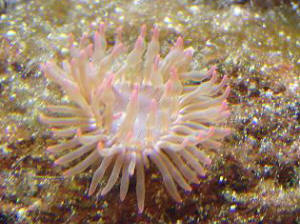
Majano I.D. - 01/24/2007 Hey guys (and
girls) - I love your website. <Thanks!> It has got to be fun
to run it! <Umm'¦ okay'¦ we'll
go with that hehe.> Okay, on to my question... <Of
course.> My husband and I started our 75g tank a little over a
year ago. <Neat.> A few months after getting set up, we
noticed this little polyp hanging out. Since it
didn't look too much like the dreaded Aiptasia guys, we left it
alone. <Not quite Aiptasia but almost as
unfriendly'¦.it appears to be
majano'¦http://www.wetwebmedia.com/ca/cav1i3/aiptasia_impressions/aiptaisia_impressions.htm
The above is an article which entails a little info about them as
well as some useful methods on getting rid of them.> Since then,
it has gotten larger - it is currently approximately 3/4"
across when open. In all this time, it hasn't spread
or even split once! <Likely due to low nutrient
levels'¦..consider yourself lucky.> It has little pink
tips on its tentacles. I'm attaching a couple pics
and I was hoping someone might know what this guy is? <The
pictures were very helpful, thanks.> Thanks for providing such a
great service to us all! <Welcome.>
~Christine
<Adam J.> |
|
|
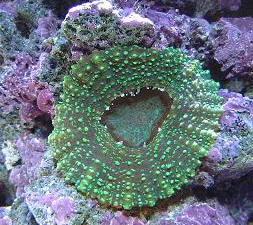
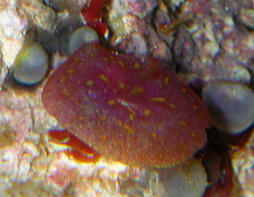
| Coral(limorph) ID 6/2/06 Hello to all the
Crew! <John> I have used this site many times and often refer
others here. Great information in a easy to use format. <Ah,
thank you and welcome> Recently I purchased a small rock of
Zoanthid corals and received a bonus. tentative ID is LPS Scolymia
species button coral, or a type of Fungia. Attached are two photos,
one with a flash used the other without a flash. Physical
description: Hard to the touch. The top or dome (disk?) as it were
is attached to a stalk or stem. <I see it> The parent is
attached to four smaller daughters in the same fashion as Palythoas
or zoanthids. Any help in making a positive ID would be helpful in
making correct choices in placement and possible feeding and or
dosing additives. John. <Looks like a mushroom anemone to me:
http://wetwebmedia.com/corallim.htm
Bob Fenner> |
|
|
|
|