|
FAQs on Identification of Stinging-Celled
Animals 11
Related Articles: Cnidarians, Water Flow, How Much
is Enough,
Related FAQs: Cnidarian IDs 1, Cnidarian IDs 2, Cnidarian IDs 3,
Cnidarians ID 4,
Cnidarians ID 5,
Cnidarians ID
6, Cnidarian ID 7, Cnidarian ID 8, Cnidarian ID 9, Cnidarian ID 10,
Cnidarian ID 12,
Cnidarian ID 13, Cnidarian ID
14, Cnidarian ID
15, Cnidarian ID
16, Cnidarian ID 17, Cnidarian ID 18, Cnidarian ID 19, Cnidarian ID 20, Cnidarian ID 21, Cnidarian ID 22, Cnidarian ID 23, Cnidarian ID 24, Cnidarian ID 26, Cnidarian ID 27, Cnidarian ID 28,
Cnidarian
ID 29,
Cnidarian ID 30,
Cnidarian ID 31,
& Anemone ID 1, Aiptasia
ID 1, Stony Coral ID
1, Mushroom Identification,
Soft Coral ID, Alcyoniid ID, Xeniid ID,
|
|
|
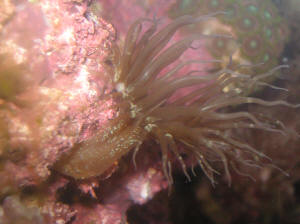
Cnidarian Identification 2-1-08 Hello. <Hello. Yunachin
here.> Can you please help me tell whether the attached photo
is an anemone or a coral? We've had this piece of live rock
for 6 months or more and originally thought this was a coral.
Yesterday, however, I noticed that it aggressively moves to take
food that drifts nearby and very quickly takes the food into a
hole in the center of its body. I thought only anemones did that,
so now it's got me wondering, which one is this? I've
checked your site for Cnidarian identification help, but I am
still unclear which this is. <This is in fact a type of
anemone, Aiptasia. It is a common site in marine aquariums and if
not removed can become a very troublesome tenant, even
multiplying. Peppermint Shrimp are a good choice as are Red
Legged Hermit Crabs if you are searching for something to devour
this pest. Here is a link to help you learn more about them and
methods to eradicate them if you choose:
http://www.wetwebmedia.com/marine/inverts/cnidaria/anthozoa/Aiptasia/aiptasia.htm
;> Thanks, <You're welcome!> Stephanie
Re: Mystery Cnidarian: Aip. contr.
2-2-08 Hello Yunachin, <Hello again!> Thanks for the
response. I read (and read, and read some more) on your site now
that I know what kind of anemone we're dealing with. I
definitely want to get rid of it immediately, but I'm
concerned about my corals. We have a large variety of big,
beautiful corals that were also quite expensive. It sounds like
the peppermint shrimp and/or the hermit crab will eat those
indiscriminately, in addition to the Aiptasia. Is that the case?
<I have never experienced any problems with TRUE Peppermint
Shrimp eating corals. The problem is they are sometimes
mislabeled and are really Camelback shrimp, which will taste your
corals. Worry not though as they are easily distinguished, the
Peppermint Shrimp being a much lighter color than the Camelbacks.
As I see, the only danger of adding the shrimp is they might be
at risk of getting eaten by any current livestock you have
already. As far as the Red Legged Hermit, they too will leave
your corals alone and go on scavenging for algae and
Cyanobacteria. They may become food if you have puffers though.
Other than that you are in the clear! Good Luck with your new
clean-up crew.---Yunachin> Stephanie Well, that's good
news then, thanks for your help! <You're welcome!
--Yunachin>
|
|
And it's free! RMF
|
|
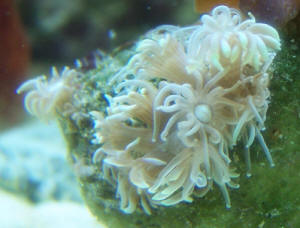
ID Help Requested - Zoanthid? 2/1/08
Yesterday I saw something on a rock of mushrooms I had recently
purchased. I didn't take a long look at them but I assumed it
was Daisy Coral (aka Clove Polyps)... <Think this is so>
but this morning I went and had a proper look and it's
something I've yet to come across and can't find on a web
search. They are small, about the size of Yellow Polyps. Each
polyps seems to have two tentacles <? Looks like more to
me> which moves around collecting particles which float past.
They are white with light green tips, white mouth and the pad at
the end of the 2 tentacles are white as well. Could they be some
kind of Parazoanthus? Regards, Paul <Please see here re Cnid.
higher tax.: http://wetwebmedia.com/cnidaria.htm and the linked
files where you lead yourself. This looks like a stoloniferan to
me. Bob Fenner>
|
|
|
Polyps? Data? 2/1/08 Crew, I have some
growths on the back of my nanoreef. I have not been able to identify
them, and sadly not been able to get a decent picture. currently living
in the tank are a damsel, some reef hermits, red and blue legged, and
Astrea snails. 1 zoanthid colony and 1 colony of "ballet
dancers" individual yellow polyps. It looks like a *Parazoanthus
gracilis *though I am only guessing based on the image. when my skimmer
crapped out one me, I have a remora on its way now, the ballet dancers
kinda went down hill, there had been something like 20 or so polyps now
there are only 4. these growths on the back of the tank do not look
like Aiptasia, but do look similar to the polyps of the Zoa, they are a
translucent white in color. I looked at the images on the site and can
find nothing that matches them, any idea what these could be? <...
how might one guess given the above description?> should I worry?
<?... maybe> they are growing on the glass and silicon, but not
on the rocks. is there anything, other than the obvious improving water
conditions, which I am working on by doing partial water changes twice
a week now, of about 10% each time, to improve the health of the
dancer? thanks again, Forrest <Possibly knowledge gained by
reading... Please start here:
http://wetwebmedia.com/marine/inverts/index.htm Cnid. Systems,
Health... the Zoanthids... Bob Fenner>
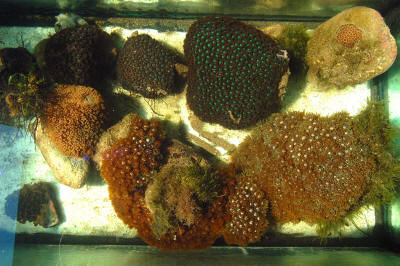
| Coral ID -- 1/26/08 Hey how you doing? Hope
all is going great! <Mmm, okay> I recently collected a few
corals from our local shore, they see to be doing fine as I had
drip acclimatized them for around 2 hrs! <Good practice> The
images are of my quarantine tank with natural sea water, which was
collected with the corals. <Mmm, okay... need to be distanced a
bit more here... like a good 15 cm. twixt colonies/pieces... I
encourage placing the skeletons up off the bottom as well... with
pieces of drilled PVC pipe... to allow circulation, observation,
the "dropping off" of unwanted hitchhikers> After the
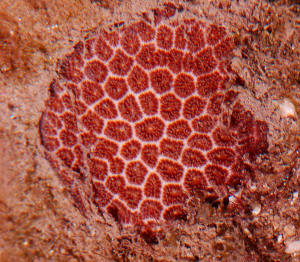
image of the full tank, I have send close ups of each type, please
try and ID these, so husbandry can be provide accordingly! <...
am given to suggest you NOT collect what you don't know the
simpler husbandry/biology of...> Thanks in advanced, happy
reefing! <? FWIW, I concur with your initial assessments the
"not know/n" is some sort of Faviid... Bob
Fenner> |
|
|
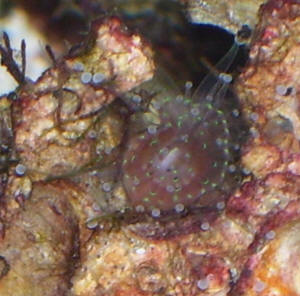
Pest? Nope, Corallimorph: Pseudocorynactis sp. --
1/24/08 Hi Crew, <Hi there.> Not the best pictures but
here are two of what I think are pests. <Thankfully, they're
not pests. They're neat little Corallimorphs in the genus
Pseudocorynactis, commonly called Ball Anemones, or Ball
Corallimorphs. They're mostly nocturnal, extending their
feeding tentacles at night to catch any zooplankton or pods that
might happen by.> I only see 3 in the tank but want to make sure
what they are. The third one is deep in a rock and I can only see
the white tips. <That's typical with these. For more
information, please see the FAQ at the first link, along with the
photos and FAQ's at the second:
http://www.wetwebmedia.com/mushridf4.htm
http://www.wetwebmedia.com/mushrmidfaq2.htm .> Thanks
<You're welcome. Take care -Lynn> |
|
|
Identification of
Mushroom/Ricordea/Zoa's 01/13/2008 Hey Guys,
<<Hello, Andrew here>> I love your site, its priceless to
beginners like me! You save me hours of dead ends with all the posts!
:) <<Thank you, nice to hear>> I recently decided to
upgrade my fish only tank with Fiji live rock and a few easy soft
corals...some small Zoanthids (about 7 baby polyps), a mushroom, and a
Ricordea, all of which are pretty tiny as I have a 20 gallon tank for
the moment.. looking to upgrade to larger more stable system when funds
allow, and it will make most things such as selection so much easier.
Anyway, I need some ID's on what I bought so I can care for them
better, and the guy at the saltwater aquarium store got on my nerves
and I forgot to ask for more specific names. (They are the best within
several hours drive, although they do push sales with little regard to
what happens to them after :( ) So here is what they look like so far:
Mushroom- a kind of bright burnt orange color with a small stalk for a
base (its a little bigger than a dime) <<These will be
Actinodiscus - or commonly known as red mushrooms. Keep separate from
the other corals, can be a little feisty>> Zoanthids- also
orange\red color with a whitish core (tini tiny) <<One manu
different Zoanthid SP - Treat as any standard Zoanthid. Read more here.
http://www.wetwebmedia.com/zoanthid.htm >> Ricordea- blue\green
and a little bigger than a quarter <<This will be Ricordea
florida - More info can be found here.
http://www.wetwebmedia.com/corallim.htm >> I have about a 1/4
inch of sand base with about 1 1/2 inch crushed coral on top
(didn't want to lose my sand critters when I changed substrates). I
am running a protein skimmer and a Penguin 150 water filter with carbon
and an Aqualight 60w actinic\10,000k and about 6lbs live rock\ 14lbs or
so dead live rock (just started buying live rock). The water filter
pushes enough water around the tank but at low flow so I put the
Ricordea where the water makes the slime move a little but not the
Ricordea and also the Zoanthids. The mushroom I put to the other side
where the water flow is lowest but still circulating well and
consistent....is that about right? Everything I've read said
mushrooms don't do best in much current and Ricordea like a little
current to remove slime but like I said, the Penguin doesn't push
very much. Don't know where I should put the Zoanthids so I just
put them in the same area but about 4 inches apart. Don't know if
powerheads are necessary or desired so I don't have them.
<<Ricordea don't need a vast amount of flow, the Zoa's
need more flow again, not high though and the mushrooms are best to be
placed in slow to medium flow>> Being so small, is there anything
I need to do differently? I figured I need to be more careful with the
small ones than I would larger ones. Calcium is very high (just did 40%
water change) but don't know if its harmful at high
levels.<<Wont do hard at 500ppm, however the water change is good
for bringing that own>> I bought some frozen coral food (mix of
zooplankton and other stuff). am I doing everything right so far? Do I
need to feed the mushroom usually? Some things I read so I really
shouldn't supplement them much, just allow them light....
<<You sound like your on the right track with it all. Just be
diligent with water quality, more info on feeding and habitat can be
found in the above linked articles>> Thanks for your willingness
to help! Joshua <<Thank you for the questions, A
Nixon>>
| Coral (?) identification James, <Now
Bob... James couldn't get your file to open... but it does here
for me> Sorry about that. I resent to myself and it said about
78kb so it should be ok. Thanks Coral ID 1/6/08> <Brian, can
you resize the photo to something like two or three hundred Kb and
resend. I had two beers waiting for the file to download and it
still wasn't finished.> Thanks, James (Salty Dog)>>
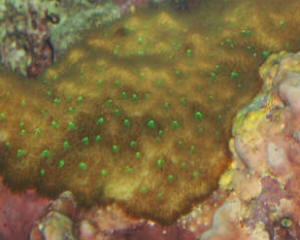
Hello, I didn't see anything quite like the attached picture in
the archives, so I'm hoping you could give me a hand by helping
identify. I've had it since I received the live rock about 1
year ago. It was about half the size it is now, and has many evenly
spaced, bright green centers with brown hair-like
'appendages' all around it. It doesn't appear to spread
to other parts of the tank or grow rapidly or have any threatening
features, so I'm just curious what you think it may be. If you
think it is something I should be concerned about, please let me
know. On the other hand, if there's something I should do to
help take care of it I'm open to suggestions. Thanks. >
<Looks like a sponge rather than a Cnidarian... but need to have
a "closer", more highly resolved pic to make out a bit
better. Please send this along... of whatever size. Bob
Fenner> |
|
|
|
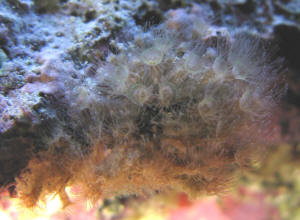
Hitchhiker #2 I.D. and advice 1/6/2008 Dear Crew:
<B in B> Here is my second question for the New Year.
Please forgive me for being so greedy. But, after reviewing of a
dozen pages of Cnidarians I.D. and Hydrozoan I.D., I am stumped.
These tiny fellows are approximately 4-5mm in length. They grow
in clusters as shown and are starting to spread across the
underwater landscape. I fear them to be some sort of unwelcome
Hydroid. What do you think? <Look more like Zoanthids to me...
do they share a communal base?> I chose to send this
photograph because one of the animals in the lower left hand
corner of the picture is back-lit showing some of the internal
structure. If indeed a hydroid, I presume you recommend waging
war. Thanks again for all the help you give to all of us. Brad in
Basalt <Mmm, I'd somehow isolate the colony to prevent its
spread, bumping up against other sessile life. Please read here:
http://wetwebmedia.com/zoanthid.htm Particularly on
Compatibility/Control. Bob Fenner>
Re: Hitchhiker #2 I.D. and advice, Zoa?
Thanks for the reply Bob, <Welcome Brad> Good question and
good advice! I cannot tell you if they share a communal base yet
because they are so small and fuzzy that destructive testing
would be required. <Mmm, yes. Do take a cursory read through
here: http://wetwebmedia.com/cnidaria.htm re the major
distinctive differences twixt Cnidarian higher taxa> I can
tell you that they seem to be able to "propagate"
rather than "spread" to other locations as 4 of these
clusters have shown up in various locations within the tank. Is
it possible that the original colony was fractured by
invertebrates with the pieces subsequently swept away on the
current? <Yes> Thanks again, B in B (under piles of a major
snow today) <Brrrrr! No thanks. The weather is currently even
bad in S. California. BobF>
|
|
|
|
|

