|
FAQs on Identification of Stinging-Celled
Animals 12
Related Articles: Cnidarians, Water Flow, How Much
is Enough,
Related FAQs: Cnidarian IDs 1, Cnidarian IDs 2, Cnidarian IDs 3,
Cnidarians ID 4,
Cnidarians ID 5,
Cnidarians ID
6, Cnidarian ID 7, Cnidarian ID 8, Cnidarian ID 9, Cnidarian ID 10,
Cnidarian ID 11,
Cnidarian ID 13, Cnidarian ID
14, Cnidarian ID
15, Cnidarian ID
16, Cnidarian ID 17, Cnidarian ID 18, Cnidarian ID 19, Cnidarian ID 20, Cnidarian ID 21, Cnidarian ID 22, Cnidarian ID 23, Cnidarian ID 24, Cnidarian ID 26, Cnidarian ID 27, Cnidarian ID 28,
Cnidarian
ID 29,
Cnidarian ID 30,
Cnidarian ID 31,
& Anemone ID 1, Aiptasia
ID 1, Stony Coral ID
1, Mushroom Identification,
Soft Coral ID, Alcyoniid ID, Xeniid ID,
|
|
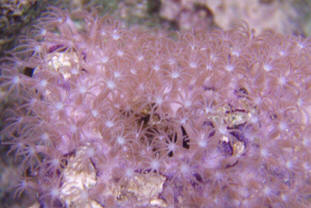
| Can You Identify This Please'¦ Hydroids
-- 03/08/08 Hello <Hi there, Mich here.> I have a
125-gallon marine tank that has been up for about 6 months - this
is my third tank. Can you please tell me what the small brown
things are - I believe that they are either a cluster of tiny glass
anemone (I haven't been able to find any pictures on the web of
tiny clustered glass anemones but did read on WetWebMedia that they
do come very small) <Nope.> or some sort of tiny cluster
feather dusters. <They are hydroids, perhaps Myrionema sp. They
can be a nuisance and you will need to wear gloves when removing
them as they can deliver a sting. They seem to be about 1/4 inch
long each. Let me know if the photo is not good enough and I will
get a friend with a better camera to take a picture. They are so
little it is actually difficult to see the details of them. <The
picture is fine. There also appear to be worm snails (Petaloconchus
spp) in the background, which are harmless filter feeders, but be
careful when moving about them as they can be quite sharp and
easily puncture finger tips.> I do know what a normal glass
anemone looks like and have had them before but never this tiny. I
did read on the site that the fish will avoid them and I have not
seen any fish stung but they do seem to avoid them. If these are
glass anemones I will try to remove them, <Hydroids are pests
and should be removed.> my biggest problem will be that they are
on one of the rocks my feather duster is attached to, which is
reasonably close to one of my bubble tip anemones. Can you suggest
the best way to remove these without damaging the feather duster or
the bubble tip anemone assuming it is tiny glass anemones. <Well
removal can be a bit of a challenge. If possible, you should remove
the rock from the system while you go about with the removal of
these buggers so they are not accidentally spread. You will likely
have to remove the top layer of the rock, as much as an inch with a
chisel or Dremel as these pests can attach themselves quite deeply
in the rock.> thanks for your help and for this wonderful
resource. <I am happy to help and I too thank all who have
contributed to this tremendous body of work. I was a student here
before I was a teacher.> regards Jackie for NZ <Cheers, Mich
from the good ole US of A.> |
|
|
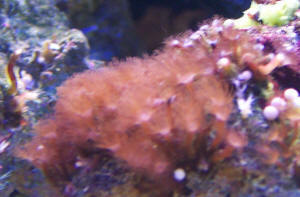
| Tiny pest anemone or some type of polyp? (Picture
Included) 3/3/08 Hello WWM crew, I would first like
to say, your site is a treasure trove of information. Now back on
topic, I've noticed lately on one of my live rock there are
about 2 dozen of these tiny things. They look like polyp, with over
24 tentacles, white brownish in color, retracts a little when
touched, and about a few millimeters in height. I've been
digging through your website trying to figure out what they are,
and I was hoping there might be a picture, but I haven't seen
one or probably missed it. So far base on other peoples
description, it sound like Aiptasia, right? <Mmm, not
necessarily... could be Zoanthids, other types of Polypoid life...
Even just juvenile forms... Likely transient... will go in time>
I've included a picture which has a pair of them near the upper
center of the photo. Thanks, Kent <I see them... but need more
detail than these show. You can work your way through the
description of the major Cnidarian groups here:
http://wetwebmedia.com/cnidaria.htm Thanks for sending this along.
Bob Fenner> |
|
|
|
ID please -02/29/08 Please see attached. I can't tell
what it is, but hopefully someone can. :) <I'll try!>
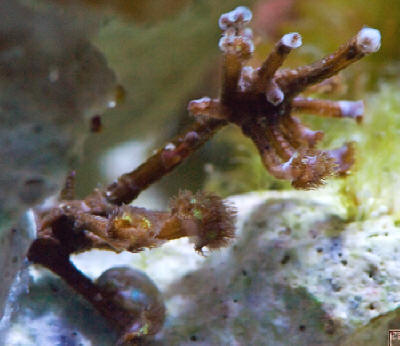
Grows very tree like and on top of a colony of some palys. The
'polyps' withdraws into itself and tips becomes a whitish
color (like the ones up the top of the picture). When they're
open, they resemble zoas/palys, with a green center.
http://ericdo.com/pictures/Starfire%207.2.07/unknown_soft_022708.jpg
<Wow, that's certainly something different. Is there any
chance you could get a close up of the open and closed
polyps?> Please let me know if you guys can ID it. <To be
honest, I'm not even entirely sure it's even a coral...
but maybe some type of hydroid? More pictures will help.> Many
thanks, Eric <Best, Sara M.>
ID please -hydroids 02/29/08 <Eric- Just following
up... I asked one of my friends who is more of a marine invert ID
expert and he agrees with my guess that it's a hydroid of
some sort. But more importantly, he was able to explain a bit of
why he thinks so. The tubes are brown and translucent which
suggests they're proteinaceous, not calcium carbonate. That
means it's not a coral. And neither of us can think of
anything else (except a hydroid) that would have branching
proteinaceous tubes (and have polyps) like this thing has.
Hydroids are extremely difficult to ID, but if I can narrow it
down more at all, I'll let you know. :-) Best,
Sara M.>
|
|
 Outstanding. RMF. Outstanding. RMF.
|
|
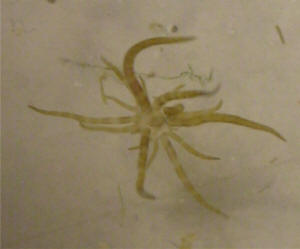
Need Help With An ID No One Knows In My Reef
Forum 2/24/08 <Hi Jim, Mich here.> I bought snails from
the LFS and on 1 of the shells was this aiptasia looking thing,
that's what I assumed until it released itself and started
swimming. It swims like a octopus flailing its tentacles I've
posted on a reef forum and looked all over the Internet
researching this thing but have come up with nothing. Any help
would be appreciated. <Looks like a hydroid jellyfish to me.
More here:
http://www.ronshimek.com/Animal%20Groups%203%20Cnidarians.htm
http://www.wetwebmedia.com/jellyidfaqs.htm > I do have it in a
catch bucket but was wondering if it's safe to put it in my
reef. <Likely wouldn't hurt. Populations tend to wax and
wane. Is interesting to observer for sure.> Thank you for any
help you can give me. <Hope this helps. Mich>
Jim
|
|
|
|
Identification question 2/23/08 Hi you
guys have great info here. I was curious if there was anyone
there who can ID these things in my tank. <Mmm, are
Corallimorphs. Please read here:
http://wetwebmedia.com/corallim.htm and the linked files
above> They look like some sort of mushroom. Several have come
off the rock they were initially growing on. Where they had been
attached has a hard stony reminder. The ones that have come off
are living happily on the bottom of my tank. These can blow up to
quite a large size, 5-6 inches across and 1.5 inches
"tall", or expel their water and get down to being just
1-1.5 inches across and maybe 1/4 inch tall when fully
compressed. One pic is taken under actinic lighting and the other
is under white light. <Very nice. Thanks for sharing. Bob
Fenner>
|
|
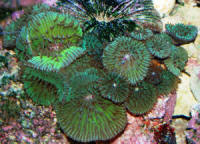
These are actually anthocauli, i.e. baby
Fungia -Sara M.
|
| LR Critter ID 2/18/08 Hi all, Thanks for
putting together such a great site. I can spend hour upon hour
sifting through all the great data. The wife is threatening to
limit my time on WWM. <I have recently "found" your
message delinquently here... Will respond> I need help
identifying this little critter that hitchhiked in on some live
rock (see attached photo. Its not the best quality. It's harder
than I thought to get a nice clean picture). Its about a quarter of
an inch tall by 3/16 diameter cream colored stalk topped with a
group of white/translucent balls at the end. <Yes... some sort
of polypoid, Cnidarian animal> Its growing in a shaded area of
the rock. Originally, this little guy hung around about a month
after I cured the rock then receded to barely visible nub. I
figured that it was a critter that couldn't survive in the tank
and didn't think about it much. However, it has now grown,
receded back a nub and grown back again 3 more times over the last
5 months. Since it seems rather tenacious, I would like to see if I
can provide better for its needs. Any ideas or pointers to it's
identity would be greatly appreciated? Thanks in advance. Dave
<Might be an anemone... perhaps a Zoanthid... to some degree
photosynthetic maybe... Please read here:
http://wetwebmedia.com/cnididfaqs.htm and the linked files above
and where you find them in text... till you find enough information
to satisfy you. Bob Fenner> |
|
|
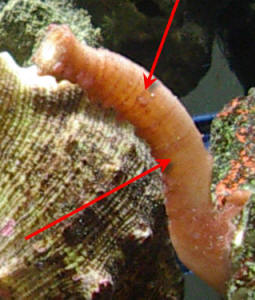
| Help with ID please 2/8/08
Hiya....Its Andrew by the way...from here on WWM... <Hello
Andrew. Nice to see you from "the other side"> Would
it be possible for anybody to ID the pointed out in the attached
picture please...A friend has asked myself, and I do not
know...learning time for me I guess... Thanks ladies and gents..
Andrew <Mmm... interesting. My best guess is that this may be a
sea pen of some sort... does the "head" ever open up? If
so, would you have an image, close-up of this sent along? Cheers,
Bob Fenner> |
|
|
|
Ricordea under a rock ledge... Maybe
Majanos 2/5/08 Hi All, I love your website!
I have learned so much from it along with the book "The
Conscientious Marine Aquarist". <Hello and thanks!
Bob's book is great isn't it?!> I recently acquired a
55 gallon reef tank set up with LR and LS. It was covered with
green hair algae that has now died off (amazing what decent water
will do). OMG the things that are now appearing on the rocks! I
have discovered 3 Ricordea under a ledge of the biggest rock and
completely in shadow about 2-3 inches above the substrate. Will
they move to seek the light or should I try to move them? If I
need to move them, how should I go about doing it? Due to the
angle, I can't get a chisel in there to get them on a chunk
of rock. Thanks so much in advance. These are very pretty bright
green little guys I really want to help out. Peg <Peg,
Ricordea don't usually just pop out on rocks. However, Majano
Anemones do. Here is some FAQ's...
http://www.wetwebmedia.com/anemoniafaqs.htm These types of
anemones pack a big sting and are not very well liked by aquarist
as they sting and kill corals. Google "Majano Anemone
Pics" and see if they are the same ones you have. HTH,
Rich...aka...Mr. Firemouth>
Re: Ricordea under a rock ledge
2/8/08 Thanks, Rich (Mr. Firemouth? Surely there's a
story to that alias) <I love to breed Firemouth Cichlids.>
I've read all areas on your website and looked at pictures on
the web. It doesn't look like any I've seen: no pedicle,
lies flat and no bubble tips. Still it must be a Majano of some
sort. I just got a Ricordea Yuma and they sure look alike in
structure. <It could be possible that it is a juvenile
Rhodactis Mushroom Coral from the Tonga area. They would have the
Yuma Ricordea appearance/structures.> I'm going to go with
Anthony's response to "Pest Anemone" on 2/14/03,
pretend they're not a pest and try to keep the pretty little
guys from multiplying. <To help prevent rapid spreading of a
pest anemone while keeping it in the system, you can take the
rock it is on and make an island away from the main liverock
structure. These anemones spread in close proximity of each other
and can be concentrated on one rock by keeping the rock isolated.
Many times these majano type anemones tear their "foot"
while moving and create a new anemone. This is known as petal
laceration. Another thing they do is divide. They
"split" into 2 separate pieces. Therefore, it is much
harder for them to spread all over if they are isolated. A
picture of the anemone would help. Good luck and happy
reefing!-Rich> Thanks again, Peg
Re: Ricordea under a rock ledge
2-14-08 Hi, I'm sorry for the delay in responding. I did
not have much (OK any) success with my attempts to photograph the
"thing". I finally found a picture on the web and it
looks just like mine, it is labeled as a green Ricordea. I dug
out my dive camera, but need new batteries. I will keep trying.
Thanks again, Peg <After reviewing the pic provided it does
look like Ricordea floridae. Here is a link with more info...
http://www.wetwebmedia.com/corallim.htm <<Image
not placed as it is others property. RMF>>
|
|
ID help, please 2/5/08 Hey Crew, <Andy>
Presently curing a batch of live rock pending setting up my tank
in March, and came across these on a small piece of rubble; not a
great picture, I know, but any thoughts you might have are much
appreciated. I¹ve searched all of the sponge and
anemone ID pages, and I¹m not having any luck. I
don¹t THINK they¹re Aiptasia, but
I¹m a relatively new to the hobby haven¹t
seen all of the variants of that pest. What do you think, friend
or foe? Thanks, Andy <The larger batch of stalked polyps at
top? Please see here: http://wetwebmedia.com/zoidfaq2.htm and the
linked files above. Bob Fenner>
Re: ID help, please 2/5/08 Thanks, Bob.
Yeah, they do resemble the Palythoa, with one row of 6-8
tentacles. I thought I read that the Zoas are toxic, <Are, to
many organisms... including humans> but my hermit crab seemed
to enjoy them as a snack... twice. Looks like they're easy to
care for, as well. I'll keep looking to see if I can classify
them more accurately. Thanks! Andy
<A closer-up pic please. BobF>
|
|
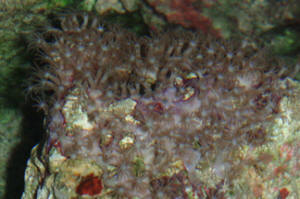
Re: ID help, please 2/5/08 Bob
(or crew), <Andy> Here¹s a little better
picture, not much, but such are the limitations of my little
digital camera. This is certainly a truer color. A friend
suggested these might be Green Star Polyps. <Does appear
to be a Clavulariid> Thanks again,
Andy
<BobF> |
|
|
|
|
|

