|
|
| Home | Marine Aquariums |
Freshwater Aquariums |
Planted Aquariums |
Brackish Systems |
Ponds,
lakes & fountains |
Turtles & Amphibians |
Aquatic Business |
Aquatic Science |
Ask the WWM Crew a Question |
| Please visit our Sponsors | ||||
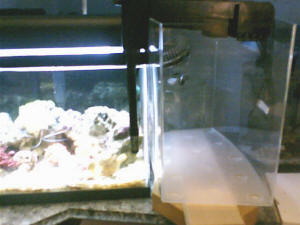
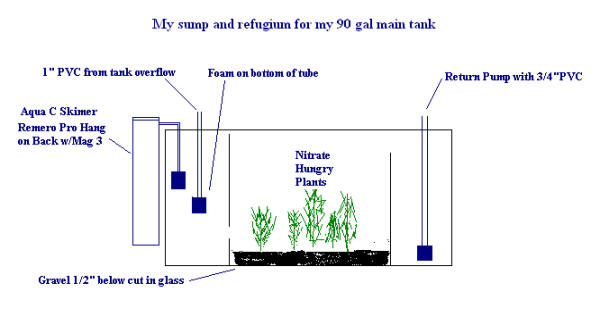
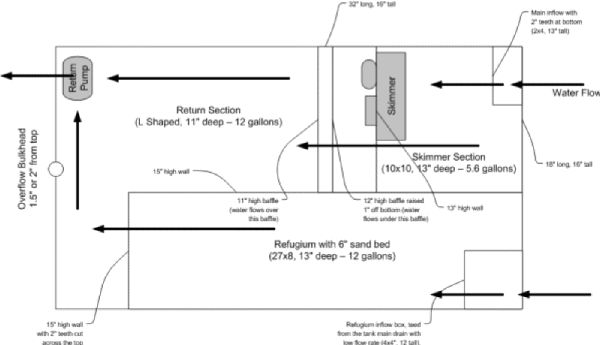
Refugium...Putting his/her Money Where his/her Mouth Is! 4/26/07 Hi <Hello.> I bought a 10 gallon glass aquarium and put baffles in and designed a refugium. <Awesome.> I currently use a wet dry on my 55gall.. <A good change then...> Would this refugium be sufficient/big enough to replace the wet/dry. <I'll answer with the refugium cliché here....the bigger the better...anything is better than nothing.> Is the design ok? <Seems workable. Will it be above the tank (upstream) or below (downstream) in the sump position/area?> As always, thank you <Welcome, Adam J.> Refugium Installation...No Siphon U-Tubes Please! -- 04/26/07 Hello WWM crew, <<Hello Casey>> After reading about all of the benefits of a refugium, I just had to have one. <<Ah yes, a very worthwhile addition>> My main tank is a 55 gallon, and I created a 10 gallon refugium that sits next to and about 3 inches above my main tank. The refugium has a 4" sand bed, 10 pounds of live rock, and Chaetomorpha and Cup Caulerpa. <<I would remove the Caulerpa/keep the Chaetomorpha. The differing macroalgae will 'battle' each other (reducing their benefit at best...negating it altogether at worst), and of the two the Chaetomorpha is the most 'user friendly'>> I intended to just have the Chaetomorpha as I read in the other FAQ's that it's best in small refugiums to stick with 1 type, <<Mmm...is best in 'any' size refugium, in my opinion>> but there was a small piece of the Caulerpa mixed in when I bought it, and now it's all growing well. <<So it may appear, but be assured there is a chemical war waging>> Anyway, the refugium has been running for about 3 weeks, and has lots of amphipods and copepods already. <<Excellent...do think to add a bit of food (fish flakes/shrimp pellets) a few times a week to help bolster the populations/reduce the likelihood of cannibalism>> Currently, it is unconnected to my main tank as I used some live rock from the LFS and I am waiting 5-6 weeks so that I don't introduce harmful elements into the main system. <<Not likely a concern...considering the small amount of rock involved>> I have 2 more weeks before I'll be connecting the tanks. <<I see no need to wait...>> Being that I'm not that handy, I found what seemed like an easy plan (image attached) to connect the two tanks. <<I see the image...and I suggest you DO NOT do this. The siphon U-tube 'will fail' at some point causing the display to drain/the refugium to overflow. It is much safer and highly recommended to either place the refugium lower than the display and let water gravity feed to the refugium (the plumbing/refugium static water level will need to be 'balanced' to prevent an overflow in the event of a power outage) and then pump water back up to the display...or position the refugium above (even slightly) the display and 'drilled/plumbed' to allow water pumped from the display to 'gravity drain' back in to the display tank>> I was planning to use a pump from the main tank to the refugium and a "U" type tube to siphon from the refugium to the main tank as pictured in the image. <<A very bad idea in my opinion>> However, it seems that if the siphon were to lose its seal, I'd have a big mess of saltwater all over my carpet. <<Indeed>> Is this truly risky or am I over thinking things? <<Not a risk, is a CERTAINTY...just a matter of time my friend>> If this is not a feasible and safe plan, what would be the best way to proceed? <<As previously explained>> Will I need to drill and attach an overflow fitting? <<You will, yes>> Will I need to drain the tank to do this? <<Not at all...merely drain the water to a couple inches below where you will drill the throughput>> The algae, amphipods, and copepods are all doing so well that I hope I won't have to disturb them. <<They will be little bothered>> Thanks for the wealth of knowledge that's available at WWM. Casey <<Is our pleasure to share...and feel free to give me a shout should you need more clarification re the refugium installation. Eric Russell Refugium Design/Application -- 04/26/07 You have an unbelievably informative site, thank you. <<A collective effort...quite welcome>> I would like to know if my plan for a refugium makes sense to you. <<Well let's see...>> We have a tall 30 gallon seahorse tank that currently houses 2 Hippocampus kelloggi, 2 gobies, 1 cleaner shrimp, 1 peppermint shrimp, 2 Fromia stars and 2 snails. Live rock, macro algae, pulsing xenia, eel grass and a gorgonian make up the rest of the tank. <<Sounds very nice...but I think this rather 'large' species (can grow up to 12') needs a tank at least twice as large as this>> We have an AquaC Remora Skimmer with a Maxi-jet 1200 housed in the AquaC Prefilter box. The filter box is modified with a plastic mesh screen over the inflow cutouts to prevent creatures from disappearing into the skimmer (a sad experience with a 3rd seahorse led to this modification.). <<Mmm, yes...a hard learned lesson>> Filtration is provided by an Eheim Classic 2213. The environment is 6 months old and all inhabitants appear to be thriving. <<Very good...but this tank is still quite 'young'>> Before the seahorses were introduced, we had an active population of copepods and amphipods, or at least I presume that's what they were. <<Likely so...and quickly/eagerly consumed by the Syngnathids>> With constant grazing by the seahorses and the shrimp, they have largely disappeared. <<Indeed>> We would like to add more seahorses, up to as many as six, <<Not in 'this' tank (see my previous comment re)>> and want to supplement their feeding and enjoyment with a "regular" supply of pods. To accomplish this, I would like to add a 10 gallon refugium above the display tank to act as a breeding ground for the pods. <<Ok>> I plan to use a standpipe (Durso design) in the refugium draining through a 1-inch bulkhead and 1¼' PVC to the display tank. <<This is fine, though I think a simple 'through the side' bulkhead and screen will provide for better 'transfer' of organisms than the 'thin sheet' skimming action of the standpipe>> The standpipe will be in the corner of the 10-gallon tank and will be open to the whole tank, i.e. no enclosure surrounding it. I'm hoping pods will be drawn into the standpipe and drain into the main tank. <<Refer to my previous statement re>> The intake tube will be a 10-inch length of PVC, capped at the end but with ¼ inch holes drilled along its length. The skimmer would stay on the main tank but mechanical filtration and heating would move to the refugium. <<Heating is fine, but adding mechanical filtration to the refugium is counter-productive as it will remove many of the beneficial organisms you are attempting to culture here>> My original plan called for a return from the main tank powered by a Maxi-Jet 900 in the refugium. (I believe this is far less than my drain capacity so I think I'm safe.). The return is through 1¼-inch pvc and another 1" bulkhead at the bottom of the tank and the Maxi-Jet would sit inside the uptake up as with an undergravel filter in a freshwater tank. <<Hmm, if I understand what you are saying...the powerhead will not be able to 'pull' water from the display up to the refugium. You will likely need to install a pump/powerhead 'in the display' for this function>> The drain and the return would both be fitted with shut-off valves and disconnects at the bulkhead to make the whole thing easier to service. Although I'm not sure it's necessary for my size refugium and the occupants, primarily pods and macro algae, I like the design of your closed-loop return manifold and would like to use that for benefit of the inhabitants. <<Not necessary...or even desirable in my opinion. A gentle flow of 100-150 gph is fine here>> I haven't bought anything yet and could certainly switch to an appropriately sized external pump. Water turbulence in the main tank is low by design, but I think more turbulence would benefit the refugium and the system as a whole ... better oxygenation, etc. <<Keep in mind that increasing flow through the refugium will increase flow/turbulence in the display>> Is my plan for the refugium sound? <<There are a few things I would change/reconsider...as already stated>> Do you think it will work to produce a supplement of food for the main tank? <<A 'supplement' yes...but never as a 'replacement' for direct feeding>> Are there flaws in the plumbing design? <<Already stated>> I've had freshwater tanks for many years, but this is my first foray into marine aquariums. Thanks again for the great site! - David <<Do have a look through our site at the available info on refugiums (design/methodology/application)...a keyword search on 'refugium' will yield a ton of information/links. And feel free to write back for further clarification/validation if you wish. EricR>> Re: Refugium Design/Application - 04/26/07 Eric: <<David>> Wow, thanks for the quick response. <<Quite welcome>> I did find the refugium links last night and was up late researching. <<Excellent>> My apologies because I realize many answers were already there. <<No worries>> However your comments on plumbing very helpful. <<Ah good>> Your comment on size was a good reminder as well. <<So then you are aware...>> My understanding is it will take as much as 2 years to reach max size. <<Maybe...and it may be lesser factor with the Syngnathids...but I'm a believer of animals developing behavioral disorders/health issues from "growing up" in a "too small" environment>> However, it sounds like I would be better off rethinking the proposition and maybe moving to a larger tank sooner rather than later. <<Much agreed>> I'll add the refugium anyway and then plan for the larger tank. <<Very good>> I see your point on lower flow in the refugium, but did not quite understand why greater turbulence in the 'fuge would increase turbulence in the main display. <<Mmm, did not state such...stated increased "flow" through the refugium would translate to the display>> I would think that by the time water is channeled through the drain, much of the turbulence would be eliminated. <<Other than that generated by the flow itself, agreed>> Clearly I have more to learn. <<You are on your way my friend>> Thanks again, David <<A pleasure to share. Eric Russell>> Refugium Setup -- 04/19/07 Hi guys, <<Howdy Dave>> I want to set up a refugium for my 62 gallon reef. <<Excellent! A very beneficial addition>> I don't have many corals yet. <<Ok...sounds like a fine time to get the 'fuge up and running/matured in preparation for your future additions>> I don't want to rush into anything until I know that my tank will be ready for them. <<Wise>> I want to set up a refugium so I can keep my nitrates is check. <<A refugium can/will help with this...as well as provide other benefits (additional water volume, plankton generation)>> That is the only problem with my tank. My nitrates are at 60ppm. <<Yeeikes!>> I did buy some macroalgae for my sump but know that a refugium would be much better as an export of nutrients from reading your site. <<Better to have these as separate units/vessels, yes>> My question is do I have to set up and cycle my refugium before I can hook it up to my tank. <<I would be nice to have some detail about the type refugium/methodology you plan to employ, but generally speaking the refugium will not require 'cycling'...just assemble and connect to your system>> What would be the minimum-gallon refugium you would set up. <<Go as LARGE as you can accommodate...but with this (most any) system I would consider 30g as 'minimum'...though smaller can still be of benefit if that is all that can be accommodated>> I know you say that it can never be too big. <<Indeed...ideally refugiums would be larger than the display tanks they support>> What type of flow should be used? <<Opinions vary...but I have found that a few tank volumes per hour is quite sufficient...even with what is considered by some authors as 'high-flow' macroalgae (e.g. - Chaetomorpha)>> Should I use sand or mud? <<Sugar-fine aragonite sand will do nicely...and is a whole lot cheaper than the 'mud' offered in the trade>> Is there a big difference? <<My understanding is the 'mud' claims to be a better medium and contains more bio-mineral/trace-elements...do give it a go if you wish>> I want to do this right the first time. <<You're on your way...>> Thanks for your time. Dave <<Happy to help Dave...and feel free to come back and bounce ideas off me about the particulars of your refugium if you wish. Regards, EricR>> NNR and nutrient export refuge 3/30/07 Good Afternoon, <Hello Eric> Just got the Reef Invert book, simply awesome!! It helped me with lots of issues but of course left me with more questions. I've been struggling with the decision on what type of refuge and would like your opinion. I primarily am looking for NNR and nutrient export, nitrates and nuisance algae have plagued me in the past. I have a 90 gallon, 4 month new, what's going to be a mixed reef tank. 180 lbs of FL aqua cultured LR - not as "pretty" but environmentally sound- about 1-2 in of FL live sand, 4 110w VHO's. I am ordering a new sump and separate refuge. I have two options: 1) In cabinet underneath tank - 20x12x18 'fuge at the expense of a larger sump. 2) Beside tank - 20x17x20 'fuge and I get the bigger sump. Seems like an easy answer, except the tank is in my living room and if I have "another" tank beside the main display with just a "green blob" in it, my wife will have a fit. I had decided to go with option 1 to avoid the fit, but the part in the book about animal filters got me thinking again! That's always trouble!! <Heeeee!> I could get away with the beside the tank option, if it was pleasing to eye. I want a 6in DSB for the NNR in either option. Which would be better for nuisance algae control; smaller "green blob" 'fuge or larger "animal filter"? <Best to have a mix of both> If the "animal filter" is the better choice, can you give me some stocking recommendations, types and quantities? <Mmm... sure... can be bought or simply "recruited" from the LR in part of your system...> I have searched the site some and have not found very many specifics or can you recommend some more info sources? <You have read here: http://wetwebmedia.com/marsetupindex2.htm The fourth batch of materials linked... on Refugiums? Biota, Algae for same?> I have not purchased any lighting yet and will base that on how I end up stocking the 'fuge. Thanks for the help; you all are a huge benefit to the reef community!! Eric <Thank you for your kind words... I myself would take on the challenge of recruiting the wife into your aquatic interest... Or at worst, make a trade for some sharing within her value system. Bob Fenner, who once taught H.S. Bio... "selling" the imperfect fungi to teenagers...> Re: Emerald Crabs Hate My Tank! 3/29/07 Thanks for the heads up on the Twinspot, I'll keep an eye on the little piranha want-to-be. <Heee!> Addressing the refugium... I've hit the mother load! <You lucky pug!> My wife suggested that we get a 'show' refugium to service the Nitrate requirements of our main reef tank. <Yay!> Two questions; She is partial to seahorses and pipefish, 1) Can Chaetomorpha be kept in a typical day/night lighting cycle? <Oh yes> 2) How big a refugium do I need for a 60 gal reef tank? Thinking of a 15"x cube (14.6 gal) <The bigger the better, but this size will do nicely> Thanks in advance, as always! <Welcome, BobF> Sump/Refugium Setup - 03/15/07 Hey Guys/Gals! <<Hey Ryan!>> Hope you all are well. <<As can be, thanks>> I/We can never thank you guys enough for what you do. <<Is enough just to say...>> I am currently in the process of setting up a sump/refugium for my 110 gal reef tank. <<Excellent...always a worthwhile addition>> It's a little different than most I think due to the fact that the sump/refugium will be in a closet behind my main tank and will be higher than the main tank and will gravity feed back to main tank. <<Ah yes...an "upstream" configuration>> I am planning to pump into a sump area first which will have my protein skimmer (AquaC EV-180) and heater. The water will then flow over into the refugium area, which is about 50 gal, plan to have a 5-inch DSB, 75-100 lbs live rock and Chaetomorpha. I'm wondering if it would be ok to feed the water straight back to the main tank from this refugium, or would a return area still be necessary? <<Return area? Not sure what you mean here, but letting the water gravity feed back to the tank directly from the 'fuge is fine/desirable>> Thanks for your help. Ryan <<Hope it helps, EricR>> Refugiums, Lighting, & Frags, Oh My! -- 03/06/07 I have read many pages on WWM and have found a great deal of info. <<Excellent to know>> Thank you. <<And thanks to you for 'using' the site>> The information shared has enabled me to have propagated my first mushrooms and xenia in a ten-gallon tank for trading with the LFS. <<Cool>> I am also starting propagating to place specimens into our larger tank coming soon- a 40-gallon with a 30-gallon refugium, 7-gallon sump. <<Neat...and interesting you have opted for a larger refugium versus the sump. Most hobbyists go the other (and maybe misguided?) route>> I plan on using all man-made live rock, and have some pieces curing. <<Mmm, speaking from experience here...I recommend you 'don't' do this. Use a couple 'specialty' pieces for caves/ledges if you wish, but do keep the bulk of the rock as 'natural' live rock. Regardless how 'real' the man-made rock appears, it falls well short of the real thing in all other aspects. Even when composed of some aragonite material, the man-made rock will not have the buffering capacity nor contribute bio-mineral/earth elements to the tank like natural live rock. Obviously the man-made rock will contribute NO BIOTA at all to the system...yes; it will populate to some extent...but will never come close to the real thing. And maybe the biggest consideration here for me...it has been my experience that the first thing to colonize the man-made rock are species of nuisance alga. It is anecdotal proof for sure, but it seems to me the cementous surface is prime habitat for nuisance alga. Sooo, don't be swayed by the seeming value in man-made rock...tis false economy in my opinion>> The 40 is in-wall, and the 30 will be less noticeable for frags/refugium in another room. <<Ah, I see>> I have a couple questions if you can respond or direct me to the answers I would be much obliged. <<Fire away>> I have read about refugiums with 24-hour lighting housing Caulerpa utilizing lighting reverse to the show tank (on when the main tank is off). <<Mmm, a contradiction here. 24-hour refugium lighting would indicate the lighting is on all the time...regardless of when the tank lighting is on (and is best when housing Caulerpa species of macro-algae to preclude a sexual event...in my opinion). I think what you mean is 'RDP' or 'Reverse Daylight Photoperiod'>> The intent of reverse lighting is to eliminate ups and downs in oxygen, thus causing other water quality issues that I don't claim to be able to explain, but seem to understand with fair accuracy. <<Several things going on actually as a result of the photosynthesis...with the primary benefit being pH support/stabilization>> My wife is into the idea of a reef tank, fascinated by the little creatures in our 10-gallon, but doesn't support the 'glowing closet' of reverse lighting or 24hr lighting. <<Mmm...a dilemma then...>> So... Q: If oxygen is the main issue, can we as aquarists violate the "keep it simple" rule and simply put an air pump on a timer in the refugium when lights are off to maintain stable water conditions? <<Oxygen is not the 'main' issue re a refugium. Use of a protein skimmer will keep the water saturated with oxygen...and even vigorous water movement at the surface of the tank greatly facilitates gas exchange. Though not the 'best' method maybe...but if the lighting at night is an issue, simply run the refugium lighting in synch with the display tank lighting>> Q: If I fill the 40g and 30g with salt water, placing all the goodies <<...?>> from the 10g into the system, can I place my soft corals into the tank once the water clarity is fair? <<Though moving some rock/water from the old system to the new will likely speed cycling, I would still wait a few days and move your livestock once the water tests show it is safe to do so>> The 10g has some coralline growth, bunches of copepods dancing/sticking around, some Caulerpa and the sand is crawling with critters. How long should I wait to place cuttings/frags into the show tank? <<Ideally? If you have the capacity to run both systems I would let the new system sit empty/run for a month at least (the more time the better in the long run) if only to 'mature' the system a bit before moving in the livestock>> The 40g will have much more appropriate lighting and I can't wait the get the extra space to frag/propagate. <<I understand your excitement...but try to not let it overshadow your reasoning>> Q: I don't see any reason I shouldn't divide the refugium into two parts, one for a deep sand bed, the other for frags/propagation? <<Is up to you...>> Any suggestions on proportions? <<Always difficult to mix usage in a small tank...but the bigger the better for the DSB. Perhaps adding a separate inline frag tank is in your future>> Q: Can one safely use latex paints in the same room as a running reef system? <<Has been fine in my experience, yes>> Thanks for fielding these questions if you are able. <<Quite welcome>> Coach Tom Stephan <<Regards, Eric Russell>> Re: Sand from beach Re: Necessary Filtration in Reef Aquaria 3/5/07 OK, I had checked those out on LiveAquaria...I'll do more research on WWM. <Good.> Are refugiums hard to set up? <Depends... some are VERY simple, hang on...built into main sump. Other are infinitely more difficult to plumb, upstream versions. Keep in mind that the term refugia does not refer to a specific set-up or targeted livestock. In it's most basic definition a refugium is an area, a safe-haven, set-up separate from the display where a Lifeform can thrive that would not normally thrive within the display.> I do 5 gal water changes 2x/week (55 gal). would that be sufficient to maintain this system? <Depends on your stocking level nd issue with nutrients, could be enough.> By the way. does anyone else have a spouse that is let's say a little less than happy with the time (and money) that we spend with this hobby? <Umm...a lot of people do yes, not me I'm 21 and live alone in a condo :) ...and it's going to stay that way as long as I can swing it.> Thanks for all your help, Adam. <Anytime.> I'm now going to read up on refugiums. Jennifer <Adam J.> Re: Necessary Filtration; refugia employment 3/5/07 I've seen some that actually hang on the back of the tank... <Hehe, me too they are quite popular.> I'm trying to avoid any kind of plumbing that could result in flooding the house in the event of a power outage.. <Can be avoided when planned right but I understand.> I live in Florida and it happens a lot...happened this morning for no reason. <We're a "fan" of the rolling blackouts here in SoCal too.. Thanks for all your help, Adam! <No problem.> Jennifer <Adam J.> Flood prevention in upstairs/downstairs display/sump 2/26/07 Hello again. <Hi, Kris. GrahamT here.> I'm back with a new question/suggestion. I have been entertaining the idea of adding a sump to my 55gal FOWLR tank. <I agree with sumps. "Add volume, add buffering!" I always say. At least, I *should* say that. That would be cool.> The sump will be in the basement, my tank is in the living room one floor up. <I hope you have a solid plan for this. Can be troublesome in the early stages if not planned extremely thoroughly. Imagine having to run up/down stairs to observe what is happening simultaneously.> One of my hesitations about adding the sump is the plumbing involved and the fear of flooding when something goes wrong. <Mmm, flooding can happen regardless of location of the sump. Actually, that's probably what you meant; sumps introduce the possibility of flooding. D'oh!> I understand that of the three options for getting water out of the tank siphoning is the worst, external overflow boxes are better but still problematic, and a drilled tank is best. <Would agree on basic principles here, but every situation calls for a different application, as you probably know.> My tank is not drilled, and for the obvious reasons I will not go the route of a siphon, so I'm left with a hang-on overflow box. <Or you could drill the tank? That aside, I think the overflow is a solid plan. (BTW some of the systems I service have been drilled, and still utilize a overflow, but instead of the lift-tube that could potentially fail, we plumb directly between the two with PVC bulkhead fittings.> That said, I understand that, should I lose power, the sump won't flood because the overflow box will only let a minimal amount of water into the sump. <Right. The overflow will reduce the level in the tank only to the point where water cannot cascade over the skimmer-edge.> What I am worried about, however, is flooding the display tank with sump water when the power returns and the pump empties my sump. <Not to say that that is altogether unlikely, but it *is* quite avoidable with some basic planning/foresight. Make sure the overflow is designed so that the water level never goes so far down below the skimmer-box level that the siphon is lost and you will be alright.> However, if there were something the pump could be plugged into that would require a manual reset to restore power to the pump after power returns then the display tank could not be flooded from the sump as there would be no water returning to the tank until I reset the pump. <This is true, and there are interrupt-reset power-supplies that serve this purpose. The only thing I would reflect on here, is that while the pump is off, your filtration, circulation, possibly heating, etc. are all isolated from the main display. All this is moot if the sump pumps onto the floor though, huh?> This makes all the horror stories of floods seem easily avoidable to me. <I would try to avoid needing the interrupt-reset power-supply, but it would make a great backup in case of failure. One thing you need to have in mind when designing a system is contingency and flexibility.> Am I missing something in the dynamics of water flow or do you agree that what I have described would all but eliminate flooding at either the tank or the sump? <I think that if the siphon in the overflow is never interrupted, you won't have to worry about the water not returning to the sump, causing a flood. That said, insurance is the backbone of a solid dependable aquarium. You need to feel secure that you can leave home without placing a camera and broadcasting on a webcam that you check every half-hour. Your idea is one more wall of security. I say, do it!> Thanks again for your great service to this incredibly enjoyable and sometimes challenging hobby. <You're welcome, and thank you! -GrahamT.> -Kris Should I just ditch the wet/dry? 2/26/07 Hi, Just want to say that you guys are the best. I have learned so much from your web site. I hope you can help, well I'm sure you can. My tank has been running for 7 months. Here's my tanks specs, 55g sw 110lbs LR 125 ProClear wet/dry (my problem child) 2200 ca pump remora AquaC skimmer CoraLife uv sterilizer Tek T5 HO lights 215 watts 2 maxi jet 600 pumps 2 skunk cleaner shrimp 3 percula clowns (they all love each other so I couldn't separate them when I bought them) 1 sand sifter goby 1 yellow clown goby 2 PJ cardinals 25 Hermits, 7 turbo snails, 1 emerald crab and I have a few club-tip anemone grew on LR. So here's my problem. My nitrates are constantly 20 -40 ppm. Which I know is acceptable for a fish only system, but I have decided I want to start adding some coral mainly zoos for know, figured I would start slowly. So I have been trying to think of a way to incorporate my wet/dry into a new system, <Easy to do... Read here: http://www.wetwebmedia.com/wdmodconv.htm> I want to get rid of the bio balls. <I would> My idea was to add a 10gallon glass refugium next to the wet/dry. I thought I could somehow tie the two into one system. I'm just not sure where to start. Could I just drill into the wet/dry and drill the 10 gallon glass tank and pipe them together. <Mmm, you could> Then place some baffles in the glass tank and put my return pump in there also. I thought I would use the wet/dry to place a skimmer in and some LR. Or should I just toss the wet/dry and build a refugium from scratch maybe have one built. <I would use the container you now have...> My other problem is I need this to all fit in my stand which is only 10" deep because of the supports. Please can you lead me in the right direction. Any suggestions? Thanks Laura <Read on my friend... the above link and in turn, the links above where you lead yourself. Bob Fenner>
|
|

|
Features: |
|
| Featured Sponsors: |