|
FAQs on Identification of Stinging-Celled
Animals
18
Related Articles: Cnidarians, Water Flow, How Much
is Enough,
Related FAQs: Cnidarian IDs 1, Cnidarian IDs 2, Cnidarian IDs 3,
Cnidarians ID 4,
Cnidarians ID 5,
Cnidarians ID
6, Cnidarian ID 7, Cnidarian ID 8, Cnidarian ID 9, Cnidarian ID 10,
Cnidarian ID 11,
Cnidarian ID 12, Cnidarian ID 13, Cnidarian ID
14, Cnidarian ID
15, Cnidarian ID
16, Cnidarian ID 17, Cnidarian ID 19, Cnidarian ID 23, Cnidarian ID 24, Cnidarian ID 26, Cnidarian ID 27, Cnidarian ID 28,
Cnidarian ID 28,
Cnidarian
ID 29,
Cnidarian ID 30,
Cnidarian ID 31,
& Anemone ID 1, Aiptasia
ID 1, Stony Coral ID
1, Mushroom Identification,
Soft Coral ID, Alcyoniid ID, Xeniid ID,
|

|
|
Identification, Zoanthid 06/02/09
I'd like to thank you folks for the use of your great
site.
<Welcome>
I usually use the information on your site to answer all of my
questions. Unfortunately I am stumped about this identification.
I attached a photo of the unknown. I have read up about the
majano anemone and it seems that they have rounded tips and there
mature size is not to large and coloring varies from brown to
greenish depending on antics used.
<Mmm, yes... Note the absence of tentacles about the mouth...
the squat body...>
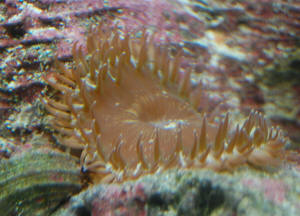
Let me describe to you what mine look like. Yes coloring varies
brownish-green pending on antics, tips are pointed, approximate
size of some of the largest 1"-2" (in the photo there
is a Mexican turbo snail next to it), the base of mature ones
when fully extended (1"-2") and is brownish with green
polka-dots and they do have a visible mouth. I believe I acquired
4-6 of them on a frag 3 years ago and I now have about 24 of
them, most of them live in clusters and a few that sit alone.
Lastly the reason for my concern now is that I am changing over
to a reef system and would like to know if these guys are a
problem to other corals.
<Am pretty sure this is a Zoanthid... see a/the chart
here:
http://wetwebmedia.com/zoanthid.htm
Can be problematical in proximity (and not) to other Cnidarian
life. (see the linked FAQs file re Compatibility) Bob
Fenner>
|
 |
|
Aiptasia? & Cyano? 5/23/09
Hi can you identify what exactly is in the black rectangle I
painted on this picture?
< Looks like Green star Polyps.( Pachyclavularia sp.). Not the
dreaded Aiptasia but under certain conditions can become just as
much of a nuisance. >
This is a tank some one is selling... Also, this tank has been
running for 2 years or so, is that Cyano in the sand?
< Cyano, diatoms lots of things. Common in deep sand beds. I
wouldn't worry about it unless it starts to appear on the
rock and top of the sand bed.
Read here for more info on DSB.
http://www.wetwebmedia.com/deepsandbeds.htm GA Jenkins >
Thanks,
Nathan
|
 |
|
pH problems & Invertebrate ID
5/22/2009
<Hi Darren>
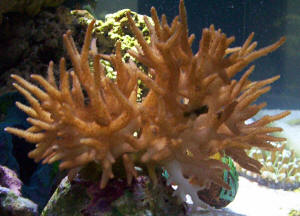
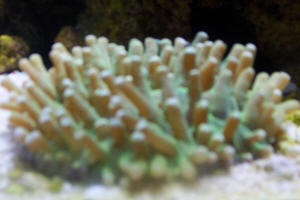
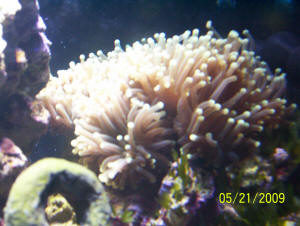
I have a 34 gallon reef tank, about 4 months old, only 2 fish- a
six line wrasse and a bi-color blenny, and a few stony corals- a
birdsnest, long tentacle plate, I believe a torch? and another I
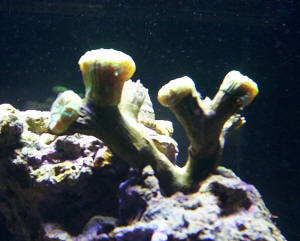
can't identify, I'll attach some photos if you don't
mind identifying them for me?
<OK>
Anyway, I've had a couple of reef tanks in the past that I
had some success with, but my job kept me moving pretty often and
I had to sell most of the stuff I had.
<As a former military member, I understand.>
This time I had the opportunity and a little more cash and
figured I'd set up a pretty decent reef tank somewhere
between a nano and small, a 34 gallon Solana cube, although I
didn't like the included skimmer, and wanted the flexibility
of more water and a sump, so I removed the cheap skimmer, used a
CPR overflow box I had and added a two tier sump system, first
the water travels from the overflow to a 20 gallon Rubbermaid
container that I have the heater/chiller in as well as a hang on
Turboflotor skimmer in, then via a bulkhead fitting, the water
flows by gravity to a 3012 Eco-system sump, no mud just a few
pieces of live rock and Chaeto algae that is lit 24 hours a day,
then from there an external Quiet One 400 GPH at a four feet head
height back to the display tank.
<Sounds like a well thought out filtration system>
The display tank has 3 or so inches of sugar sized aragonite
sand, 30 lbs of live rock and again the wrasse and blenny, about
10 blue leg hermits, 4 Astrea snails, the corals I've
attached pics of, and I added a detritivore kit from inland
aquatics that included mysis shrimp, small brittle and micro
starfish, Gammarus shrimp, copepods, amphipods to seed the
sandbed. For water movement addition to the return pump from the
sumps I have two small Koralia powerheads powered by a wavemaker
that alternates them, and an Eco-tech marine Vortech (mp20). For
lighting I have a 14 inch Solaris LED light, it's supposed to
put out the equivalent of a 400 watt metal halide, but I'd
estimate just looking at the output somewhere from a 175 to 250
watt metal halide, that was expensive but neat with all of the
features and little or no heat to the tank.
<Sounds like a nice setup as well.>
I get about 1 or 2 cups of medium dark skimmate from the skimmer
a day, and the problem child is the pH....from about 7.75 with
the display light off at night, to about 7.80 to 7.90 with the
light in the display on during the day, again the light in the
sump is on 24 hours.
<So a bit low, but not too low. I prefer stability over
fighting to hit an exact number.>
I can't understand why, everything else according to Salifert
tests is good... magnesium at 1200 ppm, calcium at or above 400
ppm, strontium at 3 to 6 ppm, iodine about .06 ppm, alkalinity at
usually about 3.70 meq/L, dKH at about 10 to 11, the phosphate,
nitrates, silicates, ammonia, nitrites all are at or about
non-existent. I keep these levels by 5 gallon water changes per
week (de-ionized water with D-D H2Ocean salt mix and adding
C-Balance parts A and B about twice a week. I would try more
buffer agents, but I really don't want the dKH or alkalinity
any higher than it already is. The only thing I can think of is
the salt mix, but the H2Ocean is highly recommended from what I
read, and the calcium and magnesium, etc are better than I ever
had before by using instant ocean or reef crystals. So I'm at
a loss here, the surface movement with the powerheads, and the
skimmer and other powerheads should keep the water plenty
oxygenated, not to mention the Chaeto and live rock in the sump
at 24hour lighting. The fish and corals seem to be healthy, I
don't overfeed, it is what I believe understocked if anything
so I just read and read and scratch my head trying to figure it
out. Can you suggest anything?
<I must thank you for the amount of detail you've
provided. The one thing you did not mention is likely your
culprit. What are you using for source water, and what is
it's pH before and after you add the salt mix? Do test these
and I'm sure you will find the reason.>
<API makes a product called "pH 8.2" I use this to
raise the pH of my new water.>
Also if you don't mind could you properly identify my
corals?
<Sure: You are correct on the named pictures see the following
pages for reference.:
http://www.wetwebmedia.com/pocilloporidae2.htm
http://www.wetwebmedia.com/fungiidae.htm
http://www.wetwebmedia.com/elegance.htm
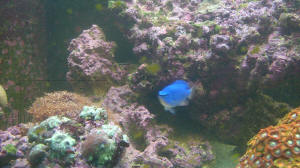
For your unknowns, the first one appears to be some sort of
"Candy Cane" coral (Caulastrea)
http://www.wetwebmedia.com/faviidae.htm
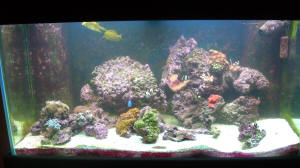
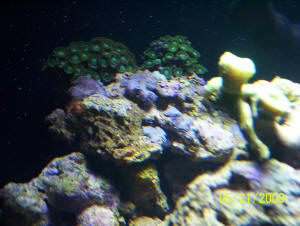
And the last picture has two different inverts on it, the green
"flowers" appear to be zoanthids.
http://www.wetwebmedia.com/zoanthid.htm
and the blue mushrooms are corallimorphs
http://www.wetwebmedia.com/corallim.htm
>
Sure. Thanks for all of your time and expertise....
<My pleasure>
Darren
<Mike>
Re: pH problems & Invertebrate ID
5/22/2009
<Hi Darren>
Wow, thanks for the quick response!
<No Problem.>
I never thought to check the pH of my RO/DI source water before
adding the salt, or after for that matter,
<Ahh ha!. Do realize that fresh RO\DI water will start out
around 7.0, and then usually drop as it ages Adding salt mix
stops the pH drop.>
I always just check the tank and sump water after mixed together,
good advice, I'll do that first thing when I get home
tonight. One additional question though, do you add the "pH
8.2 directly to the RO/DI water before mixing with salt, or
after?
<I mix up my water about a week in advance., so I add it a day
or so before I add the water to the tank. My aged, mixed water
usually comes out at 7.9
- 8.0, so a quarter scoop takes it to 8.2>
Thanks also for the id of my corals!
<You're Welcome>
You guys rock..... Darren.
<Mike>
|
 |
|
Strange Growth 5/8/2009
Hello Everyone!
<Adam>
I posted this on a couple other forums before trying you guys. My
question is about a saltwater reef tank if that gets me to the
right person. A few weeks ago, possible a little more than a
month, I started supplementing calcium. I noticed an almost
immediate change in the corals, but a few new things appeared.
One of them I had seen before and have identified as Neomeris
sp.
<Yes, the droopy bit to the lower right>
There is one of the "stalks" of Neomeris visible in the
bottom right corner of the picture I have attached.
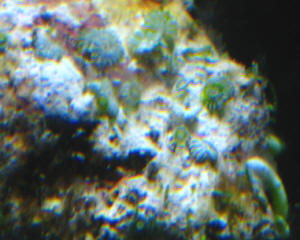
The growth I am emailing you about is the small green round
things growing in the center of the picture. They are very small,
about 1/16th - 1/8th of an inch. They are very hard to the touch.
On another forum people suggested they could be coral either
mushrooms or zoas, but they are not soft, are much smaller, and
do not form a mat.
<Zoanthids may start as individual polyps...>
They also do not retract or react at all when touched.
For reference, the picture is taken under 14k metal halide lights
with actinic supplementation, but the darkness is turned way down
on the camera in order to focus. The colors shown in the photo
are accurate,
but just a little dark. The width of the flat section of rock
they are growing on is about 1 - 1.5 inches.
Do you have any idea what this might be? Is it a type of algae?
How large might they grow to be?
<Not algae, are a polypoid animal of some sort (Cnidarian). My
guess based on the low res. image is that these are Zoanthids.
Please see WWM re Cnidarian taxonomy>
Thank you for your help. I read the section about using grammar
when submitting a query, and was a little intimidated. I hope
this meets the specifications!
Thanks,
Adam
<Ah yes. Bob Fenner>
|
 |
|
Coral ID 4/26/09
Hi there,
hope all is going great!
<Summat... flight out of Denver has been delayed...
they're "looking for a plane" (not easy to hide
I'd think)>
I had been for local collection trip on the Indian western cost
(inter tidal zone).
where i found this lovely frag...
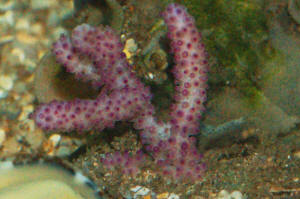
Was wondering if you could ID this coral, looks like an Acropora
of some kind, its not very hard to touch, but quite firm as its
very small (1in in height)!
pls see the attached file, and let me know what family/ species
do you think this frag could be?
<Mmm, on close inspection this is an octocoral... I think
it's likely a juvenile Gorgonian of some sort... am away from
my in-print ref. works....
Bob Fenner>
thanks a lot, keep rocking!
Sameer
|
|
|
|
|

